
Ramen: what it is, why a bowl costs what it does, and the lineages behind the word
I have not been to every place in this guide. The figures below are taken from the sources listed at the end, with the date each one was published — not measured by me. Where I have been, the article says so.
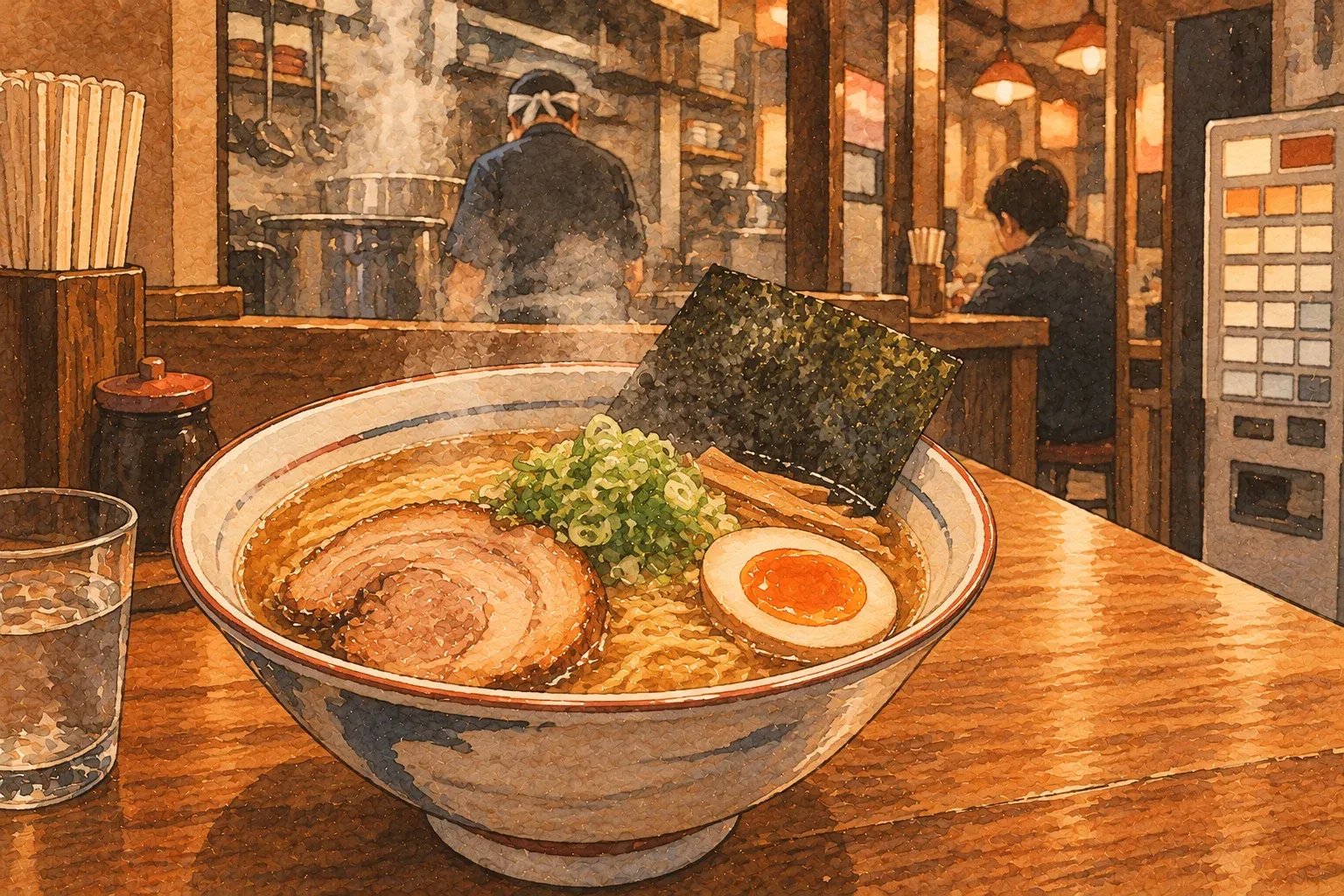
Ramen is the dish visitors are most likely to eat on their first night and least likely to understand. It looks like one thing. It is a dozen, and the people of Fukuoka, Sapporo and Kitakata would each tell you the others are eating something else. This page is the map: what the word covers, why a bowl costs what it does in Japan, and where each lineage comes from. The lineage pages go deep on one city at a time.
What it is
Wheat noodles made with alkaline water (kansui), which gives them their yellow colour and spring, in a hot seasoned broth, with a few toppings. That is the whole definition, and it is why the regional variants can differ so much: everything except the noodle is up for grabs.
It is also, by Japanese standards, new. The Shin-Yokohama Ramen Museum’s timeline starts the modern story in 1884, with an advertisement for “Nanking soba” in a Hakodate newspaper, and gives 1910 — the opening of Rairaiken in Asakusa, Tokyo — as the year ramen became popular. The museum is careful about the wording: not the first ramen shop, but the first to start a ramen boom, with 2,500–3,000 customers a day in its busy season. The dish was called Nanking soba, then shina soba, then chūka soba — the same food renamed as the politics of the word for China changed — and the katakana word rāmen only became general after 1958, when Nissin put it on a packet of instant noodles.
The war reset it. Ramen stalls fed the black markets of 1945 as cheap, high-calorie food; the white pork-bone soup of Kyushu appeared in 1947, Sapporo’s miso in 1954 by one account and 1958 by another, and dipping noodles (tsukemen) in 1955 by the best-documented of several accounts, which credit different shops. Nissin’s Chicken Ramen launched in August 1958 at ¥35 a packet when a ball of udon cost ¥6; Cup Noodle followed in 1971 at ¥100. Japan now produces about 5.9 billion servings of instant noodles a year, 47.9 per person (fiscal 2025, by the industry association’s count); more in instant noodles.
The regional boom came in the 1980s — Kitakata in 1984, Ogikubo in 1985, the Tokyo tonkotsu wave in 1989 — and the museum itself opened in Shin-Yokohama in March 1994 so that people could eat the country’s ramen “without getting on a plane”. In December 2015 a nine-seat shop in Sugamo, Tsuta, became the first ramen shop in the world with a Michelin star.
Why it is the way it is
Two mechanics explain most of what you will see.
The noodle is engineered to the soup. The museum’s dictionary gives the two numbers that matter. Hydration is the share of water in the dough: about 35% is typical, Kitakata runs near 40% (soft, slippery, slow to go limp), Hakata 24–28% (dry, hard, quick to soften, hence the refill). Cutter number is how many strands come out of a 30 mm band: a low number is a thick noodle (18 and below), Hakata is around 26. When a shop asks how hard you want the noodles, it is asking a question that only makes sense for its own noodle.
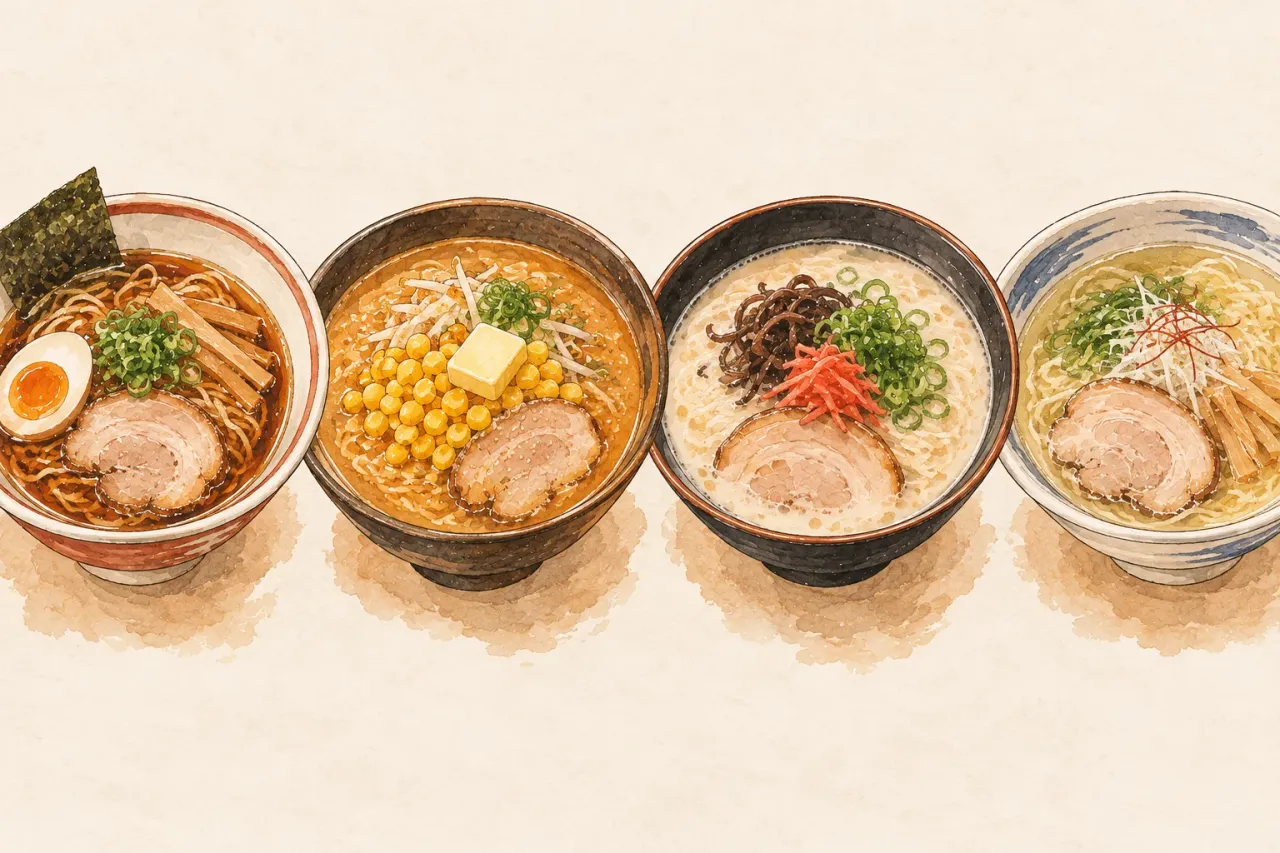
The soup is two layers. A stock (dashi) from animal bones, dried fish, or both, and a seasoning (tare) of soy sauce, salt or miso that is added to the bowl, not the pot. “Shōyu ramen” and “shio ramen” describe the tare; “tonkotsu” describes the stock. This is why “tonkotsu-shōyu” (Yokohama’s iekei) is not a contradiction, and why “tonkotsu” as the name of a style is, by the museum’s account, a coinage of the late 1970s — the Kyushu shops had simply called it ramen.
The old Tokyo bowl — clear chicken-and-pork stock with a Japanese fish dashi folded in, soy tare, a wavy noodle, pork, bamboo shoot, a slice of fish cake, spinach — is the baseline the lineages diverge from. The museum’s phrase for what the postwar shops settled on is “soy, wavy noodle, Japanese dashi”, and it calls that the thing that made ramen Japanese.
What it costs
Ramen ラーメン
- Survey
- ¥620 (≈ €3 / $4)中華そば(しょう油味)外食 1杯 · Aug 2026 · 特別区部
- Chains
- ¥420–¥748Plain soy-sauce ramen, one bowl · Hidakaya, Kourakuen, Gyoza no Ohsho · tax incl. · checked 2026-10-05
- Our guide figure
- ¥1,000 (≈ €6 / $6)From ¥800 for a plain bowl in Tokyo, about ¥1,000 once you add toppings · Oct 2026
Tsukemen (dipping noodles) つけ麺
- Chains
- ¥990Standard tsukemen · Tsukemen TETSU · tax incl. · checked 2026-10-05
- Our guide figure
- ¥900 (≈ €5 / $6)Tokyo, a standard bowl · Oct 2026
The figures above are kept on the price reference page and update there. What they show is a market in three tiers, and the credit-research firm Teikoku Databank now describes it exactly that way: about ¥500, about ¥1,000, and ¥1,500 and up.
- The statistical bowl — “chūka soba, eating out, one bowl”, central Tokyo, government survey, tax included — was ¥620 in September 2026, up from ¥569 in May 2024. The industry’s own figure for the national average is still under ¥700.
- The chain bowl is ¥420–750 including tax, as the chains list it (Hidakaya, Kourakuen, Gyoza no Ohsho).
- The specialist bowl in a city — Harukiya in Ogikubo, the founding iekei shop Yoshimuraya, Sapporo’s miso originator, Ichiran’s head shop — sits above the chains. These shops’ menus do not say whether tax is included, so their prices are not given here.
- The Michelin bowl is Tsuta’s, the first ramen shop to win a star, and it is the dearest of the four.
The phrase everyone in the trade uses is the ¥1,000 wall — the price above which customers are said to stop ordering a plain bowl. Nobody can tell you who coined it, but the pressure behind it is documented: Teikoku Databank’s ingredient-cost index for a pork-bone bowl stood 29% above its 2020 level across 2024, and a record 72 ramen shops went bankrupt that year, up from 53. The market still grew — ¥790 billion in 2024, ¥885.5 billion in 2025 — because the shops that survived raised prices. The 2016 economic census counted 18,041 ramen shops in Japan.
For a visitor the practical reading is this: under ¥700 you are eating what Japanese people eat on a weekday; around ¥1,000 you are at a shop someone chose on purpose; above ¥1,500 you are paying for a name, and the queue is part of the product.
The lineages
The table is kept in one place so that every lineage is described on the same terms. Rows without a link are on the list but not written yet.
| Lineage | Origin | Soup | Noodle | On top | How it is eaten |
|---|---|---|---|---|---|
| Hakata (Fukuoka) 博多ラーメン | Fukuoka city1940s–50s | Pork bones boiled hard until white; salt or light soy seasoning | Extra-thin, straight, low-water (24–28%) | Spring onion, pork, wood-ear; ginger, sesame and garlic on the counter | Choose noodle hardness; order kaedama (a paid second portion) into the soup you keep |
| Kurume 久留米ラーメン | Kurume, Fukuoka1937 / 1947 | Stronger, thicker pork bone, cooked in a cauldron; yobimodoshi (never-emptied kettle) | Straight, firm, slightly thicker than Hakata | Pork, spring onion, often pickled greens | Mostly no kaedama |
| Kumamoto 熊本ラーメン | Tamana / Kumamoto1950s | Pork bone with chicken; finished with black garlic oil (mā-yu) | Medium, firmer and thicker than Hakata | Fried garlic chips, pork, wood-ear, egg | Garlic is cooked, not raw |
| Kagoshima 鹿児島ラーメン | Kagoshima city1947 | Pork with chicken and vegetables; milder | Soft, pale, made without lye water | Scorched spring onion, pork | Free pickled radish and a pot of tea at most shops |
| Kitakata 喜多方ラーメン | Kitakata, Fukushimamid-1920s | Light soy on pork stock; salt and back-fat versions too | Flat, thick, wavy, very high in water (jukusei takasui) | Slow-cooked pork belly, sometimes covering the bowl (niku soba) | From 7 a.m. — asa-rā, morning ramen |
| Shirakawa白河ラーメン | Shirakawa, Fukushima1921 | Clear soy on chicken and pork | Hand-cut wavy, soba-making technique | Pork, bamboo shoot, naruto | — |
| Yonezawa米沢ラーメン | Yonezawa, Yamagataearly 20th c. | Light soy on chicken and dried sardine | Thin, wavy, high-water, hand-kneaded after resting | Pork, bamboo shoot, spring onion | — |
| Sapporo 札幌ラーメン | Sapporo1954 / 1958 | Miso; vegetables and mince fried in lard before the stock goes in | Medium-thick, strongly waved, with egg, aged (Nishiyama type, 1955) | Bean sprouts, onion, pork; butter and corn optional, not standard | — |
| Hakodate函館ラーメン | Hakodate1884 advertisement | Clear salt on pork, chicken, kelp and scallop | Thin, straight | Pork, bamboo shoot, a slice of wheat gluten (fu) | — |
| Asahikawa旭川ラーメン | Asahikawa— | Soy on pork and seafood stock | Medium-thin, wavy | Pork, bamboo shoot, spring onion | — |
| Yokohama iekei 横浜家系ラーメン | Yokohama1974 | Pork bone and soy, with chicken oil | Thick, short, straight | Spinach, three sheets of nori, pork | Set richness, oil and hardness; wrap rice in the soup-soaked nori |
| Tokyo soy (chūka soba) 東京醤油ラーメン | Tokyo1910 / postwar Ogikubo | Soy on chicken, pork and dried sardine | Medium, wavy | Pork, bamboo shoot, naruto, spinach, nori | — |
| Onomichi 尾道ラーメン | Onomichi, Hiroshima1928 / early Shōwa / c. 1947 (accounts differ) | Soy on chicken stock with small fish, topped with minced pork back-fat; varies by shop | Flat, medium-thin, straight | Pork, bamboo shoot, spring onion | Small bowls, so locals suggest trying several shops; often sold as chūka soba |
| Tokushima 徳島ラーメン | Tokushima (Komatsushima, by one account)c. 1949 (post-war stalls) | Three types of pork-bone soup; brown (dark soy) is the most common, with white and yellow | Medium-thin, straight, on the soft side | Sweet-simmered pork belly; a raw egg at many shops | Eaten with a bowl of rice |
| Wakayama和歌山ラーメン | Wakayama— | Pork bone and soy | Thin, straight | Pork, kamaboko, spring onion | Pressed mackerel sushi and boiled eggs on the table, counted at the end |
| Toyama black富山ブラック | Toyama— | Very dark, salty soy with coarse black pepper | Thick, firm | Pork, bamboo shoot, lots of spring onion | Made to go with rice |
| Jirō-style二郎系 | Tokyo (Mita)— | Pork bone and soy, heavy with back-fat | Very thick, chewy, large portion | A mountain of bean sprouts and cabbage; garlic on request | Call out your extras when asked; a culture with its own rules |
| Tsukemen (dipping) つけ麺 | Nakano, Tokyo (one account); Higashi-Ikebukuro from 19611955 (one account) | Served separately for dipping; the first was ramen soup with extra soy in a teacup | Chūka soba noodles served apart; some shops sell several weights at one price | — | Dip the noodles in the soup, like a Chinese-style zaru soba |
| Hiyashi chūka (chilled) 冷やし中華 | Sendai / Tokyo (two claims)1930s | Served cold; the Sendai shop calls it 'ryanbanmen' | Chilled under running water | Tokyo's Yōsukō Saikan serves a five-colour version | A summer dish |
Lineages without a link are on the list but not written yet. The table is kept in one place so every lineage is described on the same terms.
A few things the table cannot show:
- The Kyushu styles are a family with a quarrel. Kurume (1937, white soup 1947), Hakata and Kumamoto descend from each other and argue about who was first; Kagoshima is said to owe nothing to any of them. The Hakata page lays out the two origin claims without choosing.
- The northern styles are about the noodle. Kitakata’s wide, wet, wavy noodle and Sapporo’s egg-enriched wavy noodle were both products of a specific noodle maker working with a specific shop. Sapporo’s dates from January 1955 and the company still supplies the city.
- Tokyo has two traditions, not one: the clear soy chūka soba of Ogikubo and the old shitamachi shops, and the heavy pork-bone-and-soy iekei that started in a Yokohama suburb in 1974 and has since become a national chain category.
- Everything is younger than it looks. The oldest lineage on the table has a documented start in 1884; most are postwar; the Michelin-starred modern “clear” style dates from 2012.
Where to eat it, and how to get there
Each lineage page ends with the town, the shops that publish their prices, and the way in from the nearest airport or Shinkansen station, taken from the operators’ own pages. In brief:
- Hakata — Fukuoka. The airport is on the city subway: 5 minutes to Hakata station, 11 to Tenjin.
- Sapporo — JR’s Airport rapid from New Chitose, 33–37 minutes; the Ramen Yokochō alley is three minutes from Susukino station.
- Kitakata — the Ban’etsu West line from Kōriyama via Aizu-Wakamatsu; the morning shops open at seven, so stay the night before.
- Yokohama iekei — Yoshimuraya is by Yokohama station’s west exit; Keikyū from Haneda Airport is 28 minutes.
- Tokyo soy — Harukiya is two minutes from Ogikubo station on the Chūō line.
The same name, a different bowl
Every lineage page on this site now ends with a section on what changes when the dish leaves home, because it usually does, and because Japanese people are often as unaware of it as visitors. The pattern across the lineages written so far:
- Chains carry a price map. Ichiran lists a price for every shop, and its classic bowl costs more in Shibuya and Dōtonbori than in Fukuoka’s Tenjin, though the noodle refill costs the same everywhere.
- Tokyo reformulated Kyushu on purpose. The shop that led the 1989 tonkotsu boom says it invented a “mild tonkotsu” because Tokyo would not accept the real thing.
- The noodle travels further than the shop. Sapporo’s noodle maker has shipped to Honshu since 1965 and now supplies about 3,500 shops nationwide; the founding Sapporo shops mostly never left.
- The chain is a different company from the original. Kitakata Ramen Bannai (Tokyo, 1988) is not Bannai Shokudō (Kitakata, 7 a.m.); the town’s association certifies nobody outside the town.
- Nobody owns the name. Iekei, Sapporo, Hakata and Kitakata are descriptions, not designations. The only certification in Japanese ramen is Yoshimuraya’s private list of five direct-line shops.
And one number worth carrying: in the government household survey, the city that spends most on ramen eaten out (the survey’s item is chūka soba, which also counts yakisoba and sara udon, and “eaten out” includes delivery and takeaway) is Yamagata (¥21,695 a year per household), followed by Niigata, Sendai, Utsunomiya and Toyama. Sapporo, Fukuoka, Yokohama and Osaka — the homes of the famous styles — are all below the national average. The place that invented a bowl is not the place that eats it most.
What people get wrong
- “Ramen is traditional Japanese food.” It is a Chinese noodle made Japanese over the last century, and its most famous styles are postwar. The oldest documented sale is 1884.
- “Tonkotsu is the default.” It is a Kyushu style that reached Tokyo as a fashion in 1989. Tokyo’s own ramen is soy.
- “Shōyu, shio, miso and tonkotsu are the four types.” Three are seasonings and one is a stock. A bowl is one of each, which is why the combinations exist.
- “A bowl should be under ¥1,000.” The statistical bowl is ¥620 including tax, and specialist shops sit near the wall; it is real, and shops are climbing over it.
- “Ask for hard noodles anywhere.” The hardness vocabulary belongs to the thin Hakata noodle. In Sapporo or Kitakata the question is not asked.
- “The Michelin shop is the best ramen in Tokyo.” Tsuta was the first to be starred, in 2015; it held the star for four editions, moved in 2019, and is not in the current guide. It is a good bowl, and a milestone — not a verdict.
Questions people ask
Is ramen Japanese or Chinese?
Both, in order. The noodle came from China in the Meiji era; the dish as Japan eats it was shaped in Tokyo from 1910 and rebuilt after the war on cheap flour. Every regional lineage on this page is a Japanese invention of the last hundred years.
What does a bowl of ramen cost in Japan?
The government price survey puts a basic soy-sauce bowl in central Tokyo at ¥620 including tax (September 2026). The big chains charge ¥420–750 including tax. A specialist shop in a city costs more, and a bowl from a shop with a Michelin history more again. Industry research says the national average is still under ¥700.
What is the "¥1,000 wall"?
The price above which Japanese customers are said to stop ordering a plain bowl. Credit-research firms use it to explain why ramen shops go bust while costs rise; the ingredient cost index was 29% above its 2020 level in 2024. Shops are now splitting into about ¥500, about ¥1,000, and ¥1,500-plus.
Sources
- 総務省統計局 家計調査年報 付録8 収支項目分類表(「中華そば」「外食」)
- 新横浜ラーメン博物館「日本のラーメンの歴史」
- 新横浜ラーメン博物館 トリビア「支那そば、中華そば、ラーメンの違いは時代の違い」
- 新横浜ラーメン博物館 トリビア「とんこつラーメンは実は造語であった」
- 新横浜ラーメン博物館 ニュースリリース「淺草 來々軒 110年の歳月を経て蘇る」
- 新横浜ラーメン博物館「ラーメン大辞典」(加水率・切刃番手・鶏油)
- 新横浜ラーメン博物館「東京ラーメン」
- 新横浜ラーメン博物館「ラー博事始め」
- 日本即席食品工業協会「インスタントラーメンの誕生」
- 日本即席食品工業協会「グラフで見るインスタントラーメン」
- 日清食品 年表
- 総務省統計局 小売物価統計調査(動向編)東京都区部 主要品目(2025年9月〜2026年9月)
- 帝国データバンク「ラーメン店」の倒産動向(2024年)
- 帝国データバンク 全国「ラーメン店」市場動向調査(2024年度)
- 帝国データバンク「ラーメン店市場、25年度は8855億円」
- 中小機構 J-Net21「ラーメン店」(平成28年経済センサス)
- トラベルWatch「ミシュランガイド東京2016」発表(蔦が一つ星)
- Japanese Soba Noodles 蔦 公式 ABOUT・MENU
- 一蘭 店舗ページ(天神・総本店・渋谷・道頓堀の価格)
- 九州じゃんがら 沿革
- 西山製麺 会社沿革
- 蔵のまち喜多方老麺会
- 総務省統計局 家計調査 品目別都道府県庁所在市ランキング 外食「中華そば」(2023〜2025年平均)
Prices are in Japanese yen. Conversions are approximate, at ¥177.30 to the euro and ¥158.23 to the US dollar as of 20 Oct 2026. Rates come from the European Central Bank, which publishes on working days only. Prices checked Oct 2026. What food costs in Japan →