
Kumamoto ramen: Kurume’s descendant with chicken in the pot and black garlic oil on top
I have not been to every place in this guide. The figures below are taken from the sources listed at the end, with the date each one was published — not measured by me. Where I have been, the article says so.
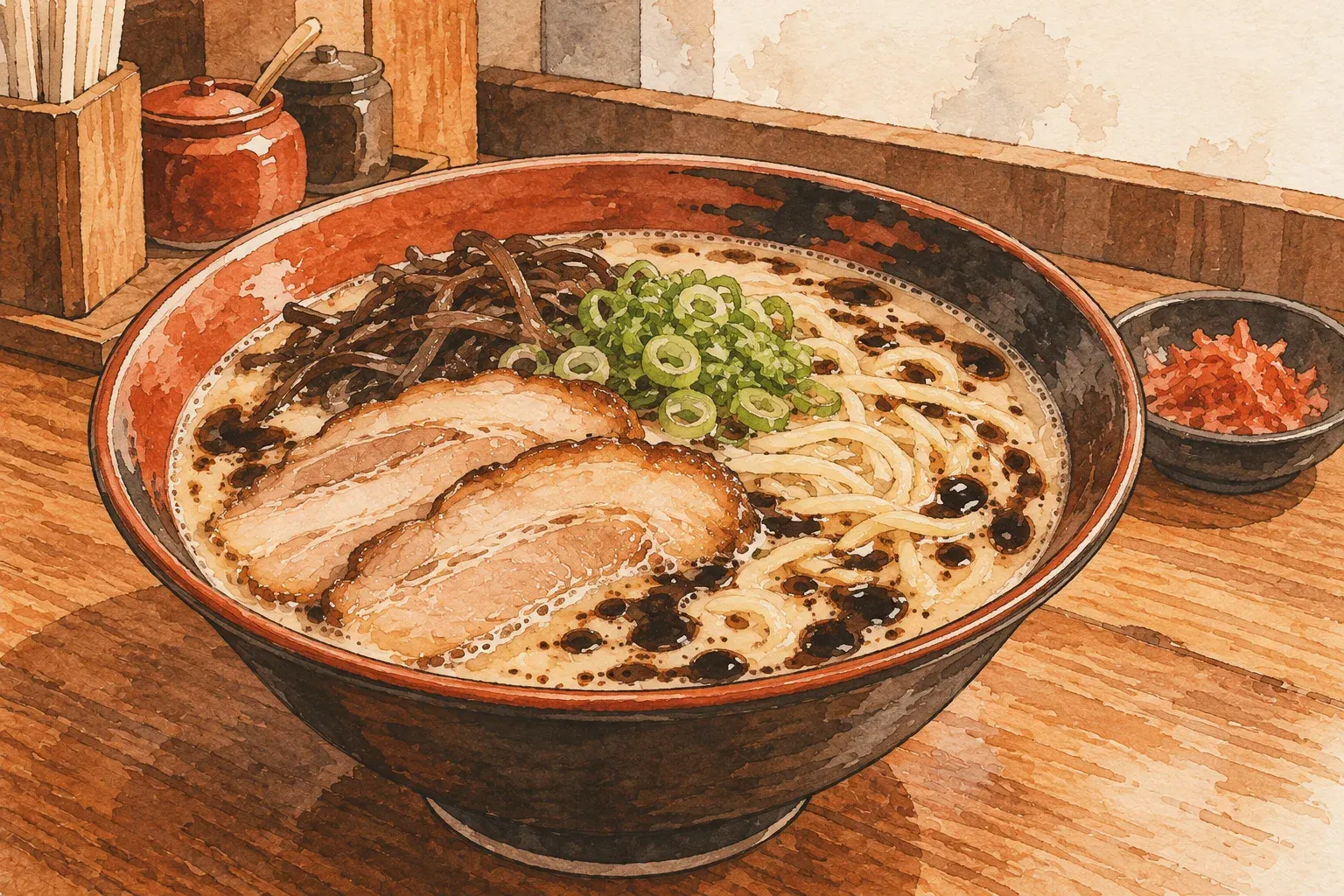
If Hakata is the famous child of Kyushu tonkotsu and Kurume the parent, Kumamoto is the cousin who went his own way: the same white pork-bone base, but with chicken in the pot, the garlic cooked rather than raw, and a spoon of black garlic oil floating on top that makes the bowl smell of something roasted. It is the one Kyushu ramen you can recognise from across the room.
Where it came from
The Ramen Museum’s account begins in 1952, when a man named Shikasho opened a ramen shop in Tamana, a town north of Kumamoto city, which it calls the pioneer of Kumamoto ramen. The Japan Tourism Agency’s own explanatory text for the style describes it as a derivative of Kurume ramen — the white-soup technique carried south from the Chikugo river — and the museum’s Kumamoto page is the one that records both Kurume’s Sankyū and Hakata’s Akanoren as having begun white soup around 1947–48, without deciding between them.
What makes it Kumamoto ramen
The soup. Pork bones with chicken carcasses added — the museum says many Kumamoto shops do this, and the tourism agency’s text describes the chicken stock as blended into the pork. It is rounder and less aggressively porky than Kurume’s.
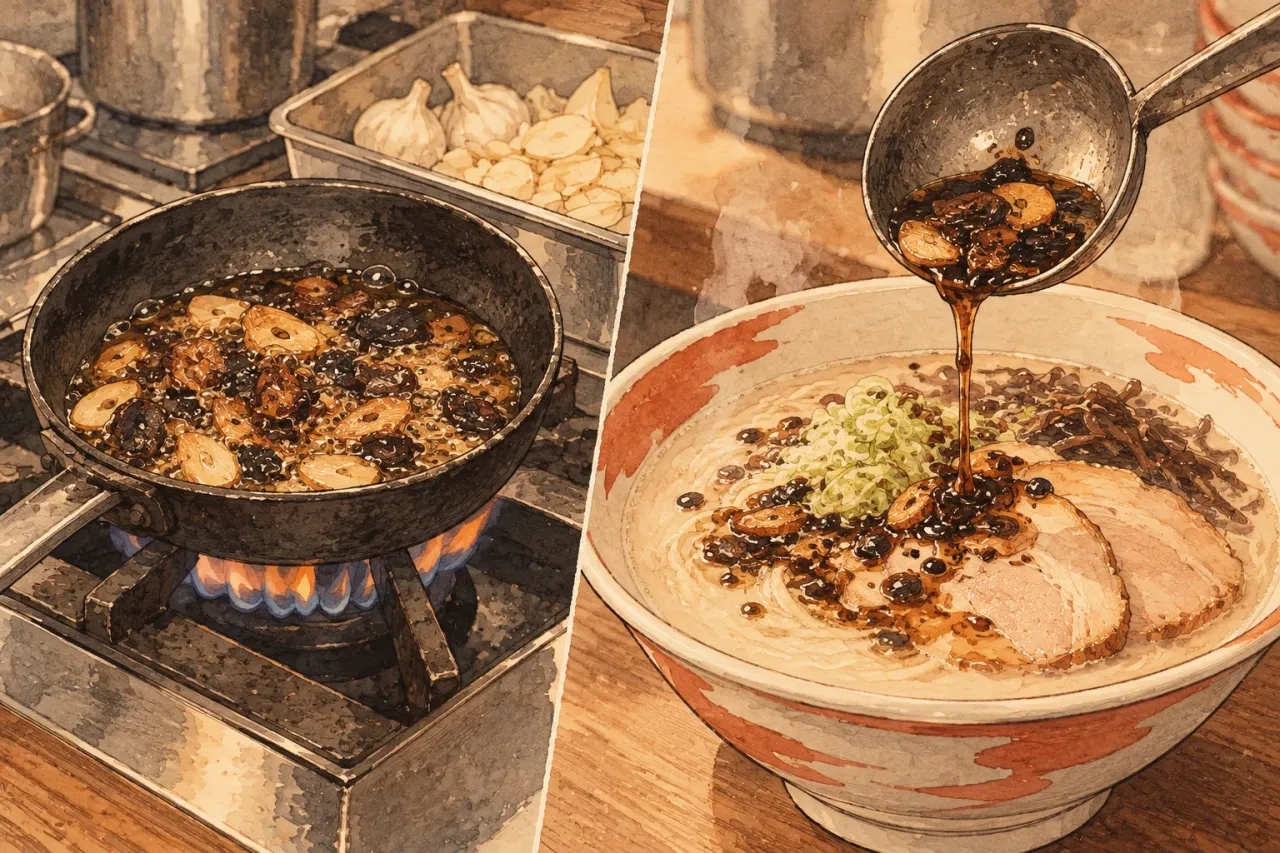
The garlic. Hakata serves garlic raw, crushed at the counter. Kumamoto cooks it: fried garlic chips on the bowl and mā-yu, black garlic oil, spooned over the soup. The museum’s summary is that Kumamoto flavours the bowl “with garlic in processed forms”.
The noodle. Thicker and firmer than Hakata’s, with what the museum calls a solid bite.
On top. Pork, wood-ear mushroom, often a soft egg, and the garlic chips.
Why Kumamoto
The sources are thin on the why. What is documented is the route — Kurume to Tamana to Kumamoto city — and the regional preference, in a prefecture with its own strong garlic and pork farming, for the roasted rather than the raw. The museum’s phrase for the whole Kyushu family is that Sankyū’s taste spread “through about a hundred apprentices”; Kumamoto is where one branch of that spread settled and changed.
The shops, and what they charge
Ramen ラーメン
- Survey
- ¥620 (≈ €3 / $4)中華そば(しょう油味)外食 1杯 · Aug 2026 · 特別区部
- Chains
- ¥420–¥748Plain soy-sauce ramen, one bowl · Hidakaya, Kourakuen, Gyoza no Ohsho · tax incl. · checked 2026-10-05
- Our guide figure
- ¥1,000 (≈ €6 / $6)From ¥800 for a plain bowl in Tokyo, about ¥1,000 once you add toppings · Oct 2026
The best-known Kumamoto shops — Kokutei, Keika, Ajisen — have national or international branches, but none of their current prices could be confirmed from an official page for this edition, so none are given.
How to eat it
Stir the black oil in before the first mouthful or leave it on top for the aroma; either is normal. There is no hardness question and no refill. The garlic chips soften in the soup within minutes, so eat from the start.
Kumamoto ramen away from Kumamoto
Kumamoto’s style travelled early and far — Ajisen alone has shops across Asia — and what changes abroad is usually the mā-yu, which is either reduced or dropped for customers who find it bitter. In Tokyo, bowls sold as “Kumamoto ramen” without the black oil and the chips are Kyushu tonkotsu with a Kumamoto label. The oil is the test.
Getting there
Kumamoto is on the Kyushu Shinkansen from Hakata; Tamana is on the Kagoshima main line to the north.
What people get wrong
- “Kumamoto ramen is Hakata ramen with garlic.” It is Kurume’s descendant, with chicken in the stock, cooked garlic, and a thicker noodle.
- “The black oil is a sauce.” It is garlic oil, and it is bitter on purpose.
Questions people ask
What is mā-yu?
Black garlic oil — garlic fried in oil until it is dark, then blended into a bitter, aromatic oil that is spooned onto the soup. With fried garlic chips it is the signature of Kumamoto ramen; the Japan Tourism Agency’s description of the style lists both.
How is it different from Hakata ramen?
Chicken bones go into the pork stock; the garlic is cooked rather than raw; the noodle is thicker and firmer. The Ramen Museum describes all three differences, and the tourism agency calls Kumamoto ramen a derivative of Kurume’s.
Sources
Prices are in Japanese yen. Conversions are approximate, at ¥177.30 to the euro and ¥158.23 to the US dollar as of 20 Oct 2026. Rates come from the European Central Bank, which publishes on working days only. Prices checked Oct 2026. What food costs in Japan →