
Sapporo ramen: the miso bowl is younger than your parents, and the corn is optional
I have not been to every place in this guide. The figures below are taken from the sources listed at the end, with the date each one was published — not measured by me. Where I have been, the article says so.
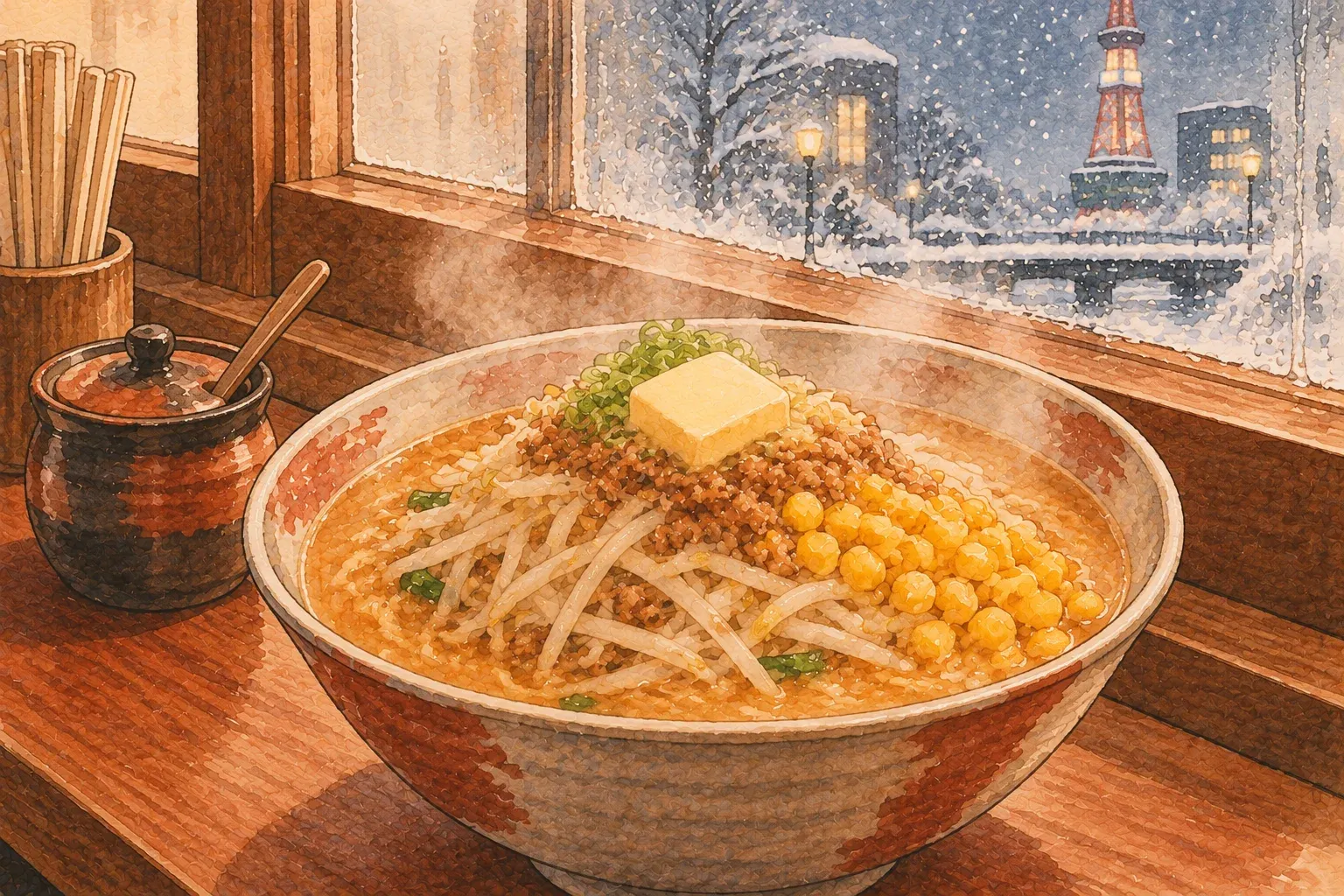
Sapporo is the city that made miso a ramen flavour. Before the 1950s, ramen was soy sauce or salt; a Sapporo shopkeeper stirred fermented soybean paste into the soup, a noodle maker across town built a noodle to stand up to it, and within a generation “Sapporo ramen” meant miso everywhere in Japan. The style is barely seventy years old, and the butter and corn that visitors associate with it are a later addition that the city itself does not treat as standard.
Where it came from
The word. The Hokkaido Shimbun traces a claim that the word rāmen was coined in Sapporo in 1922, at Takeya Shokudō in front of Hokkaido University, where the proprietress is said to have named the dish after her Chinese cook’s call of hǎo le (“it’s ready”). Takeya closed in 1943 under wartime rationing. The claim is one of several origin stories for the word; this is Sapporo’s.
The alley. After the war, the Sapporo tourism association says, the city’s ramen grew out of stalls at the Nijō market and spread to Susukino. In 1951 a row of eight small shops opened beside a cinema in Susukino; one ramen shop, Rairaiken, did so well that the neighbours switched to ramen, and the row became the Kōraku Ramen Meitengai — the first Ramen Yokochō. It was demolished in 1969 for road widening ahead of the 1972 Winter Olympics and reopened on its present site in 1971. The alley is 42 metres long and 1.8 metres wide, and marked 75 years in 2026.
Miso. Aji no Sanpei, a shop in central Sapporo, calls itself the birthplace of miso ramen, and nobody disputes it. The year does: the agriculture ministry’s timeline (compiled with the Shin-Yokohama Ramen Museum) gives 1954, the Sapporo tourism association gives 1958. The inventor was the shop’s first owner, Ōmiya Morito. The noodle came from a second man: Nishiyama Takayuki, who had run the noodle section at a shop called Darumaken from 1950, founded Nishiyama Seimen in 1953, and in January 1955 — by the company’s own history — succeeded in making the aged, high-water, egg-enriched wavy noodle that Sapporo ramen still uses.
Butter. In 1964 a shop called Kahei put butter into miso ramen. That is the first recorded appearance, a decade after the soup itself.
What makes it Sapporo ramen
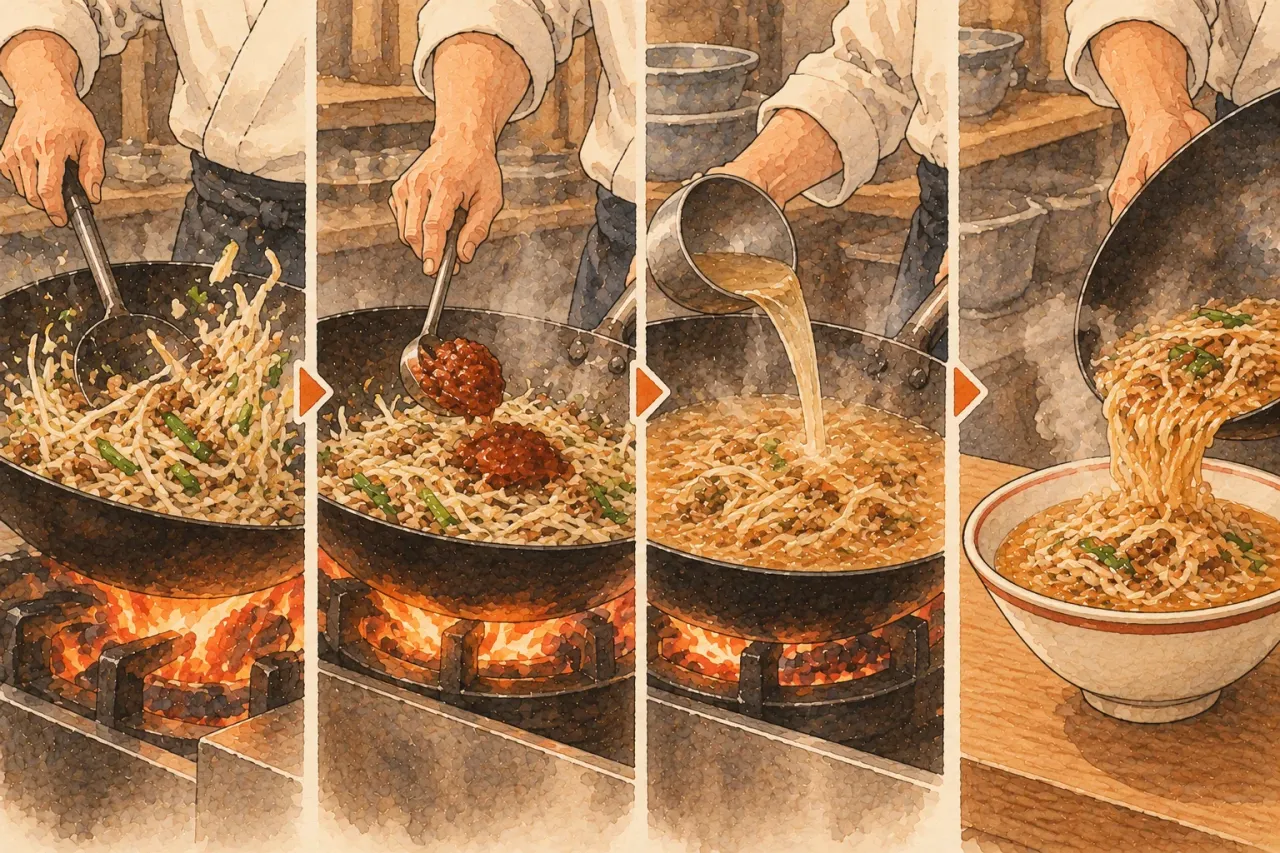
The soup is miso. The tourism association’s definition of the old standard is simple: miso soup, a medium-thick wavy noodle, eaten with bean sprouts and onion. In the influential Sumire–Junren family of shops the method is to heat raw miso in a wok with lard, then fry minced pork, garlic, onion and bean sprouts hard before the stock goes in — which is why a good Sapporo bowl arrives with a sheen of fat and a smell of scorched miso. Grated raw ginger is a common finish.
The noodle is the Nishiyama type: medium-thick, strongly waved, with egg, aged to develop chew. The tourism association’s explanation of the wave is practical — the curl holds the thick soup. Nishiyama Seimen says it now makes more than 500 different noodles to individual shops’ specifications, which tells you how much Sapporo ramen is a noodle-maker’s city.
The toppings of the classic bowl are the fried vegetables and mince already in the soup, plus pork. Butter and sweetcorn are options, and the Hokkaido Shimbun’s 2026 piece on the alley is headlined, in effect, “not just butter and corn”.
Why Sapporo
Honestly, the sources I trust do not explain it beyond the people. The cold-climate story — that lard and miso suit a snowy city — is told everywhere and I could not find a public body or company that states it, so it is not on this page. What is documented is an industrial fact: a city with a noodle maker capable of building a new noodle for a new soup in 1955, and of exporting it from 1975 and training overseas shops from the 1980s. Sapporo ramen went national and then global on Nishiyama’s trucks and later its ships, and the company appeared in the city’s primary-school social-studies textbook in 1987 as “the work of a noodle factory”.
The shops, and what they charge
Ramen ラーメン
- Survey
- ¥620 (≈ €3 / $4)中華そば(しょう油味)外食 1杯 · Aug 2026 · 特別区部
- Chains
- ¥420–¥748Plain soy-sauce ramen, one bowl · Hidakaya, Kourakuen, Gyoza no Ohsho · tax incl. · checked 2026-10-05
- Our guide figure
- ¥1,000 (≈ €6 / $6)From ¥800 for a plain bowl in Tokyo, about ¥1,000 once you add toppings · Oct 2026
Those are national figures. In Sapporo:
- Aji no Sanpei (大丸藤井セントラルビル 4F, 南1条西3丁目, a short walk from Ōdōri station). Open 11:00–15:30 and 17:00–18:20, closed Mondays and some Tuesdays. The shop announced in August 2026 that its miso, soy, salt and spicy-miso bowls would rise in price in September; chāshū-men, wonton-men and rice are also on the menu. The menu does not say whether tax is included, so prices are not given here. Expect queues during the Snow Festival in February.
- Sumire (中の島) and Sapporo Junren (平岸), the two shops of the family that defined the rich modern style. Founded as one shop in 1964 by Muranaka Akiko, split between her sons in 1987 and 1989. Neither shop’s prices could be verified from an official page, so none are given.
- Ganso Sapporo Ramen Yokochō (南5条西3丁目, three minutes from Susukino station). The alley’s own site lists 16 ramen shops; the tourism association counts 17. It has nothing to do with the nearby “Shin Ramen Yokochō”, and says so.
- New Chitose Airport. The domestic terminal’s third floor has a cluster of ramen shops; the airport’s own guide lists each shop’s bowls. Ebisoba Ichigen’s airport branch lists its shrimp-salt and shrimp-miso bowls at ¥990 each, tax included.
How it is eaten
There is no Sapporo ordering ritual to learn — no hardness scale, no refill. One thing is worth knowing: at Aji no Sanpei the standard sides are rice and a house-made shūmai, and the queue in February is the city’s own warning about Snow Festival week. Everything else people will tell you — eat from the far side because the soup under the lard is hotter, drink the soup with the spoon not the bowl — is good advice but not something I can source, so take it as that.
The other two of the “three”
Hokkaido’s tourism bodies, and Hakodate’s city tourism office, speak of the “three great Hokkaido ramens”: Sapporo miso, Asahikawa soy, Hakodate salt. Who coined the phrase is not recorded, but the three styles are real.
- Hakodate makes a clear salt soup on pork, chicken, kelp and scallop, with a thin straight noodle and a slice of wheat gluten (fu) on top. The city points to a newspaper advertisement from 1884 for “Nanking soba, 15 sen” as possibly the earliest ramen sold in Japan, and counts around 150 ramen shops.
- Asahikawa combines a soy base with pork and seafood stock on a medium-thin wavy noodle. The Asahikawa Ramen Village, a cluster of eight shops with 220 seats, opened in 1996, and the national timeline marks 1998 as the year Asahikawa ramen became a talking point.
Getting there
From New Chitose Airport, JR Hokkaido’s Airport rapid reaches Sapporo in 33 minutes (special rapid) or 37 minutes (rapid), six trains an hour through the day and 163 a day; reserved seats cost extra, and less if booked ticketless. Ramen Yokochō is three minutes on foot from Susukino subway station; Aji no Sanpei is by Ōdōri station in the city centre. Sumire and Junren are in the southern suburbs on the Namboku subway line.
Sapporo ramen away from Sapporo
Sapporo’s miso bowl travelled earlier and further than any other regional style, and it travelled as a noodle.
The noodle left in 1965. Nishiyama Seimen’s own chronology records the first shipments of its noodles to restaurants in Honshu in January 1965, an appearance at a Hokkaido products fair in a Honshu department store that October, overseas exports from 1975, and sales offices in Kanto (1987) and Kansai (1990). The trade press now puts the company at about 3,500 ramen shops across Japan and 357 shops in 36 countries, with exports that grew tenfold between 2014 and 2024. A “Sapporo ramen” shop in Tokyo or Osaka may well be cooking on the same noodle as a shop in Susukino. There is no certification for the name, and neither the noodle maker nor any trade body publishes one.
The department-store fair is how Japan met miso ramen. The Ramen Museum records that in 1964–65 a Sapporo shop, Kumasan, demonstrated miso ramen at Takashimaya’s Hokkaido fairs in Tokyo and Osaka, and that the reaction led shops elsewhere to add miso to their menus. The style’s national life began at a counter in a department store basement.
The founding shops mostly stayed home. Sapporo Junren lists two shops, both in Sapporo. Sumire lists its Nakanoshima main shop, Susukino and Satozuka in Sapporo and one shop in Yokohama; its own history says the family agreed to open at the Ramen Museum in 1994 half against the founder’s wishes. Aji no Sanpei, where miso ramen began, has one shop.
Who eats it. In the government household survey (2023–25 average), Sapporo ranks 37th of 52 cities for spending on ramen eaten out, at ¥7,627 a year per household, below the national average of ¥8,752. The city that invented miso ramen eats less ramen than most of Tōhoku.
What people get wrong
- “Sapporo ramen means butter and corn.” The old standard is miso, wavy noodle, bean sprouts and onion. Butter arrived in 1964 at a different shop; the city’s own tourism office does not list either as part of the definition.
- “Miso ramen is an old tradition.” It dates from 1954 or 1958. The word “ramen” in Sapporo is a century old at most.
- “Ramen Yokochō is the original alley.” It is the 1971 successor to a 1951 row that was demolished for the Olympics — and there is a second, unrelated alley next to it.
- “Hokkaido ramen is miso.” Hakodate is salt, Asahikawa is soy, and Hakodate’s claim on the oldest ramen in Japan is older than Sapporo’s claim on the word.
Questions people ask
Is miso ramen a traditional dish?
No. It was created at a Sapporo shop called Aji no Sanpei in the 1950s — 1954 by one account, 1958 by another. The word "ramen" itself is said to have been coined in Sapporo in 1922.
Does Sapporo ramen come with butter and corn?
Not by default. The classic bowl is miso soup, a wavy medium-thick noodle, bean sprouts and onion. Butter was first added by a different Sapporo shop in 1964, after the style existed. You can order it; it is not the definition.
How much does a bowl cost in Sapporo?
At the shop that invented it, Aji no Sanpei, prices rose in September 2026, but its menu does not say whether tax is included. At New Chitose Airport, Ebisoba Ichigen lists its shrimp-salt and shrimp-miso bowls at ¥990 each, tax included.
Sources
- 札幌観光協会「札幌でラーメンを食べるなら!」特集
- 農林水産省 aff 2024年12月号「知るほどに好きになる!ラーメン今昔物語」
- 味の三平 公式 お品書き・お知らせ(2026年9月の価格改定)
- 西山製麺株式会社 会社沿革
- 北海道新聞「札幌ラーメンのルーツは?」
- 北海道新聞「バターコーンだけじゃない!札幌・ススキノ『元祖ラーメン横丁』進化し続けて75年」
- 元祖さっぽろラーメン横丁 公式(歴史)
- 北海道観光振興機構「元祖さっぽろラーメン横丁」
- ASCII.jp「30年前の濃厚味噌ラーメンが復活!! 札幌『すみれ1994』」
- 北海道観光振興機構「函館ラーメン」
- 函館市公式観光情報 はこぶら「昔ながらのすっきり味、函館の塩ラーメン」
- 北海道観光振興機構「あさひかわラーメン村」
- JR北海道「札幌↔新千歳空港間 快速エアポート」
- 新千歳空港 公式 ラーメン特集
- 新千歳空港 公式 店舗ページ「えびそば一幻」(価格)
- 西山製麺 会社沿革(本州出荷1965年、海外1975年)
- 日本食糧新聞「西山製麺」(全国約3,500軒、36か国357店)
- 新横浜ラーメン博物館「札幌ラーメン」(1965年の物産展)
- すみれ 公式「歴史」
- さっぽろ純連 公式「歩み」
- 総務省統計局 家計調査 品目別都道府県庁所在市ランキング 外食「中華そば」(2023〜2025年平均)
Prices are in Japanese yen. Conversions are approximate, at ¥177.30 to the euro and ¥158.23 to the US dollar as of 20 Oct 2026. Rates come from the European Central Bank, which publishes on working days only. Prices checked Oct 2026. What food costs in Japan →