
Onomichi ramen: soy soup, flat noodles and pork back-fat in an Inland Sea port
I have not been to every place in this guide. The figures below are taken from the sources listed at the end, with the date each one was published — not measured by me. Where I have been, the article says so.
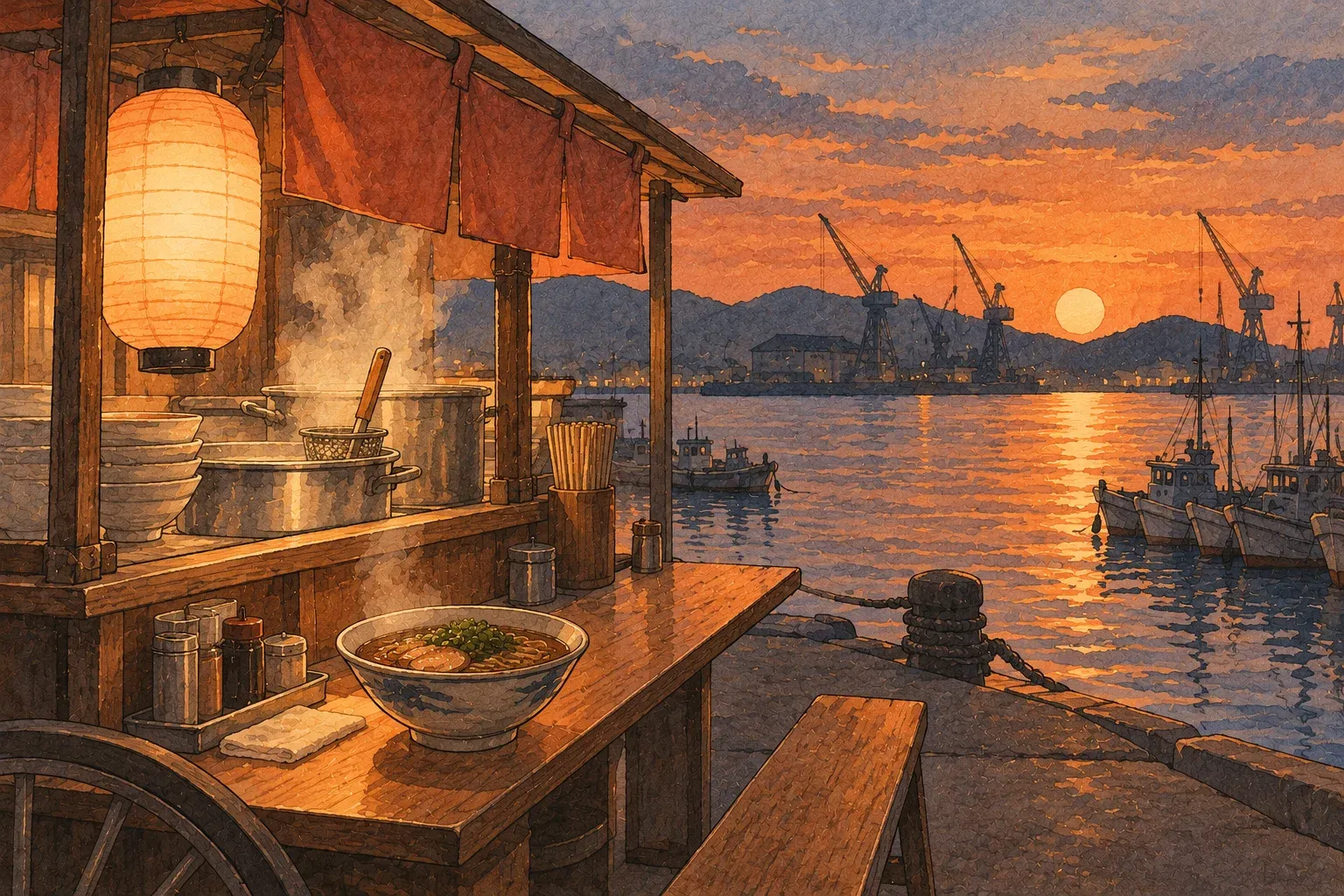
Onomichi is a port on the Inland Sea in Hiroshima prefecture, and its ramen is the kind you can recognise by eye: a dark soy soup, flat noodles, and small white flecks of pork back-fat floating on the surface. The town’s tourism association calls it nationally known and, in the same sentence, says every shop tastes different.
Both halves are true. This page covers the four accounts of where it came from, what the official descriptions say, and why the menu often does not say “ramen”. For how it sits against Japan’s other styles, start from the ramen overview.
Where it came from
There are four accounts, and I am not choosing between them.
Chinese stalls in the early Shōwa years. The Onomichi tourism association, captioning a photograph of a bowl at Shukaen, says the dish is said to have developed from the shina soba (Chinese noodles) that people from China made at street stalls in the early Shōwa period — the late 1920s and 1930s.
A post-war stall, around 1947. A 2024 article in the Cabinet Office’s magazine Highlighting Japan, quoting tourism association staff, gives the town’s ramen about 90 years of history. In the 1930s, it says, Onomichi ramen was a cloudy white soup made from beef and pork bones. Onomichi was a shipbuilding town, and before and during the war people from the continent worked in the yards. After the war, as shipbuilding declined, some people took to pulling chūka soba stalls. Around 1947 Zhu A-jun (朱阿俊) started Shukaen as a stall and devised a soy soup with fried pork back-fat and his own flat noodles; that taste is said to have spread to the town’s other shops and become Onomichi ramen.
The Ramen Museum’s version. The Shin-Yokohama Ramen Museum, a company-run museum, says Onomichi had a few chūka soba shops before the war but that their origin has not been researched. It agrees that stalls appeared after the war as shipbuilding declined, and dates Zhu’s stall to 1947 (Shōwa 22). The first shop run by a Japanese owner, it says, was Tsutafuji, whose founder had been a ship’s crewman. It credits a local noodle maker, Hasebe Seimen, with spreading the style by training new shop owners and supplying them with noodles and tare (seasoning).
A shop’s own story, from 1928. The product page for Onomichi Ramen Ichibankan, sold through the tourism association’s online shop, takes the story back to Shōwa 3 (1928): a Mr Zhang from Fujian province lived in at a noodle factory, made noodles with a hand-cranked rolling machine and sold them, and shops using the same method followed. This is the seller’s account, and I found nothing else that confirms it.
They differ on when the stalls started (early Shōwa or after the war) and who started them (unnamed people from China, Mr Zhang, or Zhu A-jun). Whether the 1930s white soup links to the early-Shōwa stalls, no source says.
What makes it Onomichi ramen
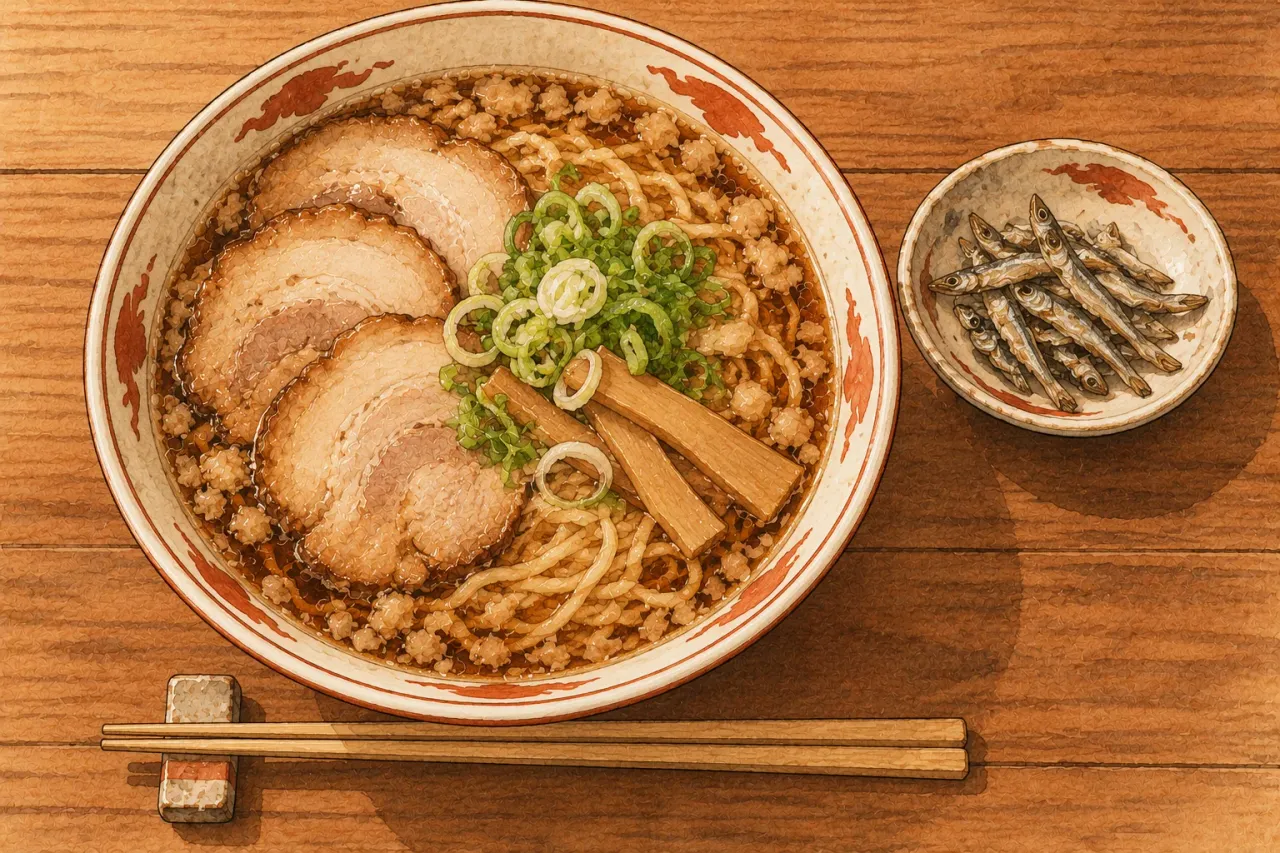
The soup. The tourism association: a stock taken from seafood, with plenty of pork back-fat floating on it. Hiroshima’s tourism federation (DIVE! HIROSHIMA): a soy-sauce base, with back-fat floating to add richness, on a chicken-bone stock with fish stock — such as iriko, dried small sardines — added. The Highlighting Japan article: many shops use small sea bream and other small fish as a hidden flavour. The Ramen Museum describes the basic form as a dark soy soup with minced back-fat on top, and says the typical bowl adds stock from the Inland Sea’s small fish.
The noodles. Flat. The tourism federation says firm flat noodles are the norm; the Highlighting Japan article says most are medium-thin and flat. The Ramen Museum gives the figures: straight, flat in cross-section, cut with a number 16–18 cutter, 25–32% water, about 120 g a portion.
The toppings. Pork (chāshū), bamboo shoots (menma) and spring onion, according to both the tourism federation and the Highlighting Japan article.
The variation. The Ramen Museum says Shukaen used chicken bones with only a little pork bone, and Tsutafuji chicken, pork bone and fish. Small fish, back-fat and soy are the typical bowl, not a definition.
Why Onomichi
The sources tie the bowl to the shipyards — the Highlighting Japan article links both the stall-keepers and the post-war stalls to the town’s shipbuilding and its decline — and to the sea, whose small fish go into the stock.
What I could not find is anyone who defines or certifies the style. Onomichi city’s website mentions it only as a favourite food of its mascot, Onyan; the chamber of commerce’s food pages do not mention ramen; the tourism association publishes a ramen map but, as far as I could see, no standard. The name is not among the regional collective trademarks registered with the Japan Patent Office as of 31 August 2026 — the ramen names on that list are Yonezawa, Wakayama and Kasaoka. Ramen is not in the farm ministry’s list of local dishes for Hiroshima (see the Setouchi local-dishes page), and the Agency for Cultural Affairs’ “100-year food” entries for Hiroshima include in-oko, an okonomiyaki from Innoshima in Onomichi city, but no ramen.
The shops, and what they charge
Ramen ラーメン
- Survey
- ¥620 (≈ €3 / $4)中華そば(しょう油味)外食 1杯 · Aug 2026 · 特別区部
- Chains
- ¥420–¥748Plain soy-sauce ramen, one bowl · Hidakaya, Kourakuen, Gyoza no Ohsho · tax incl. · checked 2026-10-05
- Our guide figure
- ¥1,000 (≈ €6 / $6)From ¥800 for a plain bowl in Tokyo, about ¥1,000 once you add toppings · Oct 2026
Those are national figures. For Onomichi itself:
- The shops. The tourism association’s Onomichi Ramen Map (2026 edition, updated 19 January 2026) maps its member shops with their closing days and phone numbers. Shukaen and Tsutafuji do not appear in the text I could extract from that map — they may be in its images — and I found no official source on whether they still trade, so they are described here only as the sources describe them.
- Shop prices. I did not find any Onomichi shop’s tax-inclusive menu on an official page, so none are given here.
- The nearest statistics. Onomichi is not in the government’s retail price survey, which covers prefectural capitals and cities over 150,000. In its 2025 annual averages, a bowl of soy ramen (tax included, eat-in) was ¥840 in Hiroshima city — second-highest of the 81 cities — and ¥751 in Fukuyama. Hiroshima’s figure moved during the year (¥873 to April, ¥817–825 after), so treat it as an average, not a price.
How to eat it
Try more than one shop. The tourism association recommends going round the shops; its staff member in Highlighting Japan says an Onomichi bowl is smaller than most regional ramen, so you can compare several.
Look for chūka soba. Hiroshima’s tourism federation notes that many shops write “chūka soba” (中華そば) rather than “ramen” on their signs and menus. It is the same dish.
I found no official record of a refill (kaedama) custom or of how many shops use ticket machines, so I make no claim about either. For how the machines work where they exist, see the ticket-machine guide.
Not all Onomichi ramen is this
The Ramen Museum divides Onomichi shops into two kinds: the seimenjo-kei, or noodle-maker style — the generally recognised bowl — and original-kei, shops with their own recipes. With the tourism association’s “every shop tastes different”, it is a family of bowls with a common look.
For a ramen from the other side of the Inland Sea built on a completely different idea — sweet-simmered pork belly, a raw egg and a bowl of rice — see Tokushima ramen.
Eating it in Onomichi, and getting there
Start from the tourism association’s ramen map: closing days differ from shop to shop, and the map lists them. I have not confirmed routes, journey times or fares from an official page, so none are given here.
Onomichi ramen away from Onomichi
The name came from souvenirs. Two sources say “Onomichi ramen” spread as a packaged product. The Ramen Museum says the first company to use the brand was a souvenir-ramen business in Fukuyama, and that Shukaen and others have said theirs is chūka soba, not Onomichi ramen. The Highlighting Japan article says that in the 1990s a delicacy maker launched an Onomichi ramen souvenir that sold two million servings in a year and made the name known nationwide. Neither says whether these are the same company.
Souvenir packs are not always made in Onomichi. The tourism association suggests the souvenir versions as a way to taste several shops at home. On its own online shop, the Inoue Seimenjo four-serving pack lists its maker as Amochinmi of Fukuyama (¥1,390, tax included at the reduced 8% rate), and the Ichibankan two-serving pack (¥730, tax included) has noodles from Takeda Seimen in Fuchū and soup from Sugakiya Foods in Toyoake, Aichi. The name on a packet does not tell you where it was made.
Tokyo was not won over. The Ramen Museum says Onomichi shops multiplied in the Tokyo area in the regional-ramen boom around 1998, without the breakthrough of Asahikawa or Wakayama. I found no official comparison of a Tokyo bowl with one in the town.
The home region is not a big spender. Onomichi is not in the household survey either. Hiroshima city ranks 31st of 52 cities for household spending on chūka soba eaten out, at ¥7,941 a year against a national ¥8,752 (2023–25 average). That category also covers yakisoba and sara udon, and includes takeaway and delivery.
What people get wrong
- “Onomichi ramen has an official recipe.” I found no body that defines or certifies it, and the tourism association says every shop is different.
- “It is always fish stock.” The typical bowl uses small fish; the Ramen Museum says Shukaen, a popular early shop, did not.
- “The story is settled.” Four accounts give dates from 1928 to around 1947 and three different founders.
- “Ramen and chūka soba are different dishes.” In Onomichi they are usually the same bowl under two names; the government’s statistics use chūka soba too.
- “A packet labelled Onomichi ramen comes from Onomichi.” Two packs on the tourism association’s own shop are made elsewhere.
Questions people ask
Why does the menu say chūka soba, not ramen?
Many Onomichi shops call the dish chūka soba, as Hiroshima's tourism federation notes. The Ramen Museum says the name Onomichi ramen was first used by a souvenir-noodle company in Fukuyama, and that older shops have said that what they serve is chūka soba, not Onomichi ramen.
Is there an official definition or certification of Onomichi ramen?
I could not find one. The tourism association describes the style and publishes a ramen map of member shops, but I found no certification scheme, no association that sets a standard, and no regional collective trademark for the name.
Is it always made with small fish and back-fat?
Usually, not always. The tourism bodies describe a soy soup with fish stock and pork back-fat, but the tourism association itself says every shop tastes different, and the Ramen Museum says Shukaen, a popular early shop, used chicken bones with very little pork bone rather than fish.
Is the Onomichi ramen sold as a souvenir made in Onomichi?
Not necessarily. Two packs sold through the tourism association's own online shop list makers in Fukuyama, Fuchū and Toyoake in Aichi.
Sources
- 尾道観光協会 おのなび「尾道の概要」
- 尾道観光協会 おのなび 写真素材 No.528「朱華園の中華そば」
- 内閣府政府広報室 HIGHLIGHTING Japan 2024年11月号「瀬戸内海の海の幸の風味を活かした『尾道ラーメン』」
- 広島県観光連盟 DIVE! HIROSHIMA「広島のご当地麺」
- 新横浜ラーメン博物館 ラーペディア「尾道ラーメン」
- おのなびショップ「尾道ラーメン壱番館(2食入)」
- おのなびショップ「尾道ラーメン(4食入)井上製麺所」
- 尾道観光協会「地図・パンフレット」おのみちラーメンマップ(2026年版)
- 尾道市「おのにゃんについて」
- 尾道商工会議所 グルメ
- 特許庁 地域団体商標登録案件一覧(2026年8月31日現在)
- 農林水産省「うちの郷土料理」広島県
- 文化庁「100年フード」広島県
- 総務省統計局 家計調査 品目別都道府県庁所在市及び政令指定都市ランキング 外食「中華そば」(2023〜2025年平均)
- 総務省統計局 家計調査 収支項目分類表(「中華そば」「外食」の範囲)
- e-Stat 小売物価統計調査(動向編)年報 2025年「中華そば(外食)」
- 総務省統計局 小売物価統計調査 2025年 統計表利用上の注意
Prices are in Japanese yen. Conversions are approximate, at ¥177.30 to the euro and ¥158.23 to the US dollar as of 20 Oct 2026. Rates come from the European Central Bank, which publishes on working days only. Prices checked Oct 2026. What food costs in Japan →