
Hakata ramen: why the noodles are thin, why you order a refill, and what Fukuoka actually charges
I have not been to every place in this guide. The figures below are taken from the sources listed at the end, with the date each one was published — not measured by me. Where I have been, the article says so.
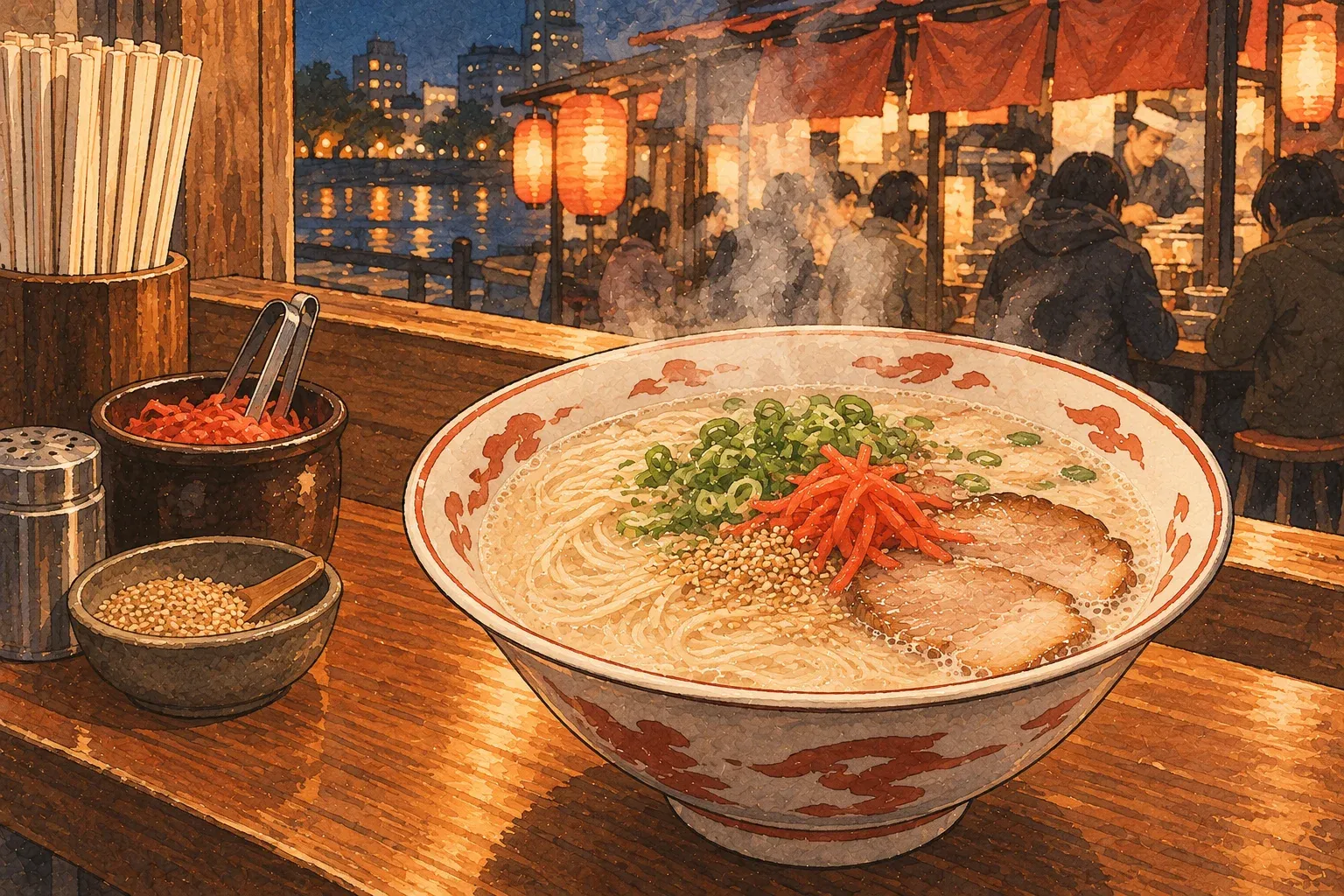
Hakata ramen is the bowl most visitors picture when they hear the word tonkotsu: a white, opaque pork-bone soup, very thin straight noodles, a scatter of spring onion, and the ritual of ordering a second helping of noodles into the soup you have left. All of that is real. Almost none of it was designed. The thin noodles, the refill, and the vocabulary for how hard you want them cooked were worked out at a fish market, for people who had a few minutes between auctions.
This page is about where the style came from, what makes it what it is, how to order it the way people in Fukuoka do, and what it costs there today. For how it sits against the rest of Japan’s ramen, start from the ramen overview.
Where it came from
Three threads run into what is now called Hakata ramen, and they come from three different places.
Hakata, before the war. The Fukuoka prefectural tourism federation traces the origin to a stall called Sanmaro, founded in 1940, which served a lightly clouded pork-bone soup with flat, thin noodles. The Shin-Yokohama Ramen Museum puts it the same way: a stall that existed “from before the war”, followed in 1946 by Hakatasō, whose soup was a clear Chinese-style broth. So the first Hakata ramen was not the thick white soup the city is known for now.
Kurume, 40 km to the south. The white, emulsified pork-bone soup has two claimed birthplaces, and the Ramen Museum records both. One is Akanoren in Hakata, opened in 1946, whose founder is said to have eaten a cloudy pork soup as a soldier in Manchuria and reproduced it. The other is Sankyū, a stall in Kurume opened in 1947, where — the story goes — the soup was left on too high a flame and turned white by accident. The museum’s own timeline credits Sankyū as the source of today’s Kyushu ramen, and its Kumamoto page says both began serving white soup around 1947–48. Kurume itself had the earliest ramen in Kyushu: Nankin Senryō, a stall opened in 1937 by an udon seller who had trained in Yokohama’s Chinatown. Nobody has settled which city was first, and this site does not pretend to.
Nagahama, the fish market. The thin noodles and the refill come from here. Ganso Nagahamaya began as a stall in front of the fish market in 1952 (the shop’s own date; the Ramen Museum says 1953). When the city’s wholesale fish market moved to Nagahama in 1955, the stalls moved with it. The customers were market workers eating between auctions.
By the tourism federation’s account, the Hakata shops then absorbed both of the other threads: the Kurume technique of boiling bones hard enough to emulsify the fat, and the Nagahama thin noodles and kaedama refill. What you eat today in central Fukuoka is that merger. The museum’s verdict is that Hakata ramen and Nagahama ramen were originally different things, and the difference is now very small.
What makes it Hakata ramen
The soup. Pork bones, boiled hard until the stock turns white, with almost no chicken or seafood. Garlic or ginger may be added against the smell. The seasoning is salt or light soy sauce — which is why the bowl looks pale rather than brown.
The noodles. Very thin, straight, low in water. The museum gives the hydration at 24–28% and a portion at 100–120 g. They were not always this thin. The Nagahama stalls kept making them finer so a bowl could be served faster to market workers, and the “extra-thin” noodle of today dates only from around 1970.
The toppings. Finely chopped spring onion, sliced pork, and wood-ear mushroom. On the counter: pickled red ginger, sesame, and crushed garlic. Spicy pickled mustard greens (karashi takana) are common on counters in the city, but I could not find them in the public sources used for this page, so take that as observation rather than record.
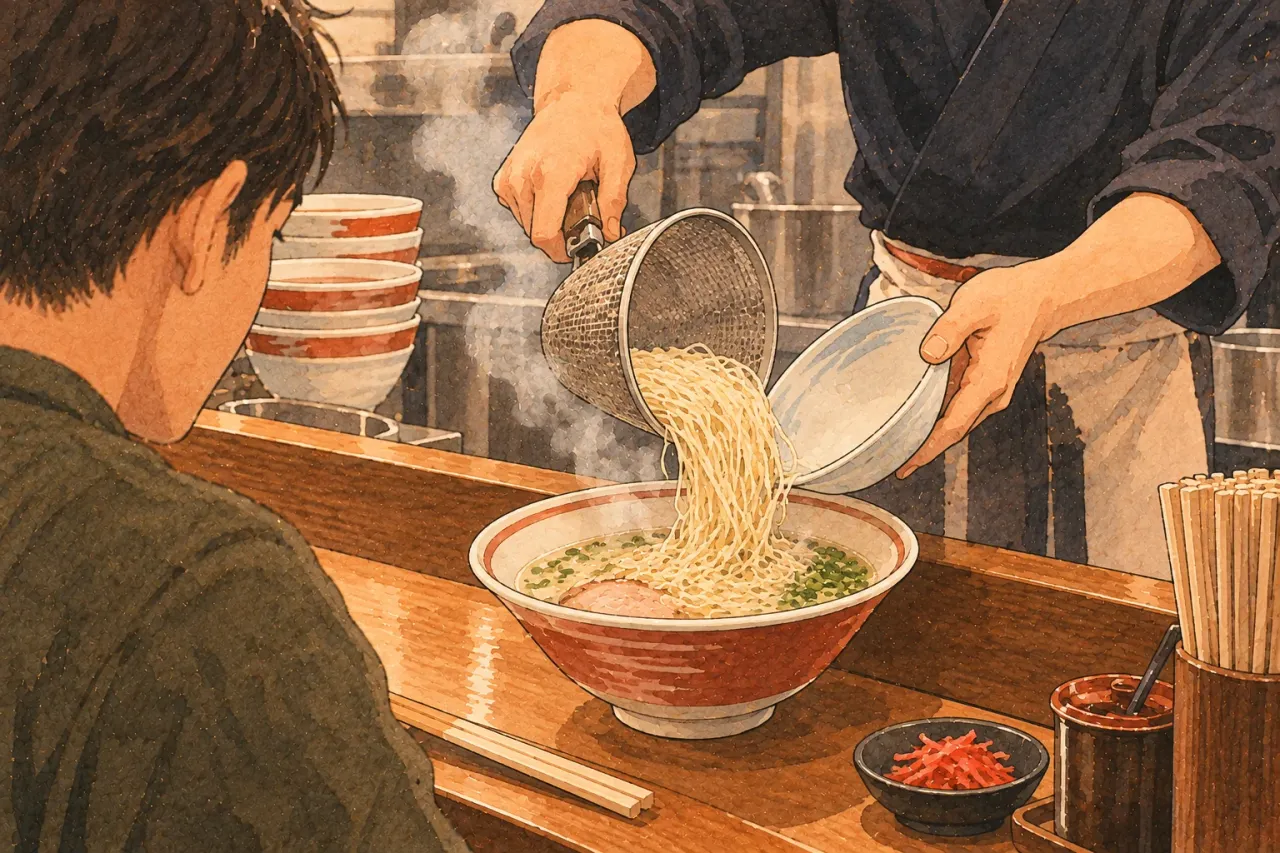
The refill. Because thin noodles go soft quickly, a bowl holds a small portion and you order a second one, dropped into the soup you have kept. This is kaedama. It is a paid extra, not a free top-up, and it was born at the Nagahama market. Kurume, notably, mostly does not do it.
Why Fukuoka
The city’s fish market is the reason the style looks the way it does. Fukuoka’s official market history records that the wholesale fish market began operating at Nagahama in June 1955, after the first joint-stock fish market in Japan had formed in the same district in the Meiji era. The stalls that fed its workers needed a bowl that could be cooked in seconds and eaten in minutes. Thin noodles cook fast; a small portion is finished before it goes soft; the refill solves the appetite; and the vocabulary for noodle hardness exists because, as the museum puts it, those words only make sense for a noodle this thin.
The stalls themselves are the other half of the story. Fukuoka’s yatai began as makeshift mobile food stands in the ruins after the war. At the peak in the late 1960s there were more than 400; by 2022 there were 100. In 2013 the city passed Japan’s first basic ordinance on yatai, making them a regulated, licensed part of public space rather than a tolerated leftover. Since 2016, new stall operators have been chosen by public competition. The fifth round, in 2025, drew 61 applicants for six pitches, and the winners’ average age was 31.6 against 54.5 for existing operators. In 2025 the system won a Good Design Award. Fukuoka’s roughly 100 stalls make it, by a wide margin, the yatai city of Japan: about nine out of ten licensed stalls on public land in the whole country are here.
The shops, and what they charge
Prices below are tax included, for eating in, as posted by the operator on the date at the top of this page. Where a shop does not publish its prices, I say so rather than guess.
Ramen ラーメン
- Survey
- ¥620 (≈ €3 / $4)中華そば(しょう油味)外食 1杯 · Aug 2026 · 特別区部
- Chains
- ¥420–¥748Plain soy-sauce ramen, one bowl · Hidakaya, Kourakuen, Gyoza no Ohsho · tax incl. · checked 2026-10-05
- Our guide figure
- ¥1,000 (≈ €6 / $6)From ¥800 for a plain bowl in Tokyo, about ¥1,000 once you add toppings · Oct 2026
Those are national figures. In Fukuoka specifically:
- A stall. Three stalls featured by the city’s tourism office in September 2026 list their basic bowl at ¥700 (Takechan fr Tsukasa, Nakasu), ¥750 (Kojima Shōten, Nakasu) and ¥750 (Tomochan, Tenjin). City rules require every stall to display a price list, and ban vague labels such as “market price”. Some stalls add a cover charge, and it must be on the list too.
- Ganso Nagahamaya. The shop that started the Nagahama style, now in a building at Nagahama 2-5-25, open 06:00 to 01:45 with a break only over New Year. It does not publish its prices online.
- Ichiran. Founded 1960, incorporated 1993, head office in Nakasu, 93 shops as of June 2026 (85 in Japan, 8 abroad). At the 24-hour head shop in Nakasu the classic bowl is ¥1,080, a kaedama ¥210, a half kaedama ¥150, a soft-boiled egg ¥140, rice ¥250. Other branches have listed the same bowl at ¥980, so the price depends on the shop, and a late-night surcharge applies from 22:00 to 06:00 at the head shop.
- Ippudō and Hakata Ikkōsha. Both publish menus whose prices did not load in a form I could verify, so none are given here. Ikkōsha states that its foamy “awa-kei” soup was created by its founder in March 2004 — a reminder that even in Hakata, much of what is served is recent.
For a sense of scale, the city’s 2023 survey put average spending per person per visit at a yatai at ¥1,923 — ramen plus a drink or two, and the cover.
How to order it
Hardness. The counter will ask how you want the noodles. The prefectural tourism federation lists the scale as nama (barely cooked, also called konaotoshi), harigane, barikata, kata, futsū, yawa, bariyawa — from near-raw to very soft. Its advice to first-timers is to start at kata. Nagahama-style shops will also ask how much fat you want: beta (heavy), futsū, nashi (none).
The refill. Eat the noodles, keep the soup, then order kaedama. You can ask for a different hardness the second time. If you have drunk the soup, there is nothing to put the noodles into, and shops will tell you so.
The counter. Garlic (often with a press), pickled red ginger and sesame are there to adjust the bowl, not to prove anything. A little ginger is what most locals add.
Ichiran’s system is Ichiran’s. The individual booths, the paper order form with seven choices (noodle hardness, richness, oil, pork, spring onion, the house chilli sauce, garlic), the refill plate you place on a button that plays a tune — all of it was devised by the company’s president, starting at the first shop in 1993. It is a good system. It is not how Hakata traditionally eats ramen, and you will not find it elsewhere.
At a stall. Check the price list before you sit. Some stalls have a cover or a one-order-per-person rule, and both are allowed as long as they are posted. Stalls open around 18:00–19:00 and may trade until 04:00; the city’s rule is 17:00 to 04:00 including setting up and packing away. When it gets busy, finish and give up your seat. As of 2026, more than three in ten stalls take cards or QR payment, so cash is still the safer assumption.
Not all of Kyushu is this
“Kyushu ramen” is often used as a synonym for Hakata tonkotsu. The island disagrees.
- Kurume is thicker, stronger-smelling, boiled in a large cauldron rather than a stockpot, with slightly thicker noodles, and mostly without kaedama. It is also the home of yobimodoshi: a stock kettle that is never emptied, topped up for decades from a second pot, a technique the Ramen Museum attributes to Taihō Ramen, founded as a stall in 1953.
- Kumamoto adds chicken bones to the pork, cooks the garlic rather than serving it raw, and finishes with black garlic oil (mā-yu) and fried garlic chips, on a thicker noodle. Japan’s tourism agency describes it as a descendant of Kurume.
- Kagoshima is said to be the one Kyushu style not influenced by Kurume at all. Its first shop, Noboruya, opened in 1947 after its founder learned in Yokohama. The soup uses chicken and vegetables alongside pork and is milder; the noodles are soft and made without lye water; most shops put out free pickled radish and a small pot of tea.
- Nagasaki is a champon city. The prefectural tourism federation’s own food guide leads with champon and Gotō udon and does not list a ramen style at all.
And in Tokyo, the pork-bone soup that visitors now assume is “Japanese ramen” was a novelty boom as late as 1989, when Hakata-style shops opened in the capital.
Eating it in Fukuoka, and getting there
Nagahama. The birthplace of the thin-noodle style lost most of its stalls over the decades. In 2023 seven new stalls were awarded pitches there by public competition, joining the two that remained, and the city has kept adding Nagahama pitches in later rounds. Ganso Nagahamaya is a 20–30 minute walk from Akasaka station on the subway Kūkō line, or a bus to Minato 1-chōme.
Nakasu and Tenjin. Most of the city’s stalls are in these two districts and around them, with the river-side rows in Nakasu the most photographed. Tenjin is the commercial centre; Hakata station has the ramen shops that feed train passengers.
From the airport. Fukuoka’s airport is on the city subway. The Kūkō line runs Fukuoka Airport to Hakata in 5 minutes and to Tenjin in 11, and the posted fare for either journey is ¥260 (adult, single). Between Hakata and Tenjin it is ¥210. Few large cities in the world put their airport this close to a bowl of noodles.
Next door. Kurume is on the same JR Kagoshima line and the Nishitetsu line south from Fukuoka; the Kyushu routes on this site cover the connections.
Hakata ramen away from Hakata
Most people who eat “Hakata ramen” eat it in Tokyo or Osaka, and it is worth knowing what changes on the way.
The price goes up with the rent. Ichiran publishes a price for every shop. On the date of this page its classic bowl is ¥980 at the Tenjin shop in Fukuoka, ¥1,080 at the 24-hour head shop in Nakasu, and ¥1,180 at both Shibuya in Tokyo and Dōtonbori in Osaka. The kaedama is ¥210 everywhere. The company does not explain the gap, but the pattern is the one you will see across the country: the same bowl, dearer where the rent is. The sauce, at least, is the same — Ichiran says its red tare is made at one site in Itoshima, Fukuoka, and shipped to every shop in Japan and abroad.
Tokyo got a milder soup on purpose. Kyūshū Jangara, which opened in Akihabara in 1984 and is one of the three shops the Ramen Museum credits with the 1989 Tokyo tonkotsu boom, says on its own history page that “rich, wild Kyushu ramen would not be accepted by Tokyo people”, and that it created a new, “mild tonkotsu” in response — pork bone with chicken and vegetables. It added a proper Kurume–Hakata-style creamy bowl, Bonshan, only in 1988. So the first “Hakata ramen” many Tokyoites ate was a Tokyo reformulation, and the shop says so.
The big names are not always the same bowl. Ippudō, founded in Fukuoka in 1985 and now at 96 shops in Japan, notes in its own releases that menus and prices vary by shop and have been revised with ingredient changes; Hakata Ikkōsha lists separate regional menus for Kyoto, Osaka, Okinawa and Okayama and none for Tokyo. If the point of the trip is the bowl, the Fukuoka shop is the reference and the others are its interpretations.
And Fukuoka does not eat the most of it. In the government household survey (2023–25 average), spending on ramen eaten out (the survey’s item is chūka soba, which also counts yakisoba and sara udon, and “eaten out” includes delivery and takeaway) puts Yamagata city first at ¥21,695 a year per household and Fukuoka 38th at ¥7,604 — below the national average. Hakata is where the style comes from; it is not where Japan eats the most ramen.
What people get wrong
- “Tonkotsu is standard Japanese ramen.” The white pork-bone soup is a Kyushu style from the late 1940s. Tokyo’s own ramen tradition is soy-sauce-based, and tonkotsu was a trend there in 1989.
- “Everything in Kyushu is tonkotsu.” Kagoshima, Kumamoto and Nagasaki each eat something else (see above).
- “Stalls are cheap.” A bowl is ordinary-priced, but a visit averages ¥1,923 per head, and a cover charge is normal and legal as long as it is posted.
- “Kaedama is a free refill.” It is a paid extra — ¥210 at Ichiran — and it needs soup left in the bowl.
- “Hakata ramen has always been white and extra-thin.” The 1940 original had a lightly clouded soup and flat noodles; the extra-thin noodle dates from around 1970.
- “Barikata works everywhere.” The hardness words were invented for the Nagahama noodle. Order barikata on a thick Sapporo noodle and you will get a puzzled look.
- “The yatai are unregulated.” Since 2013 they have been licensed under a city ordinance, with public competition for pitches, fixed hours, posted prices, and a ten-year limit on a licence.
- “Ichiran is the traditional Hakata experience.” It is a Fukuoka company’s invention from 1993 onwards, and a very successful one.
Questions people ask
Is Hakata ramen the same as tonkotsu ramen?
Hakata ramen is one kind of tonkotsu (pork-bone) ramen, from Fukuoka city. The cloudy white soup it is known for was first made in Kurume, 40 km south, and in Hakata itself, within a year or two of each other in the late 1940s. Other Kyushu cities make quite different pork-bone soups.
Is kaedama a free refill?
No. Kaedama is a paid second portion of noodles dropped into the soup you have left. At Ichiran it is ¥210, or ¥150 for a half portion. You must leave soup in the bowl to order it.
Are the yatai stalls cheap?
A bowl of ramen at a stall is around ¥700–750, which is ordinary for Fukuoka. But a city survey puts average spending per person at a stall at ¥1,923, and some stalls charge a cover (otōshi). Stalls are required by city rules to display their prices, so look before you sit.
Sources
- 総務省統計局 家計調査年報 付録8 収支項目分類表(「中華そば」「外食」)
- 福岡県観光連盟 クロスロードふくおか「博多・長浜・久留米の違いとは?とんこつラーメン大解剖!」
- 新横浜ラーメン博物館 ラーペディア「博多ラーメン」
- 新横浜ラーメン博物館 ラーペディア「久留米ラーメン」
- 新横浜ラーメン博物館「日本のラーメンの歴史」
- 新横浜ラーメン博物館 トリビア「その昔、長浜の麺は意外に太かった」
- 新横浜ラーメン博物館「ラーメン大辞典」(替え玉・呼び戻し)
- 新横浜ラーメン博物館 ラーペディア「鹿児島ラーメン」
- 新横浜ラーメン博物館 ラーペディア「熊本ラーメン」
- 福岡市中央卸売市場「市場概要 令和6年度版」
- 元祖長浜屋 公式サイト
- 福岡市屋台基本条例(平成25年条例第43号)
- 福岡市屋台基本条例施行規則
- 福岡市「屋台公募制度 2025年度グッドデザイン賞ベスト100に選出」
- 福岡市 報道発表「第5回公募屋台の概要について」
- 福岡市観光公式 よかなび「福岡市における屋台の経済波及効果 100億円を突破!」
- よかなび「データで見る福岡博多屋台」
- よかなび「屋台の店主が教える!美味しい屋台〜ラーメン編〜」
- よかなび「福岡博多屋台の初心者あるある6選【後編】」
- よかなび「【新規参入屋台4期生】長浜屋台街が復活!」
- 一蘭 本社総本店 店舗ページ(価格)
- 一蘭 会社概要・沿革
- 一蘭コラム「味集中カウンター」
- 福岡市地下鉄 普通券運賃表
- 福岡市地下鉄「地下鉄の概要」
- 一蘭 天神店・渋谷店・道頓堀店別館 店舗ページ(価格)
- 一蘭「五つの元祖」(たれの製造地)
- 九州じゃんがら 沿革(1984年創業、マイルドとんこつ)
- 一風堂 プレスリリース(国内96店・海外55店)
- 博多一幸舎 店舗一覧(地域別メニュー)
- 総務省統計局 家計調査 品目別都道府県庁所在市ランキング 外食「中華そば」(2023〜2025年平均)
Prices are in Japanese yen. Conversions are approximate, at ¥177.30 to the euro and ¥158.23 to the US dollar as of 20 Oct 2026. Rates come from the European Central Bank, which publishes on working days only. Prices checked Oct 2026. What food costs in Japan →