
Tsukemen: dipping ramen, the staff meal it grew from, and the shops that each claim the original
I have not been to every place in this guide. The figures below are taken from the sources listed at the end, with the date each one was published — not measured by me. Where I have been, the article says so.
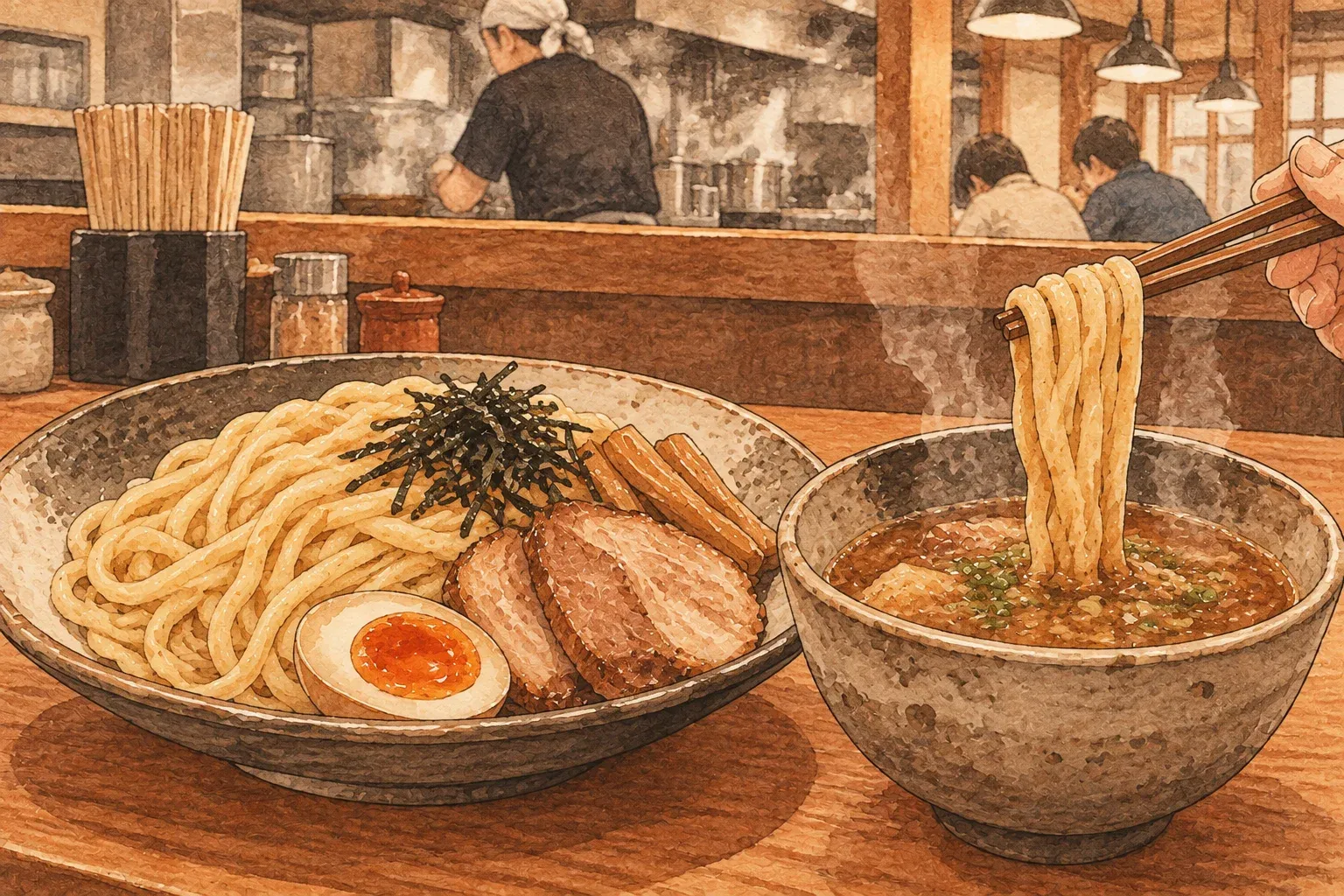
Tsukemen — “dipping noodles” — is ramen taken apart. The noodles come on one plate, the soup in a separate bowl, and you dip as you eat. It is a Tokyo dish, and it is young: the best-documented account puts it on a menu for the first time in 1955. It is also a dish with more than one claimant, because the man most associated with it worked inside a family of shops that each tell the story a little differently.
This page sets out who claims it, what the first dipping soup was, and how tsukemen shops sell their noodles.
For ramen in general, start from the ramen overview.
Where it came from
There are three accounts, and they overlap more than they conflict. This site does not choose between them.
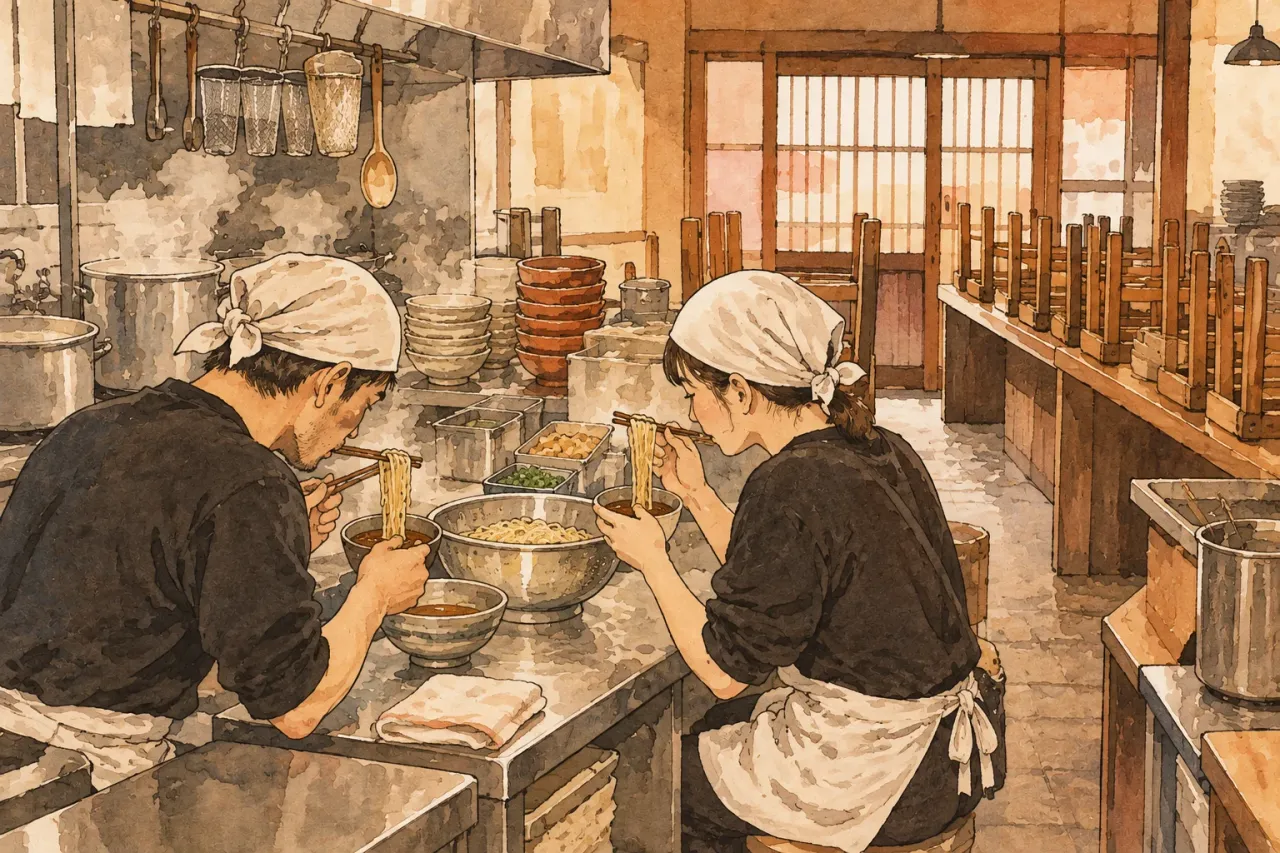
Nakano, 1955: Yamagishi Kazuo’s account. A 2025 article by the writer Kitao Toro in Bungeishunju PLUS, based on Yamagishi Kazuo’s own book, says that on 1 April 1955 Yamagishi (1934–2015), then manager of the Taishoken shop in Nakano ward, put a dish called tokusei morisoba — “special plain noodles” — on the menu. It began as a staff meal for busy times. When noodles were moved from the draining basket into bowls, some were left behind; Yamagishi, who came from Shinshū, applied the way Japanese buckwheat soba is eaten, and made what the article calls a “Chinese-style zaru soba”: noodles with the soup on the side. Regular customers asked about it, and it became a menu item. Ramen was ¥35 and the new dish ¥40.
Nakano, around 1955: the shop’s account. A 2017 article on the food site Meshi-tsū quotes Sakaguchi Mitsuo of Nakano Taishoken. In his telling, the founder Sakaguchi Masayasu opened in Nakano in 1951, moved the main shop to Yoyogi-Uehara in 1954, and left Nakano as a branch. Around 1955, while Yamagishi was at Nakano, he served customers the staff meal — a Chinese version of morisoba — and that was the birth of tsukemen as a menu item. Yamagishi stayed about ten years, until 1961. The article rests mainly on this one testimony and does not cite other records.
Ogikubo: the Marucho family. The same article describes a wider lineage. Marucho opened in Ogikubo in 1947, run jointly by three Aoki brothers, Yamagami Nobunari and Sakaguchi Masayasu, and a Marucho association of shops was formed in 1959. In this account, the tsukesoba style was shaped and spread across the whole group through study meetings in the 1960s and 70s, and Yamagishi began a way of making it different from the Marucho shops’ from around the end of the Shōwa era. The article itself suggests that views on “the original” may differ.
Higashi-Ikebukuro, 1961. Yamagishi opened his own shop in Higashi-Ikebukuro in 1961, according to PRESIDENT Online in 2025. A 2013 company press release says the tokusei morisoba he devised during his training years became Taishoken’s signature, and gives the same 1961 date.
I found no ward or local government that officially recognises a birthplace of tsukemen.
What makes it tsukemen
The noodles and the soup are served separately, and the noodles are dipped. That is the whole definition this page can support.
The first dipping soup. According to the Bungeishunju PLUS article, the original was ramen soup with soy sauce added, served in a teacup (yunomi). The taste was adjusted using the sourness and sweetness of hiyashi chūka, chilled Chinese-style noodles, as a guide.
Today’s dipping soups. How shops make their soups now — with fish, pork bones or anything else — I could not confirm from a primary source, so this page does not describe it.
The shops, and what they charge
Tsukemen (dipping noodles) つけ麺
- Chains
- ¥990Standard tsukemen · Tsukemen TETSU · tax incl. · checked 2026-10-05
- Our guide figure
- ¥900 (≈ €5 / $6)Tokyo, a standard bowl · Oct 2026
Those figures are kept on the price reference page and update there.
The pattern worth knowing is about weight, not price. Some tsukemen shops let you choose a bigger portion of noodles for the same money. Two examples are on record, and both are dated:
- Taishoken next, Shibuya (2013). The operator’s press release of 24 September 2013 lists regular 300 g, medium 400 g and large 500 g of noodles, and says all are the same price. The release does not say whether its prices include tax, and it is thirteen years old.
- Mita Seimenjo (2022). A 2022 article reporting the chain’s release gives uncooked noodle weights of regular 200 g, medium 300 g, large 400 g and extra-large 500 g, with regular to large at one price and no extra charge. The chain’s own menu page, which I opened, shows neither weights nor prices.
So the “same price, choose your size” model existed at two shops on those dates. Whether it still applies at either, and what they charge now, I could not confirm, and no current shop price is given here.
How to eat it
Dip the noodles into the soup and eat. That is what the dish was built for — a Chinese noodle eaten the way Japanese soba is eaten.
You will hear of soup-wari, something done with the dipping soup at the end of a bowl. None of the sources I used for this page describe it, and I could not confirm an official explanation, so I cannot tell you how it works or whether a given shop offers it. Ask.
Not all tsukemen is this
The dish now exists in many styles, but I have no source for how they differ by region or by shop, and I will not guess. What the sources do show is that the Taishoken name itself covers several shops with different claims: the 2025 PRESIDENT Online article quotes the head of Ochanomizu Taishoken saying his shop is the closest to the original. Each shop that carries the name has its own position.
Tsukemen away from Nakano
The shop the earliest account points to, Nakano Taishoken, is described as still operating in the 2025 article. Which shop is the true head of the family is a matter on which the shops and the Marucho association do not agree. I found no official comparison between the Higashi-Ikebukuro shop, the Nakano shop and tsukemen elsewhere in Tokyo, so this page does not say one is closer to the original than another.
Check fares and journey times with the operator before you travel.
What people get wrong
- “Tsukemen has one inventor and one birthplace.” The best-documented account names Yamagishi Kazuo and Nakano in 1955, but the Marucho family’s account describes the style as shaped across a group of shops. No local authority has ruled on it.
- “Tsukemen started in Higashi-Ikebukuro.” Yamagishi opened there in 1961. The accounts above put the dish’s first appearance earlier, in Nakano.
- “The dipping soup was always thick and fishy.” The original described in Yamagishi’s account was ramen soup with extra soy, in a teacup.
- “A large is always free.” Two shops have sold several sizes at one price, on dates in 2013 and 2022. Whether any given shop does today is on its own menu.
Questions people ask
Who invented tsukemen?
The best-documented account credits Yamagishi Kazuo, then manager of Taishoken in Nakano, Tokyo, who put a dish called tokusei morisoba on the menu on 1 April 1955. Sakaguchi Mitsuo of the Nakano shop gives a similar account in a 2017 interview. Others say the dipping style was shaped across the wider Marucho group of shops. This site does not choose.
What was the first dipping soup?
According to an article based on Yamagishi’s own book, it was ramen soup with extra soy sauce, served in a teacup, with the taste adjusted using the sourness and sweetness of hiyashi chūka as a guide.
Why can I choose a large portion for the same price?
Some tsukemen shops sell several noodle weights at one price. Two examples are on record, from 2013 and 2022. I could not confirm current prices or rules at either shop, so check the menu where you eat.
What is soup-wari?
I could not confirm an official or public description of soup-wari, and none of the sources used for this page mention it, so this page does not explain how it works at any shop.
Sources
Prices are in Japanese yen. Conversions are approximate, at ¥177.30 to the euro and ¥158.23 to the US dollar as of 20 Oct 2026. Rates come from the European Central Bank, which publishes on working days only. Prices checked Oct 2026. What food costs in Japan →