
Tokushima ramen: three colours of soup, sweet pork belly, a raw egg and rice
I have not been to every place in this guide. The figures below are taken from the sources listed at the end, with the date each one was published — not measured by me. Where I have been, the article says so.
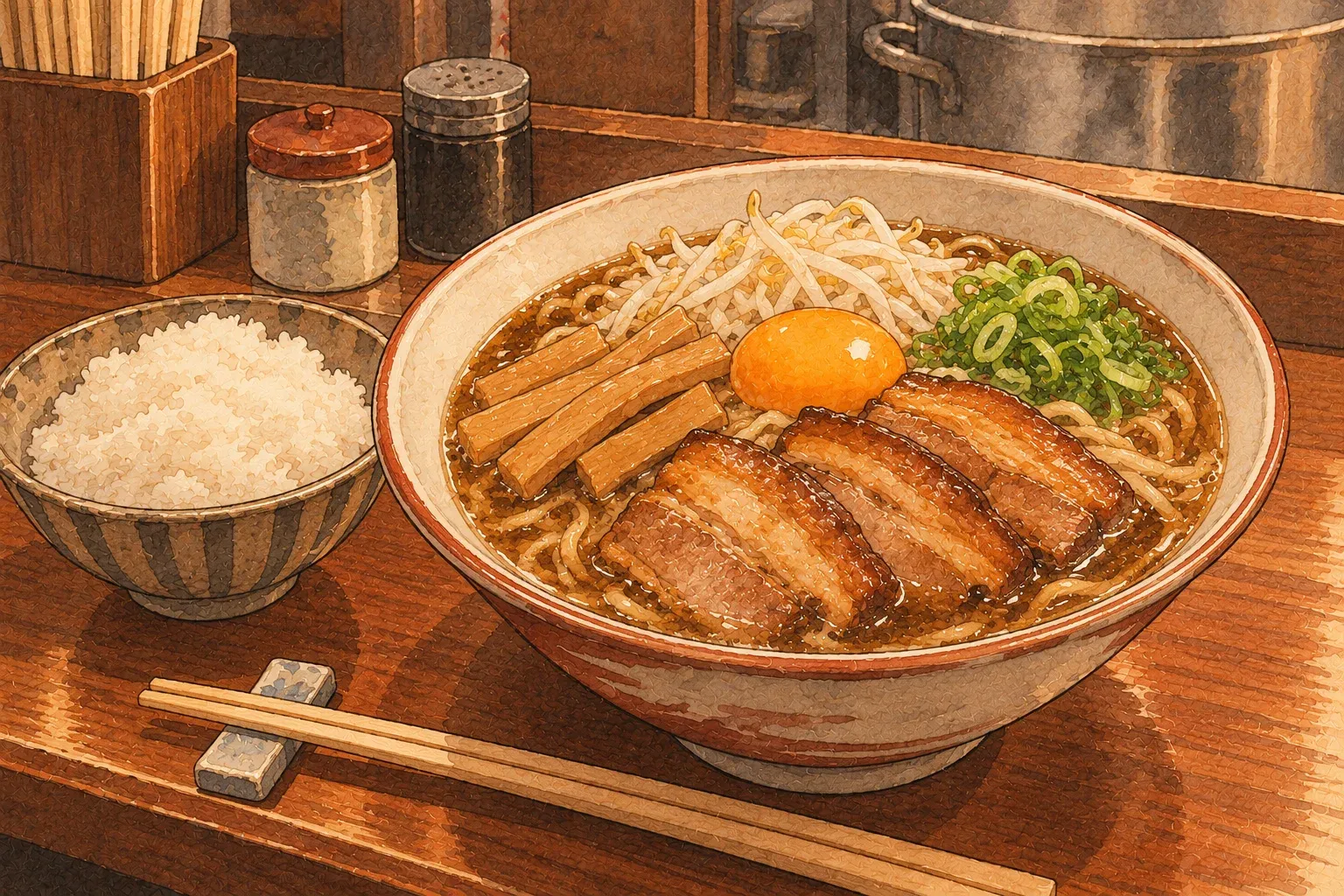
In Tokushima a ramen shop will usually offer a choice of soup by colour — brown, white or yellow — and the brown one comes with slices of pork belly simmered sweet and savoury, a raw egg if you want one, and a bowl of rice on the side. Tokushima city’s own website describes the style much the same way: a rich brown soup, pork belly and raw egg on top, eaten together with rice.
It is easy to recognise and hard to describe neatly, because the official sources do not agree on what the three colours are. This page sets out what each says. For how it sits against Japan’s other styles, start from the ramen overview.
Where it came from
Everyone puts the start after the war, at street stalls.
- The Japan Tourism Agency’s description, written in fiscal 2020 by a Tokushima city team, says the dish is thought to have its origins in stalls after the end of the Second World War.
- Awa Navi, the prefectural tourism site, says it is said to have been born in eastern Tokushima, and that its roots are the cloudy white soup served at post-war stalls.
- The Tokushima Prefecture Ramen Business Cooperative, a private association, says it began at stalls around 1949.
The Shin-Yokohama Ramen Museum, a company-run museum, gives the most detail, with dates from its own research. The starting point appears to be a stall that Futaki Hiroshi began pulling in Komatsushima around 1949 (Shōwa 24). How it travelled from Komatsushima to the city, it says, there is no clear testimony. The city’s first ramen was probably the yellow type, at Hachimanya and Tarafukuya around 1950–52; the white type appeared at Ginza Ippuku and Yoake at about the same time. The brown type — the museum calls it “black” — appeared in the late Shōwa 30s, the early 1960s, at Kanton and Inotani at about the same time, and it is not clear which came first.
Who first used pork belly is disputed. Awa Navi, in a feature on Ginza Ippuku, calls the shop the pioneer that first used pork belly — the shop’s own account. The Ramen Museum says Kanton and Inotani were the first to make the meat and the egg popular. I am not choosing.
What makes it Tokushima ramen
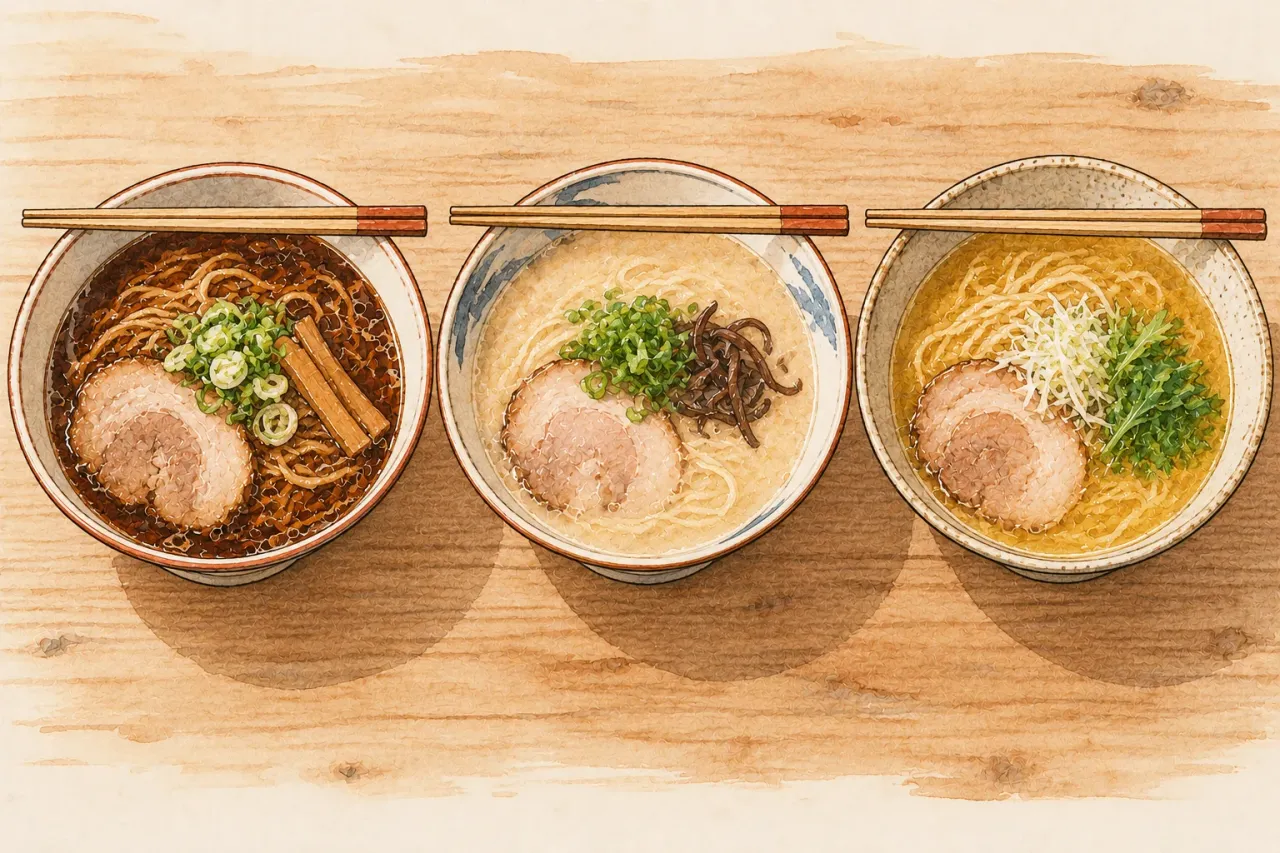
Three soups. This is where the sources agree on the outline and disagree on the details.
- Brown (茶系, cha-kei). Pork bone with dark soy sauce, sweet and savoury, and the most common — all sources agree on that. The Ramen Museum calls it kuro, black, and describes it as the white soup with dark soy added.
- White (白系). The tourism agency: light soy sauce, saltier. Awa Navi: light. The cooperative: a cloudy pork-bone soup that uses little soy. The Ramen Museum: cloudy pork bone with light soy.
- Yellow (黄系). The tourism agency: pork bone with chicken and vegetable stock. Awa Navi: mild, also using chicken bones and vegetables. The cooperative calls it ōgon-kei, golden, a light soup of chicken and pork bones, pale in colour. The Ramen Museum: a clear chūka soba of the kind served in Chinese restaurants all over Japan.
Even single shops move between categories: one Awa Navi article puts Ginza Ippuku in the yellow group, and Awa Navi’s own shop guide lists it under brown.
The pork. Instead of ordinary chāshū, pork belly simmered sweet and savoury, as the tourism agency puts it. Awa Navi notes that some shops use chāshū instead, and the cooperative says the golden type mostly comes with chāshū.
The egg. A raw egg. The tourism agency says many shops let you add one; Awa Navi calls it the mainstream topping and says it makes the soup mellower.
The rest. Bamboo shoots, spring onion and bean sprouts. The Ramen Museum describes the noodles as straight, medium-thin and on the soft side: a number 20–24 cutter, 27–32% water, 120–140 g a portion.
The Ramen Museum adds that some people call the brown bowl a “sukiyaki-like ramen”, for the sweet-savoury seasoning, the dark soup, the pork belly and the raw egg.
Why Tokushima
The Ramen Museum’s explanation for the pork-bone soup is that pork bones were cheap locally, because a factory of Tokushima Ham — the predecessor of Nippon Ham — was in Tokushima. That is the only reason for the style’s shape I found in the sources.
Who defines it today is newer. The Tokushima Prefecture Ramen Business Cooperative was set up in February 2025, led mainly by volunteers from outside the ramen trade, to raise the brand value of Tokushima ramen and revive the region. Its listed supporting organisations are the Tokushima chamber of commerce, the prefectural federation of small business associations and the prefectural tourism association. It runs a certified-shop scheme — 20 certified shops are in its digital stamp rally from 1 August to 31 December 2026 — but I could not find the certification criteria on its website. Its stated goals include unified standards, its own official certification, and registering Tokushima ramen as a regional collective trademark. As of 31 August 2026 it is not on the Japan Patent Office’s list of registered regional trademarks.
Ramen is not in the farm ministry’s list of local dishes for Tokushima (see the Shikoku local-dishes page), and it is not among the prefecture’s eight “100-year foods” chosen by the Agency for Cultural Affairs.
The shops, and what they charge
Ramen ラーメン
- Survey
- ¥620 (≈ €3 / $4)中華そば(しょう油味)外食 1杯 · Aug 2026 · 特別区部
- Chains
- ¥420–¥748Plain soy-sauce ramen, one bowl · Hidakaya, Kourakuen, Gyoza no Ohsho · tax incl. · checked 2026-10-05
- Our guide figure
- ¥1,000 (≈ €6 / $6)From ¥800 for a plain bowl in Tokyo, about ¥1,000 once you add toppings · Oct 2026
Those are national figures. In Tokushima:
- The statistic. In the government’s retail price survey, the 2025 average for a bowl of soy ramen (tax included, eat-in) in Tokushima city was ¥678 — 53rd of 81 cities. Tokyo’s wards were ¥604.
- Shop prices. I did not find a Tokushima shop’s tax-inclusive menu on an official page, so none are given here. The city’s website mentions “niku ramen” (meat ramen) among its hometown-tax gifts.
- Selling out. Awa Navi’s shop guide notes shops that close when they sell out.
How to eat it
With rice. Both the city and the prefectural tourism site describe eating it with a bowl of rice as part of the style.
The egg is your choice. At most shops, the Ramen Museum says, asking for tamago brings a raw egg. One shop in Awa Navi’s brown-soup guide has served raw eggs free since it opened; I could not confirm how other shops charge. Awa Navi’s reason for the egg is flavour: it makes the soup mellower. I found no official figure for how many local people add one.
As for why raw eggs are eaten in Japan at all, the farm ministry says Japan has built thorough measures against food-poisoning bacteria into production, processing and distribution — hygiene on farms and at egg-grading and packing plants, and standards for eggs in the shell — and that eggs are produced on the assumption they will be eaten raw. The best-before date on Japanese eggs is the date until which they can be eaten raw; the longest is currently 21 days, including seven in a home fridge. The ministry also says that people who feel uneasy, or who are unwell, should cook eggs so the whole dish reaches 70°C. For more, see the egg page.
Choose the colour. The tourism agency says shops generally have all three soups ready. The cooperative counts all three as Tokushima ramen.
Not all Tokushima ramen is brown
The Ramen Museum says “Tokushima ramen” now often means the black (brown) type, and attributes that to itself: it introduced Inotani, a black-type shop, nationwide in 1998. The cooperative at home counts all three soups. The outside picture is one colour; the local one is three.
The Ramen Museum says a raw egg is standard elsewhere only in Miyazaki and parts of Kyoto. For a bowl from across the Inland Sea built on back-fat and fish stock, see Onomichi ramen.
Eating it in Tokushima, and getting there
Awa Navi’s ramen and chūka soba guide, which sorts shops by soup colour, is the most useful official starting point I found. I have not confirmed routes, journey times or fares from an official page for this article, so none are given here.
Tokushima ramen away from Tokushima
In Tokyo. The Ramen Museum names Udatsu Shokudō and Tokufuku as Tokyo-area shops. Its page also says Inotani appeared at the museum, but Inotani is not on the museum’s current list of shops, so that may be out of date.
It is not a big-spending city. In the government household survey (2023–25 average), Tokushima city ranks 45th of 52 for spending on chūka soba eaten out, at ¥6,551 a year per household against a national ¥8,752. That category also covers yakisoba and sara udon, and includes takeaway and delivery.
Price is not a Tokyo premium. In the 2025 retail price survey, Tokushima city’s average bowl (¥678) was dearer than Tokyo’s wards (¥604). The survey averages a set specification across sample shops; it says nothing about any one shop.
I found no official comparison of how Tokushima ramen is made in Tokushima and in Tokyo.
What people get wrong
- “Tokushima ramen is the brown one.” Brown is the most common, but the local cooperative counts white and yellow too.
- “The raw egg comes automatically.” The tourism agency describes it as a topping many shops let you add.
- “It is officially certified.” A cooperative founded in 2025 runs a certified-shop scheme, but I could not find its criteria, and the name is not a registered regional trademark.
- “There is a Tokushima Ramen Association.” The body I found is the Tokushima Prefecture Ramen Business Cooperative; I found no organisation under the other name.
- “It is a listed local dish.” It is not in the farm ministry’s list for Tokushima.
Questions people ask
Does Tokushima ramen always come with a raw egg?
Not automatically. The Japan Tourism Agency's description says many shops let you add a raw egg as a topping, and the Ramen Museum says that at most shops asking for tamago brings a raw egg. One shop in Awa Navi's guide has given raw eggs free since it opened. How it is charged elsewhere I could not confirm.
What are the brown, white and yellow types?
Three kinds of soup. Every source agrees there are three and that brown, a pork-bone soup with dark soy sauce, is the most common. They describe white and yellow differently, and even call them by different names, so this page sets out who says what.
Why is it eaten with rice?
Tokushima city's own website and the prefectural tourism site both describe eating it with rice as part of the style. I found no official explanation of why, so this page does not offer one.
Sources
- 観光庁 多言語解説文データベース「徳島ラーメン」(徳島市の多言語解説整備プロジェクトチーム)
- 徳島市 公式サイト「徳島ラーメン特集」
- 阿波ナビ(徳島県・徳島県観光協会)「県民のソウルフード 徳島ラーメンを味わう」
- 阿波ナビ「徳島のラーメン&中華そばガイド」(茶系/白系・黄色系)
- 阿波ナビ「たべたび徳島」
- 徳島県ラーメン業協同組合「徳島ラーメンとは」
- 徳島県ラーメン業協同組合「組合について」
- 徳島県ラーメン業協同組合 プレスリリース(PR TIMES)
- 新横浜ラーメン博物館 ラーペディア「徳島ラーメン」
- 農林水産省 aff 2024年4月号 特集「たまご」
- 食品安全委員会 Q&A「生卵の賞味期限について」
- 特許庁 地域団体商標登録案件一覧(2026年8月31日現在)
- 農林水産省「うちの郷土料理」徳島県
- 文化庁「100年フード」徳島県
- 総務省統計局 家計調査 品目別都道府県庁所在市及び政令指定都市ランキング 外食「中華そば」(2023〜2025年平均)
- 総務省統計局 家計調査 収支項目分類表(「中華そば」「外食」の範囲)
- e-Stat 小売物価統計調査(動向編)年報 2025年「中華そば(外食)」
- 総務省統計局 小売物価統計調査 2025年 統計表利用上の注意
Prices are in Japanese yen. Conversions are approximate, at ¥177.30 to the euro and ¥158.23 to the US dollar as of 20 Oct 2026. Rates come from the European Central Bank, which publishes on working days only. Prices checked Oct 2026. What food costs in Japan →