
Tokyo soy ramen: the clear brown bowl that everything else diverged from
I have not been to every place in this guide. The figures below are taken from the sources listed at the end, with the date each one was published — not measured by me. Where I have been, the article says so.
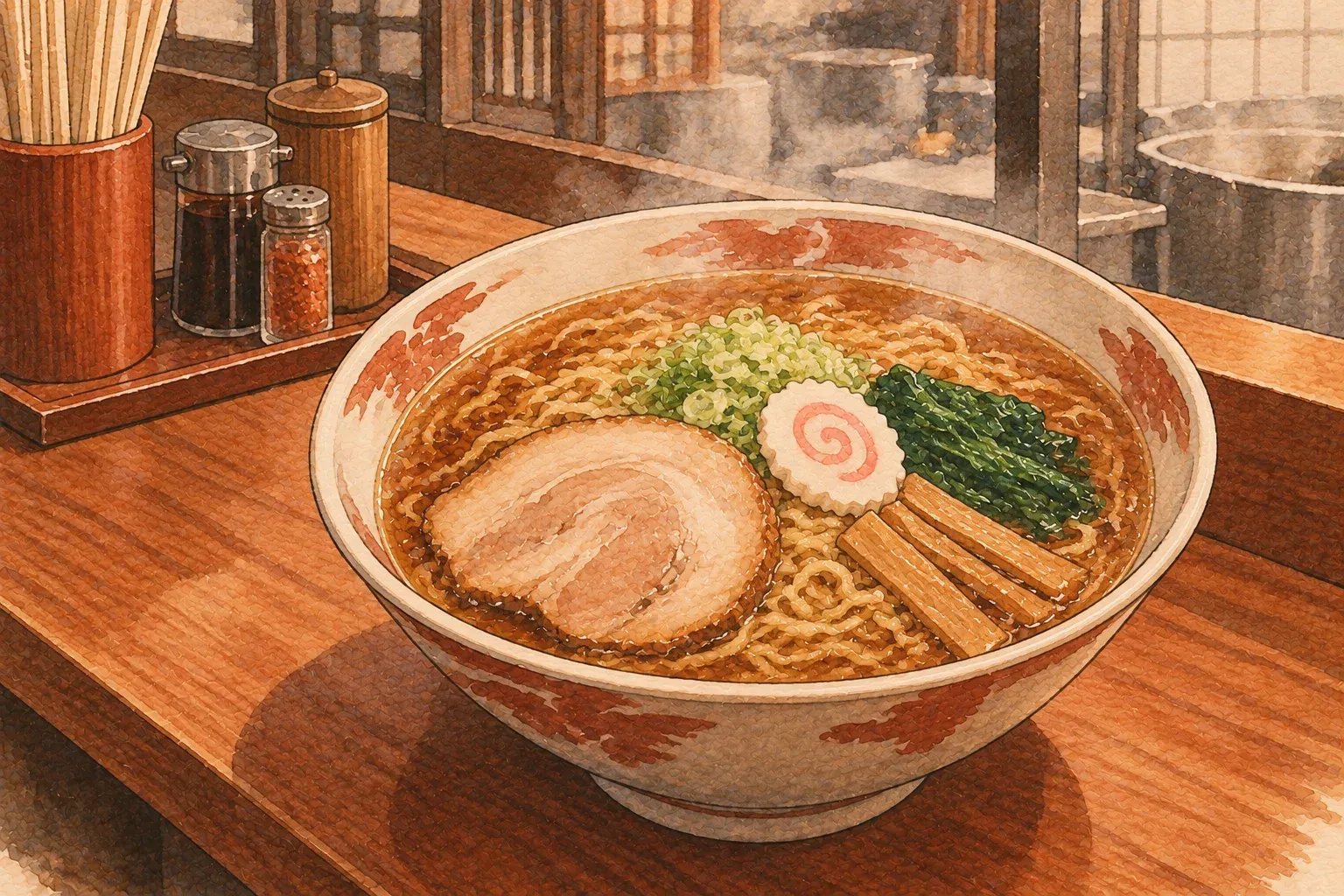
Every other lineage on this site is defined by how it departs from this one. The Tokyo bowl is the plain sentence of Japanese ramen: a clear brown soup that tastes of chicken, pork and dried fish, seasoned with soy sauce; a wavy yellow noodle; a slice of pork, a few strips of bamboo shoot, a pink-and-white swirl of fish cake, some spinach, a square of nori. In Tokyo it is still called chūka soba on the menus of the shops that have been making it longest, and that is also what the government calls it when it prices a bowl every month.
Where it came from
The Ramen Museum’s history of Tokyo ramen credits Rairaiken, opened in Asakusa in 1910 by Ozaki Kan’ichi, with spreading the dish. The museum is precise about the claim: not Japan’s first ramen shop — it lists a Hakodate “Nanking soba” advertisement from 1884 — but the shop that caused the first ramen boom, drawing 2,500–3,000 people a day at its peak, by the evidence of pre-war newspapers and books. Rairaiken closed in 1976; its descendants helped the museum recreate it from 2020 to 2025.
The name moved with the century. Nanking soba in early Meiji, shina soba from mid-Meiji, chūka soba after the war when the word shina fell out of use — and in the museum’s account the katakana word rāmen only took over after Nissin’s instant noodles in 1958. Shops that opened before the war still tend to say shina soba; shops that opened after it say chūka soba. It is the same bowl.
The postwar centre of gravity was Ogikubo, a station on the Chūō line in western Tokyo. Marucho opened there in 1947, run by five partners, and spun off so many apprentices that it became a family of shops in its own right; one of them, Yamagishi Kazuo, turned a staff meal into “special mori soba” at a Marucho-family shop in Nakano in 1955 — the best-documented account of where tsukemen began. Another account has the style shaped across the wider Marucho group of shops, and this site does not choose between them. Harukiya began as a stall in postwar Ogikubo and became a company in April 1949. In 1985 a television feature made “Ogikubo ramen” a national phrase and started the first ramen boom of the modern era; Itami Jūzō’s film Tampopo came out the same year.
What makes it Tokyo soy
The museum’s description of the old Tokyo bowl is the one to keep: clear stock from chicken carcasses and pork bones, simmered rather than boiled so it does not cloud, blended with a Japanese-style dashi — dried sardine, bonito flakes — and seasoned with soy. The museum’s judgement is that this postwar move, adding fish dashi to a Chinese stock, is what made ramen Japanese, and that “soy, wavy noodle, Japanese dashi” became the shape of the national dish.
The noodle is a medium wavy noodle; the museum gives Tokyo’s typical hydration as 20–24% and a portion as 130–150 g, so it is a drier, firmer noodle than the northern styles and thicker than Hakata’s.
Harukiya’s version, by the shop’s own account: a stock of dried sardine and shaved dried fish with vegetables and kelp, the house soy tare, and a noodle made in-house from several flours with kansui and a crimp worked in by hand.
On top: pork, bamboo shoot, naruto fish cake, spinach, nori. No system of hardness or oil — you order a bowl and you get the shop’s bowl.
Why Tokyo
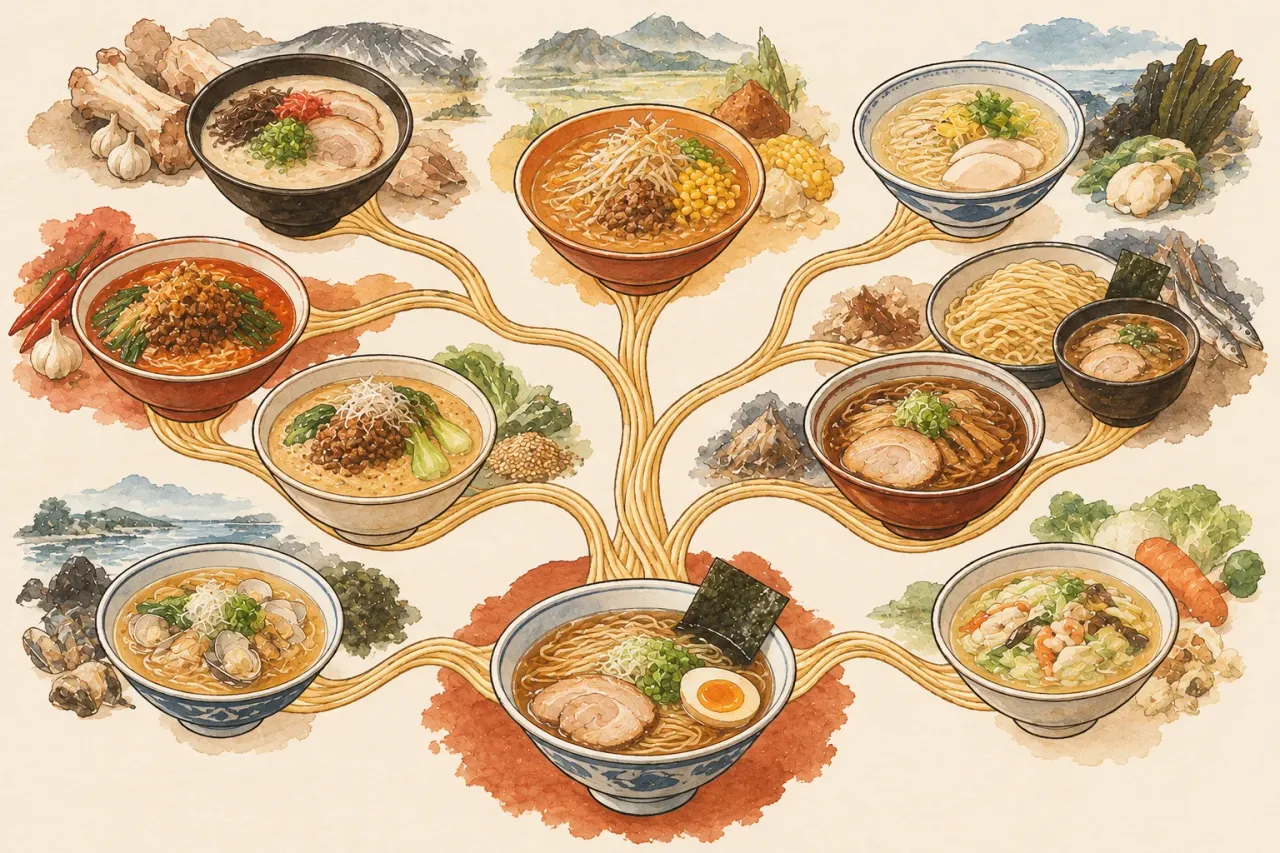
Because this is where the dish was assembled. Yokohama had Japan’s first Chinese restaurant in 1870 and its Chinatown was where the Kurume pioneer went to learn the craft; Tokyo had the customers. The 1923 earthquake scattered Tokyo and Yokohama ramen cooks across the country, which the museum lists as one reason the dish spread. After 1945 the black markets of Tokyo ran on cheap wheat noodles, and the western suburbs along the Chūō line — Ogikubo above all — filled with stalls that became the shops of the classic style.
The shops, and what they charge
Ramen ラーメン
- Survey
- ¥620 (≈ €3 / $4)中華そば(しょう油味)外食 1杯 · Aug 2026 · 特別区部
- Chains
- ¥420–¥748Plain soy-sauce ramen, one bowl · Hidakaya, Kourakuen, Gyoza no Ohsho · tax incl. · checked 2026-10-05
- Our guide figure
- ¥1,000 (≈ €6 / $6)From ¥800 for a plain bowl in Tokyo, about ¥1,000 once you add toppings · Oct 2026
The national survey item is literally this lineage: “chūka soba, eating out, one bowl”, central Tokyo, ¥620 including tax in September 2026. Around that figure:
- The chains — Hidakaya’s chūka soba at ¥420, Kourakuen’s at ¥490, both including tax as the chains list them — are the floor, and they are soy bowls in exactly this style.
- Harukiya, Ogikubo (上荻 1-4-6, two minutes from the station’s north exit, 18 seats, 11:00–21:20, no closing day, cashless only since August 2024). The menu has chūka soba in regular and large, wonton-men, chāshū-men, tsukemen and rice, and notes that prices may differ at other branches. The menus of Harukiya and Tsuta do not say whether tax is included, so their prices are not given here.
- Tsuta, Yoyogi-Uehara (西原 3-2-4 B1F, 11:00–15:00). Opened in Sugamo in January 2012; Bib Gourmand 2015; the first ramen shop in the world with a Michelin star, in the Tokyo 2016 guide, and starred for four editions; moved to Yoyogi-Uehara in December 2019; relaunched under a new owner in December 2022. The menu has shōyu soba and shio soba at one price and a lighter chicken chūka soba for less. It is not in the current guide.
The survey bowl, Harukiya and Tsuta, then, are the same dish at three altitudes: the bowl the city eats on a weekday, the postwar classic, and the modern “clear” style that put ramen in a restaurant guide.
How to eat it
There is nothing to learn, which is the point. Buy a ticket if there is a machine, sit, eat. At Harukiya the wonton-men is the house pride and the shop takes no cash. At Tsuta you will queue. Slurping is normal, and nobody will look up.
The country cousin: Sano
Two hours north in Tochigi, Sano makes the other famous clear soy bowl of eastern Japan, and its noodle is the attraction: hand-pressed under a green bamboo pole, very high in water (the museum gives 37–38% for the style and 45–50% for the hand-pressed version), flat and uneven. The museum dates it to a Chinese cook at a Western-style restaurant in the Taishō era, and in the early Shōwa years a town of about 50,000 had more than 150 ramen shops. The soup is clear chicken-based soy; the toppings are the Tokyo set; the water comes from a famous spring. Sano organised itself as a ramen town in 1988, when a trade paper counted 220 shops.
Getting there
Harukiya: JR Chūō line or Marunouchi subway line to Ogikubo, north exit, two minutes. Tsuta: Odakyū or Chiyoda line to Yoyogi-Uehara. JR changed its fares in March 2026 and I could not confirm the Tokyo–Ogikubo fare from an official page, so none is given here.
The Tokyo bowl away from Tokyo — and what Osaka means by chūka soba
This lineage is the one that got exported as “ramen” itself, so there is less to say about it changing abroad than about the city that resisted it.
Osaka was a late convert. Until the 1990s, by nippon.com’s account, Osaka was a dashi-and-udon city where “ramen does not catch on” was a saying; the change came in the 2000s, and the city is now described as the second most competitive ramen market after Tokyo. The household survey still shows the old pattern: Osaka city is 41st of 52 for spending on ramen eaten out (¥7,408 a year) and Kobe last at ¥4,810, against Tokyo’s ¥9,364 and Yamagata’s ¥21,695.
Osaka’s own chūka soba is thicker and plainer. The Takaida style, from the Takaida district on the Osaka–Higashiōsaka border, dates from the 1950s and is a very thick straight noodle in a soup where the soy sauce is the point; its origin shop, Kōyōken, began as a stall near Fuse station, and Sumiyoshi is the long-running reference. It is a different answer to the same question as Ogikubo, with the noodle doing the work the dashi does in Tokyo.
“Tokyo ramen” elsewhere. No public body describes how the Tokyo bowl is altered when it is served in other regions, so this page does not. What the Ramen Museum does say is that the postwar Tokyo formula — soy, wavy noodle, Japanese dashi — became the common inheritance of Japanese ramen. When a shop in Kyushu or Hokkaido serves a plain chūka soba, this is what it is reaching for.
What people get wrong
- “Tokyo ramen is tonkotsu.” Tokyo’s own bowl is clear soy. The white pork-bone soup arrived from Kyushu as a fashion in 1989.
- “Chūka soba is a different dish.” It is the postwar name for the same thing, kept by old shops and by the statisticians.
- “Ramen is traditional.” The oldest documented sale is 1884, the first boom 1910, the classic postwar style 1947–49, and the Michelin style 2012.
- “Harukiya is expensive for ramen.” For the shop that has made it since 1949, its price is in the middle of the market. The survey bowl, ¥620 including tax, is the price of an ordinary soy bowl, the kind the chains also sell.
Questions people ask
What is chūka soba?
Literally "Chinese noodles" — the postwar name for the dish, and still the name used on the menu at old Tokyo shops and in the government price survey. In Tokyo it means a soy-sauce bowl on a clear stock. It is the same food as ramen; the word is older.
Where is the classic Tokyo bowl?
Ogikubo, on the Chūō line, is the postwar home of the style. Harukiya has been there since 1949 and still serves chūka soba; Marucho, from 1947, is the family of shops that the accounts of tsukemen's origin all trace back to.
Why is the statistical price so low?
The government survey item is "chūka soba, eating out, one bowl" in central Tokyo, defined as a soy-sauce ramen eaten in the shop. It was ¥620 including tax in September 2026. That is the price of an ordinary bowl; the chains charge ¥420–490 including tax, and the specialist shops charge more.
Sources
- 新横浜ラーメン博物館「東京ラーメン」
- 新横浜ラーメン博物館「日本のラーメンの歴史」
- 新横浜ラーメン博物館 トリビア「支那そば、中華そば、ラーメンの違いは時代の違い」
- 新横浜ラーメン博物館 ニュースリリース「淺草 來々軒」
- 新横浜ラーメン博物館 店舗情報「東京 淺草 來々軒」
- 新横浜ラーメン博物館「佐野ラーメン」
- 荻窪中華そば春木屋 公式「春木屋の歴史」
- 春木屋 公式「メニュー紹介」
- 春木屋 公式「荻窪本店」
- 春木屋 公式「春木屋のこだわり」
- 現代ビジネス「丸長とつけ麺」
- 日本食糧新聞 地域ルポ「佐野らーめん会」
- Japanese Soba Noodles 蔦 公式 ABOUT
- 蔦 公式 MENU
- トラベルWatch「ミシュランガイド東京2016」発表
- 総務省統計局 小売物価統計調査(動向編)東京都区部 主要品目(2025年9月〜2026年9月)
- 日高屋 公式メニュー「中華そば」
- 幸楽苑 公式グランドメニュー「中華そば」
- nippon.com「大阪のラーメン」(うどん文化と2000年代の転換、高井田系)
- 関西ウォーカー「高井田系ラーメン」
- 総務省統計局 家計調査 品目別都道府県庁所在市ランキング 外食「中華そば」(2023〜2025年平均)
Prices are in Japanese yen. Conversions are approximate, at ¥177.30 to the euro and ¥158.23 to the US dollar as of 20 Oct 2026. Rates come from the European Central Bank, which publishes on working days only. Prices checked Oct 2026. What food costs in Japan →