
Kurume ramen: the cauldron that started Kyushu tonkotsu, and the soup that is never emptied
I have not been to every place in this guide. The figures below are taken from the sources listed at the end, with the date each one was published — not measured by me. Where I have been, the article says so.
Kurume is forty kilometres south of Fukuoka, a tyre-making city on the Chikugo river, and it is where the white pork-bone soup of Kyushu was — by one of the two accounts on record — made for the first time, by mistake. Its ramen is the heavy, smelly, honest original from which Hakata, Kumamoto and the rest descend, and the city calls itself the birthplace of tonkotsu ramen on its own municipal pages.
Where it came from
Kyushu’s first ramen stall was here. In 1937 Miyamoto Tokio, an udon seller who had learned Chinese noodle-making in Yokohama’s Chinatown in the mid-1930s, opened a stall called Nankin Senryō; the Ramen Museum’s timeline records it as the first ramen business in Kyushu, and notes that its original bowl was a soy-sauce ramen.
The white soup came ten years later. In 1947 a stall called Sankyū, run by Sugino Katsumi, began serving a cloudy pork-bone soup. The museum’s Kurume page tells the story the city tells: Sugino asked someone else to watch the fire while he was out, the soup was boiled too hard, and it came back white. The museum’s timeline calls Sankyū’s soup “the source of today’s Kyushu ramen”, and says its taste spread across the island through about a hundred apprentices and their apprentices. Hakata disagrees, citing Akanoren (1946); the museum records both and, on its Kumamoto page, says both began around 1947–48. The word tonkotsu ramen itself, the museum notes, is a coinage of the late 1970s — Kurume had just called it ramen.
What makes it Kurume ramen
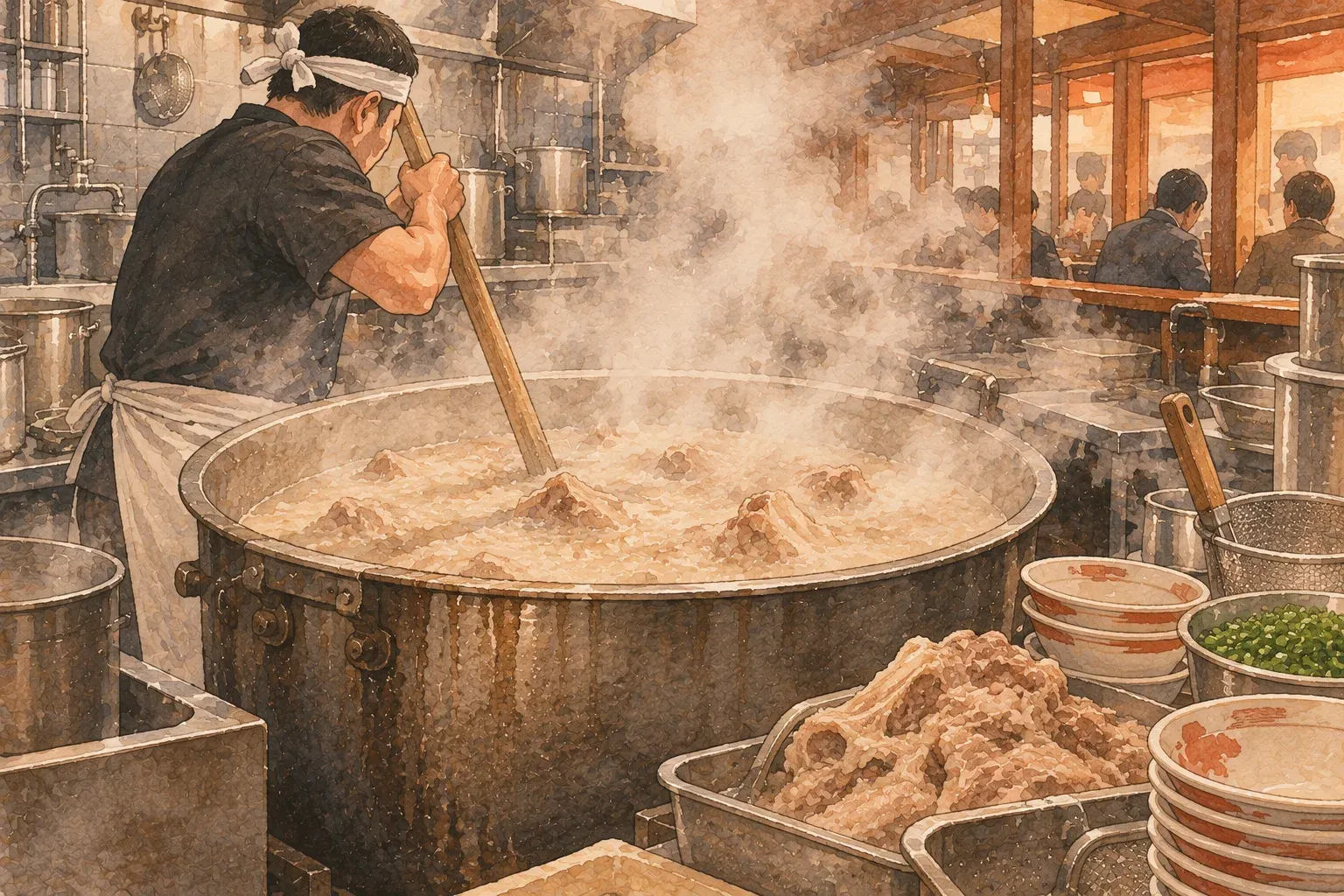
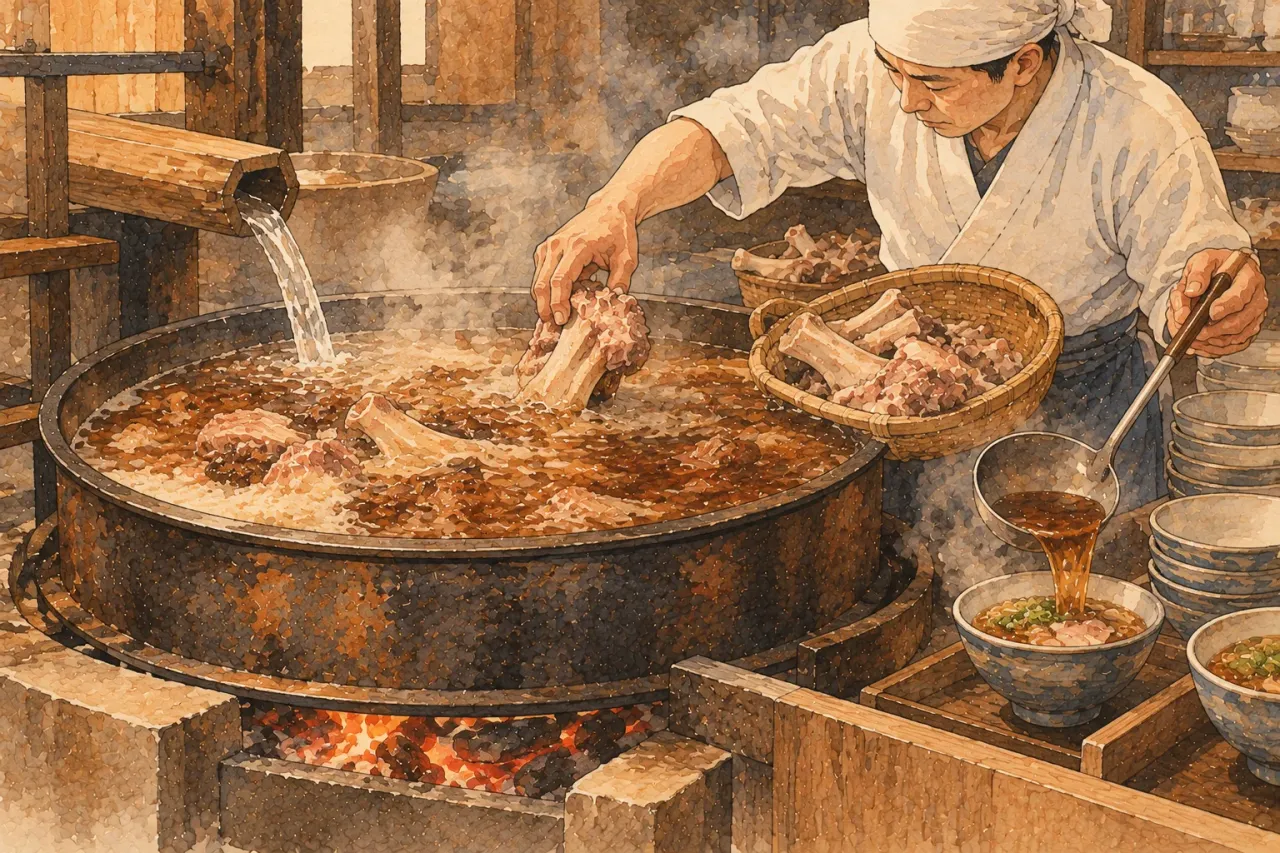
The soup. Thicker, richer and stronger-smelling than Hakata’s — the prefectural tourism federation’s phrase is “thick tonkotsu” — and cooked not in a stockpot but in a wide iron cauldron (hagama) over a fierce flame.
Yobimodoshi. The museum’s dictionary defines it: a stock kettle that is never emptied, from the day the shop opens and for decades after, to which new stock from a separate pot is added little by little. It attributes the technique to Taihō Ramen, opened as a stall in 1953 by Kōzuki Noboru, who worked it out by trial and error. The result is a soup with layers of age in it that a fresh pot cannot imitate.
The noodle. Straight and firm, a little thicker than Hakata’s thin strand.
No refill. Kurume mostly does not do kaedama; the museum says most shops here never adopted it. The refill was a Nagahama fish-market solution to a noodle that went soft in a minute, and Kurume’s noodle does not.
Why Kurume
The honest answer in the sources is: because the people who made it were here. A Yokohama-trained udon seller, an over-boiled pot, a stall-keeper who worked out how to keep a kettle alive for decades, and a city of apprentices who carried the method across Kyushu. The museum’s remark that Sankyū’s descendants number in the hundreds is the real geography of the style.
The shops, and what they charge
Ramen ラーメン
- Survey
- ¥620 (≈ €3 / $4)中華そば(しょう油味)外食 1杯 · Aug 2026 · 特別区部
- Chains
- ¥420–¥748Plain soy-sauce ramen, one bowl · Hidakaya, Kourakuen, Gyoza no Ohsho · tax incl. · checked 2026-10-05
- Our guide figure
- ¥1,000 (≈ €6 / $6)From ¥800 for a plain bowl in Tokyo, about ¥1,000 once you add toppings · Oct 2026
None of the founding Kurume shops publish prices on an official page this site could verify — Nankin Senryō and Sankyū have no official sites, and Taihō’s current menu was not confirmed — so no Kurume prices are given here. For the national picture, the chains above are the floor and the Hakata page has Ichiran’s station-by-station prices.
How to eat it
Order a bowl; there is no refill ritual to learn and usually no hardness question. Pickled mustard greens and sesame are on the counter at many shops. The soup is the point, and it is strong — the local word is koi — so a first bowl is better without extra garlic.
Kurume ramen away from Kurume
Kurume’s descendants are everywhere in Kyushu, which is the difficulty: what reaches Tokyo as “Hakata ramen” or “Kyushu tonkotsu” is as often the Kurume lineage as the Fukuoka one, filtered through the Tokyo reformulations the Hakata page describes. The two things that do not travel are the cauldron and the kettle. A yobimodoshi soup cannot be franchised, and shops outside Kurume that advertise it are advertising a method, not the pot. If a Tokyo bowl is sold as Kurume ramen and comes with a kaedama plate, it has been Hakata-ised on the way.
Getting there
Kurume is on the JR Kagoshima main line and the Nishitetsu Tenjin–Ōmuta line south from Fukuoka; the Kyushu Shinkansen also stops at Kurume. Taihō’s shops are in the city and its suburbs.
What people get wrong
- “Kurume is a suburb of Hakata ramen.” Hakata’s own tourism federation credits Kurume with the white-soup technique that Hakata later adopted.
- “The white soup was a recipe.” It was an accident, by the city’s own telling.
- “No kaedama means a small bowl.” It means a noodle that does not go soft.
Questions people ask
Did tonkotsu ramen start in Kurume or Hakata?
Both claims are on record at the Shin-Yokohama Ramen Museum. Its timeline credits Sankyū in Kurume (1947) as the source of today’s Kyushu ramen; another of its pages gives Akanoren in Hakata (1946). Its Kumamoto page says both began serving white soup around 1947–48. This site does not choose.
What is yobimodoshi?
A stock kettle that is never emptied. New stock from a second pot is added to the old a little at a time, for years or decades. The museum credits the method to Taihō Ramen in Kurume, founded as a stall in 1953.
Is there kaedama in Kurume?
Mostly not. The noodle refill is a Nagahama (Fukuoka) habit, born of the thin market noodle; Kurume’s noodle is a little thicker and the shops generally do not offer it.
Sources
Prices are in Japanese yen. Conversions are approximate, at ¥177.30 to the euro and ¥158.23 to the US dollar as of 20 Oct 2026. Rates come from the European Central Bank, which publishes on working days only. Prices checked Oct 2026. What food costs in Japan →