
Kitakata ramen: a town of 40,000 that eats noodles for breakfast
I have not been to every place in this guide. The figures below are taken from the sources listed at the end, with the date each one was published — not measured by me. Where I have been, the article says so.
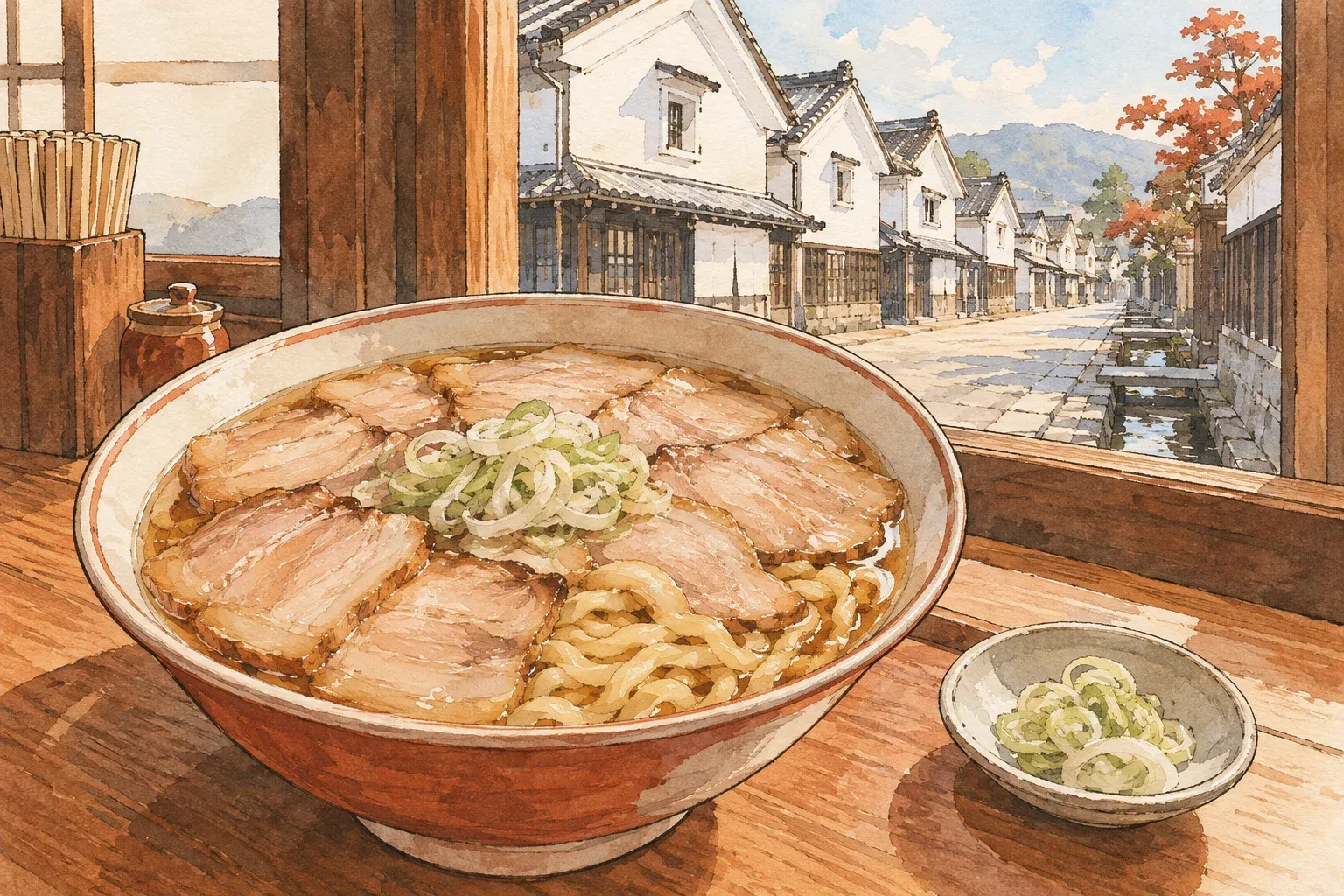
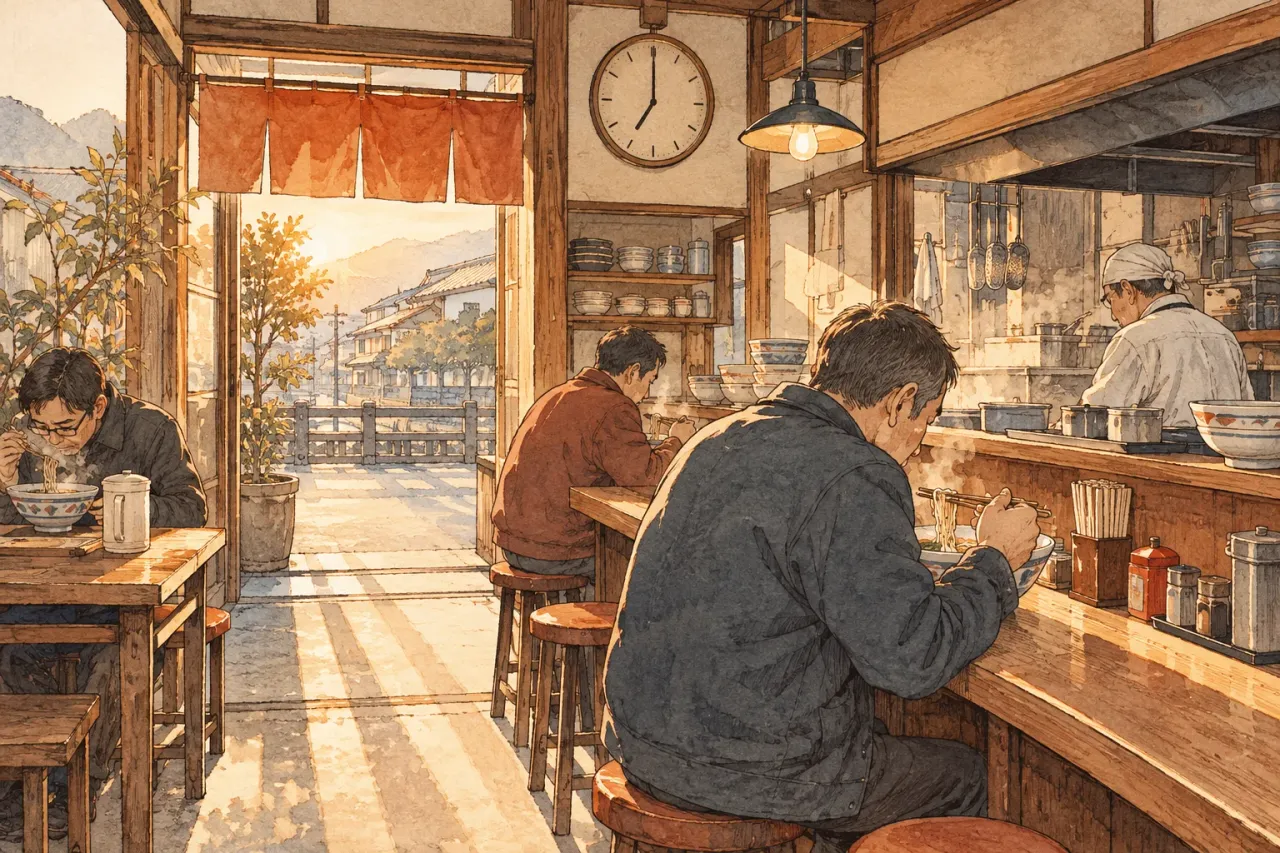
Kitakata is a small town in the Aizu basin of Fukushima, inland and snowy, known for its kura — the thick-walled storehouses that line its streets, more than 4,000 of them by the prefecture’s count. It has about 40,000 people and around 90 shops serving ramen. Some of them open at seven in the morning, and the people eating there are not tourists.
That is the whole story of Kitakata ramen in one scene: a quiet style, in a quiet town, eaten at an hour when the rest of Japan is having toast or rice.
Where it came from
The tourism bodies for the town and the region agree on the outline. In the late Taishō or early Shōwa years — the mid-1920s — a young man from China sold shina soba from a cart in the town. Local eateries learned the method from him, and the town’s noodle makers refined it into what is now called Kitakata ramen. The shop regarded as the origin was Genraiken, a Chinese restaurant founded by that man, Pan Qinxing (潘欽星), and it carried the word “original” (元祖) over its door until it closed in September 2025, after roughly a hundred years.
The style stayed local for half a century. What changed was the storehouses. From the 1970s Kitakata became known as a “town of kura”, and in 1983 it tied up with a travel-guide publisher. The ramen rode along: by the agriculture ministry’s account, 1984 is when Kitakata became the first town in Japan to attempt to revive itself through ramen. At the peak in the 1980s the town had a population in the 30,000s and some 120 ramen shops. In 1987, 40 shops and five noodle makers formed an association, the Rōmenkai; in 1988 a Tokyo company began a franchise chain under the Bannai name, which is how most of Japan outside Fukushima first ate Kitakata ramen.
What makes it Kitakata ramen
The noodle is the point. It is flat, wavy, thick, and made with a lot of water — the term used locally is jukusei takasui men, “aged high-water noodle”. The tourism federation describes it as containing noticeably more water than an ordinary noodle; the effect is a slippery, springy chew that no other regional style quite has. Compare it with the dry, hair-thin Hakata noodle and you are looking at the two ends of the Japanese spectrum.
The soup is light. Soy sauce is the base, though the shops vary widely, and salt and back-fat versions have become popular. Pork bone is the usual stock, with dried sardine at some shops. Bannai Shokudō, probably the best-known shop today, serves a clear salt-based bowl on a pork stock; Makoto Shokudō, until it closed in 2023, was the reference for the soy version.
The pork. Slices of slow-cooked pork belly. At Bannai Shokudō the signature bowl is the niku soba, in which the pork covers the surface so completely that you cannot see the noodles.
Why Kitakata
Two things, both to do with the storehouses. The first is water: the town sits on soft water from the Iide mountains (the tourism association cites a hardness of 13, among the softest in Japan), which is why it had brewers of sake, soy sauce and miso in the first place — and good soy sauce and good water are most of a Kitakata soup. The second is the morning. The town has long had the habit of eating ramen early, and the tourism association describes asa-rā as a local breakfast first and a tourist attraction second; JR East’s campaigns made it famous, but did not invent it.
The density is real but the superlative is not sourced. “Most ramen shops per head in Japan” is a claim you will see everywhere; I could not find a public body that states it, so this page says only what the region’s tourism office says: about 90 shops for a town of roughly 40,000–50,000 people.
The shops, and what they charge
Ramen ラーメン
- Survey
- ¥620 (≈ €3 / $4)中華そば(しょう油味)外食 1杯 · Aug 2026 · 特別区部
- Chains
- ¥420–¥748Plain soy-sauce ramen, one bowl · Hidakaya, Kourakuen, Gyoza no Ohsho · tax incl. · checked 2026-10-05
- Our guide figure
- ¥1,000 (≈ €6 / $6)From ¥800 for a plain bowl in Tokyo, about ¥1,000 once you add toppings · Oct 2026
Those are national figures. In Kitakata itself:
- Bannai Shokudō (細田 7230). Open 07:00 to 18:00 (last orders 17:50), closed Thursdays and some Wednesdays. Its prices are not published online, so none are given here.
- Genraiken closed in September 2025. Makoto Shokudō closed in September 2023. Both were still trading when most English-language guides were written; check before you plan a day around a named shop.
- Kitakata Ramen Bannai (the chain). Operated by Menshoku Co. of Tokyo, which traces its recipe to Bannai Shokudō; the first franchise shop opened in 1988. The chain’s menu lists the basic Kitakata ramen with negi, chāshū and wonton versions, rice, gyōza and a large portion at extra cost, and notes that some branches do not carry every item. The menu does not say whether tax is included, so prices are not given here.
How it is eaten
Early. Bannai Shokudō opens at seven, and until it closed Makoto Shokudō did too. The niku soba — the pork-covered bowl — is the thing to order at Bannai Shokudō; at the chain the same idea is sold as yakibuta rāmen. Beyond that there is no system to learn: no hardness scale, no refill, no order form. You sit, you order, you eat. If you want the town’s version of the experience, go before nine.
Nearby, and different
Fukushima has a second ramen town, and Yamagata a third.
- Shirakawa, in southern Fukushima, makes hand-cut wavy noodles using soba-making technique, in a clear soy soup on chicken and pork stock. Its tourism association dates the lineage to a shop opened in 1887 and a hand-pulled-noodle shop in 1921, and counts more than 100 shops around the city.
- Yonezawa, across the mountains in Yamagata, uses a thin wavy noodle, high in water and hand-kneaded after resting, in a light soy soup on chicken and dried-sardine stock; guidebooks count more than 100 shops there too.
The three share the light soy soup and the wavy noodle. What separates Kitakata is the sheer width of the noodle, the salt-and-pork alternative, and the morning.
Getting there
Kitakata is on JR’s Ban’etsu West line, which runs from Kōriyama on the Tōhoku Shinkansen through Aizu-Wakamatsu to Kitakata. In the October 2026 timetable the morning trains out of Kōriyama mostly terminate at Aizu-Wakamatsu, where you change; the direct services to Kitakata (including the Akabeko limited express and the Aizu Satono rapid) leave Kōriyama around 10:00. If the point is morning ramen, that means either staying the night before in Kitakata or Aizu-Wakamatsu, or accepting a late-morning bowl — the shops are still open. I have not been able to confirm the fare and journey time from an official page, so none are given here.
Kitakata ramen away from Kitakata
Outside Fukushima, “Kitakata ramen” almost always means the Bannai chain, and the distinction matters.
The chain and the shop are different businesses. Kitakata Ramen Bannai is run by Menshoku Co. of Tokyo. Its first shop, called Kura, opened under the railway at Shinbashi in Tokyo in 1987; the chain proper began in December 1988 with a shop in Tōmi, Nagano. It has about 90 shops (79 in Japan, 11 abroad, as of June 2026), franchised at a 3% royalty, and sells its own noodles, soup and pork to franchisees through a wholesale arm. The chain says it inherited the taste of Bannai Shokudō in Kitakata and uses a hand-kneaded, aged, high-water noodle; it does not say where the noodles are made or whether the soup is cooked in each shop. Its basic bowl is listed at the same price for every branch.
The town’s association does not certify anyone outside the town. The Rōmenkai, founded in March 1987, describes itself as the association of the roughly 100 ramen shops in Kitakata city. Its member list has 31 shops, all in Kitakata — Bannai Shokudō among them — and no mechanism for shops elsewhere to join. “Kitakata ramen” on a sign in Tokyo is a description, not a certification.
The noodle is the easiest thing to check. The Ramen Museum puts ordinary ramen noodles at around 30% water and Kitakata’s above 40%; the association describes a flat noodle about 4 mm wide. A “Kitakata” bowl with a thin or dry noodle is not pretending very hard.
Who eats it. In the government household survey (2023–25 average), Fukushima city ranks sixth in the country for spending on ramen eaten out (the survey’s item is chūka soba, which also counts yakisoba and sara udon, and “eaten out” includes delivery and takeaway), at ¥13,031 a year per household, and Yamagata, over the mountains, is first at ¥21,695. Tōhoku eats ramen the way the rest of Japan eats udon.
What people get wrong
- “It is a tourist dish.” The morning habit belongs to the town. Tourism came after the storehouses, in the 1980s.
- “The famous shops are all still there.” Two of the three names in every guide have closed since 2023.
- “Kitakata ramen is the Bannai chain.” The chain is a Tokyo franchise from 1988; the shop it is named after is in Kitakata and opens at seven.
- “It is always soy sauce.” The best-known shop today serves salt.
- “It has the most ramen shops per capita in Japan.” Often said, never sourced. About 90 shops for 40,000–50,000 people is remarkable enough without the superlative.
Questions people ask
What is "asa-rā"?
Morning ramen. In Kitakata several shops open at 7 a.m. and local people eat ramen for breakfast. It began as a local habit and was later promoted by JR East's tourism campaigns; now visitors come for it too.
Is Kitakata ramen the same as the Bannai chain?
No. Kitakata Ramen Bannai is a Tokyo-based franchise started in 1988 that traces its recipe to Bannai Shokudō in Kitakata. The shop in Kitakata is the original; the chain is a separate company.
Can I still eat at the shop where it started?
No. Genraiken, the Chinese restaurant regarded as the origin of Kitakata ramen, closed in September 2025 after about a century. Makoto Shokudō, long the reference for the soy-sauce style, closed in September 2023.
Sources
- 総務省統計局 家計調査年報 付録8 収支項目分類表(「中華そば」「外食」)
- 東北観光推進機構「旅東北」喜多方ラーメン
- 喜多方観光物産協会「喜多方ラーメン」
- 喜多方ラーメン案内所(喜多方観光物産協会)坂内食堂
- nippon.com「喜多方ラーメン」
- 農林水産省 aff 2024年12月号「知るほどに好きになる!ラーメン今昔物語」
- 現代ビジネス「このままだと日本三大ラーメンが死語に…」
- 東洋経済オンライン「喜多方ラーメン『源来軒』が101年の歴史に幕」
- 喜多方ラーメン坂内 公式メニュー
- 株式会社麺食(喜多方ラーメン坂内の運営会社)
- 喜多方市 公式サイト(人口)
- 福島県「【喜多方市】蔵のまち」
- 白河観光物産協会「白河ラーメン」
- JR東日本 郡山駅 磐越西線 時刻表(2026年10月)
- 喜多方ラーメン坂内「坂内のこだわり」(1988年の1号店、麺)
- 株式会社麺食 FC募集・卸売事業
- 蔵のまち喜多方老麺会「老麺会とは」「加盟店一覧」
- 新横浜ラーメン博物館「喜多方ラーメン」(加水率)
- 総務省統計局 家計調査 品目別都道府県庁所在市ランキング 外食「中華そば」(2023〜2025年平均)
Prices are in Japanese yen. Conversions are approximate, at ¥177.30 to the euro and ¥158.23 to the US dollar as of 20 Oct 2026. Rates come from the European Central Bank, which publishes on working days only. Prices checked Oct 2026. What food costs in Japan →