
Yokohama iekei ramen: one shop in 1974, three hundred successors, and a bowl you order in three settings
I have not been to every place in this guide. The figures below are taken from the sources listed at the end, with the date each one was published — not measured by me. Where I have been, the article says so.
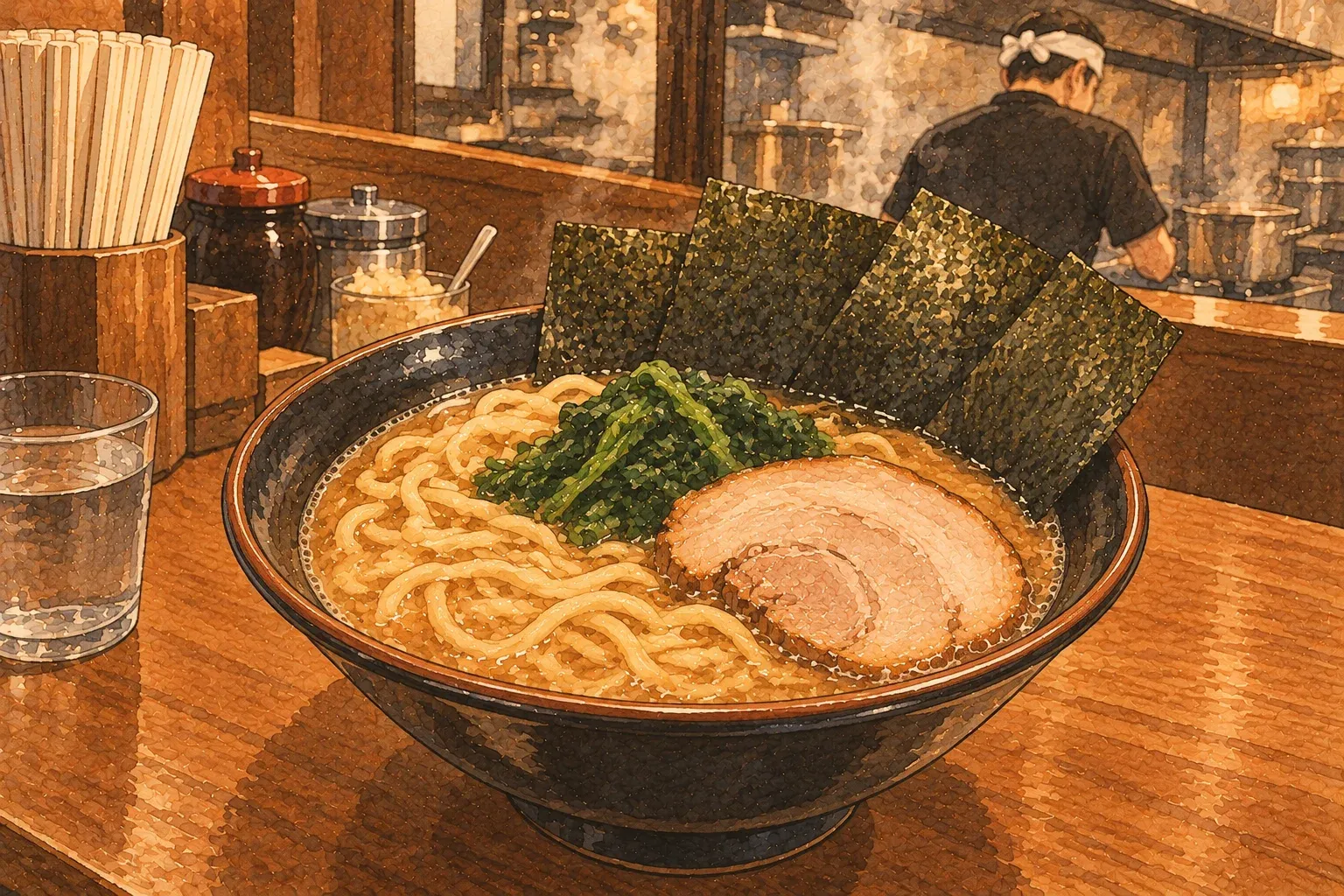
If you have eaten ramen in a Japanese suburb in the last decade, there is a fair chance it was this: an opaque brown soup that is both pork-bone and soy sauce, a yellow slick of chicken oil, thick short noodles, a clump of spinach, three sheets of nori standing against the rim, and a bowl of rice on the side. Iekei — “the -ya lineage” — began as one man’s shop in a Yokohama suburb in 1974 and is now the most copied ramen format in the country, copied so widely that the lineage’s own members argue about who belongs.
Where it came from
In 1974 Yoshimura Minoru opened a small ramen shop in Shin-Sugita, a suburb on the south side of Yokohama. His own account is plain: a rich soup on pork bone and chicken, with a house soy tare. The Ramen Museum’s timeline records the same year and calls the shop the origin of iekei. Yoshimuraya moved to the west exit of Yokohama station in 1999 and into its own two-storey, 30-seat building nearby in March 2023; it serves about 1,500 people a day and, by its own count, some 300 people have trained in its kitchen as apprentices or apprentices’ apprentices.
The name came later and from outside. Shops opened by people who had trained at Yoshimuraya took names ending in -ya (家) — Rokkakuya, Kondōya — and, in the museum’s words, the term “iekei” was born on the internet among enthusiasts to describe the family. Yoshimura’s own view, on his website: it just came to be called that.
What makes it iekei
The soup is tonkotsu-shōyu: pork bones (the museum notes vegetables and fruit go in too) boiled hard until cloudy, seasoned with soy sauce, and finished with chi-yu, chicken oil — the yellow layer on top, which the museum’s dictionary describes as rendered chicken fat added in small quantity for aroma and sweetness. It is thicker and saltier than Kyushu tonkotsu, and it is seasoned with soy, which Kyushu’s is not.
The noodle is thick, short and straight — Yoshimuraya’s own words are “thicker and shorter” — the opposite of Hakata’s hair-thin strand. A thick noodle in a heavy soup does not go limp, so there is no refill culture; the second course is rice.
On top: sliced pork, spinach, and sheets of nori — three in the standard bowl, by the trade-press description; Yoshimuraya’s chāshū-men carries three slices of pork in the regular size and five in the medium and large. On the counter: grated ginger, garlic, vinegar, chilli-bean paste.
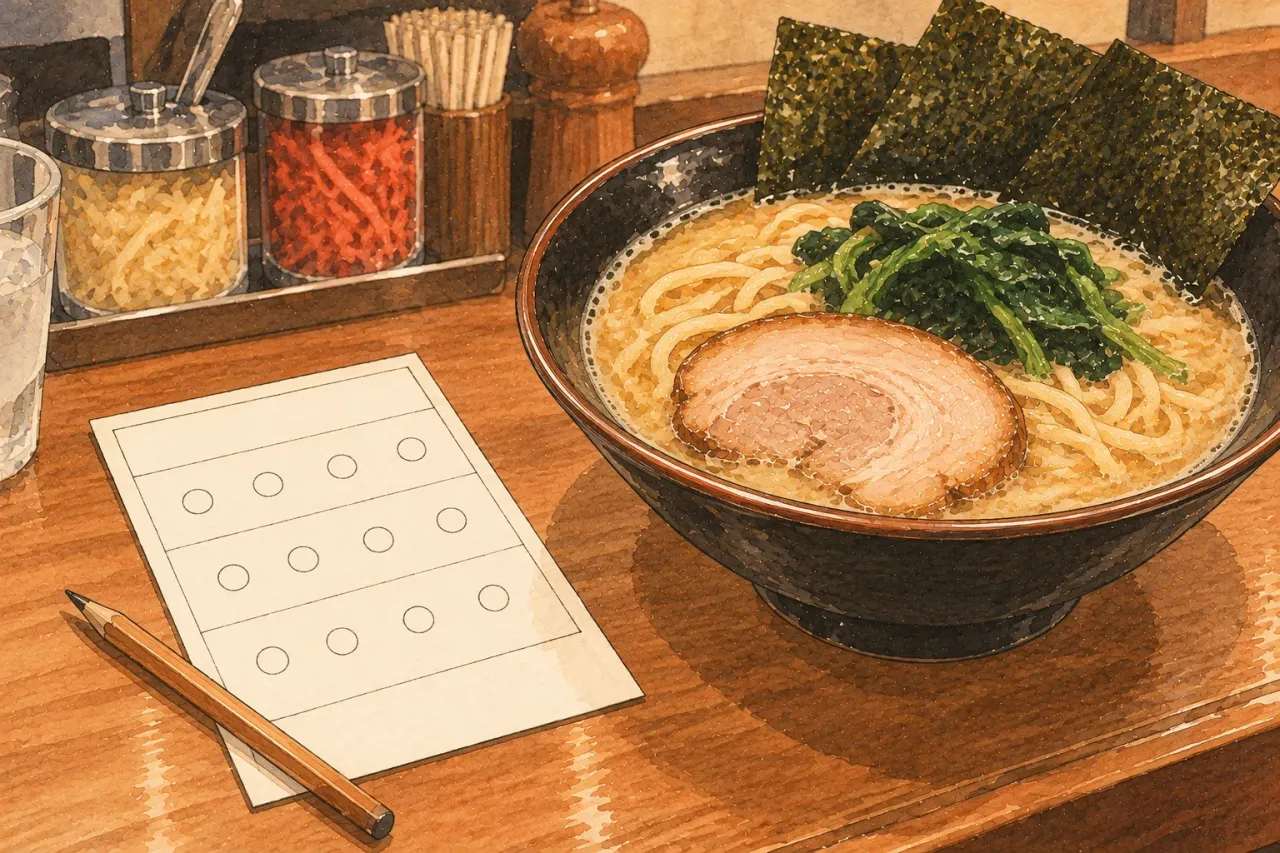
The three settings. Yoshimuraya’s menu asks for the bowl in three dimensions — noodle: soft, normal, hard; oil: little, normal, more; flavour: light, normal, strong — and every shop in the lineage asks the same three questions. Say futsū three times and you get the house bowl.
Why Yokohama
There is no fish market or climate story here; iekei is a case of one shop and its apprentices. What Yokohama supplied was a port city of commuters and a tradition of taking in food from outside — Japan’s first Chinese restaurant opened here in 1870, by the museum’s timeline — and, after 1994, the Ramen Museum in Shin-Yokohama, where Rokkakuya was one of the eight opening shops. Rokkakuya left the museum in 2003 and closed its main shop in 2017; in April 2024 it returned to the museum as “Rokkakuya 1994+”, the first iekei there in 21 years.
Who counts
This is where the lineage gets political, and the categories below are the ones the trade uses.
- Chokkei (直系), the direct line. Yoshimuraya’s definition is strict: a shop whose owner trained at Yoshimuraya and opened and runs a successful iekei shop. Finishing the apprenticeship is not enough. On the date of this page the official list has five shops: Sugitaya (Shin-Sugita, Yokohama), Hajimeya (Uozu, Toyama), Jōetsuya (Jōetsu, Niigata), Atsugiya (Atsugi) and Takamatsuya (Takamatsu). Sugitaya, opened in September 1999 back in Shin-Sugita, is “direct-line shop number one”, serves about 500 bowls a day, and opens at five in the morning.
- The Honmokuya–Rokkakuya branch. The “three great houses” of the early days were Yoshimuraya, Honmokuya and Rokkakuya; Rokkakuya’s founder had trained at Yoshimuraya and managed Honmokuya before opening in 1988. This branch and its descendants are iekei by any reasonable definition but not chokkei.
- Ichi-kei (壱系). Shops descended from Ichirokuya, opened in Isogo in 1992 in admiration of Yoshimuraya but without training there. Fans call this the “Ichi line”, and shops with no connection at all “inspired”.
- Shihon-kei (資本系), the capital line. The trade press’s term for iekei run by large restaurant companies. Machida Shōten, started in Machida in 2008 and run by Gift Holdings, and Ichikakuya, run by Garden Co. (listed in Tokyo in 2024, more than 100 Ichikakuya shops and 212 in the group as of May 2026), are the two names you will see from Hokkaido to Kyushu. The museum’s summary, written 25 years after 1974, was already “several hundred shops”.
None of this changes what is in the bowl much. It changes who is allowed to put the word iekei on the sign, and in Yokohama people care.
The shops, and what they charge
Ramen ラーメン
- Survey
- ¥620 (≈ €3 / $4)中華そば(しょう油味)外食 1杯 · Aug 2026 · 特別区部
- Chains
- ¥420–¥748Plain soy-sauce ramen, one bowl · Hidakaya, Kourakuen, Gyoza no Ohsho · tax incl. · checked 2026-10-05
- Our guide figure
- ¥1,000 (≈ €6 / $6)From ¥800 for a plain bowl in Tokyo, about ¥1,000 once you add toppings · Oct 2026
Those are national figures for a basic bowl. In the lineage:
- Yoshimuraya (岡野 1-6-4, Yokohama station west side; 11:00–20:00, closed Mondays). Ramen and chāshū-men in three sizes, with egg, extra nori, rice and cabbage charged separately. Prices were revised on 1 September 2026, and the shop’s own note is that the website figures are a guide and the ticket machine is the truth.
- Sugitaya (新杉田 3-5-101; 05:00–22:00, closed Sundays). Four minutes from JR Shin-Sugita. Prices are not published online.
- Machida Shōten. The menu lists ramen, egg ramen, negi ramen, chāshū-men and a “MAX” bowl, and does not list rice. Neither its menu nor Yoshimuraya’s says whether tax is included, so their prices are not given here.
- Ichikakuya. No standard price list is published. The chain’s promotions give a floor: its monthly “Ichikakuya Day” price went to ¥760 including tax from January 2026, and anniversary offers have discounted the basic bowl further.
How to order it
- Buy a ticket at the machine. Ramen, size, and rice if you want it.
- Hand it over and answer three questions — noodle, oil, flavour. Futsū for all three is the house bowl; katame, ōme, koime (hard, more oil, strong) is the enthusiast’s order and not a good first one.
- Rice is the second course, not a side. Soaking a sheet of nori in the soup and folding it round a mouthful of rice is a common way to eat it, though no shop’s official page describes it.
- The counter condiments are for the second half of the bowl: ginger lightens it, vinegar cuts the fat, garlic makes it heavier.
Getting there
Yoshimuraya is a few minutes’ walk from Yokohama station’s west exit. From Haneda Airport, Keikyū’s airport line runs direct to Yokohama in 28 minutes, and to Shinagawa for Tokyo in 14 minutes. For Sugitaya, Keikyū’s Sugita station is next to JR Shin-Sugita, four minutes from the shop. Keikyū’s own site lists the fares.
Iekei away from Yokohama
Iekei is the one lineage where the version you meet in Tokyo, Osaka or Sendai is more likely to be a chain’s than a shop’s, and the two are made differently.
The chains cook in factories. Gift Holdings, which runs Machida Shōten, says plainly that it makes its noodles, pork and soup in its own plants and supplies them to directly run, produced and franchised shops: five noodle factories (Hiratsuka and Yokohama in Kanagawa, Kamisu in Ibaraki, Kuwana in Mie, and Tamba-Sasayama in Hyōgo, opened in 2020 to serve the west), two soup factories and a pork factory. It lists 45 shops in Tokyo and 11 in Osaka prefecture, with more in Hyōgo, Kyoto and Nara. Ichikakuya, the other big name, uses a noodle made to its specification by a contract maker and had no shops in Kansai on the date of this page. Yoshimuraya, by contrast, says its owner starts the stock at five every morning, and warns that its prices move with the market and the judgement of each shop.
There is no rule about the name. Yoshimuraya defines only chokkei, its five direct-line shops. Nobody defines “iekei”, and the Ramen Museum notes that shops with no connection at all have adopted the -ya suffix. Teikoku Databank credits “so-called iekei” and heavy-tonkotsu chains with most of the growth in the ramen market’s shop count in 2024.
Prices, same bowl, different places. Yoshimuraya says its prices move with the market and each shop’s judgement; Machida Shōten’s list price “may differ by shop”; Ichikakuya publishes only its promotional prices, ¥760 including tax on Ichikakuya Day.
Who eats it. Yokohama ranks 25th of 52 cities in the household survey for ramen eaten out, at ¥8,335 a year — a little under the national average. Iekei conquered the country from a city that is not especially a ramen city.
What people get wrong
- “Iekei is tonkotsu.” It is tonkotsu-shōyu; the soy and the chicken oil are the point. The word “tonkotsu ramen” for the white Kyushu bowl is itself a 1970s coinage.
- “Rice is free.” Not at the original, where it is a ticket on the machine. Free rice is a chain promotion at some branches, some of the time.
- “Any shop called -ya is iekei.” The founder recognises five direct-line shops. The hundreds of others range from faithful to inspired, and the chains are a category of their own.
- “It is old.” 1974. The founder is still alive and his shop still has a queue.
Questions people ask
What does "iekei" mean?
Literally "the -ya lineage". Shops that trained under Yoshimuraya named themselves with the suffix -ya (家), as in Rokkakuya and Kondōya, and fans on the early internet called the whole group iekei. The founder himself says the name just stuck.
Is iekei a tonkotsu ramen?
It is tonkotsu-shōyu — a pork-bone stock seasoned with soy sauce and finished with chicken oil. It is thicker and saltier than Kyushu tonkotsu and is eaten with rice, not a noodle refill.
Is rice free at iekei shops?
Not as a rule. At the original Yoshimuraya rice is a paid item on the ticket machine. Some chains run free-rice promotions at some branches; treat it as an offer, not a custom.
Sources
- 家系総本山 吉村家 公式(トップ・お品書き・家系総本山とは・直系店舗)
- 吉村家 公式「お品書き」
- 吉村家 公式「直系店舗のご案内」
- 吉村家 公式「直系店 杉田家」
- 新横浜ラーメン博物館「横浜ラーメン」
- 新横浜ラーメン博物館「ラーメン大辞典」(家系)
- 新横浜ラーメン博物館「日本のラーメンの歴史」
- ヨコハマ経済新聞「家系ラーメンの元祖『吉村家』が移転」
- ヨコハマ経済新聞 特集「王者『吉村家』を人気店、新業態店が猛追」
- All About NEWS「ラー博に家系ラーメンが復活!六角家1994+」
- 東洋経済オンライン 家系ラーメン記事
- Jタウンネット「壱六家・壱系」
- 日本食糧新聞「資本系ラーメンの台頭」
- 町田商店 公式メニュー
- 株式会社ガーデン プレスリリース(壱角家の店舗数)
- 壱角家「壱角家の日」告知
- 京急電鉄 羽田空港第1・第2ターミナル駅からの運賃一覧
- 京急電鉄 羽田空港アクセスガイド(所要時間)
- ギフトホールディングス 事業紹介(自社工場)・沿革
- 町田商店 店舗検索(東京都・大阪府)
- 壱角家 公式(麺・店舗)
- 帝国データバンク 全国「ラーメン店」市場動向調査(2024年度)
- 総務省統計局 家計調査 品目別都道府県庁所在市ランキング 外食「中華そば」(2023〜2025年平均)
Prices are in Japanese yen. Conversions are approximate, at ¥177.30 to the euro and ¥158.23 to the US dollar as of 20 Oct 2026. Rates come from the European Central Bank, which publishes on working days only. Prices checked Oct 2026. What food costs in Japan →