Honshu hot springs: five regions, a volcanic front, and hot water where there is no volcano at all
I have not been to every place in this guide. The figures below are taken from the sources listed at the end, with the date each one was published — not measured by me. Where I have been, the article says so.
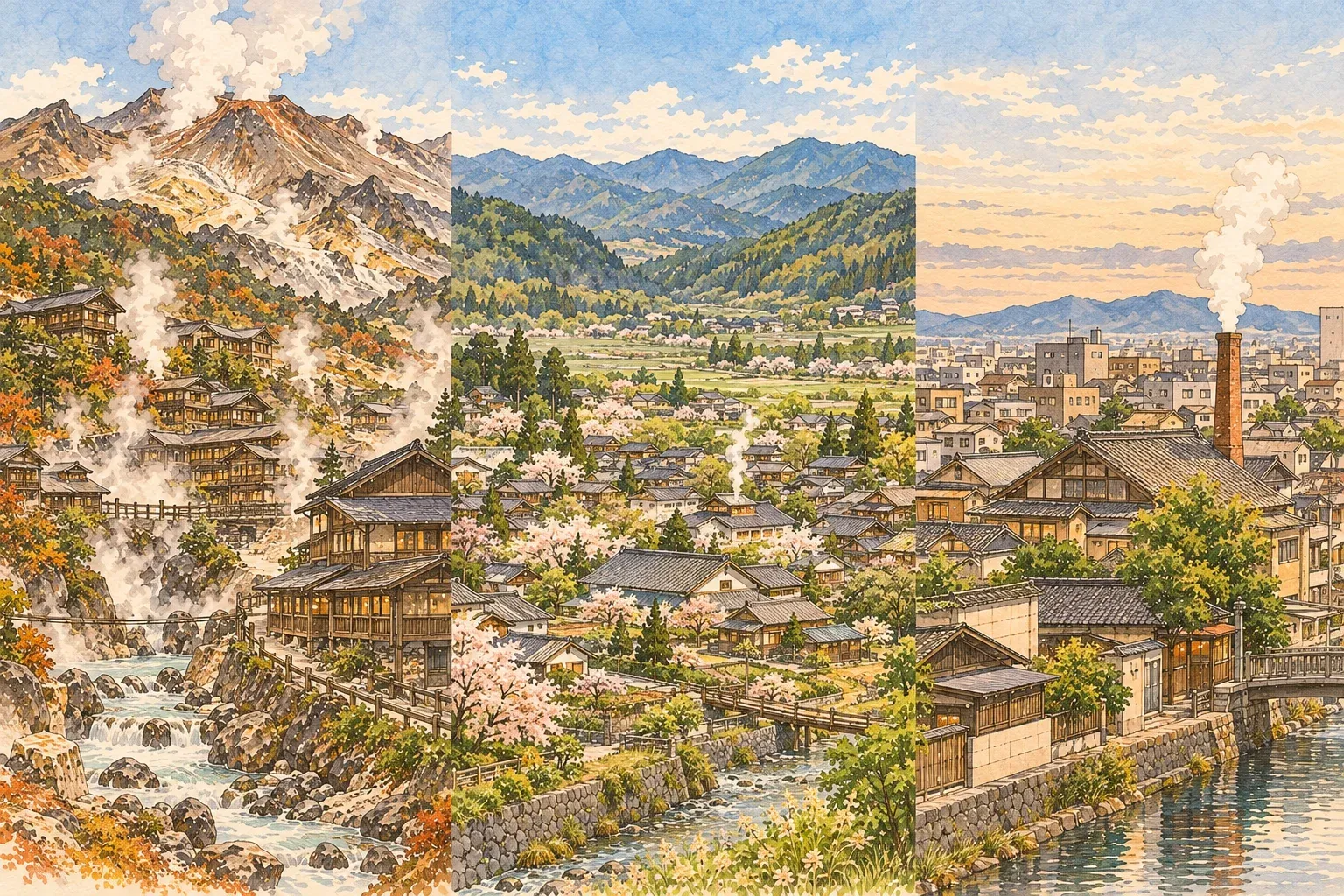
Honshu, the main island, holds most of Japan’s hot spring towns, and it holds them for more than one reason. Along a line of volcanoes the heat source is close to the surface. In parts of Kansai there is no active volcano at all and the water is still hot. Under Tokyo, wells hundreds of metres deep bring up ancient seawater warm enough to count as onsen. This page takes the island region by region: what the official figures say, what makes the water, how the best-known towns began, and how they are used. The town guides go deeper; for how to read a spring’s name and the sign on the wall, start from the onsen overview.
Where the hot springs are
The environment ministry’s yearly table of hot spring use, for fiscal 2024 (as of the end of March 2025), lists every prefecture. It counts an onsen area only where there is somewhere to stay, and it marks overnight stays as a reference value. It has no ranking column; the comparisons below are mine, made from its figures.
- Springs. The most on Honshu are in Shizuoka (2,185), fourth in Japan after Oita, Kagoshima and Hokkaido. Then Aomori (1,089), Nagano (955), Fukushima (799) and Miyagi (740).
- Onsen areas. Nagano has 193, second in Japan after Hokkaido. Then Niigata (135), Fukushima (122), Aomori (120) and Shizuoka (118).
- Overnight stays. Shizuoka (10,576,818) is second in Japan after Hokkaido. Then Nagano, Gunma, Kanagawa and Hyogo.
Adding up the 34 Honshu prefectures gives 2,133 onsen areas, 14,879 springs and 90,144,920 overnight stays, against national totals of 2,839, 27,899 and 125,414,300.
By region (my grouping, not the ministry’s; Mie is counted with Chubu):
- Tohoku — 533 onsen areas, 4,049 springs. Most areas in Fukushima, Aomori and Akita; most springs in Aomori.
- Kanto — 387 areas, 2,280 springs, and 21,566,569 stays, led by Gunma, Kanagawa and Tochigi.
- Chubu (Hokuriku, Koshinetsu and Tokai) — 786 areas, 5,490 springs, 36,840,252 stays. The largest block on all three counts, led by Nagano, Niigata and Shizuoka.
- Kansai — 243 areas, 1,431 springs. Hyogo and Wakayama lead.
- Chugoku — 184 areas, 1,629 springs. Hiroshima, Shimane and Yamaguchi have the most areas.
More springs does not mean better springs. A spring count includes springs in use and not in use.
Why here
The volcanoes. The Japan Meteorological Agency defines an active volcano as one that has erupted within roughly the last 10,000 years or is now actively steaming, and counts 111 in Japan. Its list puts active volcanoes in Tohoku (from Osorezan and Iwakisan down through Zao, Bandai and Nasu), in Kanto (Akagi, Haruna, Kusatsu-Shirane, Asama, Hakone, the East Izu group, Fuji, and the Izu islands south of Tokyo), in Chubu (Niigata-Yakeyama, Myoko, Yakedake, Norikura, Ontake, Hakusan and others) and in Chugoku (Sanbesan in Shimane and the Abu group in Yamaguchi). It lists none in the Kansai prefectures, and none in Tottori, Okayama or Hiroshima.
The volcanic front. The government’s Headquarters for Earthquake Research Promotion explains that the line joining Japan’s active volcanoes, the volcanic front, runs from the Kurils across Hokkaido, down the middle of Tohoku to the western edge of Kanto, and on through the Izu peninsula and islands. It runs parallel to the ocean trench, and there are almost no active volcanoes on the Pacific side of it. Water squeezed out of the sinking Pacific plate lowers the melting point of the rock above and makes magma. That page does not discuss hot springs, so this page does not map onsen along the front.
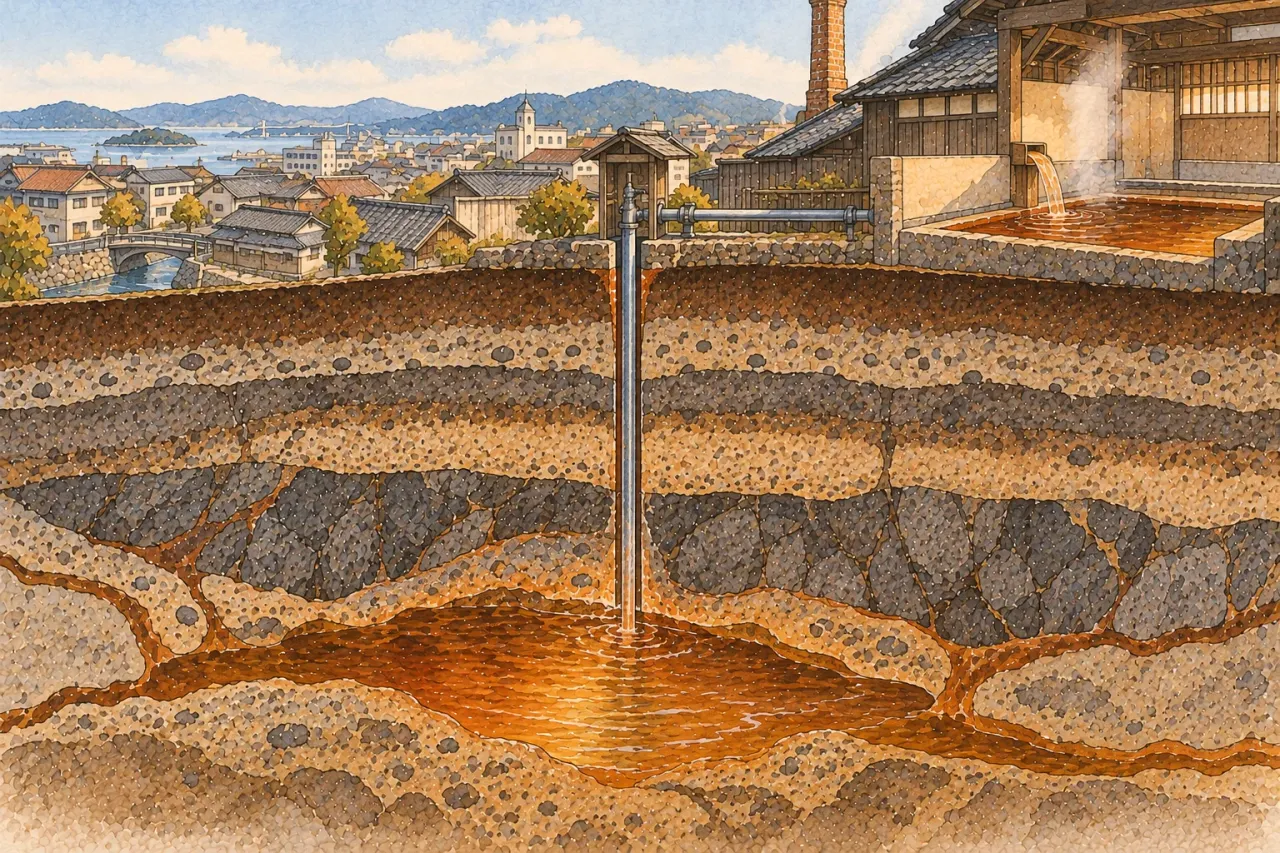
Volcanic and non-volcanic water. Kanagawa’s Hot Springs Research Institute separates the two. Volcanic springs, like those of Hakone, are heated by a magma chamber; the typical type there is a chloride spring, and near Owakudani the water is an acidic calcium sulphate spring. Non-volcanic springs come in two kinds. Deep groundwater, warmed by the ordinary rise in temperature with depth, is fairly cool (around 40°C at most), low in dissolved matter and strongly alkaline; Nakagawa and Nanasawa are its examples. “Fossil seawater”, trapped in the strata long ago, gives Tsurumaki and the brown springs of Yokohama and Kawasaki. The institute adds that most hot spring water starts as rain and snow that soaked into the ground.
Hot water without a volcano. A 2024 newsletter from the National Institute of Advanced Industrial Science and Technology (AIST) says most springs are rain or seawater warmed by the earth’s heat or by volcanic gas and magma, but that some, like Arima, have no volcano nearby and are hot because deep fluids have mixed in. Its diagram separates volcanic deep fluid (magmatic water) from non-volcanic deep fluid, which it labels “Arima-type hot water”. AIST does not say where it draws the edges of “Arima-type”, and this page does not say where Arima’s water ultimately comes from.
Under Tokyo. Tokyo’s environment bureau says the city’s coastal wards, around Ota, can produce pale or dark brown water called kuroyu, “black water”, long used in public baths: a mineral spring below 25°C, said to come from ancient seawater. Deeper wells, hundreds of metres down and pumped hard, reach water above 25°C that also carries salts from old seawater, which makes it onsen under the law, and more springs are being developed this way. In western Tokyo there are alkaline and sulphurous springs, some flowing naturally and some used for about 600 years. The islands, the bureau says, have many volcanic springs, some above 80°C.
Official sources do not explain what makes the springs of Tohoku, Hokuriku or Chugoku as a whole, so this page does not generalise.
The towns
Official sources do not give a ministry or prefectural count of the most common spring type in any region, or official spring types for Hokuriku or Koshinetsu as regions. What follows is what each town’s own page says.
Tohoku. Osaki city says Naruko has about 370 sources and seven of the ten modern spring types; Miyagi’s tourism federation says eight of eleven. The two use different classifications, so the number depends on which list you count against. Hijiori’s official site gives a sodium chloride and hydrogen-carbonate spring and says the colour and feel differ from source to source. The environment ministry’s plan for Sukayu (March 2025) names its water an acidic, sulphur-bearing sodium sulphate spring of the hydrogen sulphide type.
Kanto. Kusatsu’s “Senshitsu Shugi” page describes strongly acidic water, the most naturally flowing water in Japan by its own account, poured into the baths without added water. The Japan Spa Association, an industry body, lists acidic, sulphur, aluminium-bearing, sulphate and chloride springs there; “aluminium-bearing” is an older name that is not among today’s ten categories. Kanagawa’s institute names Yugawara a sodium-calcium chloride-sulphate spring (Yugawara town’s page gives the same name, citing the institute’s analysis; more in the Yugawara guide) and Tsurumaki a sodium-calcium chloride spring.
Chubu. Gero’s tourism association gives an alkaline simple spring at pH 9.2. Atami city says chloride springs are the majority in the city, with more than 500 sources, a total flow close to 20,000 litres a minute, about nine in ten above 42°C and an average of about 63°C.
Kansai. Arima’s tourism association describes kinsen, “gold spring”, as water with iron and salt, and ginsen, “silver spring”, as either water with carbonic acid or water “with radon” — both called ginsen. It does not give official spring names. Kinosaki’s association pages give no spring type, and Shirahama’s is not covered here.
Chugoku. Tamatsukuri’s official site gives a weakly alkaline sodium-calcium sulphate-chloride spring. Yonago city gives Kaike as a sodium-calcium chloride spring with 19 sources and a flow of 4,456.5 litres a minute, the most in Tottori; the city page gives both “70 to 85 degrees” and a top source of 83°C, and the prefecture’s tourism federation gives an average of 66.5°C. A 2025 geological survey by AIST says Kaike’s water is now drawn by boreholes from 200 to 300 m down, and that the geology of the sources is unknown. The federation describes Misasa as radioactive, averaging 52.8°C, with “one of the highest radon contents in the world”.
National health resort onsen. The environment ministry designates some areas as kokumin hoyō onsenchi, which it explained in 2017 as onsen areas the minister designates to promote public use, where the benefits of bathing can be expected and the place can serve as a healthy resort. Its list says 79 places as of October 2022. Counting its Honshu entries by region: Tohoku 19 (eight in Yamagata alone, including Zao, Ginzan and Hijiori), Kanto 6, Chubu 17, Kansai 5, Chugoku 12. Osaki city says three parts of Naruko were designated in Shōwa 35 and the whole district in Heisei 28. The ministry’s 2017 announcement spoke of 94 places so far; official sources do not explain why that differs from the 79 of 2022.
How they began. Several towns give more than one origin, and this site does not choose.
- Gero: found in the Tenryaku era (947–957) or the Engi era (901–923), by two accounts. The association says the spring first rose near the top of Mt Yugamine, stopped before 1265 and was found again on the bank of the Hida river, the “white heron legend”.
- Atami: the city cites a record that the monk Mangan moved the spring in 749, and the Izu fudoki of 713 mentioning Atami’s hot water. In 1604 Tokugawa Ieyasu came to bathe with two of his sons, and later made Atami land held directly by the shogunate.
- Hijiori: opened in 807, with 1,200 years marked in 2007. Of several stories behind the name, the site tells of an old monk who broke his elbow and bathed it here.
- Kinosaki: the association marked 1,300 years in 2020 and says the monk Dōchi came in 717.
- Tamatsukuri: its site says the date is not certain, that it is counted among Japan’s oldest springs, and that the Izumo fudoki, compiled in 733, describes people of all ages enjoying water rising by the river.
- Kaike: found in 1900, by fishermen, but the accounts differ on where. Yonago city says hot water was rising in the shallows off the beach; the prefecture’s tourism federation says fishermen had long told of warm water when diving offshore; JNTO says bubbles were seen on the seabed about 200 m out.
- Sukayu: its operator says the spring was found in 1684 and has been a place for long-stay bathing since the Edo period.
The three famous springs. Kusatsu, Arima and Gero are often grouped as Japan’s three great springs. Gero’s association traces this to writers: the Muromachi-era monk Banri Shūku, who named Gero alongside Kusatsu and Arima, and the Edo-era Confucian scholar Hayashi Razan, who named the same three. No official source says a government chose them. Arima calls itself “one of Japan’s three ancient springs” without naming the other two or who chose them, so this page does not either.
How people use them
Long stays. Tōji is the custom of staying at a spring for days or weeks. Osaki city says Naruko is “renowned as a tōji spa of Tohoku”, where you can choose a self-catering inn for a long, quiet stay or an ordinary ryokan. Hijiori’s site says many inns have kitchens for guests, and that there is a morning market at 5 am every day except in winter. Tottori’s federation describes long-stay inns at Misasa where guests cook for themselves and stay three nights or more.
With food. Kinosaki’s association says the snow crab season opens on 6 November, and its “crab kingdom” promotion runs from then to the end of March. The farm ministry lists boiled matsuba-gani, the San’in name for snow crab, among Hyogo’s local dishes. The ministry’s entry does not name Kinosaki, so this page says only that both sides feature the crab. For Kusatsu, Arima, Gero, Atami, Naruko, Tamatsukuri, Misasa and Kaike, no dish is named by both the town and the ministry.
City baths and onsen towns. On the ministry’s table Tokyo has only 22 onsen areas but 142 public baths using hot spring water; Kanagawa has 199 and Chiba 150. Of Tokyo’s 168 springs, 72 are below 25°C, about 43%. Under the law, water below 25°C is still onsen if it meets the mineral standards. The difference between an onsen town and a city day spa is mostly in how the water reaches you: flowing up near a volcano, or pumped from deep wells. Official sources do not say city baths dilute or recirculate more. What you can always do is read the sign: a bath open to the public must post its water’s analysis and say whether, and why, the water is diluted, heated, recirculated or disinfected.
Getting there
These are the times on the towns’ or prefectures’ official pages, checked on 10 October 2026. Timetables change; check the operator before you go. Fares are not on this page.
- Kinosaki — From JR Osaka by limited express Kounotori about 2 hours 40 minutes; from Sannomiya by Hamakaze about 2 hours 30 minutes; from Kyoto by Kinosaki about 2 hours 20 minutes.
- Arima — From JR Osaka about 1 hour, changing trains on the way; from Osaka Itami Airport by bus about 30 minutes.
- Atami — From Tokyo by Kodama shinkansen about 45 minutes. The city’s page was last updated in March 2017, so treat this as old information.
- Gero — The association’s sample timetable has a train from Nagoya taking about 1 hour 34 minutes. It says every train, including the limited express Hida, stops at Gero.
- Naruko — From Sendai by Tohoku shinkansen to Furukawa 15 minutes, then the Rikuu East line to Naruko-Onsen 50 minutes. Highway bus 1 hour 30 minutes.
- Kaike — From Yonago station about 15 minutes by car or 20 minutes by bus.
- Misasa — From JR Kurayoshi about 20 minutes by car.
Kusatsu’s association lists highway buses from Tokyo station, Busta Shinjuku and Shibuya, and Tamatsukuri’s own site lists its airports and station, but neither gives a journey time. For Tamatsukuri, Shimane’s tourism federation gives about 10 minutes by bus from JR Tamatsukuri-onsen station to the town, and Matsue’s English site about 8 minutes by train from Matsue station to Tamatsukuri-onsen station; see the Tamatsukuri guide. Official times for Hakone and Shirahama are not given here.
What people get wrong
- “Onsen need a volcano.” Kansai has no active volcano on the agency’s list and still has Arima. Tokyo’s deep wells and Kanagawa’s fossil seawater are non-volcanic too.
- “Honshu’s onsen line up along the volcanic front.” The front is real, but the source that describes it does not talk about hot springs, and no official source makes the link.
- “The three great springs are an official list.” They come from writers of the Muromachi and Edo periods.
- “Silver spring is a radium spring.” Arima says one of its silver springs contains radon. The official classification decides radioactive springs by radon content, and has no “radium spring” category.
- “Naruko has seven spring types,” or eight. Both figures are official; they count against different lists.
- “City onsen are fake.” Tokyo’s deep-well water meets the legal definition. Whether one place is better than another is not something the official sources say.
- “The water will treat a condition.” The ministry’s rules list indications by spring type and say treatment at a spa is best done with a doctor’s guidance. This page does not claim that any town’s water cures anything.
Questions people ask
Which prefecture on Honshu has the most hot springs?
On the environment ministry’s fiscal 2024 table, Shizuoka has the most springs on Honshu (2,185) and the most overnight stays, and Nagano has the most onsen areas (193). The table has no ranking column; the order comes from comparing its figures.
Are there hot springs in the Kansai region without volcanoes?
Yes. The Japan Meteorological Agency’s list of active volcanoes has none in the Kansai prefectures, yet Arima is a hot spring. A national research institute notes that springs such as Arima, with no volcano nearby, can be hot because deep fluids have mixed into them.
Who chose the three famous springs of Kusatsu, Arima and Gero?
No government body. Gero’s tourism association traces the grouping to writers of the past, the Muromachi-era monk Banri Shūku and the Edo-era scholar Hayashi Razan, who named the three together.
Is the water at a Tokyo day spa real onsen?
It can be. Tokyo’s environment bureau says deep wells in the city reach water above 25°C that also carries salts from ancient seawater, which makes it hot spring water under the law.
Sources
- 湯河原町「温泉の成分と効能について」
- 島根県観光連盟「玉造温泉」
- Visit Matsue「South of Lake Shinji」
- 環境省 自然環境局長通知 平成26年7月1日(禁忌症及び入浴又は飲用上の注意の掲示等の基準)
- 環境省「令和6年度温泉利用状況」(令和7年3月末現在)
- 環境省 国民保養温泉地
- 環境省 報道発表 国民保養温泉地の新規指定(2017年5月16日)
- 気象庁 活火山とは
- 気象庁 活火山リスト
- 地震調査研究推進本部 火山フロントと沈み込み帯
- 神奈川県温泉地学研究所 火山性と非火山性温泉
- 産総研 活断層・火山研究部門ニュースレター Vol.11 No.2
- 東京都環境局 温泉とは
- 大崎市 鳴子温泉郷
- 宮城県観光連盟 鳴子温泉郷
- 肘折温泉 公式サイト
- 酸ヶ湯温泉 公式サイト(事業者)
- 草津温泉「泉質主義」
- 日本温泉協会 温泉地詳細 草津(業界団体)
- 熱海市 熱海の温泉
- 熱海市 交通案内
- 下呂温泉観光協会 下呂温泉を知る
- 下呂温泉観光協会 JRモデルコース
- 有馬温泉観光協会
- 有馬温泉観光協会 泉質
- 有馬温泉観光協会 アクセス(大阪から)
- 城崎温泉観光協会
- 城崎温泉観光協会 アクセス
- 城崎温泉観光協会 松葉ガニ
- 玉造温泉 公式サイト
- 米子市 皆生温泉
- 鳥取県観光連盟 皆生温泉
- 米子市観光協会 米子観光ナビ「皆生温泉」
- JNTO「Kaike Onsen」
- 産業技術総合研究所 地質調査総合センター『米子地域の地質(第2版)』
- 環境省『酸ヶ湯温泉 国民保養温泉地計画書』(令和7年3月)
- 鳥取県観光連盟 三朝温泉
- 農林水産省 うちの郷土料理 兵庫県
Prices are in Japanese yen. Conversions are approximate, at ¥177.30 to the euro and ¥158.23 to the US dollar as of 20 Oct 2026. Rates come from the European Central Bank, which publishes on working days only. Prices checked Oct 2026. What food costs in Japan →