Kinosaki Onsen: seven public baths, one shared supply, and a town that calls itself a single inn
I have not been to every place in this guide. The figures below are taken from the sources listed at the end, with the date each one was published — not measured by me. Where I have been, the article says so.
Kinosaki Onsen, in Toyooka city in northern Hyogo, is built around its sotoyu: public bathhouses you walk between, usually in a cotton yukata and wooden geta. Its tourism association describes the whole town as one large inn — the station is the entrance, the streets are the corridors, the inns are the guest rooms and the public baths are the big baths. This page covers what the town says about its age, how the water reaches those baths, which baths are open and on which days, and what Visit Kinosaki, Toyooka city’s official English tourism site, says about tattoos and bathing. It uses the tourism association, Toyooka city, the bath trust that supplies the water, and national agencies; where they disagree, each is given. It does not rate any bath. The ten official spring types and how to read the analysis sign are in the separate guide to onsen water types, and what free-flowing water means is in the kakenagashi piece; the Honshu overview places Kinosaki among the other Kansai springs.
Where it came from
Three founding stories
The tourism association’s history pages tell three stories, and present them as legends.
- The stork. About 1,400 years ago, in the reign of Emperor Jomei (from 629), a stork that had hurt its leg came down into a field and soaked the leg in the water; a few days later it flew off well, and villagers who looked at the spot found hot water rising. Another version has a pair of storks. The association says this story is older than the one about the monk Dōchi. It is tied to Kou no Yu.
- The monk Dōchi. The association says Dōchi came to Kinosaki in 717 and prayed for 1,000 days in a hermitage where Mandara Yu now stands, chanting a sutra and asking the local guardian deities to save the sick, after which the water is said to have welled up. It presents this as an anecdote and notes that it is not certain Dōchi existed. It says that in 738 he built Onsen-ji, the temple that guards the spring, on its present site, and enshrined a Kannon image said to be carved from the same tree as the one at Hasedera in Nara; the association’s chronology lists the temple’s eleven-faced Kannon, an Important Cultural Property, under 738.
- The year. The association counts its 1,300th anniversary, in 2020, from Dōchi’s arrival in 717. Its chronology, though, puts Dōchi’s discovery of Mandara Yu in 720, and the Dōchi page itself gives no year for when the water rose. So it is 717 for his arrival and 720 for the spring in one table. All of these are traditions, and this page does not choose one.
JNTO says it was once customary to pray at Onsen-ji before bathing.
The bath trust (the Kinosaki-chō Yushima zaisanku, a public property trust whose site is run under Toyooka city) gives one story per bath on its English page:
- Kou no Yu — a stork was seen healing a wound in the water, about 1,400 years ago.
- Ichi no Yu — about 300 years ago a doctor rated it the best in Japan.
- Mandara Yu — it welled up after the monk who founded Onsen-ji prayed for 1,000 days.
- Yanagi Yu — said to spring from under a willow transplanted from West Lake in China.
- Jizō Yu — a sacred image is said to have been found at the source.
- Gosho no Yu — an emperor’s sister is said to have bathed here about 600 years ago.
The association’s chronology instead says Ankamon-in bathed at Gosho no Yu in 1267 and that it came to be called gosho no yu after that, which is further back than “about 600 years”. This page has not checked the original records and does not choose between them.
Early records
The same chronology records that the name Kinosaki Onsen first appears in history in 769, that the poet Fujiwara no Teika’s diary Meigetsuki mentions taking the waters at Kinosaki in 1226, and the Gosho no Yu entry above. These come from the association’s table; they have not been checked against the original texts. For later years the table lists the founding of Kinosaki town and of the Yushima zaisanku, the bath trust described below, in 1895, and the railway reaching Kinosaki station in 1909, with the San’in line completed in 1912.
Ichi no Yu and the Edo ranking
The association says Ichi no Yu was first called Arayu, the “new bath”, when it was built in the mid-Edo period. In 1734 the physician Kagawa Shūtoku wrote in his Ippondō yakusen that Kinosaki’s Arayu was the foremost, and the bath was renamed Ichi no Yu, “the number one bath”. Toyooka city’s page for Ichi no Yu gives the same story. This is a doctor’s opinion from 1734, not a ranking of the bath today.
The association also shows a hot spring ranking from 1851, Shokoku onsen kōnō kagami, laid out like a sumo listing. In its western half Arima is placed at the top, as ōzeki, and Kinosaki second, as sekiwake.
The 1925 earthquake
The association’s page on the North Tajima earthquake says it struck at 11:09 on 23 May 1925, at magnitude 6.8. In Kinosaki 272 people died, many of them inside collapsed houses or in the fires. The fire burned until early the next morning; most of the public baths were destroyed or burned, and only part of Jizō Yu was left standing.
The page says rebuilding the public baths came first: six of them were built between 1926 and 1932, and by 1935 the town’s present shape — public baths, inns, shops and streetscape — was largely in place. It names no single leader and stresses the residents’ mutual help.
Shiga Naoya
The association says the writer Shiga Naoya, then 30, stayed at the inn Mikiya for about three weeks in 1913 to recover after being hit by a Yamanote line train, and that his story Kinosaki nite (“At Kinosaki”) was published in 1917 in the magazine Shirakaba. In the association’s summary, the narrator kills a newt by throwing a stone at it and comes to feel that life and death are not opposites. It says he visited Kinosaki more than ten times in his life. The town’s literature museum, Kinosaki Literature Museum (KINOBUN), opened in 1996 and was renovated in 2016, and the association counts 23 literary monuments in the town. It says Shiga himself disliked monuments, and that his was put up only after residents’ enthusiasm and a collection of signatures won his consent. The association’s home page posted a notice of temporary closure for the museum on 11 September 2026; the dates and the reason are not confirmed here.
The water
The association’s public bath page gives one spring type for the public baths: sodium-calcium chloride, high temperature (natorium-karushiumu enkabutsu kōonsen), at 42°C. That is the page’s figure; it gives no analysis date, and it is not clear whether it is the source or the bath. Toyooka city’s pages for each bath give no spring type or temperature.
The official pages that could be checked, from the association, Toyooka city and the bath trust, do not give the number of sources, the flow rate or why the water rises here. The trust’s site has headings for the water’s components, indications and contraindications, and for its central supply, but the text under them could not be opened, and the city’s PDFs that might carry an analysis returned errors.
Kinosaki is not a kokumin hoyō onsenchi, a hot spring area designated by the environment ministry for health and recreation: the ministry’s list gives only Hamasaka in Hyogo.
How the town works
One supply
The bath trust says the spring water goes to a limited set of places: the seven public baths, the baths of some inns, five footbaths and three drinking fountains set up by the trust and Toyooka city. Since December 2023 it has been handing out a certificate, the Kinosaki Onsen Natural Hot Spring Supply Certificate, to places that use the natural water. Toyooka city’s hot spring management office lists the trust, the sources, the supply and the seven public baths as its responsibilities. Technical detail on how the central supply works is not confirmed here.
Sotoyu and uchiyu
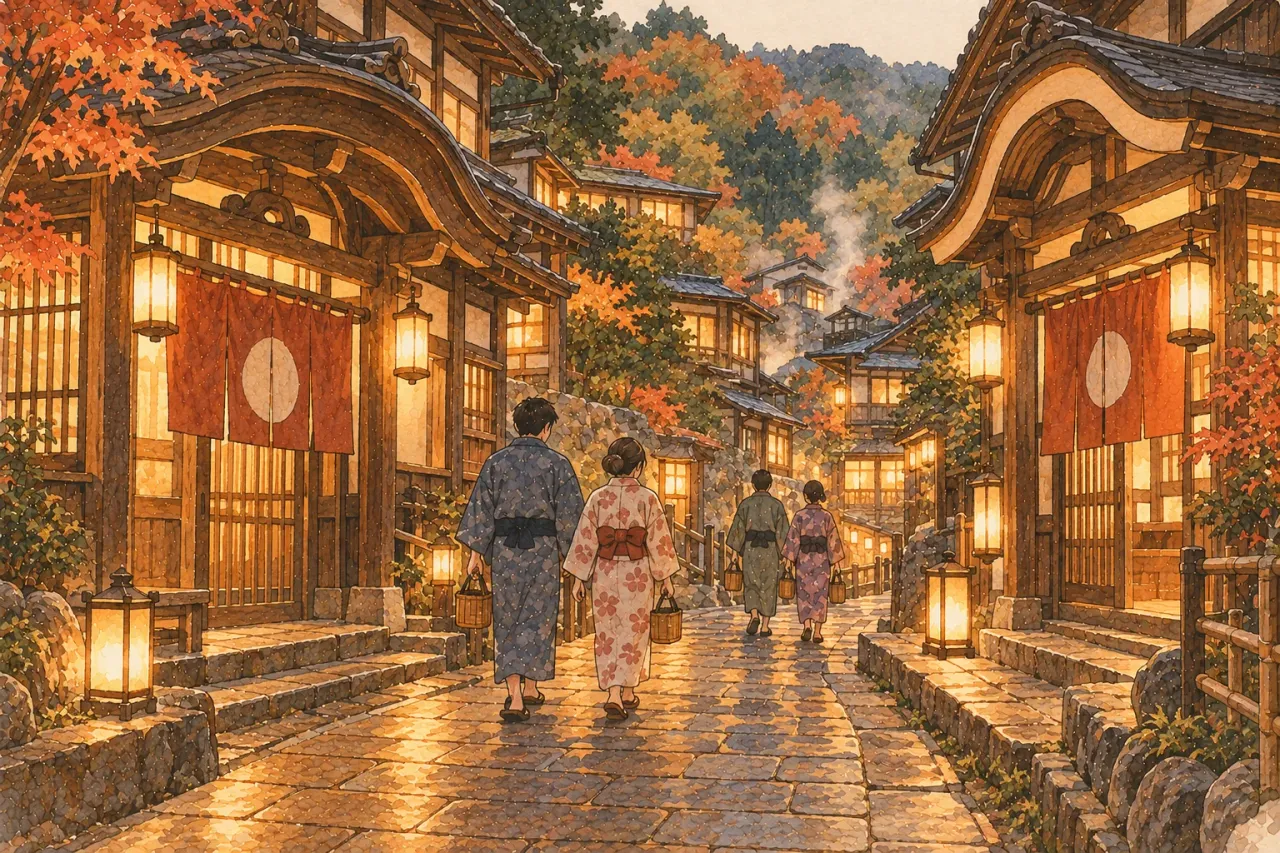
The association distinguishes uchiyu, the bath inside your inn, from sotoyu, the shared public baths, and says walking the sotoyu is what Kinosaki is known for. From Jizō Yu to Kou no Yu is about 15 minutes on foot, by the association’s figure. The association calls Kinosaki a town where yukata are taken for granted, says walking between baths in yukata and geta is something particular to Kinosaki, and suggests changing into a yukata when you reach your inn; there are also shops that rent designer yukata. JNTO says inns lend yukata and geta, and that there are rental shops.
The willows and the river
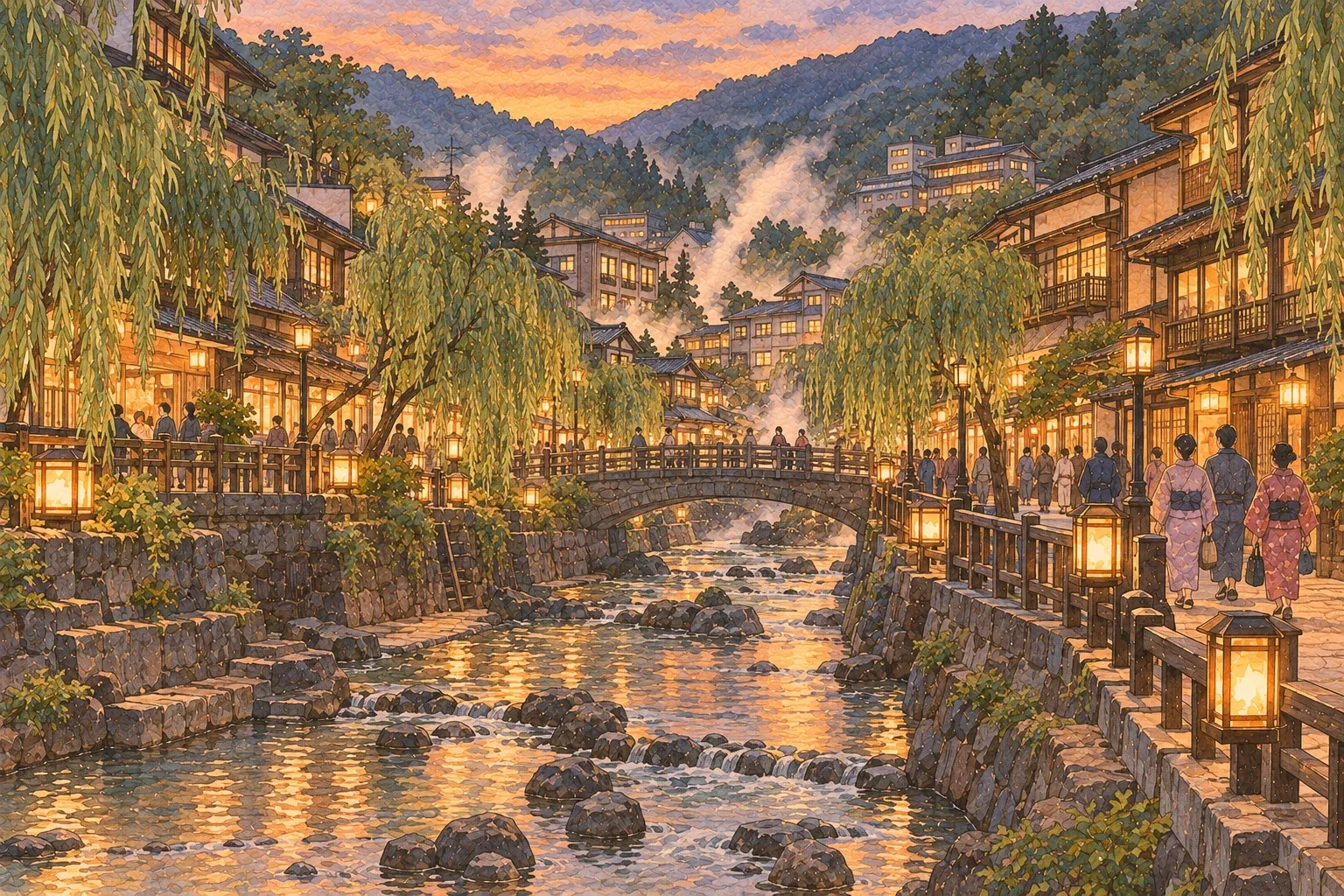
The association’s guide to the town has a heading calling the willow-lined Ōtani river and its arched stone bridges the place in Japan where yukata suit people best. It says the river and bridges are about five minutes’ walk from Kinosaki Onsen station, and that Shiga Naoya also loved the willows. The association’s chronology records willows being planted along the river in 1932. The willow in the Yanagi Yu legend above is a separate story.
Which baths are open
Toyooka city lists seven public baths: Ichi no Yu, Jizō Yu, Gosho no Yu, Yanagi Yu, Mandara Yu, Kou no Yu and Sato no Yu. As of 11 October 2026:
- Sato no Yu has been closed long-term. The bath trust says it closed after 31 March 2024; Visit Kinosaki says it has been closed for renovation since 1 April 2024, with no end date, and warns its information may be out of date. The association lists it as closed long-term, without a date.
- Kou no Yu is closed for long-life renovation, which the association describes as urgent repairs. The association’s notice of 11 May 2026 gives the closure as 11 May to 30 October 2026 (planned), and Visit Kinosaki gives the same dates. The bath trust says it reopens on 28 October 2026. The two dates are two days apart, and both are given; check before you go at the end of October.
- While Kou no Yu is closed, the association says Mandara Yu opens on its usual closing day, from 15:00.
- The bath trust says the family baths at Ichi no Yu and Jizō Yu are out of use because the buildings need major repairs.
So six baths are open in normal times, and five during Kou no Yu’s closure. The association’s public bath page lists six, while the city still speaks of “seven public baths”; the bath trust’s English page says seven but describes six.
Hours and closing days
Toyooka city’s page for each bath (updated October 2024), the association’s public bath page and Visit Kinosaki give the same closing days:
| Bath | Hours | Closing day |
|---|---|---|
| Kou no Yu | 7:00–23:00 | Tuesday (closed for renovation in 2026) |
| Mandara Yu | 15:00–23:00 | Wednesday (open on Wednesdays while Kou no Yu is closed) |
| Gosho no Yu | 7:00–23:00 | Thursday |
| Ichi no Yu | 7:00–23:00 | Wednesday |
| Yanagi Yu | 15:00–23:00 | Thursday |
| Jizō Yu | 7:00–23:00 | Monday |
| Sato no Yu | Closed long-term | — |
The city’s pages say a bath opens if its closing day falls on a public holiday, and that days can change. The last entry is 30 minutes before closing, at 22:30. Two older pages give other days: the bath trust’s English page has Jizō Yu closing on Friday, and an association notice from April 2020 has Friday for Jizō Yu, Thursday for Mandara Yu and every other Wednesday for Ichi no Yu. Because the city’s 2024 pages, the association and Visit Kinosaki agree, this page uses their days. The trust also posts a monthly calendar of closures as a PDF.
Bathing there
The official pages give an adult and a child price for a single bath, the same at every bath, and for a one-day pass, Yumepa, sold at each bath’s counter and good for all the baths that are open that day. Toyooka city raised both from 1 April 2023. None of the pages — the association, the bath trust, the city or Visit Kinosaki — says whether the prices include tax, so the figures are not given here.
If you stay in town, Visit Kinosaki says inns usually give you a pass for the public baths at check-in, and asks you to check that yours does. The bath trust’s English page calls it a free pass. The association’s bath page does not mention inn guests.
How to bathe, according to the town’s guides
Visit Kinosaki’s bathing guide sets out the steps: show your pass or buy a ticket, leave your shoes, go to the changing room for your sex (red for women, blue or purple for men), put your things in a locker and keep the key on your wrist, wash sitting down and rinse off the soap before getting in, keep your towel and long hair out of the water, get out and cool down if you feel too hot or light-headed, and dry off before going back to the changing room. It lists what is not allowed: swimsuits or underwear, entering the other side, cameras and photography, swimming or diving, climbing the walls, eating or drinking in the bath, shaving and brushing your teeth, taking up space for yourself, and leaving the bath area wet.
The bath trust’s own manners page adds pouring water over yourself before getting in (kakeyu), washing before entering, keeping towels out of the bath, not bathing after drinking alcohol, and not using any device with a camera in the changing room or bath. Official sources give no recommendation on how long to stay in each bath.
Tattoos
Visit Kinosaki — Toyooka city’s official tourism site, run by Toyooka Tourism Innovation, with Toyooka City Hall in its copyright line — says all seven public baths accept tattoos of all sizes, and that you do not need to cover them. It adds that baths at places to stay may have different rules, so ask yours in advance. The page carries no date. JNTO, in an older article, also calls the seven public baths tattoo-friendly, without the condition.
The association’s Japanese pages, the city’s bath pages and the bath trust’s site say nothing about tattoos. The association’s English link led only to a notice for drivers about a pedestrian-only trial, so no English bathing or tattoo guidance from the association is confirmed. Note that “all seven” includes Sato no Yu, which is closed. The general picture across Japan, including private baths as an option elsewhere, is in the water types guide.
The ropeway
The Kinosaki Onsen Ropeway runs up Daishi-yama; JNTO says you can stop at Onsen-ji on the way. The operator’s own site gives the first car at 9:10 and the last car up at 16:50, depending on the weather, and says it is closed on the second and fourth Thursday of each month, opening if that day is a public holiday. The fare and whether it includes tax are not confirmed, so it is not given here. The association’s home page notes that part of the Daishi-yama hiking course is closed (posted 17 March 2026).
What it is eaten with
Snow crab. The association calls snow crab matsuba-gani in San’in, the region along this coast, where it is more widely known as zuwai-gani. Its winter page says the crab is landed at Tsuiyama port in Kinosaki and auctioned the same day, that crab from there carries a blue tag as Tsuiyama-gani, and that it is eaten raw, grilled, boiled or in kani-suki, a crab hot pot. The page says the season opens on 6 November “this year” and runs to the end of March, without giving a year, and that it opens in early November every year. Hyogo prefecture’s fisheries centre says the Sea of Japan season opened on 6 November in the 2025 season; the 2026 opening date is not confirmed. The association’s “Crab Kingdom” promotion, with crab offers at shops and restaurants that take part, is shown for November 2026 to March 2027.
The farm ministry lists boiled matsuba-gani among Hyogo’s local dishes, with the Tajima area — Shin’onsen, Kami and Toyooka — as where it is handed down. Kinosaki appears on that page only for Kinosaki Marine World, an aquarium raising snow crab from eggs to adults. So the ministry ties the crab to Toyooka city, which includes Kinosaki, but does not name Kinosaki Onsen. The ministry also says the name may come from pine needles used as fuel, one of several explanations, and that catches peaked around 1965, fell sharply from the early 1970s through overfishing, and are now protected by a shorter season and catch limits.
Tajima beef. The association says Tajima cattle are known as the stock from which Kobe, Matsusaka and Ōmi beef are raised, and JNTO names Tajima beef with snow crab for inn meals. The farm ministry’s Hyogo list has no entry for it.
Izushi soba. The farm ministry lists Izushi sara-soba, buckwheat noodles served on small plates, for the Izushi district of Toyooka city. Its page does not mention Kinosaki, and the association’s Kinosaki food page does not list it, so this page does not present it as a Kinosaki dish. No dish is presented as Kinosaki’s own by both the farm ministry and the tourism association.
Getting there
From the association’s access page, which carries no update date (checked 11 October 2026):
- Osaka — about 2 hours 40 minutes from JR Osaka by the limited express Kounotori; about 3 hours 10 minutes by highway bus from Osaka Umeda; about 2 hours 30 minutes by car.
- Kyoto — about 2 hours 20 minutes by the limited express Kinosaki; about 3 hours 40 minutes by highway bus from the Karasuma exit of Kyoto station; about 3 hours by car.
- Kobe — about 2 hours 30 minutes from JR Sannomiya by the limited express Hamakaze; about 3 hours 10 minutes by highway bus from the Kobe Sannomiya bus terminal; about 2 hours 30 minutes by car.
- By air — Osaka Itami to Kounotori Tajima Airport, about 35 minutes, then about 40 minutes by bus to Kinosaki Onsen station.
Visit Kinosaki says limited expresses run on the JR San’in line from Kyoto, Osaka, Sannomiya and Himeji, that all of them need seat reservations, and that the JR Pass and JR West rail passes can be used. It also lists direct Zentan buses from Osaka and from Kobe, and a bus that leaves for Kinosaki Onsen just after the daily Itami flight lands. JR West’s page for its Kansai WIDE Area Pass lists Kinosaki Onsen as a trip from the Kansai area and says seat reservations on the Kounotori can be made with it. JNTO gives about 2.5 hours by direct limited express from Kyoto or Osaka on one page, and about 3 hours from Shin-Osaka by Kounotori on another.
Official sources give no directions from Kansai Airport to Kinosaki in one route. JR West describes the airport train and the limited expresses separately, and the association’s page does not cover the airport or Shin-Osaka. JR West’s page for the airport express HARUKA says it runs from Kansai Airport to Tennōji, Osaka, Shin-Osaka and Kyoto, and that a HARUKA one-way ticket cannot be used on other limited expresses. Visit Kinosaki’s access page mentions Kansai Airport only on its route map. Fares are not on this page. The association’s home page also posted traffic restrictions for the autumn festival (21 September 2026); check its notices before you go.
What people get wrong
- “Seven baths means seven open.” Sato no Yu has been closed since 2024, and Kou no Yu is closed for renovation until the end of October 2026.
- “Every bath is open every day.” Each closes one day a week, Monday to Thursday depending on the bath; some older pages give different days.
- “The one-day pass is the only way in.” Inn guests usually get a pass from their inn, according to Visit Kinosaki.
- “Tattoo-friendly means everywhere in town.” Visit Kinosaki limits it to the public baths and says inn baths may differ.
- “Kinosaki is 1,300 years old, full stop.” That is the association’s count from Dōchi’s arrival in 717, whom it says may not have existed; its own chronology puts the spring in 720, and the stork legend is put at about 1,400 years.
- “Ichi no Yu is officially the best bath.” The name comes from one doctor’s praise in 1734.
- “Snow crab is Kinosaki’s official local dish.” The farm ministry ties boiled matsuba-gani to the Tajima area, including Toyooka city, without naming Kinosaki Onsen; the tourism association is the one that features it.
- “Any bath in the area is Kinosaki water.” The bath trust says the water goes only to the public baths, some inns, the footbaths and drinking fountains, and it now issues a certificate to places that use it.
- “The water cures things.” This page does not say so. The official list of indications for each spring type is in the water types guide.
Questions people ask
What is sotoyu?
The public bathhouses of the town, as opposed to uchiyu, the baths inside an inn. Kinosaki’s tourism association names walking between the sotoyu as what the town is known for. Toyooka city lists seven.
Are all seven public baths open?
No. Sato no Yu has been closed long-term since spring 2024, and as of 11 October 2026 Kou no Yu is closed for renovation until the end of October, with the official pages giving 28 and 30 October. The tourism association’s bath page lists six.
Which days are the public baths closed?
Each bath has its own closing day. Toyooka city, the tourism association and Visit Kinosaki agree on Monday for Jizo Yu, Tuesday for Kou no Yu, Wednesday for Ichi no Yu and Mandara Yu, and Thursday for Gosho no Yu and Yanagi Yu. The city says a bath opens when its closing day is a public holiday, and that days can change.
Can I use the public baths in Kinosaki with tattoos?
Visit Kinosaki, Toyooka city’s official tourism site, says all seven public baths accept tattoos of any size without covering. It adds that inn baths may have different rules, so ask your inn in advance.
Is the bath free if I stay in Kinosaki?
Visit Kinosaki says inn guests usually receive a pass for the public baths at check-in, and asks you to check with your inn. The bath trust’s English page calls it a free pass.
Sources
- 城崎温泉観光協会「城崎温泉について」
- 城崎温泉観光協会「外湯」
- 城崎温泉観光協会「城崎温泉で過ごす」
- 城崎温泉観光協会 トップ(お知らせ)
- 城崎温泉観光協会「『鴻の湯』の長期休館について」
- 城崎温泉観光協会「外湯の入浴について」(2020年のお知らせ)
- 城崎温泉観光協会「開湯1300年の歴史」
- 城崎温泉観光協会「歴史年表」
- 城崎温泉観光協会「鴻の湯の伝説」
- 城崎温泉観光協会「道智上人」
- 城崎温泉観光協会「城崎全町崩壊からの復活」
- 城崎温泉観光協会「江戸時代の温泉番付」
- 城崎温泉観光協会「志賀直哉と文学のまち」
- 城崎温泉観光協会「一の湯の由来」
- 城崎温泉観光協会「文学のまち」
- 城崎温泉観光協会「城崎グルメ」
- 城崎温泉観光協会「アクセス」
- 城崎温泉観光協会「松葉ガニ」
- 城崎温泉観光協会「かに王国」
- 城崎温泉観光協会「観光スポット」
- 城崎温泉ロープウェイ
- 城崎町湯島財産区(城崎温泉の外湯)
- 城崎町湯島財産区「入浴料金」
- 城崎町湯島財産区「English」
- 城崎町湯島財産区「入浴マナー」
- 豊岡市「城崎温泉」(外湯7湯)
- 豊岡市「外湯の料金改定」
- 豊岡市「一の湯」
- 豊岡市「地蔵湯」
- 豊岡市「鴻の湯」
- 豊岡市「まんだら湯」
- 豊岡市「御所の湯」
- 豊岡市「柳湯」
- 豊岡市 温泉管理係
- 環境省「国民保養温泉地」一覧
- Visit Kinosaki「The 7 Mystic Onsen」
- Visit Kinosaki「Tattoos in Kinosaki Onsen」
- Visit Kinosaki「Taking a Japanese Bath」
- Visit Kinosaki「Access」
- JNTO「Kinosaki Onsen」
- JNTO「Kinosaki Onsen Hot Spring Town」
- JNTO「Soak Up the Charm of Kinosaki Onsen」
- JR西日本「Kansai WIDE Area Pass」
- 農林水産省 うちの郷土料理 兵庫県
- 農林水産省 うちの郷土料理「ゆで松葉ガニ」
- 農林水産省 うちの郷土料理「出石皿そば」
- 城崎町湯島財産区「外湯」
- JR西日本「HARUKA」(2025年2月5日時点の記載)
- 兵庫県「令和7年漁期ズワイガニ資源の状況」
Prices are in Japanese yen. Conversions are approximate, at ¥177.30 to the euro and ¥158.23 to the US dollar as of 20 Oct 2026. Rates come from the European Central Bank, which publishes on working days only. Prices checked Oct 2026. What food costs in Japan →