
Gyoza: why Japan fries a dumpling China boils, what a plate costs, and what the town rivalry really measures
I have not been to every place in this guide. The figures below are taken from the sources listed at the end, with the date each one was published — not measured by me. Where I have been, the article says so.
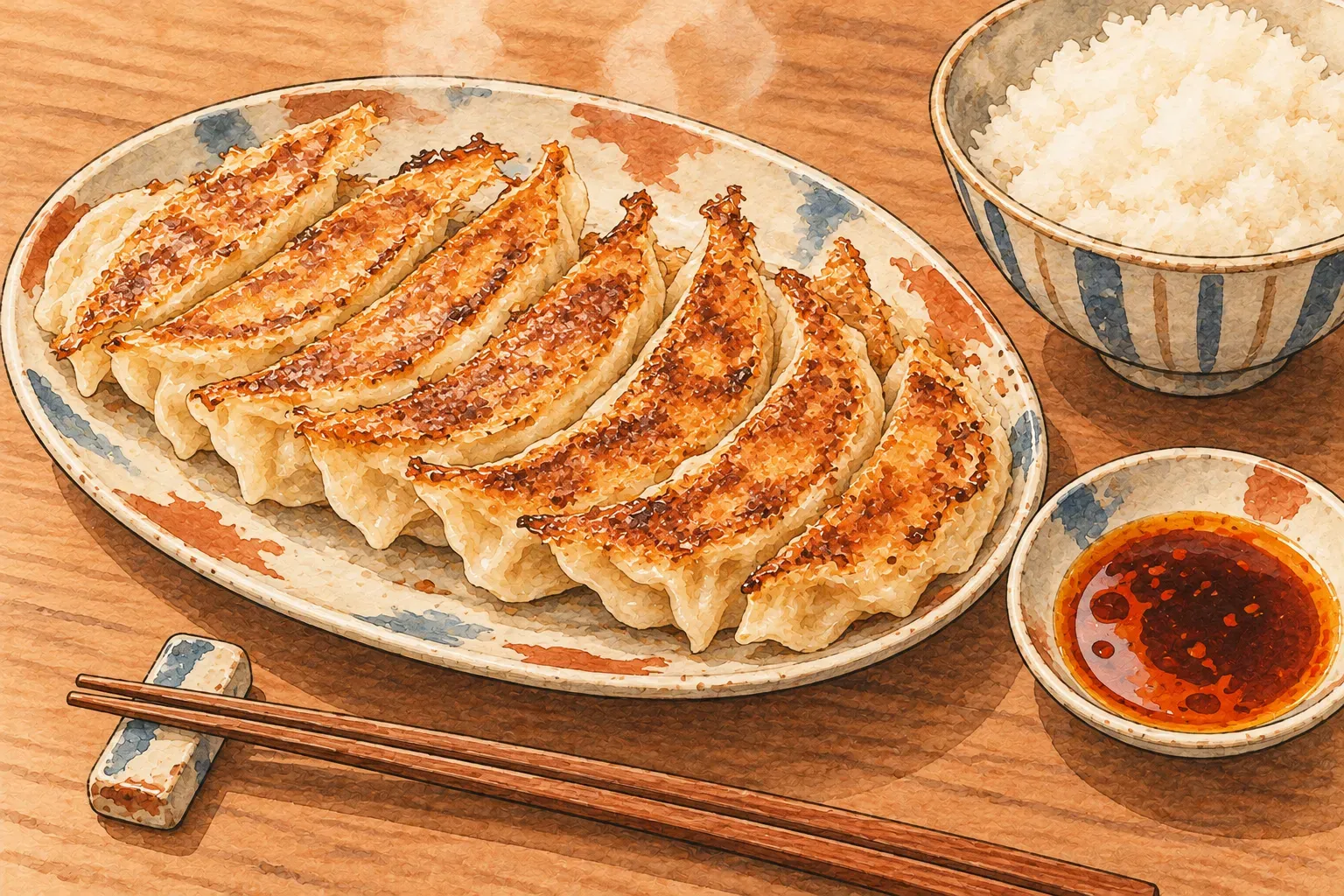
Gyoza look like the most Chinese thing on a Japanese menu, and in one sense they are. But the plate you are served in Japan — six pan-fried dumplings, browned on one side, with a bowl of rice and a saucer of soy, vinegar and chilli oil — is a postwar Japanese arrangement, and it is not how China mostly eats them. This page is the map: what changed on the way, what a plate costs, and what the famous rivalry between Utsunomiya and Hamamatsu is actually measuring. The lineage pages go deep on one town at a time.
What it is
A thin wheat wrapper folded around a filling of minced meat and vegetables, cooked one of four ways: boiled, steamed, pan-fried or deep-fried. All four exist in China. What differs is which one is normal and what the dumpling is for.
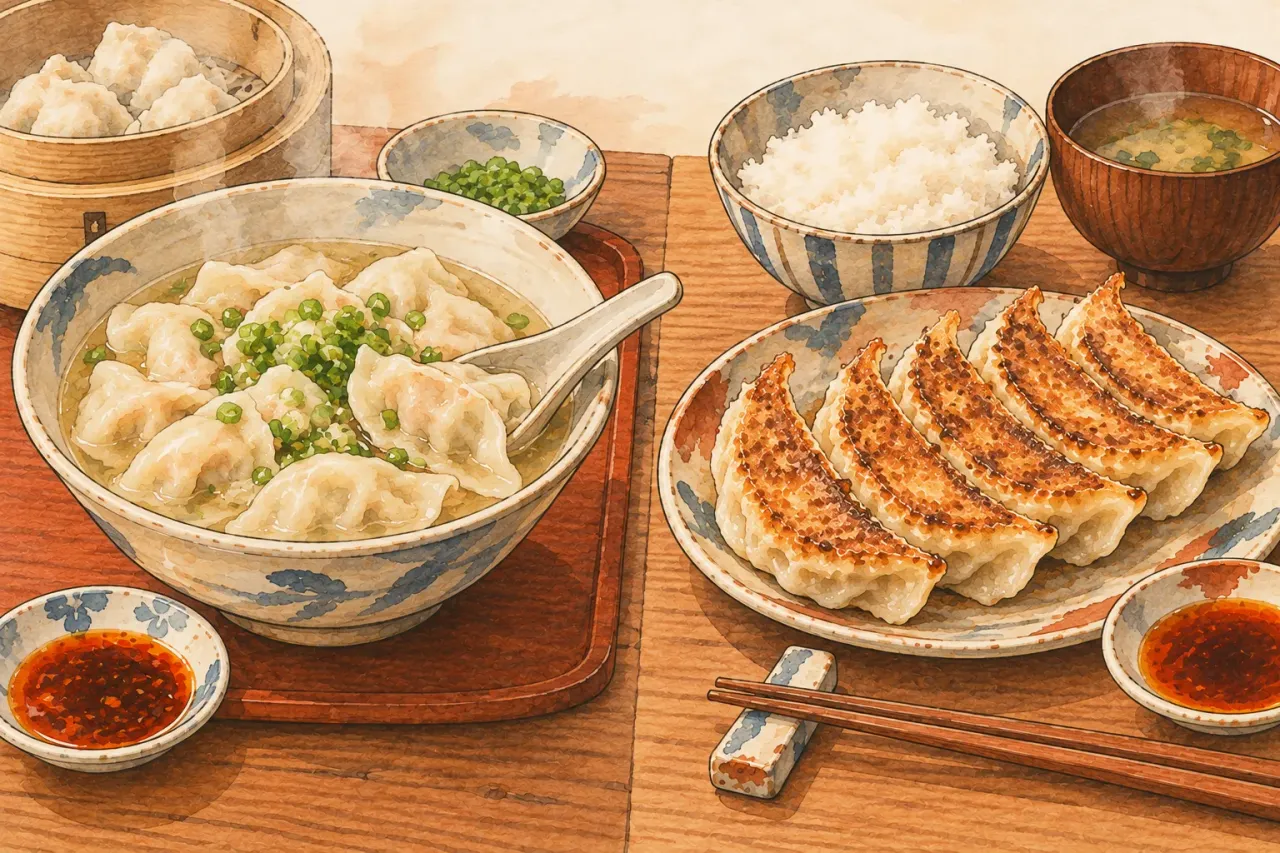
A lecture published by the Kikkoman food culture research centre sets out the contrast. In China the dumpling is a food for the Lunar New Year — the lecturer compares it to zōni, the soup Japan eats at New Year — and the boiled dumpling (shuǐjiǎo, Japanese sui-gyōza) is the mainstream. It is eaten as the staple, the meal itself, and raw garlic is put on the table to bite between dumplings. In Japan the pan-fried dumpling (yaki-gyōza) is the mainstream, it is eaten as a side dish with rice, and the garlic usually goes into the filling.
Nobody knows exactly when the dumpling began. The same lecture says it is thought to date from around the Tang dynasty, and that dried dumplings have been found in the ruins at Dunhuang.
Japan knew about it long before it ate it. A cookbook of 1778, the Takkuchōhōhō, describes deep-fried, pan-fried and steamed dumplings, but as an introduction to Chinese cooking, not as something Japanese people were eating. After the Meiji era the Chinatowns of Yokohama and Kobe served them, and still they did not become everyday food.
What changed it was the end of the war. Two sources point the same way:
- The repatriates. Japanese returning from China after 1945 are said to have introduced the dumplings they had eaten there, and the dish spread quickly. The Kikkoman lecture quotes a 1956 essay by the scholar Okuno Shintarō describing gyoza shops “flooding” the town as a new phenomenon since repatriation from the continent became active.
- Manchuria preferred them fried. The farm ministry’s local-food database, in its entry on Kobe’s miso-sauce gyoza, says the Japanese living in Manchuria before the war preferred pan-fried dumplings to the boiled ones their Chinese neighbours ate. After the war a man back from Manchuria opened a diner in Shinkaichi, Kobe, serving pan-fried gyoza with a miso sauce, and it became talked about among other repatriates.
So “repatriates brought it home” is common ground. Where Japan’s pan-fried gyoza began is not. Utsunomiya, Kobe and Fukuoka each tell their own story, and I have not found a primary source that settles which came first. This site does not pick one.
Why it is the way it is
Two things explain most of what you will see on a Japanese gyoza menu.
It is a side dish, so it is fried. Because Japan eats gyoza with rice rather than as the meal, a crisp, savoury pan-fried dumpling fits the plate better than a boiled one. The Kikkoman lecture makes the comparison between rice-eating Japan and dumpling-as-staple China; I would not push it further than a comparison. You can see the logic on menus: Utsunomiya Minmin sells a set of two portions of pan-fried, one of boiled, and rice, and describes its boiled gyoza as standing in for soup.
The portion is the shop’s decision. Six pieces is common, but it is not a rule. Utsunomiya Minmin serves six pieces weighing 120 g in all. Gyoza no Ohsho serves six, and also a three-piece “just size” plate. Hidakaya sells three or six. At Utsunomiya’s gyoza festival a plate is three to five pieces depending on the stall. When a menu says “one portion” (ichi-ninmae), read the count.
The sauce is mixed by you. The farm ministry describes the ordinary sauce for pan-fried gyoza as vinegar, soy sauce and chilli oil mixed together, and the shops put the three bottles on the table for that reason. Kobe’s miso sauce — miso with soy, vinegar, sugar and chilli oil — is the best-documented regional exception, and the ministry adds that the mix differs from house to house and shop to shop.
What it costs
Gyoza, one plate 餃子(1皿)
- Chains
- ¥300–¥363Pan-fried gyoza, six pieces · Hidakaya, Osaka Ohsho, Gyoza no Ohsho · tax incl. · checked 2026-10-05
- Our guide figure
- from ¥400 (≈ €2 / $3)A side dish in Japan, not a main · Oct 2026
The figures above are kept on the price reference page and update there. Prices below are tax included, as posted by the operator on the date at the top of this page.
- The chain plate. Hidakaya: three pieces ¥160, six ¥300. Gyoza no Ohsho on its Kanto menu: six pieces ¥363, the three-piece “just size” ¥192, six to take away ¥356. Ohsho says its menus differ by region, so these are Kanto prices only.
- The specialist plate. Utsunomiya Minmin’s Miyamirai shop lists pan-fried, deep-fried and boiled gyoza at the same price, ¥380 for six, on the Utsunomiya Gyoza Association’s page, which states that all prices include tax.
- The festival plate. At the Utsunomiya Gyoza Festival every plate is sold at one flat price, three to five pieces depending on the shop. The organiser does not say whether that price includes tax, so it is not given here.
- The neighbourhood Chinese diner (machi-chūka) is where many Japanese people eat gyoza, but these shops rarely publish prices, and I have not given any.
The practical reading: at a chain, a plate of six gyoza costs less than a bowl of ramen on the same menu — at Hidakaya ¥300 against ¥420 for chūka soba, and on Gyoza no Ohsho’s eastern menu ¥363 against ¥748, all including tax.
The lineages
The table is kept in one place so that every lineage is described on the same terms. Rows without a link are on the list but not written yet.
| Lineage | Origin | How it is cooked | On the plate | Sauce | What the town is known for |
|---|---|---|---|---|---|
| Utsunomiya 宇都宮餃子 | Utsunomiya, Tochigipostwar; brand from 1993 | Pan-fried, deep-fried and boiled, often at the same price | No fixed style; one leading shop serves six pieces of 20 g, mostly vegetable | Soy, vinegar and chilli oil, mixed to taste | Top household spender on gyoza for 15 years to 2010; a trademarked town brand and a November festival |
| Hamamatsu 浜松餃子 | Hamamatsu, Shizuoka1953 (one shop's story) | Pan-fried, laid in a circle around the pan | A round 'wheel' of 20 or 25, boiled bean sprouts in the middle | A slightly sweet vinegar-soy; chilli oil to taste | Top household spender on gyoza since 2011 in most years, and on the 2023–25 average |
| Kobe miso-sauce gyoza味噌だれ餃子(神戸) | Shinkaichi, Kobe— | Pan-fried | — | Miso mixed with soy, vinegar, sugar and chilli oil; varies by house | Listed by the farm ministry as a Hyōgo local dish |
| Hakata one-bite gyoza博多一口餃子 | Fukuoka city— | Pan-fried | Bite-sized | — | Small dumplings for drinking; a Nakasu shop dates itself to 1949 |
Lineages without a link are on the list but not written yet. The table is kept in one place so every lineage is described on the same terms.
A few things the table cannot show:
- The rivalry is about a statistic. Utsunomiya and Hamamatsu are famous as gyoza towns because of a line in the government household survey, not because of a style. Utsunomiya built its brand after city staff announced in 1990 that it led the survey; Hamamatsu overtook it for the first time in 2011.
- Utsunomiya has no house style. Its gyoza association, which owns the trademark, does not define taste, shape or filling. The town’s identity is the number of shops and the choice between fried, deep-fried and boiled.
- Hamamatsu’s look comes from one shop’s story. The ring of dumplings with bean sprouts in the middle is told as the invention of a station-front stall in 1953. It is the image of the town, not a rule every shop follows.
Where to eat it
- Utsunomiya — the specialist shops and the November festival in the castle-ruins park. The festival in 2026 is on 7 and 8 November.
- Hamamatsu — the round plate with bean sprouts and a slightly sweet vinegar-soy, at the shop whose story it is.
- Kobe — miso sauce, in Shinkaichi, where the ministry places its origin.
- Fukuoka — the bite-sized hitokuchi gyoza of the Nakasu drinking district. The city’s tourism site features a shop there started in 1949 by a founder back from the Chinese mainland.
Check fares and journey times with the operator before you travel.
The same name, a different plate
Each lineage page ends with what changes when the dish leaves home. For gyoza the pattern is short:
- The famous towns spend more at home, not necessarily in restaurants. On the household survey’s 2023–25 average, households spent ¥4,051 a year on gyoza in Hamamatsu and ¥3,192 in Utsunomiya, against ¥2,110 in central Tokyo and ¥1,984 nationally. That is money spent on fresh or cooked gyoza from shops and takeaway specialists. Frozen gyoza and eating out are not counted, and Shizuoka’s statistics office says plainly that the figure does not show how many gyoza anyone eats.
- Chains and specialists price differently. In Utsunomiya a specialist sells three cooking styles at one price; in Tokyo the big chains sell by count, down to a three-piece plate. The two are not the same kind of shop, so I would not call one cheaper.
- The town name is a brand only at home. “Utsunomiya gyoza” has been a registered trademark of the town’s gyoza association since 2002. What a shop outside Utsunomiya needs to use the name, I could not find.
What people get wrong
- “Gyoza are Japanese.” The dumpling is Chinese and very old. What is Japanese is the pan-fried, rice-side-dish plate, and that took hold after 1945.
- “Pan-fried is the Chinese way.” In China all four methods exist, but boiled is the mainstream, and the dumpling is the meal.
- “Utsunomiya eats the most gyoza in Japan.” It led the household spending survey for 15 years to 2010. Since 2011 the top place has moved between Hamamatsu, Utsunomiya and Miyazaki, and the survey measures shop-bought spending, not how many are eaten.
- “One portion is six.” It is whatever the shop says — three, five, six, or a wheel of 20.
- “There is a correct sauce.” The ordinary sauce is soy, vinegar and chilli oil mixed at the table, in proportions you choose. Kobe uses miso; Hamamatsu’s best-known shop uses its own sweetish vinegar-soy.
- “Utsunomiya gyoza have a recipe.” The association that owns the name does not define one.
Questions people ask
Are Japanese gyoza the same as Chinese dumplings?
They come from the same food, but they are eaten differently. In China the dumpling is mostly boiled, eaten as the meal itself, and is a dish of the Lunar New Year. In Japan it is mostly pan-fried and eaten as a side dish with rice, with the garlic usually inside the filling rather than on the table.
How many gyoza are in one portion?
Whatever the shop decides. Six is common (Utsunomiya Minmin, Gyoza no Ohsho), but Ohsho also sells a three-piece "just size" plate and Hidakaya sells both three and six. There is no rule that a portion means six.
Which city eats the most gyoza?
Nobody measures that. The famous ranking is the government household survey, which records what households spend on fresh or cooked gyoza bought from shops and takeaway specialists. It leaves out frozen gyoza and eating out. On the 2023–25 average Hamamatsu spent most, then Miyazaki, then Utsunomiya.
Sources
- キッコーマン国際食文化研究センター 食文化講座 大塚秀明「日中餃子文化研究」
- 農林水産省 うちの郷土料理「味噌だれ餃子」兵庫県
- 農林水産省 ニッポンフードシフト「餃子の食べ方47」
- 総務省統計局 家計調査 品目別都道府県庁所在市及び政令指定都市ランキング(2023〜2025年平均)
- 総務省統計局 家計調査 品目別ランキング 調理食品(ぎょうざ)
- 浜松市 報道発表「家計調査『ぎょうざ』」
- 静岡県統計センター「家計調査と浜松餃子の関係」
- 栃木県「餃子」
- 宇都宮餃子会 公式「宇都宮餃子会について」
- 宇都宮餃子会 店舗ページ「宇都宮みんみん 宮みらい店」(価格)
- 宇都宮餃子会「宇都宮餃子祭り2026」
- 宇都宮みんみん 公式「餃子について」
- 石松餃子 公式「こだわり餃子」
- 浜松・浜名湖ツーリズムビューロー「石松餃子」
- 餃子の王将 公式 餃子(関東メニュー)
- 餃子の王将 公式 餃子ジャストサイズ
- 餃子の王将 公式 メニュー(地域別メニューの説明)
- 日高屋 公式 メニュー「おつまみ」
- 日高屋 公式 メニュー「中華そば」
- 餃子の王将 公式「忘れられない中華そば」(東日本メニュー)
- クロスロードふくおか「博多一口餃子」
Prices are in Japanese yen. Conversions are approximate, at ¥177.30 to the euro and ¥158.23 to the US dollar as of 20 Oct 2026. Rates come from the European Central Bank, which publishes on working days only. Prices checked Oct 2026. What food costs in Japan →