
Utsunomiya gyoza: a town brand built on a statistic, and what the plate costs there
I have not been to every place in this guide. The figures below are taken from the sources listed at the end, with the date each one was published — not measured by me. Where I have been, the article says so.
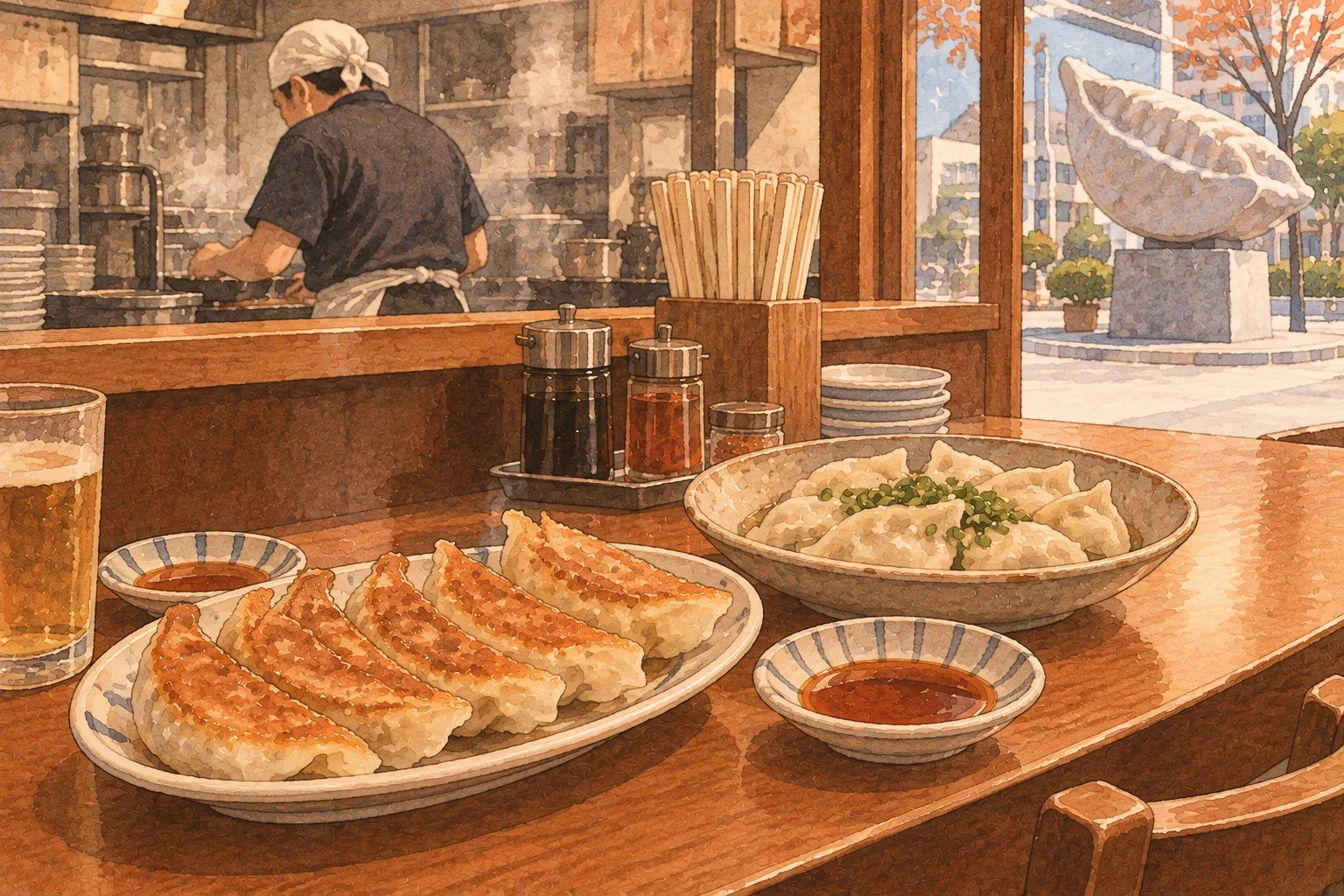
Utsunomiya is Japan’s best-known gyoza town. What it does not have is a recipe. Its fame rests on a line in a government spending survey, a group of city employees who noticed it in 1990, and three decades of the town building a brand around the number. That is not a criticism. It is the most honest food story in Japan: a town that realised it already ate something a lot, and decided to say so.
This page is about where Utsunomiya’s gyoza came from, what the famous ranking measures, how to order, and what a plate costs there. For how gyoza sits in Japanese food generally, start from the gyoza overview.
Where it came from
Tochigi prefecture gives three explanations and, unusually, declines to choose.
- The repatriates. On one of its pages, the prefecture says the most widely held view is that people returning from China after the war brought the dumpling back. This fits the national story: across Japan, gyoza spread as everyday food after 1945, carried by repatriates.
- The climate. Another prefectural page offers the idea that Utsunomiya’s inland climate, with big swings between hot and cold, made a filling, stamina-giving food like gyoza popular.
- The army. The same page gives a third: that soldiers of the 14th Division, stationed in Utsunomiya, ate dumplings when the division went to north-east China, and spread them on their return.
Then the page says, in as many words, that the truth is not known. That is the official position, and this site keeps it.
The town’s first gyoza shop is sometimes named in Japanese-language sources, but I could not confirm it from a primary source, so it is not given here.
What makes it Utsunomiya gyoza
No definition. The Utsunomiya Gyoza Association, which owns the trademark, describes its history and members but sets no standard for taste, shape or filling. “Utsunomiya gyoza” means gyoza from the town’s shops.
One shop as an example. Utsunomiya Minmin, one of the best-known names, describes its own gyoza in detail on the association’s page: each piece weighs 20 g, the wrapper is 1.0 mm thick, and the filling is about 7.5 parts vegetable to 2.5 parts meat. The ingredients listed for its frozen raw gyoza include Chinese cabbage, cabbage, onion, Japanese leek, ginger, garlic chives, garlic, pork and sesame oil. Treat that as one shop’s recipe, not a town rule.
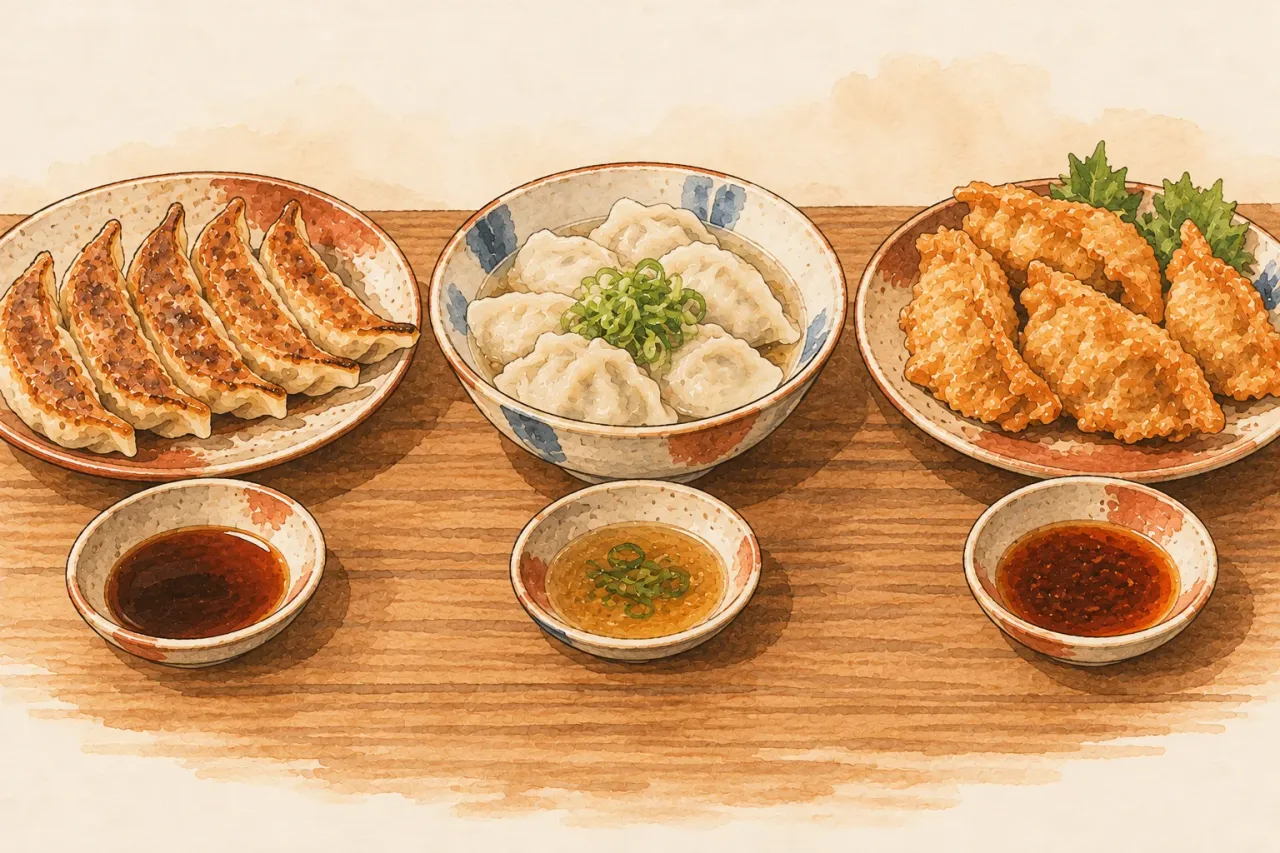
Three ways, one price. What you are most likely to notice is the choice. Minmin sells pan-fried, deep-fried and boiled gyoza, six pieces each, all at the same price, and says its boiled gyoza can stand in for soup. The festival goes further: in 2025 its 25 stalls served pan-fried, deep-fried, boiled-in-soup and plain boiled gyoza.
Why Utsunomiya
Because of a statistic, and because the town acted on it.
The government’s household survey records what households of two or more people spend each year on many foods, by prefectural capital and major city. One line is gyōza. As Hamamatsu city explains it, that line covers fresh or pan-fried gyoza from supermarkets and similar shops, and takeaway from gyoza specialists. It does not include frozen gyoza or takeaway from Chinese restaurants, and the Shizuoka statistics office adds that eating out is not counted either — so the figure, in its words, does not show how many gyoza anyone eats.
By that measure Utsunomiya was first in Japan for 15 consecutive years up to 2010. The gyoza association’s own timeline shows what the town did with the fact:
- 1990 — a research group of city employees announced that Utsunomiya’s household spending on gyoza was the highest in Japan.
- 1991 — the tourism association published a map of 23 gyoza shops.
- 1993 — the Utsunomiya Gyoza Association was formed with 38 shops.
- 1999 — the first Utsunomiya Gyoza Festival, with 20,000 visitors.
- 2001 — the association became a cooperative.
- 2002 — “Utsunomiya gyoza” was registered as a trademark.
In 2011 Hamamatsu took first place for the first time. Since then the top spot has moved around. In the decade Hamamatsu city has tabulated, Utsunomiya was first in 2017 (¥4,259) and 2019 (¥4,358), and second in 2015, 2016, 2018, 2020, 2022 and 2025 (¥3,575). On the survey’s 2023–25 average it is third: Hamamatsu ¥4,051, Miyazaki ¥3,478, Utsunomiya ¥3,192, against a national ¥1,984.
How many shops? It depends on whose count. The association’s overview gave 145 member shops in May 2023; the shop listings by area on its home page add up to about 90; the prefecture said about 80 in 2016. They are counting different things at different times, so I give all three rather than one.
The shops, and what they charge
Prices below are tax included, as posted on the date at the top of this page.
Gyoza, one plate 餃子(1皿)
- Chains
- ¥300–¥363Pan-fried gyoza, six pieces · Hidakaya, Osaka Ohsho, Gyoza no Ohsho · tax incl. · checked 2026-10-05
- Our guide figure
- from ¥400 (≈ €2 / $3)A side dish in Japan, not a main · Oct 2026
Those are national chain figures. In Utsunomiya:
- Utsunomiya Minmin, Miyamirai shop. Pan-fried, deep-fried and boiled gyoza, six pieces each, ¥380 each, on the association’s shop page, which states that all prices include tax. Minmin’s own site gives the same ¥380 for six pan-fried (120 g) but does not say whether tax is included, so the association’s page is the one used here.
- The festival. ¥200 a plate, three to five pieces depending on the stall. The organiser does not state whether that includes tax.
How to order it
Choose the cooking. Where a shop offers all three, you do not have to pick one. Minmin sells a set built on exactly that: two portions of pan-fried, one of boiled, and rice (¥1,360; tax not stated on its own site).
Mix your own sauce. Minmin’s advice is to use the soy sauce, vinegar and chilli oil on the table as you like. There is no house ratio to follow. The farm ministry describes the same three as the ordinary sauce for pan-fried gyoza anywhere in Japan.
Count the plate. At Minmin a portion is six; at the festival it is whatever the stall serves for ¥200, three to five pieces.
Not all of Japan’s gyoza is this
- Hamamatsu lays its gyoza in a ring in the pan and serves them with boiled bean sprouts in the middle and a slightly sweet vinegar-soy. Its best-known shop dates the style to a station-front stall in 1953. See the Hamamatsu page.
- Kobe dips pan-fried gyoza in a miso sauce — miso mixed with soy, vinegar, sugar and chilli oil — a local dish the farm ministry traces to a diner opened in Shinkaichi by a man back from Manchuria.
- Fukuoka eats small, one-bite gyoza in its drinking district; a shop in Nakasu dates itself to 1949.
- Miyazaki led the spending survey in 2021 and 2022, ahead of both famous towns.
Eating it in Utsunomiya, and getting there
The festival. The Utsunomiya Gyoza Festival 2026 is on Saturday 7 and Sunday 8 November, 09:00–17:00, at Utsunomiya Castle Ruins Park. It is the easiest way to compare many shops in one afternoon, at ¥200 a plate.
The shops. The association’s site lists member shops by area, with a page for each.
Getting there. Check fares and journey times from Tokyo with the rail operator before you travel.
Utsunomiya gyoza away from Utsunomiya
Most people who eat gyoza in Japan eat them in Tokyo, at a chain, and it is worth knowing what is and is not the same.
The town spends more at home. On the 2023–25 survey average, Utsunomiya households spent ¥3,192 a year on shop-bought gyoza, central Tokyo ¥2,110. That is a difference in what families buy to eat at home, not in what restaurants serve or how good it is.
The price is built differently. In Utsunomiya, Minmin sells three cooking styles at one price, ¥380 for six. In Tokyo the big chains price by count: Gyoza no Ohsho’s Kanto menu has six pieces at ¥363 and a three-piece “just size” plate at ¥192; Hidakaya sells three for ¥160 and six for ¥300. These are different kinds of shop — a specialist and two national Chinese-diner chains — so the comparison is about how the plate is designed, not which town is cheaper. Ohsho also says its menus differ by region.
The name is protected at home. “Utsunomiya gyoza” is the association’s registered trademark. What a shop elsewhere would need to use the name, I could not find, so I would not read a Tokyo sign saying “Utsunomiya gyoza” as a guarantee of anything.
What people get wrong
- “Utsunomiya eats the most gyoza in Japan.” It led a survey of household spending on shop-bought gyoza for 15 years to 2010. On the 2023–25 average it is third. Nobody counts how many gyoza a city eats.
- “Utsunomiya invented Japanese gyoza.” Its own prefecture says nobody knows how gyoza came to the town, and other cities have their own postwar stories.
- “There is an Utsunomiya recipe.” The association that owns the name does not define one. Shops differ.
- “Gyoza means pan-fried.” In Utsunomiya the deep-fried and boiled versions are on the same menu at the same price.
- “The town has always been the gyoza town.” The brand dates from 1990, when city staff noticed the statistic.
Questions people ask
Does Utsunomiya eat the most gyoza in Japan?
Not by any count that exists. The ranking behind its fame is the government household survey of spending on shop-bought fresh or cooked gyoza, which leaves out frozen gyoza and eating out. Utsunomiya led it for 15 years to 2010. On the 2023–25 average it was third, behind Hamamatsu and Miyazaki.
What makes a gyoza "Utsunomiya gyoza"?
Being made in Utsunomiya, mostly. The town's gyoza association owns the trademark but does not define a taste, shape or filling. What visitors notice is the number of shops and the choice of pan-fried, deep-fried or boiled at many of them.
How much is a plate in Utsunomiya?
At Utsunomiya Minmin's Miyamirai shop, six pieces of pan-fried, deep-fried or boiled gyoza are ¥380 each, tax included. At the November festival a plate is ¥200 for three to five pieces.
Sources
- 栃木県「宇都宮餃子」
- 栃木県「餃子」
- 宇都宮餃子会 公式「宇都宮餃子会について」(沿革・加盟店数)
- 宇都宮餃子会 公式トップ(エリア別店舗)
- 宇都宮餃子会 店舗ページ「宇都宮みんみん 宮みらい店」(価格)
- 宇都宮餃子会「宇都宮餃子祭り2025」
- 宇都宮餃子会「宇都宮餃子祭り2026」
- 宇都宮みんみん 公式「餃子について」
- 宇都宮みんみん 公式トップ(冷凍生餃子の原材料)
- 総務省統計局 家計調査 品目別ランキング 調理食品(ぎょうざ、2023〜2025年平均)
- 浜松市 報道発表「家計調査『ぎょうざ』」(過去10年の順位)
- 静岡県統計センター「家計調査と浜松餃子の関係」
- キッコーマン国際食文化研究センター 食文化講座 大塚秀明「日中餃子文化研究」
- 農林水産省 うちの郷土料理「味噌だれ餃子」兵庫県
- 餃子の王将 公式 餃子(関東メニュー)
- 餃子の王将 公式 餃子ジャストサイズ
- 日高屋 公式 メニュー「おつまみ」
Prices are in Japanese yen. Conversions are approximate, at ¥177.30 to the euro and ¥158.23 to the US dollar as of 20 Oct 2026. Rates come from the European Central Bank, which publishes on working days only. Prices checked Oct 2026. What food costs in Japan →