
Hamamatsu gyoza: the wheel on the plate, the bean sprouts in the middle, and the survey it now leads
I have not been to every place in this guide. The figures below are taken from the sources listed at the end, with the date each one was published — not measured by me. Where I have been, the article says so.
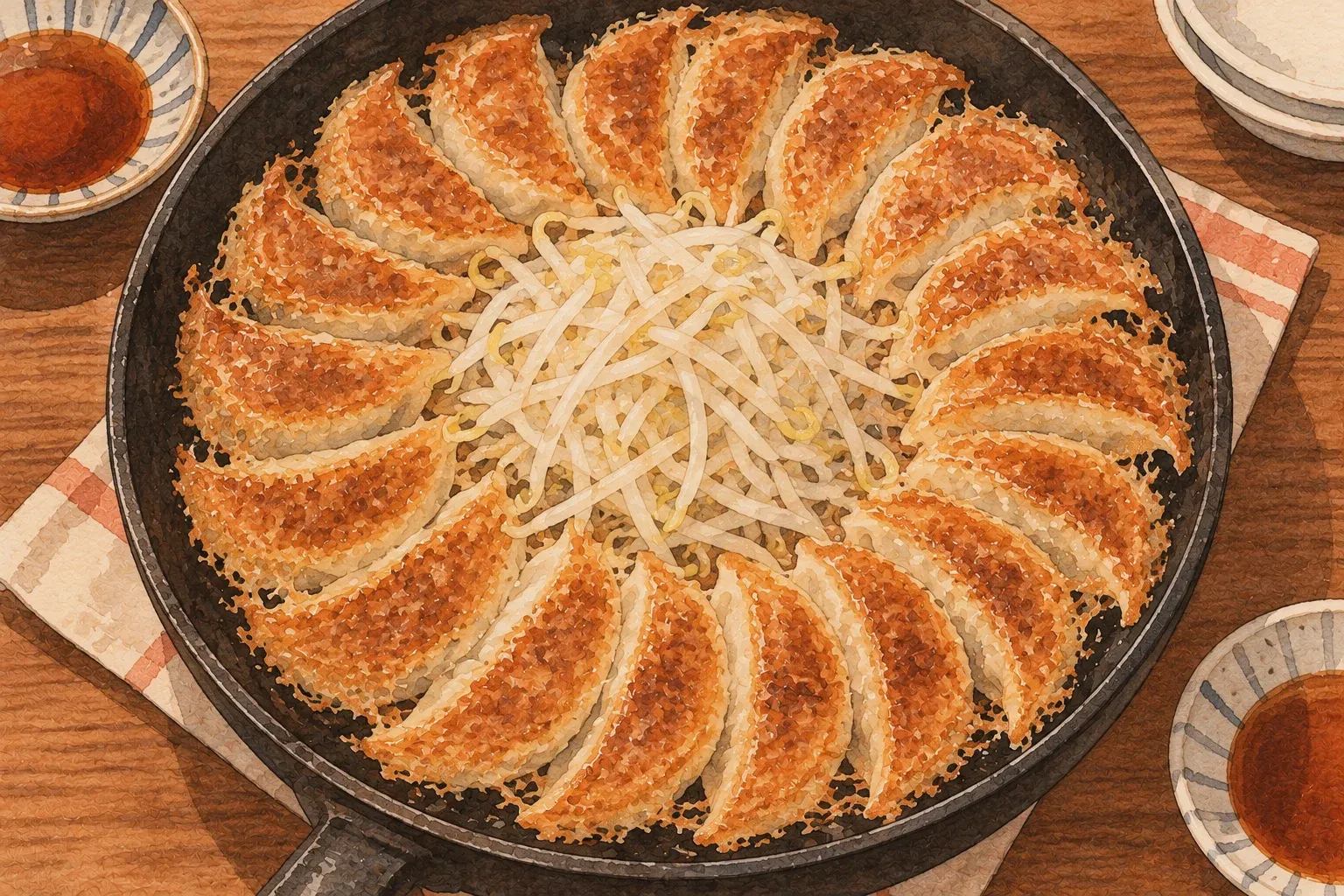
Hamamatsu gyoza are the ones you can recognise from across the room: a ring of browned dumplings filling the plate like the spokes of a wheel, with a heap of boiled bean sprouts in the hub. It is one of the few Japanese gyoza styles with a look of its own, and the story behind it is a practical one — a station-front stall that needed to fry a lot of dumplings at once.
This page is about where that plate came from, why the sprouts are there, and what the gyoza ranking Hamamatsu now leads is actually counting. For gyoza in Japan generally, start from the gyoza overview.
Where it came from
The story belongs to one shop, and it is told as that shop’s story.
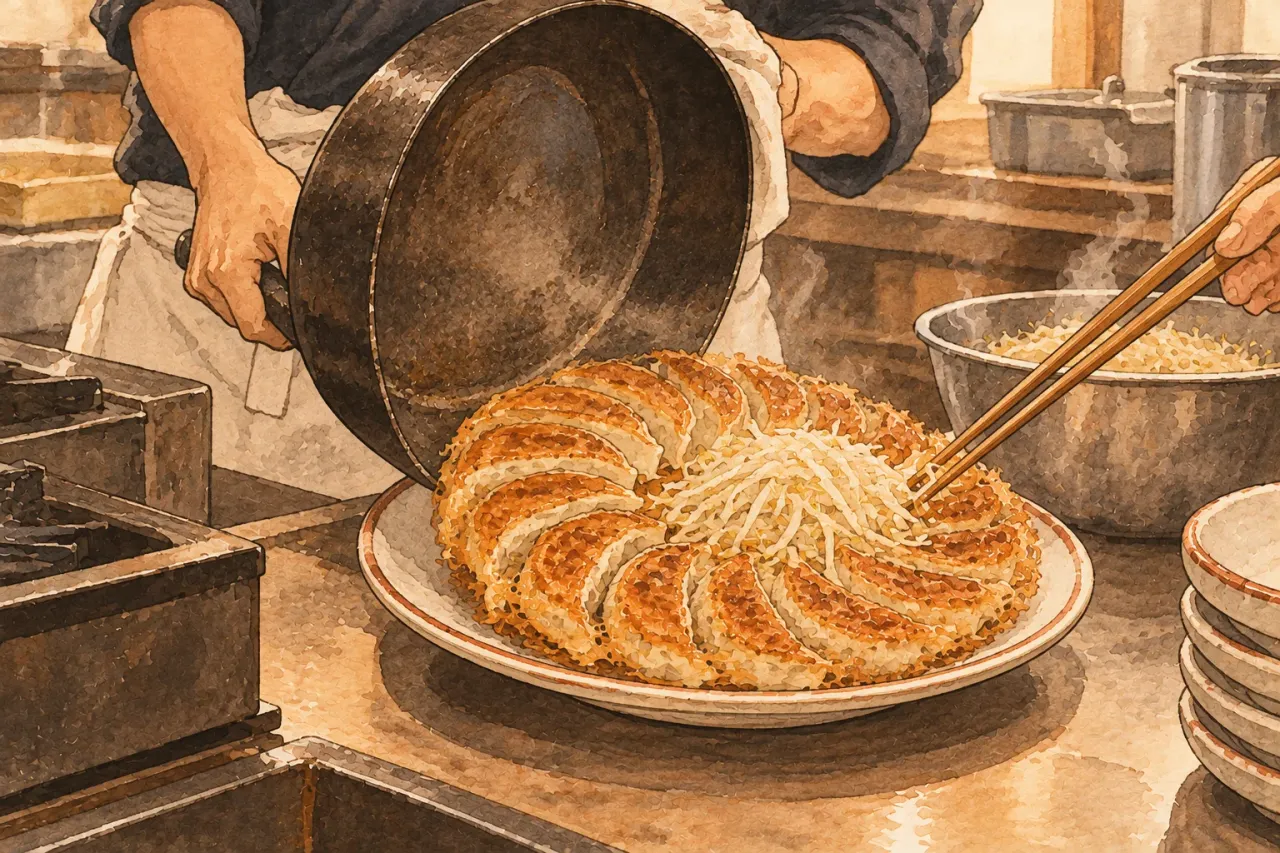
The tourism bureau for Hamamatsu and Lake Hamana introduces Ishimatsu Gyoza this way: it began in 1953 as a stall in front of Hamamatsu station. As customers multiplied, the founder arranged the dumplings in a circle following the edge of the frying pan, so that more could be cooked efficiently at once. The ring was likened to a cart wheel, and the style came to be called kuruma-mori, “wheel serving”. The space in the middle looked bare, so he filled it with boiled bean sprouts.
Two cautions. First, this is the shop’s history as the bureau relays it; I have not found other Hamamatsu shops’ accounts, or an independent record. Second, Ishimatsu’s own page on how to fry its gyoza says only to spread sesame oil around the pan in a circle — it does not describe the ring arrangement. The ring is how the plate is served at the shop, not an instruction for cooking at home.
The city’s other claim to gyoza fame is much more recent, and it is statistical (see below).
What makes it Hamamatsu gyoza
The ring. Shizuoka prefecture’s statistics office describes Hamamatsu gyoza as fried in a circle with bean sprouts in the middle. At Ishimatsu the wheel comes in 20 or 25 pieces.
The bean sprouts. Ishimatsu’s own explanation is not decorative. Eating gyoza one after another leaves the mouth oily, and the sprouts reset it. It says the sprouts that work are thick and full of water.
The sauce. Ishimatsu makes its own slightly sweet vinegar-soy, which it says suits both the gyoza and the sprouts, and leaves chilli oil to the customer.
What it is not. No source used for this page says every Hamamatsu shop serves the ring, and a local definition of “Hamamatsu gyoza” that circulates in Japanese could not be traced to a primary source. Read the ring as the town’s best-known style, not its law.
Why Hamamatsu
The round plate made Hamamatsu gyoza recognisable. The household survey made it famous.
The government’s household survey records what households of two or more people spend each year on many foods, by prefectural capital and major city. The gyōza line, as Hamamatsu city explains it, covers fresh or pan-fried gyoza from supermarkets and similar shops plus takeaway from gyoza specialists. It does not cover frozen gyoza or takeaway from Chinese restaurants, and the Shizuoka statistics office adds that eating out is not counted either — so the number does not show how many gyoza anyone eats.
Utsunomiya led that line for 15 years up to 2010. In 2011 Hamamatsu was first for the first time, at ¥4,314 against Utsunomiya’s ¥3,737 and a national average of ¥2,181. The statistics office points out that on the three-year average for 2009–11, Utsunomiya was still ahead (¥4,686).
Since then, in the decade Hamamatsu city has tabulated, Hamamatsu has been first in 2015 (¥4,646), 2016 (¥4,819), 2018 (¥3,501), 2020 (¥3,765), 2023 (¥4,041), 2024 (¥4,066) and 2025 (¥4,046). Utsunomiya took 2017 and 2019; Miyazaki took 2021 and 2022. On the survey’s 2023–25 average, Hamamatsu leads at ¥4,051, ahead of Miyazaki (¥3,478) and Utsunomiya (¥3,192), with the national figure at ¥1,984.
The definition matters when reading the ranking: takeaway from gyoza specialists counts, restaurant meals and frozen packs do not.
The shops, and what they charge
Gyoza, one plate 餃子(1皿)
- Chains
- ¥300–¥363Pan-fried gyoza, six pieces · Hidakaya, Osaka Ohsho, Gyoza no Ohsho · tax incl. · checked 2026-10-05
- Our guide figure
- from ¥400 (≈ €2 / $3)A side dish in Japan, not a main · Oct 2026
Those are national chain figures. For Hamamatsu itself, Ishimatsu’s prices appear on the tourism bureau’s page, but I could not confirm them on the shop’s own site, so they are not given here. The wheel of 20 or 25 is three to four times the six-piece portion of the national chains.
How to order it
Order the wheel. At Ishimatsu the plate is 20 or 25 pieces with sprouts.
Eat the sprouts between the gyoza. That is what the shop says they are for.
Use the house sauce first. It is a sweetish vinegar-soy made by the shop; chilli oil is there if you want it.
Not all of Japan’s gyoza is this
- Utsunomiya has no single style. Its shops are known for serving pan-fried, deep-fried and boiled gyoza, often at the same price — six for ¥380 including tax at Utsunomiya Minmin’s Miyamirai shop — and its festival in November sells plates of three to five at one flat price. See the Utsunomiya page.
- Kobe dips pan-fried gyoza in a miso sauce, a local dish the farm ministry traces to a diner opened after the war by a man back from Manchuria.
- Fukuoka eats small one-bite gyoza in the Nakasu drinking district; the city’s tourism site features a shop there opened in 1949 by a founder back from the Chinese mainland, filled with onion, mince and garlic chives.
Eating it in Hamamatsu, and getting there
Ishimatsu. The shop whose story the ring is. It began as a stall in front of Hamamatsu station.
Getting there. Check fares and journey times with the operator before you travel.
Hamamatsu gyoza away from Hamamatsu
The look may not travel. The ring with sprouts is a Hamamatsu shop style. How often you will see it served that way in Tokyo or Osaka, I could not find out, so I would not expect it.
The plate is sized differently. In Tokyo the national chains sell gyoza in threes and sixes — Hidakaya three for ¥160 and six for ¥300, Gyoza no Ohsho’s Kanto menu six for ¥363, all including tax as the chains list them. The wheel of 20 or 25 is a Hamamatsu idea of a plate.
The ranking is about home. Hamamatsu spent ¥4,051 a year per household on shop-bought gyoza on the 2023–25 average; central Tokyo spent ¥2,110 per household. That says Hamamatsu families bring home more gyoza. It says nothing about whose restaurants are better, and this site does not rank them.
What people get wrong
- “Hamamatsu eats the most gyoza.” It spends the most on shop-bought gyoza in a household survey that excludes frozen gyoza and eating out. Nobody counts the dumplings.
- “Hamamatsu has always been number one.” It first came top in 2011. Utsunomiya led for 15 years before that and has come top twice since; Miyazaki has too.
- “The bean sprouts are a garnish.” By the shop’s account they are there to clear your palate between dumplings, and started as a way to fill the middle of the ring.
- “Every Hamamatsu shop serves a ring.” It is the best-known style, told as one shop’s invention. I could not confirm that all shops follow it.
Questions people ask
Why do Hamamatsu gyoza come with bean sprouts?
The story told for Ishimatsu, the best-known shop, is that its founder laid the gyoza in a ring to fry more at once, and added boiled bean sprouts because the middle of the ring looked empty. The shop's own explanation of why they stay is practical. The sprouts clear the oiliness from your mouth between dumplings.
Do all Hamamatsu gyoza come in a circle?
I could not confirm that. The ring with sprouts is the style the Shizuoka statistics office describes and the one Ishimatsu tells the story of, but no source used here says every shop in the city follows it.
Is Hamamatsu the top gyoza city in Japan?
On the government household survey, yes, in most recent years. It led on the 2023–25 average at ¥4,051 a year per household. The survey measures spending on shop-bought fresh or cooked gyoza, not how many are eaten, and leaves out frozen gyoza and eating out.
Sources
- 静岡県統計センター「家計調査と浜松餃子の関係」
- 浜松市 報道発表「家計調査『ぎょうざ』」
- 総務省統計局 家計調査 品目別都道府県庁所在市及び政令指定都市ランキング(2023〜2025年平均)
- 総務省統計局 家計調査 品目別ランキング 調理食品(ぎょうざ)
- 浜松・浜名湖ツーリズムビューロー「石松餃子」
- 石松餃子 公式「こだわり餃子」
- 石松餃子 公式「餃子の焼き方」
- 農林水産省 うちの郷土料理「味噌だれ餃子」兵庫県
- 宇都宮餃子会「宇都宮餃子祭り2026」
- 宇都宮餃子会 店舗ページ「宇都宮みんみん 宮みらい店」(価格)
- クロスロードふくおか「博多一口餃子」
- 餃子の王将 公式 餃子(関東メニュー)
- 日高屋 公式 メニュー「おつまみ」
Prices are in Japanese yen. Conversions are approximate, at ¥177.30 to the euro and ¥158.23 to the US dollar as of 20 Oct 2026. Rates come from the European Central Bank, which publishes on working days only. Prices checked Oct 2026. What food costs in Japan →