Arima Onsen: gold and silver water, a hot spring with no volcano, and the two public bathhouses
I have not been to every place in this guide. The figures below are taken from the sources listed at the end, with the date each one was published — not measured by me. Where I have been, the article says so.
Arima Onsen sits in Kita ward of Kobe, in a valley at the foot of the northern side of the Rokko mountains, as its tourism association puts it. It is known for two kinds of water — a brown kinsen, “gold spring”, and a clear ginsen, “silver spring” — and, among geologists, for being hot with no volcano nearby. This page covers where the water comes from, what the town’s sources say about its age, and how its two public bathhouses work. The ten official spring types and how to read the analysis sign are explained in the separate guide to onsen water types, and what free-flowing water means in the piece on kakenagashi; the Honshu overview puts Arima alongside the rest of Kansai.
Where it came from
The tourism association’s history page sets out several stories side by side and treats them as tradition — “it is said”, “it is told” — not as settled history. This page does the same and does not choose a starting point.
- Myth. In the age of the gods, Ōnamuchi and Sukunahikona are said to have first found the spring, according to the shrine history of Tōsen Jinja. Another story tells of three injured crows that bathed in a puddle and healed within days; the puddle was hot spring water.
- Written record. The association cites the Nihon Shoki for Emperor Jomei bathing at Arima for 86 days, from the 19th day of the 9th month to the 13th day of the 12th month of 631, and a later text for Emperor Kōtoku staying 82 days in 647. A University of Tsukuba release says only that, according to the Nihon Shoki, the spring was known by the first half of the 7th century.
- Gyōki. The monk Gyōki, trusted by Emperor Shōmu, is said to have revived Arima and laid its foundations, and to have carved a life-size statue of the healing Buddha, after which the town is said to have thrived for about 370 years. Kobe city’s page also credits Gyōki, in the Nara period, with reviving it and founding Onsen-ji temple. Neither gives a year.
- Flood and Ninsai. According to the Onsen-ji temple chronicle, a flood in 1097 destroyed the spring and it lay waste for about 95 years. The association adds that “there are various theories”. The monk Ninsai, who came from Yoshino after the Genpei war, following a dream from the Kumano deity, is said to have restored it, and in 1191 to have renovated Onsen-ji and run twelve lodging temples. Kobe city puts Ninsai’s twelve lodgings in the Kamakura period.
- Hideyoshi. The association calls 1583 the first recorded visit of Toyotomi Hideyoshi, and says he began a large repair of the springs in 1597, after an earthquake the year before had made the water suddenly much hotter. He died the following year, before the work bore fruit. The association also writes that no repair of the springs was made for about 350 years after his. Kobe city says he came to bathe, rebuilt a town left ruined by war and fire, and built the Yuyama palace, and that remains of its bath are shown at the Taikō no Yudono-kan museum. The University of Tsukuba release notes records of the water getting hotter after the 1596 earthquake, and also refers to records after earthquakes in 1854, 1899 and 1916.
How old, then? The association’s 631 date is about 1,400 years ago, and Kobe city speaks of a 1,400-year history. JNTO says “nearly 1,500 years”. None of them explains how it counts, so this page gives all of them and does not pick one.
“Three ancient springs.” The association’s spring page calls Arima Japan’s oldest onsen; its “About Arima” page calls it one of Japan’s three ancient springs; a 2022 guide page on its site says one of the “three ancient and three famous springs”. Kobe city says it is renowned as both. Hyogo prefecture’s October 2024 newsletter says it is “counted among” the three ancient springs, and the University of Tsukuba release calls it one of Japan’s oldest. The history page quotes Sei Shōnagon’s The Pillow Book, which names Arima among four hot springs, with Nanakuri and Nasu, and reads that as Arima already ranking among the three great springs, alongside Sakakibara. All of these say “counted” or “renowned”; none says who chose any of the groupings, and none is confirmed as officially chosen.
The water
Gold and silver
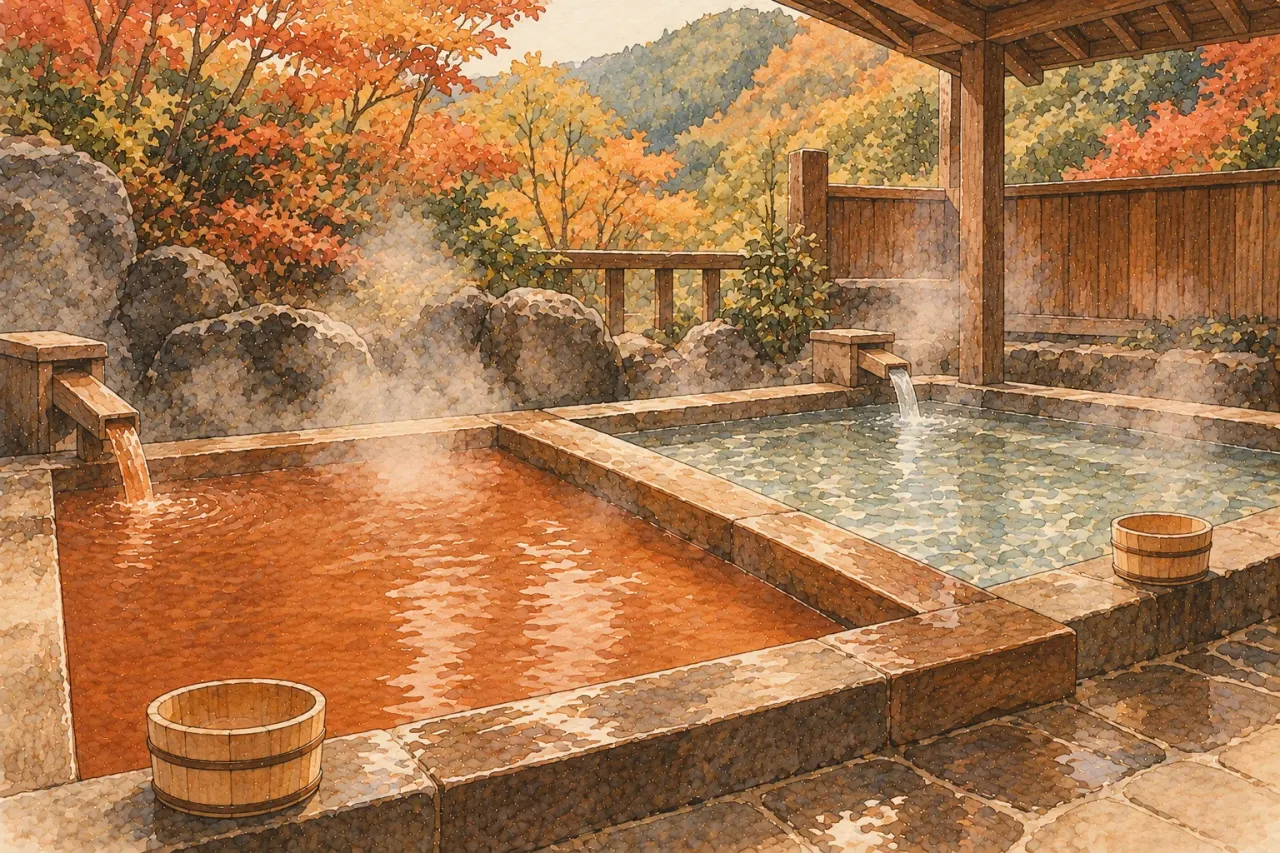
The association says Arima’s water contains seven of the nine main components the environment ministry’s guideline uses for therapeutic springs — all but sulphur and acidity — and is drawn from shallow depths, down to 300 m. Kinsen is “the water Arima has had since ancient times, containing iron and salt”. Ginsen is two things: water with carbonic acid, and water that, in the association’s words, contains radon. The official classification treats radioactive springs separately, so “contains radon” here is the association’s wording, not a spring type.
The other official descriptions match this split. Kobe city describes kinsen as brown and hot, and places the Tansan (carbonic) source under ginsen. The University of Tsukuba release says Arima has sources that give a hot kinsen, high in salt and iron, and sources that give a cool ginsen, with a lot of carbon dioxide and a little radon.
The association also lists indications for each kind on that page. This site does not reproduce them as claims; the official indications by spring type, and the ministry’s note that spa therapy is best done under a doctor’s guidance, are in the water types guide.
The sources, and how many there are
Kobe city’s Arima page (updated 27 February 2026) has a table of five sources. The figures here were taken from a summary, not checked figure by figure against the original, and the page gives no year for the measurements.
| Source | Kind | Spring type (city’s wording) | Temperature | Depth |
|---|---|---|---|---|
| Tenjin | kinsen | iron-bearing sodium chloride, strong salt, high temperature | 99.4°C | 206 m |
| Uwanari | kinsen | same type as Tenjin | 100.5°C | 187 m |
| Tansan (carbonic) | ginsen | simple cold mineral spring with carbon dioxide and iron | 18.3°C | 13 m |
| Gokuraku | kinsen | sodium chloride, high temperature | 98.1°C | 240 m |
| Gosho | kinsen | sodium chloride, high temperature | 63.9°C | 165 m |
The 99.4°C at Tenjin also appears in a 2022 guide page on the association’s site and in Hyogo prefecture’s October 2024 newsletter, and the 18.3°C at Tansan matches the city’s legal notice for that source, below. The University of Tsukuba release says today’s kinsen sources are deep wells drilled after the war, and that they stay close to 100°C.
The number of sources depends on who is counting, and this site does not choose:
- Kobe city’s table lists five.
- Kobe city’s sightseeing map names six on the map: Tansan, Uwanari, Gokuraku, Tenjin, Gosho and Ariake.
- A 2015 signed article on the association’s English site lists seven — Gosho, Tenjin, Jōryū, Gokuraku, Ariake No. 1, Ariake No. 2 and Tansan — drilled 200–300 m. That page is old and its figures are not confirmed by the association’s Japanese pages.
- The University of Tsukuba study says it measured “Arima’s seven sources”.
The sources do not say what each one counts, so this page does not give a total. Official sources, including the association’s Japanese spring pages, give no figure for the total or for the flow.
Arima is not on the environment ministry’s list of designated national health resort hot springs (kokumin hoyō onsenchi); in Hyogo the list has only Hamasaka. So there is no ministry plan document for Arima to take figures from either.
Kobe city’s records (an evaluation sheet dated 15 February 2016) say the water is supplied to inns and hotels by Arima Onsen Kigyō, a company set up by Kobe Arima Electric Railway (now Kobe Electric Railway) and the then town of Arima, which maintains the city’s sources and its own Ariake source. So some sources are city-owned and one is company-owned. Official sources do not say how individual inns draw their water.
What the sign at the carbonic source says
Kobe city publishes the legally required notice for the Tansan source, at Sugigatani in Arima, in Japanese, English, Chinese and Korean; the city’s English version is marked as a provisional translation. The water was analysed on 25 October 2019 by the Japan Hot Springs Research Center (Chūō Onsen Kenkyūjo), and the city fixed the notice on 10 March 2021. It reads: “Simple cold-water mineral spring containing carbon dioxide and iron”, hypotonic, weakly acidic, cold mineral spring, 18.3°C (air 21°C), pH 4.3, radon 23.3 Bq/kg. The notice lists poor stomach and bowel function and iron-deficiency anaemia as the indications for the type, and drinking precautions, including a contraindication for people with an overactive thyroid if more than 250 mL is drunk a day, and that children aged 15 and under should generally avoid it.
Salt, and how salty
The same 2015 English article says kinsen is 1.5 to 2 times as salty as seawater. The University of Tsukuba’s 2024 release says “more than twice”. Both are given here.
Why here: hot water without a volcano
A 2024 newsletter from the National Institute of Advanced Industrial Science and Technology (AIST) says most springs are rain or seawater warmed by the earth’s heat or by volcanic gas and magma, but that some, like Arima, have no volcano nearby and became hot because deep fluid mixed in. Its diagram puts Arima on the non-volcanic side, as “Arima-type hot water”. A 2012 conference abstract by researchers from AIST, Tohoku University, the University of Tsukuba and Tokyo Institute of Technology estimated that six places in Kansai, Arima among them, release a combined 8.5 kg a second of this “Arima-type” fluid naturally. It found that consistent with estimates of how much water the sinking plate under south-west Japan gives off, and said this supports the fluid coming from the plate. Neither defines exactly where “Arima-type” begins and ends.
The University of Tsukuba’s release of 29 August 2024, on a paper by Professor Tsutomu Yamanaka and colleagues in Communications Earth & Environment, explains what was new. Arima’s unusual water had long been thought to contain water from the Philippine Sea Plate, sunk more than 60 km down, but there was no direct evidence. The team measured hydrogen and oxygen isotopes at seven sources and found that the non-rainwater part matched a model of the plate’s water at 67.4 km below Arima. It also found that the share of plate water fell after deep wells were drilled from the 1940s, rose for a time around 1995, and that dilution by rainwater continues while the falling salt levels are levelling off. On the Great Hanshin earthquake of 17 January 1995, the release only suggests that deep water may have weakened the fault and helped trigger it. That is the team’s interpretation, not a finding this page states as fact.
Hyogo prefecture’s October 2024 newsletter quotes the head of a volunteer guide group saying the gold water took 6 million years to form from the plate, and that it is rare enough worldwide to be called “Arima-type”. That figure is his, not the prefecture’s or the university’s, and it is not in the university’s release.
How the town works
The association lists two public day bathhouses: Kin no Yu and Gin no Yu. The company that runs them, which Kobe city links to as their official site, says on that site that Kin no Yu’s water is kinsen — iron-bearing sodium chloride, strong salt, high temperature, clear when it emerges and turning brown soon after, with a strong salty, bitter, metallic taste — and that Gin no Yu’s is carbonic and radium water, giving the spring names as carbonic spring or simple carbon dioxide cold mineral spring, and radium spring or simple radioactive spring. That matches the city’s and the association’s split into gold and silver. The association’s own pages for the two do not give the water type.
The same operator publishes how each bath is run. Treat this as the operator’s own statement:
- Kin no Yu: free-flowing (kakenagashi). Tap or well water is added because the source is too hot to bathe in; it is then heated with steam to make up for the cooling; no bath additives; chlorine disinfection; the bath is fully drained and cleaned every day. Drinking the water is not allowed.
- Gin no Yu: recirculated and filtered, partly free-flowing, to protect the source and for hygiene. Water is added only now and then, when the source runs low; heated by heat exchanger; no additives; chlorine disinfection.
Neither way is officially better; the kakenagashi piece explains why operators add water, heat or disinfect.
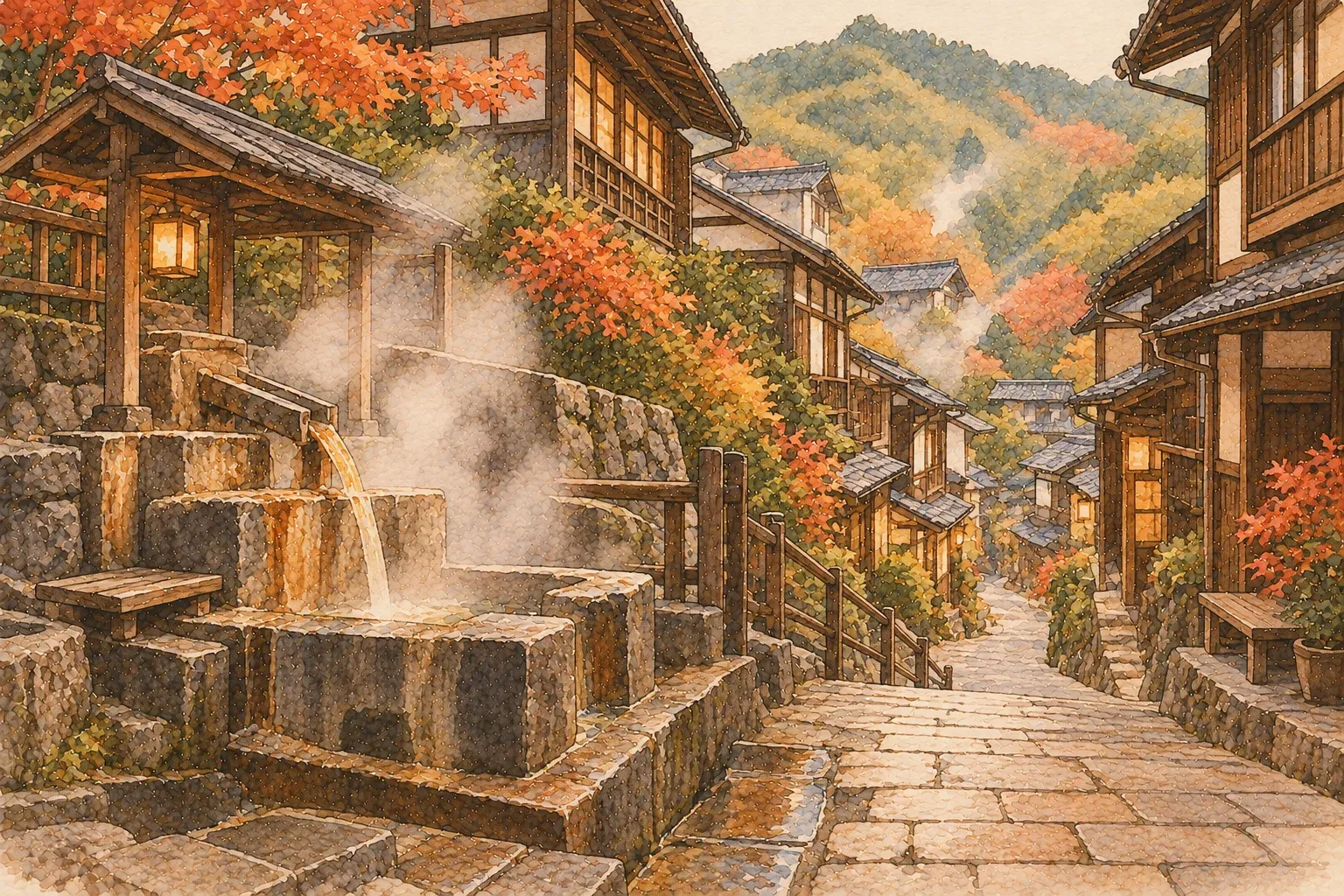
Around them, the association’s 2022 guide describes Yumoto-zaka street as two-storey wooden buildings that were once shops below and inns above, and Taikō-bashi bridge as named after Hideyoshi. Kobe city’s map also marks Nene-bashi bridge, Taikō-dōri street, the Yukemuri plaza, the Taikō no Yudono-kan, Tōsen Jinja, Onsen-ji and the Tansan Source Park. The association describes the Yukemuri plaza, beside Arima Onsen station, as having a waterfall made to look like rising steam. The same 2022 guide introduces the Tenjin, Gosho, Uwanari and Gokuraku sources as a walk, with guides booked at least three days ahead; it gives a fee without saying whether it includes tax, so this page does not give it. Hyogo prefecture’s 2024 newsletter sets out a guided course of about two hours from Nene-bashi past Kin no Yu, Onsen-ji, the Gokuraku source, Gin no Yu, the Tansan source and the Tenjin source, ending at the footbath by Kin no Yu.
The same 2022 page said the water at the Tansan Source Park had gone quiet after work uphill; the city’s analysis shows it was flowing in 2019, and its state now is not confirmed. The Taikō no Yudono-kan’s site says a display of finds from the Yuyama site began in August 2026; it lists admission without saying whether tax is included, so this page does not give it. The association’s English site calls tōji, staying to bathe as a cure, the original way to enjoy the spring.
Bathing there
As listed on the association’s pages dated 2 September 2026, which match the operator’s site (checked 11 October 2026):
- Kin no Yu — 8:00 to 22:00, last entry 21:30. Closed the 2nd and 4th Tuesday (open if a public holiday, closed the next day instead) and 1 January.
- Gin no Yu — 9:00 to 21:00, last entry 20:30. Closed the 1st and 3rd Tuesday (same holiday rule) and 1 January.
There is a ticket for both; the weekday version comes with a towel. Admission prices for adults, children and the two-bath ticket are listed, but neither the association’s pages nor the operator’s say whether they include tax, so this page does not give them. The operator says body soap, rinse-in shampoo and hair dryers are provided and towels are on sale, that weekday prices exclude busy periods such as New Year, Golden Week and Obon, and that entry may be limited when crowded. There is a free footbath next to Kin no Yu, open the same hours.
Tattoos. The association and the bathhouses’ pages give no tattoo policy. The association’s English site has no page on bathing manners, tattoos or common questions; its only word on how to bathe is the line about tōji. JNTO’s national page says policies differ by facility and suggests checking in advance. The water types guide covers what the tourism agency and JNTO say more generally, including private baths.
Food
The farm ministry’s list of Hyogo’s local dishes has nothing for Arima. On the town’s side:
- Tansan senbei, carbonated crackers — the association says they are said to have been created in 1907 (Meiji 40), using the carbonated water that was welling up, and describes them as flour mixed with carbonated water and seasoned with sugar and salt. Many shops selling them are listed on its shopping pages.
- Arima sanshō — the association lists a shop selling sanshō pepper products under that name. The 1559 date on the page is the founding of the shop, Kawakami Shōten, not of Arima sanshō. A 2019 Kobe Shimbun article says the family is told to have come from Nara with the monk Ninsai, and that Arima’s sanshō food culture is said to have continued since; both are put as tradition. Official sources give no account of where the pepper comes from.
- Arima Cider — the bathhouse operator calls it a local specialty. Its history, as told in a 2019 Kobe Shimbun newspaper series, is that the carbonated water was once called “poison water”, since insects and birds died from the gas, which is why stones nearby are marked “insect hell” and “bird hell”; that in 1875 Kajiki Genjirō, an innkeeper who then represented the town, had it analysed by a Home Ministry laboratory; that it was bottled from 1901, sold sweetened as Arima Cider from 1908, made outside Arima from 1926, and revived by eight local shopkeepers in 2001. That is a newspaper’s account, and it has not been checked against public records.
Getting there
The access information here comes only from the association’s Japanese access pages, which carry no update date (checked 11 October 2026); it has not been checked against the rail or bus operators’ own pages.
- JR Osaka — about 1 hour: JR Kobe Line to Sannomiya, Kobe municipal subway to Tanigami, Kobe Electric Railway via Arima-guchi.
- Shin-Osaka — about 1 hour 10 minutes. Hankyu/Hanshin Umeda — about 1 hour 20 minutes via Shinkaichi; direct trains from Shinkaichi run only morning and evening.
- Kansai Airport — about 2 hours 10 minutes by train; about 2 hours 30 minutes by train and the Arima Express, a highway bus from Osaka station; about 1 hour 50 minutes by airport bus and train via Sannomiya; about 2 hours by airport bus via Sannomiya and Shin-Kobe. The page gives all four, so the time depends on the route.
- Itami Airport — about 30 minutes by bus; about 50 minutes by train and bus; about 1 hour 30 minutes by train.
- Kyoto — about 70 minutes by Hankyu or Keihan bus from the Hachijō exit of Kyoto station.
- Sannomiya or Shin-Kobe — about 30 minutes by subway to Tanigami and Kobe Electric Railway via Arima-guchi; about 30 minutes by the Arima Express (Shin-Kobe, Sannomiya bus terminal, Arima Onsen) or by Shinki Bus’s express bus to Arima Onsen (Taikō-bashi).
The association’s English site gives different, rounder figures: 90 minutes from Kansai Airport and 60 from Osaka and Kyoto on its transport page, and about 1 hour from Kyoto, Osaka and Himeji and about 2 hours from the airport elsewhere on the site. The English site does not agree with itself on the airport, and neither figure matches the Japanese pages, so the Japanese figures are given by route. JNTO describes a route from Kobe-Sannomiya via Hankyu to Rokko, then the Rokko cable car, a bus and the Rokko-Arima ropeway down to Arima, without times; the association says the ropeway takes about 12 minutes between Arima and the Rokko summit station. Fares are not on this page.
What people get wrong
- “Onsen need a volcano.” Arima has no volcano nearby; AIST’s newsletter uses it as its example of a spring heated by deep fluid instead.
- “The plate-water origin was proven long ago.” The 2024 study says it had been assumed without direct evidence; the earthquake link is still only suggested.
- “Arima has seven springs.” Seven is one count. Kobe city’s table has five and its map names six.
- “Ginsen is a radium spring.” The association calls one ginsen water radon-bearing; the operator says “radium spring” and gives simple radioactive spring alongside it. “Radium spring” is a common name, and the official classification has no type by that name.
- “The three ancient springs is an official title.” No source names who chose it.
- “Kakenagashi means nothing is added.” Kin no Yu says it is free-flowing and also adds water, heats it and uses chlorine.
Questions people ask
What are kinsen and ginsen?
The two kinds of water Arima’s tourism association names. Kinsen, gold spring, is water with iron and salt. Ginsen, silver spring, covers water with carbonic acid and water the association describes as containing radon. The operator of the two public bathhouses says Kin no Yu uses kinsen, and Gin no Yu uses carbonic and radium water.
Why is Arima hot if there is no volcano nearby?
Researchers point to deep fluid. A University of Tsukuba study published in 2024 matched part of Arima’s water to water from the Philippine Sea Plate sinking more than 60 km below. Earlier, a national research institute had already placed Arima on the non-volcanic side of its diagram, as Arima-type hot water.
How old is Arima Onsen?
The answers differ by source. The tourism association cites the Nihon Shoki record of Emperor Jomei staying 86 days in 631, alongside older myths. Kobe city speaks of 1,400 years of history, and JNTO of nearly 1,500 years. This site does not choose.
Can I bathe in Arima with tattoos?
The tourism association, its English site and the public bathhouses’ own pages give no official tattoo policy for Arima. JNTO says policies differ by facility and suggests checking in advance.
Sources
- 有馬温泉観光協会「泉質」
- 有馬温泉観光協会「有馬温泉について」
- 有馬温泉観光協会「歴史」
- 神戸市「有馬温泉」(泉源)
- 神戸市「炭酸泉源 温泉の掲示内容」
- 神戸市 炭酸泉源 掲示(日本語)PDF
- 神戸市 炭酸泉源 掲示(英語・暫定訳)PDF
- 神戸市 有馬温泉 観光マップ(PDF)
- 神戸市 外郭団体(有馬温泉企業)評価シート(PDF)
- 環境省「国民保養温泉地」一覧
- 筑波大学 プレスリリース(有馬温泉とフィリピン海プレート由来の水)
- 産総研 活断層・火山研究部門ニュースレター Vol.11 No.2
- 日本地球惑星科学連合2012年大会 要旨 SCG65-06
- 兵庫県「県民だより」2024年10月号 4ページ
- 有馬温泉観光協会「金の湯」
- 有馬温泉観光協会「銀の湯」
- 金の湯・銀の湯 施設サイト トップ
- 金の湯・銀の湯 施設サイト「金の湯」
- 金の湯・銀の湯 施設サイト「銀の湯」
- 金の湯・銀の湯 施設サイト「太閤の湯殿館」
- 有馬温泉観光協会「有馬温泉観光ガイド」
- 有馬温泉観光協会「観る」
- 有馬温泉観光協会「お土産・民芸品」
- 有馬温泉観光協会「有馬山椒 山椒彩家」
- 神戸新聞NEXT「有馬温泉研究 炭酸物語(上)」(新聞)
- 神戸新聞NEXT「湯の里有馬に息づく山椒文化」(新聞)
- 有馬温泉観光協会「大阪から」
- 有馬温泉観光協会「京都から」
- 有馬温泉観光協会「兵庫から」
- Visit Arima Onsen(観光協会の英語サイト)トップ
- Visit Arima Onsen「Transportation」
- Visit Arima Onsen「Miraculous Hot Spring」(2015年の署名記事)
- JNTO「Arima Onsen & Mt. Rokko」
- JNTO「Hot springs in Japan」
Prices are in Japanese yen. Conversions are approximate, at ¥177.30 to the euro and ¥158.23 to the US dollar as of 20 Oct 2026. Rates come from the European Central Bank, which publishes on working days only. Prices checked Oct 2026. What food costs in Japan →