
Yunotsu Onsen: a silver port with two old baths, a preserved street and a World Heritage listing
I have not been to every place in this guide. The figures below are taken from the sources listed at the end, with the date each one was published — not measured by me. Where I have been, the article says so.
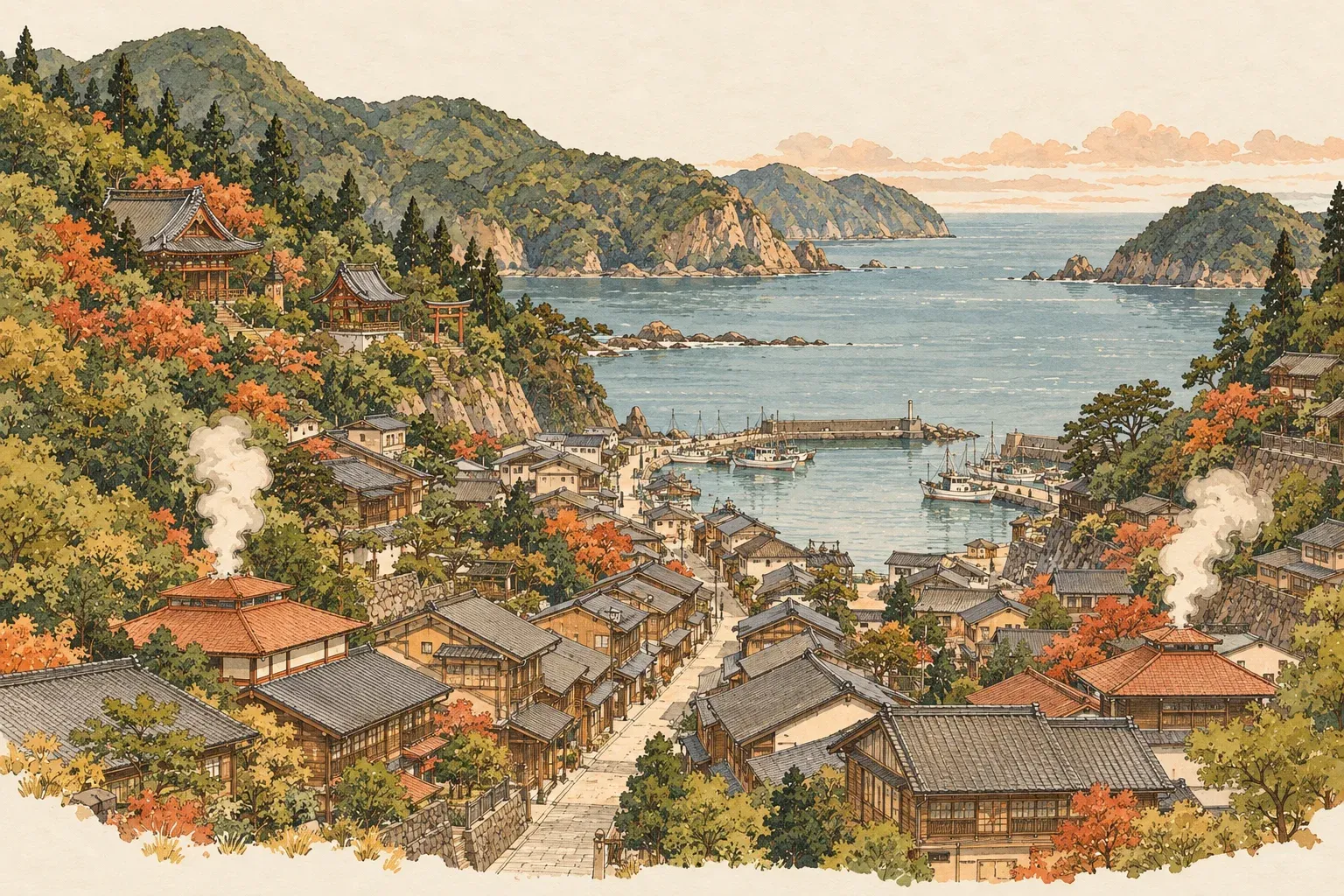
Yunotsu Onsen is a small port town in Ōda city, on the Shimane coast, where hot water rises in a narrow valley that opens onto the sea. It grew as an outer port of the Iwami Ginzan silver mine, it is part of that mine’s World Heritage listing, and its street is a nationally selected preservation district. Bathing centres on two old public baths, Moto-yu and Yakushi-yu. This page covers the water, its age, the port and the preserved town, the baths, food and the way in. It uses the national geological survey (AIST), a 2014 journal article, the Cultural Affairs Agency, the tourism agency, UNESCO, Shimane’s tourism federation, Ōda city and the national tourism organisation, plus the two baths’ own sites, which I mark as the businesses’ accounts. Where they disagree, I give each. It does not rate any bath or inn.
How chloride springs are defined is in the guide to carbon dioxide, chloride and iron springs; for sulphate springs, see hydrogen-carbonate, sulphate, iodine and simple springs. For reading the analysis sign, see onsen water types.
The water
Two sources, many figures
Yunotsu has two sources that feed its public baths, Moto-yu and the source now used by Yakushi-yu (formerly Fuji-no-yu; its old building is called Shin-yu). The type and the temperature depend on which document you read, so I give each with its date.
- AIST (2001). Yunotsu is a sodium-calcium chloride-hydrogencarbonate spring of 32 to 49°C, with two sources, Moto-yu and Fuji-no-yu.
- Onsen Kagaku, 2014 (an explanatory article based on 2007 survey material and a site visit in April 2013). Moto-yu is a sodium-calcium chloride spring at 49.5°C, 42 litres a minute. Yakushi-yu is a sodium-calcium chloride-sulphate spring at 46.0°C, flow unknown.
- Moto-yu’s own site (as of July 2024). Its source, “Moto-yu Onsen”, is a sodium chloride spring, hypotonic, neutral and high-temperature, at 49.9 to 50.0°C.
- Yakushi-yu’s own site. The source is right behind the building, rising naturally from 2 to 3 metres down, at about 46°C, a sodium-calcium chloride spring.
- Shimane’s tourism federation, on Yakushi-yu. A sodium chloride spring at 45.8°C, with 112 mg of metasilicic acid; its pH is 6.4 on the Yakushi-yu page and 6.3 on its Yunotsu page.
The names shift, and the documents are from different years and probably different analyses. I do not choose one. They agree that both are chloride springs in the mid 40s to about 50°C.
How Moto-yu reaches the bath
Moto-yu’s own site says its water flows up by itself, with no drilling, boring or pumping, and goes into the bath without added water, heating, cooling or recirculation, 1 to 1.6 metres from source to tub, and is not shared with other buildings.
How the water came up: the 1872 earthquake
AIST’s geological report, Geology of the Yunotsu and Gōtsu district (2001), says the two sources lie along a valley open to the coast. Moto-yu has flowed since long ago; Fuji-no-yu came up in the Hamada earthquake of 1872, when Moto-yu’s outlet is said to have shifted a little.
The 2014 journal article gives the date as 6 February 1872, calls the earthquake magnitude 7.1, and says the water came up through a crack in the bedrock where Yakushi-yu stands now.
Where the heat comes from
AIST’s report describes where the springs are, how hot they are and how they appeared, but does not explain the heat source.
The 2014 article in Onsen Kagaku, by Nishimura Susumu, Masuko Tamotsu and others, says both sources rise along faults and rhyolitic dykes in welded tuff of 18 to 14 million years ago. It calls Yunotsu non-volcanic, with a slight trace of mantle components, and suggests the water may be the product of fluid released by serpentinite at the leading edge of the subducting Philippine Sea plate, which dissolved material from the mantle and lower crust and was then diluted by shallow groundwater. That is the authors’ interpretation in an explanatory article, not a public body’s statement, and I have not checked whether it was peer-reviewed. So I give it as their view.
For background, the environment ministry’s onsen use table (end of March 2025) gives Shimane 267 sources, of which 62 are 42°C or above. Yunotsu is not on the ministry’s list of designated health resort onsen areas; Shimane’s are Sanbe and Sagi-no-yu.
Where it came from
The name
Moto-yu’s site says the mid-Heian-period dictionary Wamyō ruijushō records, within Iwami province, “a port (tsu) with a hot spring (yu)”. I have not seen the original; this is the bath’s account.
How old: three answers
- About 1,300 years. The tourism agency’s multilingual text (written in 2019 by the Iwami Ginzan multilingual council) says the spring is said to have been found more than 1,300 years ago. The national tourism organisation also says 1,300 years, and the 2014 journal article says Moto-yu is about 1,300 years old.
- Over 900 years. Moto-yu’s site calls its source one that has flowed “for over 900 years”.
- 1,400 years. The same site, elsewhere, says it has flowed naturally without a break “for 1,400 years”.
The counts and their grounds differ. I give all three and choose none.
The tanuki
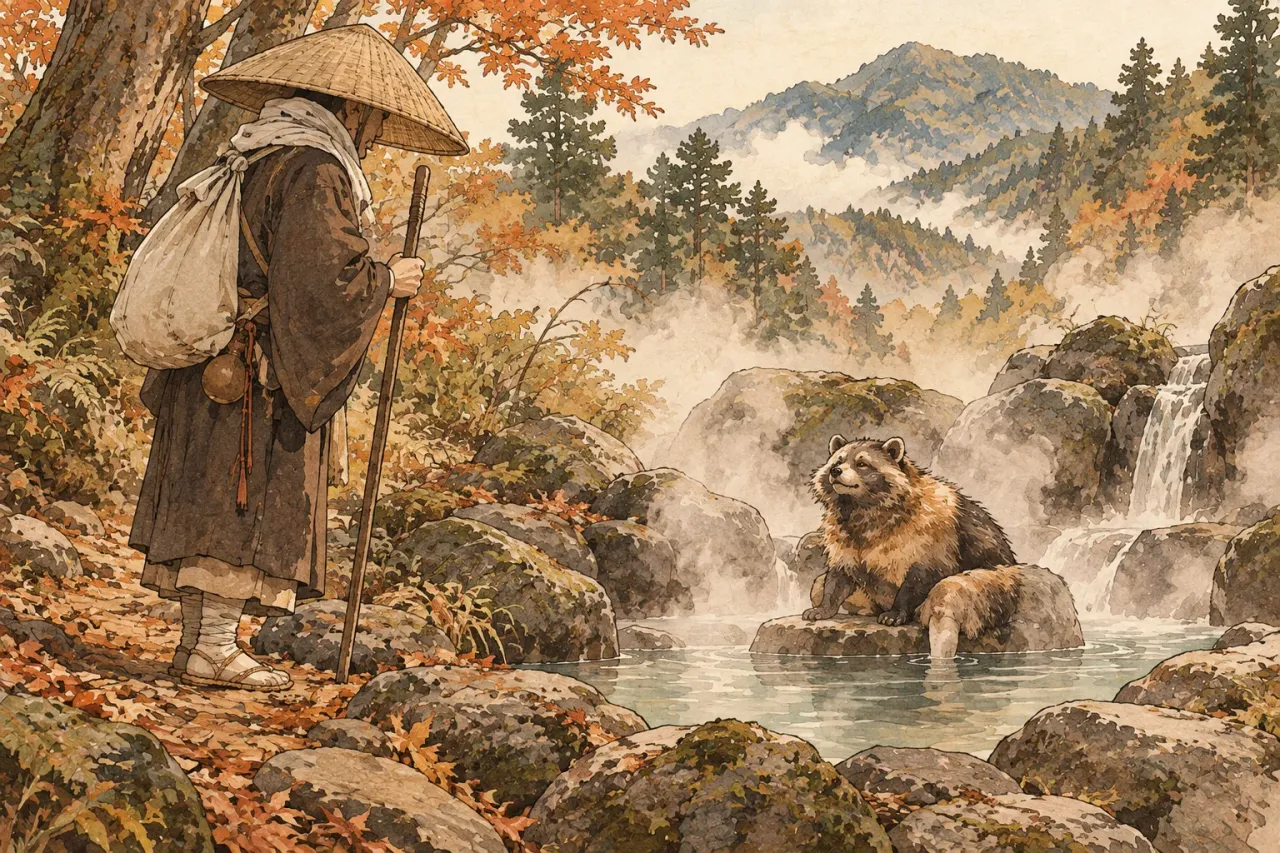
The tourism agency’s text and Moto-yu’s site share one legend. A travelling monk saw an old, wounded tanuki, the Japanese raccoon dog, soaking in a steaming pond to heal. The tourism agency’s text says the story is said to have reached Kyoto in the Heian period, but that Yunotsu drew visitors taking the waters only from the 14th century. Moto-yu’s site says the legend is told in documents kept by the Itō family, dated Kōji 1 (1555).
Fuji-no-yu becomes Yakushi-yu
The 2014 article says the second source became the town-run Fuji-no-yu in 1954 and was shared out to inns, after which Moto-yu’s flow dropped sharply and a lawsuit followed; it gives 1971 for the source’s return to its owner and 1973 for the end of the case. It was renamed Yakushi-yu in 2004.
The silver port
Ōda city’s tourism site says Yunotsu thrived in the late 16th century as a port shipping silver, and as a place to take the waters. The Iwami Ginzan World Heritage Centre says it grew from the medieval period as the mine’s outer port, and that its 800-metre street, cut into a narrow valley, keeps the early modern layout. The Cultural Affairs Agency’s Japan Heritage portal adds that the roads and waterways follow a town map of 1692 almost exactly, and that the historic buildings date from after a great fire in 1747.
World Heritage
The Cultural Affairs Agency’s heritage database says Iwami Ginzan Silver Mine and its Cultural Landscape was inscribed in July 2007, under criteria (ii), (iii) and (v),. Its 14 component parts include Yunotsu, the Iwami Ginzan road between Yunotsu and Okidomari, Okidomari and Tomogaura. UNESCO’s page gives 2007 as the date of inscription and mentions the “port towns from where it was shipped to Korea and China”. Sources word the start of silver mining differently, so I give no year for it here.
How the town works
A preserved hot-spring town
The Cultural Affairs Agency lists “Ōda-shi Yunotsu” as a preservation district for groups of traditional buildings, of the port town type, selected on 6 July 2004. Its description mentions houses built from the late Edo to the early Shōwa period, with onsen inns, temples and shrines.
The Japan Heritage portal says it was in 2004 the only onsen town in Japan to be selected. Shimane’s tourism federation and the tourism agency’s English text say the same.
Two public baths
The national tourism organisation speaks of “two main public baths”, and the tourism agency’s text says the town “continues to host two onsen baths”. Both are run privately.
Moto-yu (from its own site, checked 13 October 2026):
- Open 6:00 to 20:00 from March to November (last entry 19:30) and 6:00 to 19:00 from December to February (last entry 18:30). Closed every year on the third Monday of November.
- From January 2026, on Mondays and Thursdays, general bathing is only from 6:00 to 8:00 (last entry 7:30); from 9:00 to 16:00 it is for members only, by booking, with an annual fee.
- Its tubs are divided into hot (46 to 48°C), warm (43 to 44°C) and “first-timers” (38 to 40°C).
- There are no showers or hot taps; you wash with water from the tub or tap water, and no toiletries are supplied.
- Fees are listed without a tax note, so I do not give them.
Yakushi-yu (from Shimane’s tourism federation):
- Open 9:00 to 21:00. From 8 September 2026 it closes every Tuesday, except that it opens on 5 May for the iris bath and on 22 December for the yuzu bath. Yakushi-yu’s own site posted the same notice on 5 September 2026.
- The federation lists foreign-language support in English, and in French on some days.
- It has a rooftop terrace and a lounge.
- Fees are listed without a tax note, so I do not give them.
Kagura and the visitor centre
Shimane’s tourism federation says yokagura, night kagura dance, is held at Tatsu-no-gozen shrine every Saturday at about 8 pm. The tourist information centre, Yū Yū Kan, is at Yunotsu port, with a rest room and information on the ground floor and an exhibition upstairs, according to Ōda city’s tourism site.
Bathing there
- English and tattoos. The national tourism organisation’s English page and the tourism agency’s English text say nothing about tattoos or bathing manners, and Shimane’s English page for Yunotsu returned an error. Yakushi-yu offers English support, according to the federation. I found no official rule on tattoos. Ask each bath or inn.
- Compared with city baths. I found no official comparison. Moto-yu sells its source water to take home, by the litre, one litre or more, and says it is not for drinking. That is the business’s own offer. What you can compare anywhere is the posted sign, which says whether the water is diluted, heated, recirculated or disinfected; see the piece on kakenagashi.
What it is eaten with
I found no source in which both the farm ministry and Yunotsu’s own side name the same local dish. Here is what each says.
- Heka. The farm ministry lists heka, fish and shellfish cooked sukiyaki-style in a flat iron pan called a heka-nabe, for the Iwami area, including Ōda city. It names tilefish, flounder and nodoguro caught in Ōda’s day fishing, and says Ōda city promoted the dish widely after the World Heritage inscription and certified it as an “Ōda brand”. It does not name Yunotsu, so I do not call heka a Yunotsu dish. More in the San’in local dishes guide.
- Kaku-zushi or hako-zushi. Pressed sushi of the Iwami area. The farm ministry gives one account of its beginning, that the wife of a magistrate sent to the Iwami Ginzan area brought it in, missing the taste of Edo. It does not name Yunotsu.
- Ōda’s big conger eel. Ōda city’s tourism site promotes anago, citing fisheries statistics: Shimane’s conger catch was 509 tonnes in 2020, second in Japan, after three years at the top up to 2019, with nearly half landed in Ōda. Its Yunotsu model course describes a café in Yunotsu serving a “magistrate’s meal” linked to the silver mine and vinegared Ōda conger. I do not name the café.
Getting there
From Shimane’s tourism federation and the national tourism organisation (no update dates; checked 13 October 2026). Fares are not on this page.
- From Yunotsu station. On the JR San’in line. Shimane’s federation gives 5 minutes by bus to the “Onsen-mae” stop on its Yunotsu page, and 10 to 15 minutes on foot on its Yakushi-yu page. The national tourism organisation says the street of the town is about 700 metres from the station.
- By car. About 5 minutes from Yunotsu interchange or 10 from Yusato interchange on the San’in expressway, 25 minutes from Gōtsu interchange, 55 minutes from Izumo interchange, and 60 minutes from Ōasa interchange on the Hamada expressway.
- By air. About 1 hour 20 minutes by car from Izumo airport and about 1 hour 40 minutes from Hagi-Iwami airport.
- From Matsue or Izumo. Yakushi-yu’s site says there is no long-distance bus towards Yunotsu and recommends the train.
Train times from Izumo-shi do not add up. The national tourism organisation says Yunotsu station is about 40 minutes from Izumo-shi and an hour from Matsue. Ōda city’s tourism site gives about 40 minutes from Izumo-shi to Ōdashi station, which is east of, and so nearer than, Yunotsu. I do not give a time; check a current timetable. I found no official time from Shin-Yamaguchi, Hagi or Yonago.
For other spring towns in the region, see Tamatsukuri near Matsue, Kaike and Misasa in Tottori, Yubara in Okayama, and in Yamaguchi, Yuda and Nagato-Yumoto.
What people get wrong
- “Yunotsu is 1,300 years old.” One set of sources says so; Moto-yu’s own site says over 900 years in one place and 1,400 in another.
- “Both baths are ancient.” AIST and the 2014 journal article say the second source came up in the 1872 Hamada earthquake.
- “It is a volcanic spring.” No public source explains its heat. A 2014 journal article calls it non-volcanic and suggests a deep plate-derived fluid, as its authors’ view.
- “Yunotsu is just near the World Heritage site.” It is one of the listed component parts.
- “Heka is Yunotsu’s dish.” The farm ministry lists it for Iwami and Ōda without naming Yunotsu.
- “Moto-yu is open the same hours every day.” From January 2026, Mondays and Thursdays are open to the general public only from 6:00 to 8:00.
Questions people ask
Is Yunotsu part of the Iwami Ginzan World Heritage Site?
Yes. The Cultural Affairs Agency lists Yunotsu among the component parts of the Iwami Ginzan Silver Mine and its Cultural Landscape, inscribed in July 2007, together with the Yunotsu-Okidomari road, Okidomari and Tomogaura. Separately, the town is a preservation district for groups of traditional buildings, selected on 6 July 2004.
How old is the spring?
The sources differ. A tourism agency text and the national tourism organisation say about 1,300 years, and a 2014 article in a hot-spring science journal says the same of the Moto-yu source. Moto-yu's own site says the source has flowed for over 900 years in one place and for 1,400 years in another. I give all of them and choose none.
Can I wash with a shower at Moto-yu?
No. Moto-yu's own site says there are no showers or other hot-water taps, so you wash with water from the bath or with tap water, and no toiletries are provided. Bring your own or buy them there.
Can I bathe at Yunotsu with tattoos?
I found no official guidance. The national tourism organisation's English page and the tourism agency's English text say nothing about tattoos or bathing manners, and Shimane's English page for Yunotsu did not open. Ask each bath or inn.
Sources
- 島根県観光連盟(しまね観光ナビ)「温泉津温泉」
- 島根県観光連盟(しまね観光ナビ)「薬師湯」
- 温泉津温泉 薬師湯 公式サイト
- 温泉津温泉 薬師湯「歴史」
- 温泉津温泉 薬師湯「松江・出雲からのアクセス」
- 泉薬湯 温泉津温泉元湯 公式サイト
- 泉薬湯 温泉津温泉元湯「歴史」
- 地質調査所(現・産総研)『温泉津及び江津地域の地質』第Ⅹ章4 温泉
- 日本温泉科学会『温泉科学』64巻1号 西村ほか「島根県温泉津温泉の地質構造」
- 観光庁 地域観光資源の多言語解説文データベース「温泉津重要伝統的建造物群保存地区(全体)」
- 文化庁 文化遺産オンライン「大田市温泉津」
- 文化庁 文化遺産オンライン 世界遺産「石見銀山遺跡とその文化的景観」
- UNESCO World Heritage Centre「Iwami Ginzan Silver Mine and its Cultural Landscape」
- 石見銀山世界遺産センター
- 石見銀山世界遺産センター「歴史的建造物」
- 大田市観光サイト「大田市について」
- 大田市観光サイト「温泉津モデルコース」
- 大田市観光サイト「交通案内」
- 大田市観光サイト「大田の大あなご」
- 大田市日本遺産推進協議会「石見の火山が伝える悠久の歴史」
- 日本政府観光局(JNTO)Yunotsu
- 文化庁 日本遺産ポータル「温泉津町重要伝統的建造物群保存地区」
- 農林水産省 うちの郷土料理「へか」
- 農林水産省 うちの郷土料理「角ずし/箱ずし」
- 環境省 国民保養温泉地
- 環境省『令和6年度温泉利用状況』(令和7年3月末現在)
Prices are in Japanese yen. Conversions are approximate, at ¥177.30 to the euro and ¥158.23 to the US dollar as of 20 Oct 2026. Rates come from the European Central Bank, which publishes on working days only. Prices checked Oct 2026. What food costs in Japan →