
Soba: the buckwheat noodle, its three Edo houses, and why 70% of it is grown abroad
I have not been to every place in this guide. The figures below are taken from the sources listed at the end, with the date each one was published — not measured by me. Where I have been, the article says so.
Soba is the thin grey-brown noodle made from buckwheat, and it is the noodle of the other half of Japan: the east, the north, the mountains, the places where rice and wheat grew badly and buckwheat grew in seventy days on poor soil. Udon is the noodle of the warm west; soba is what Edo ate, what Nagano and Shimane and Iwate made into regional cuisines, and what most of the country still eats on the last night of the year. It is also the Japanese noodle with the most ritual attached to eating it, and the one where the raw material is now mostly imported.
What it is
Buckwheat is not wheat; it is a seed from a plant related to rhubarb, and it has no gluten. The ministry’s own account is that it has been grown in Japan since the Jōmon period, probably from China, and was eaten for most of that time as sobagaki — a porridge or dumpling of buckwheat flour and hot water. The noodle, soba-kiri, “cut soba”, is comparatively recent. The oldest record is a document from Jōshōji temple in Ōkuwa, Kiso, in Nagano, noting that soba-kiri was served to the craftsmen who repaired the main hall in 1574; the prefecture calls Kiso the birthplace of the noodle, with the usual caveat about other theories. The noodle reached Edo and became a city food in the eighteenth century.
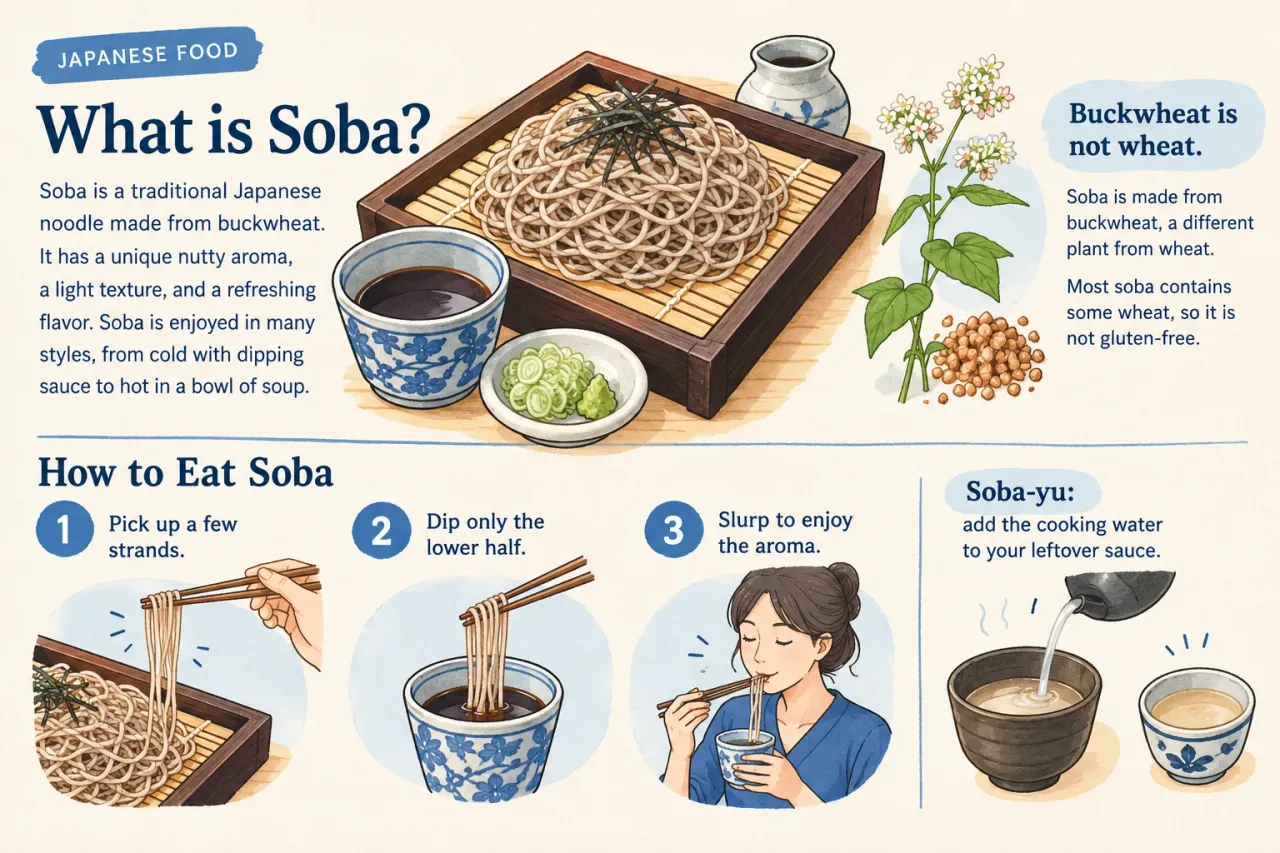
Text in this illustration
What is soba? Soba is a traditional Japanese noodle made from buckwheat. It has a unique nutty aroma, a light texture, and a refreshing flavor. Soba is enjoyed in many styles, from cold with dipping sauce to hot in a bowl of soup.
Buckwheat is not wheat. Soba is made from buckwheat, a different plant from wheat. Most soba contains some wheat, so it is not gluten-free.
How to eat soba: 1. Pick up a few strands. 2. Dip only the lower half. 3. Slurp to enjoy the aroma.
Soba-yu: add the cooking water to your leftover sauce.
Because buckwheat has no gluten, pure buckwheat noodles are hard to make and break easily, so most soba contains wheat. The names tell you the ratio: jūwari is 100% buckwheat, kuichi 90:10. Ni-hachi is read two ways, as 80:20 or as two times eight, sixteen mon, the Edo price of a bowl. The national noodle association considers the price reading the more plausible before the Keiō era (1865–68), when shop prices passed twenty mon, and the ratio reading after it, while noting problems with the ratio reading, such as the existence of ni-hachi udon and of ni-roku and san-shi soba. A food-industry paper takes the ratio side. I do not choose. The flour itself is graded by how deep into the grain the mill goes: the first milling from the kernel’s centre is the white sarashina flour, the second takes the germ, the third the inner husk, and grinding the whole grain with its husk gives the dark hikigurumi of Izumo.
Why it is the way it is
The cold plate and the dark sauce. Edo ate soba cold, on a bamboo tray, with a concentrated dipping sauce of dark soy sauce and bonito called kaeshi. The national association’s instruction for eating it is still the city’s: dip only half the noodle, so that you taste the buckwheat and not the sauce, and slurp, drawing air through the noodle. At the end the server brings soba-yu, the cooking water, to thin the leftover sauce into a drink. The difference between mori and zaru, the two cold plates on every menu, used to be a better sauce on the zaru; the association’s own officer says it is now mostly the sheet of nori on top.
Three houses. Edo’s shops sorted themselves into lineages that still name the city’s restaurants. Sarashina makes the white noodle from first-milled flour, a name its founding house traces to the Shinshū soba trade and a lord’s permission to use a character from his name, in 1789. Yabu is the dark, firm noodle with a very salty sauce, from a house founded in 1880. Sunaba is the oldest name — from the sand yard of Hideyoshi’s Osaka castle, where a soba shop prospered among the builders — and its Tokyo house, from 1869, says it invented the tempura-and-cold-soba plate.
Everywhere else kept its own idea. Izumo pours the sauce over the noodle instead of dipping; Togakushi stacks it in little bundles on a round tray as a shrine offering; Iwate feeds it to you a mouthful at a time until you shut the lid. The table below is where those differences live.
The grain comes from abroad. Japan harvests about 38,000 tonnes of buckwheat a year and imports about 88,000 — three-quarters of it from China — so the domestic share is about 30%. Hokkaido grows by far the most (16,800 t), then Tochigi, Ibaraki, Nagano and Fukui. “Shinshū soba” is a style and a brand; it is not a guarantee that the buckwheat grew in Nagano.
What it costs
Standing soba at a station 立ち食いそば
- Chains
- ¥430–¥450Plain kake soba · Yudetaro, Fuji Soba · tax incl. · checked 2026-10-05
- Our guide figure
- ¥500 (≈ €3 / $3)The cheapest hot meal on a Japanese platform, and one of the best-value · Oct 2026
The spread is the widest of any noodle. A standing soba chain in Tokyo charges ¥430–450 including tax for a hot bowl (Yudetaro, Fuji Soba). The statistical plate in central Tokyo, a survey price that includes tax, is ¥788. Among the old Edo houses, Sarashina Horii charges ¥1,000 including tax for its plain cold mori; a plate with tempura costs much more. Kanda Yabu’s menu does not say whether tax is included, so its prices are not given here. In the household survey, the city that spends most on soba and udon eaten out is Takamatsu — for udon — and the soba cities are further down: Nagano 13th (¥8,705), Tokyo 22nd (¥8,166), Matsue 32nd, Morioka 38th.
The lineages
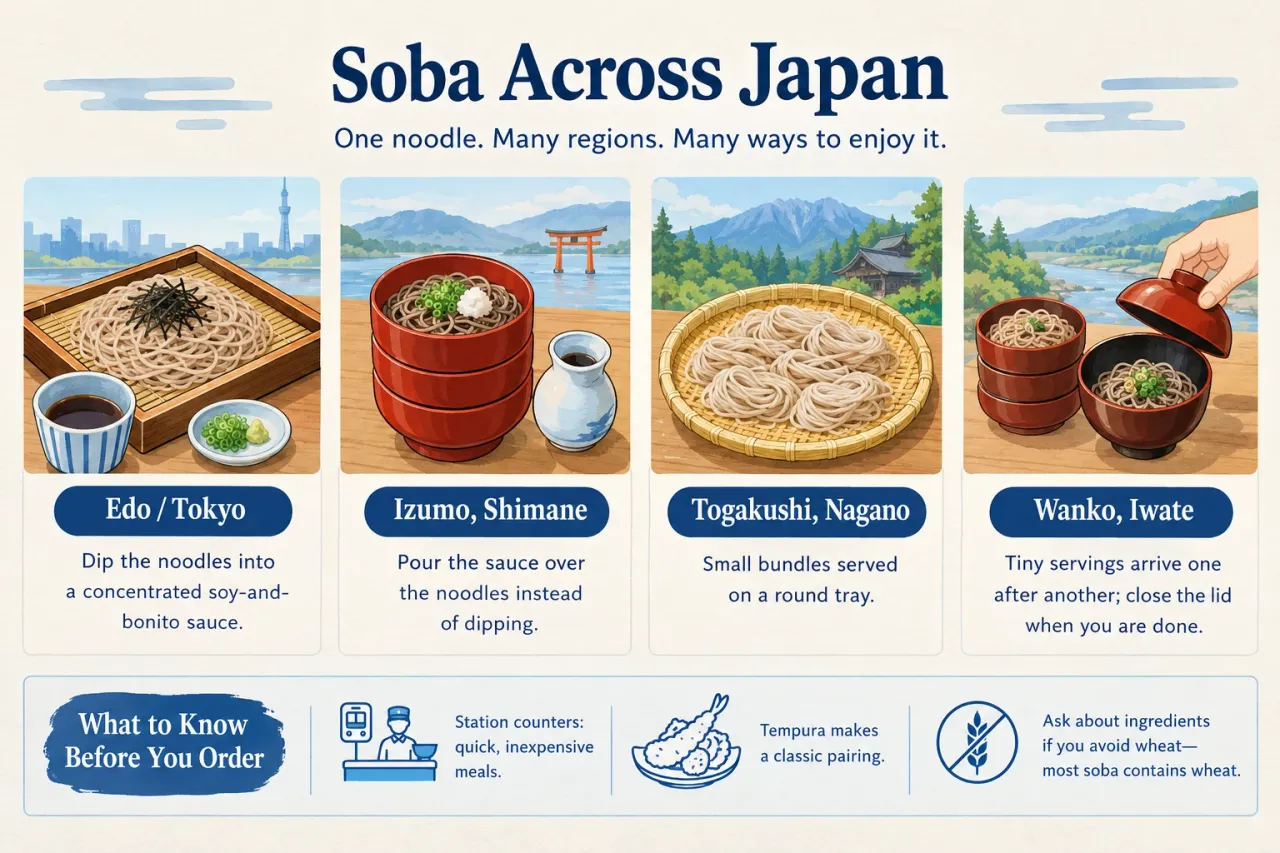
Text in this illustration
Soba across Japan. One noodle. Many regions. Many ways to enjoy it.
Edo / Tokyo: Dip the noodles into a concentrated soy-and-bonito sauce.
Izumo, Shimane: Pour the sauce over the noodles instead of dipping.
Togakushi, Nagano: Small bundles served on a round tray.
Wanko, Iwate: Tiny servings arrive one after another; close the lid when you are done.
What to know before you order: Station counters: quick, inexpensive meals. Tempura makes a classic pairing. Ask about ingredients if you avoid wheat — most soba contains wheat.
| Lineage | Origin | Flour and cut | Served | Sauce | How it is eaten |
|---|---|---|---|---|---|
| Edo / Tokyo江戸そば | Edo (Tokyo)1700s; shops from 1789 | Three houses: Sarashina (white first-milling), Yabu, Sunaba; 'ni-hachi' 8:2 with wheat | Cold on a bamboo tray (mori / zaru), or hot in broth (kake) | Strong dark 'kaeshi' soy with bonito; dip only halfway | Slurp; finish with soba-yu, the cooking water, in the leftover sauce |
| Standing soba立ち食いそば | Railway stations; Tokyo chainsstation soba known by c. 1897 (one theory); chains from 1966 | — | At a counter, standing: hot kake or cold mori, tempura soba on the same menu | Kanto stock is mostly bonito-based; two counters of one Shinagawa caterer make it to different strengths | Often between trains; Fuji Soba kake ¥450 tax included (Oct 2026) |
| Izumo (Shimane)出雲そば | Matsue / Izumo1638 or 1666, with the Matsudaira lord | Hikigurumi — whole grain milled with the husk: dark, fragrant; about 20% wheat | Wariko: three stacked round red-lacquer dishes; or kama-age in its cooking water | Poured over the noodles, not dipped; passed down from dish to dish | Grated daikon with chilli; the cooking water is part of the dish |
| Togakushi (Nagano)戸隠そば | Togakushi, NaganoHeian-era mountain ascetics; soba-kiri in the Edo period | Pale green, thin | 'Botchi-mori': five or six horseshoe-shaped bundles on a round bamboo tray, barely drained | Dipping sauce with spicy daikon | A shrine offering turned hospitality dish |
| Wanko (Iwate)わんこそば | Hanamaki / Moriokalegend of the Nambu lord, 1600s | Ordinary soba in mouthful portions | A server refills a small lacquer bowl until you close the lid | Pre-sauced; condiments change the bowl as you go | 15 bowls ≈ one normal serving; the record is 632 |
| Jindaiji (Tokyo)深大寺そば | Chōfu, TokyoEdo period | Historically flour paid to the temple by farmers in place of rice; stone-milled | Mori (seiro at some shops, zaru with nori) and hot bowls; tempura soba usually with prawn | Dipping sauce, thinned with soba-yu after the meal | Spring onion and wasabi, shichimi to taste; many shops close with the temple gate at about 5 p.m. |
| Hegi (Niigata)へぎそば | Ojiya / Tōkamachi— | — | — | — | — |
| Echizen oroshi (Fukui)越前おろしそば | Fukui— | — | — | — | — |
| New Year's Eve soba年越しそば | NationwideEdo period custom | Any | At home or by delivery, on 31 December | — | Eaten by more than 60% of households; long for long life, easily cut to cut off the year's troubles |
Lineages without a link are on the list but not written yet. The table is kept in one place so every lineage is described on the same terms.
Where to eat it
- Edo — Tokyo’s old houses in Azabu-Jūban (Sarashina Horii), Kanda (Yabu) and Nihonbashi (Sunaba); standing counters at every station.
- Izumo — the approach to Izumo Grand Shrine and Matsue; airport bus about 35 minutes to the shrine.
- Togakushi — the limited-express bus from Nagano station, 56 minutes to Chūsha.
- Wanko — Morioka and Hanamaki, on the Tōhoku Shinkansen.
What people get wrong
- “Soba is gluten-free.” Only jūwari. Most soba contains wheat; I found no official figure for how much the standing counters use.
- “Dunk the whole noodle.” Half. The association that represents the shops says so.
- “Ni-hachi has one settled meaning.” It is read as a price and as a ratio, and the noodle association says each fits a different period.
- “Shinshū soba is grown in Nagano.” Nagano grows about 2,500 tonnes a year and Japan imports 88,000. The name is a style.
- “Soba is a Tokyo food.” Tokyo made it a cuisine. The oldest record is in Nagano, and Izumo, Togakushi and Iwate each eat it in ways Tokyo never did.
Questions people ask
Is soba gluten-free?
Only if it is jūwari — 100% buckwheat. Most soba contains some wheat, and I found no official figure for how much the standing counters use. Ask, and expect the answer to be no.
How do I eat cold soba properly?
Pick up a few strands, dip only the lower half in the sauce, and slurp. That is the national noodle association's own instruction. The association's notes on soba-yu, the cooking water, say it is usual to pour it into the leftover sauce after the meal and drink it.
What does soba cost?
The government survey prices a plate of soba in central Tokyo at ¥788 including tax (August 2026). Standing soba chains charge ¥430–450 including tax for a hot bowl. Among the old Edo houses, Sarashina Horii charges ¥1,000 including tax for a plain plate; a plate with tempura costs much more.
Sources
- 農林水産省 農産局「そばをめぐる状況について」(令和8年7月)
- 農林水産省 aff 2017年3月号「ニッポン麺探訪 信州そば」
- 長野県木曽地域振興局「木曽のそば推進協議会」(定勝寺 1574年)
- 長野県「長野県のそばについて」
- 日本麺類業団体連合会「そばの散歩道」おそばの食べ方
- 日本麺類業団体連合会「そばの散歩道」おそばはどうやって作るの?
- 日本麺類業団体連合会「そばのあいうえお」二八そば
- 日本麺類業団体連合会「麺類雑学事典」そば湯
- 日本食糧新聞「2月8日。今日は東京二八そばの日」
- J-CAST「そばの『ざる』と『もり』の違いは?」
- 総本家更科堀井「更科堀井の歴史」
- 総本家更科堀井 麻布十番本店 おしながき(価格は全て税込)
- 東都のれん会「室町砂場」
- 総務省統計局 家計調査 品目別都道府県庁所在市ランキング 外食「日本そば・うどん」(2023〜2025年平均)
- 農林水産省 Let's!和ごはんプロジェクト「年越しそば」
- 農林水産省「にっぽん伝統食図鑑」出雲そば(日本三大そば)
Prices are in Japanese yen. Conversions are approximate, at ¥177.30 to the euro and ¥158.23 to the US dollar as of 20 Oct 2026. Rates come from the European Central Bank, which publishes on working days only. Prices checked Oct 2026. What food costs in Japan →