
Donburi: the bowl, the rice bowl dishes, and why "katsudon" means different things in different towns
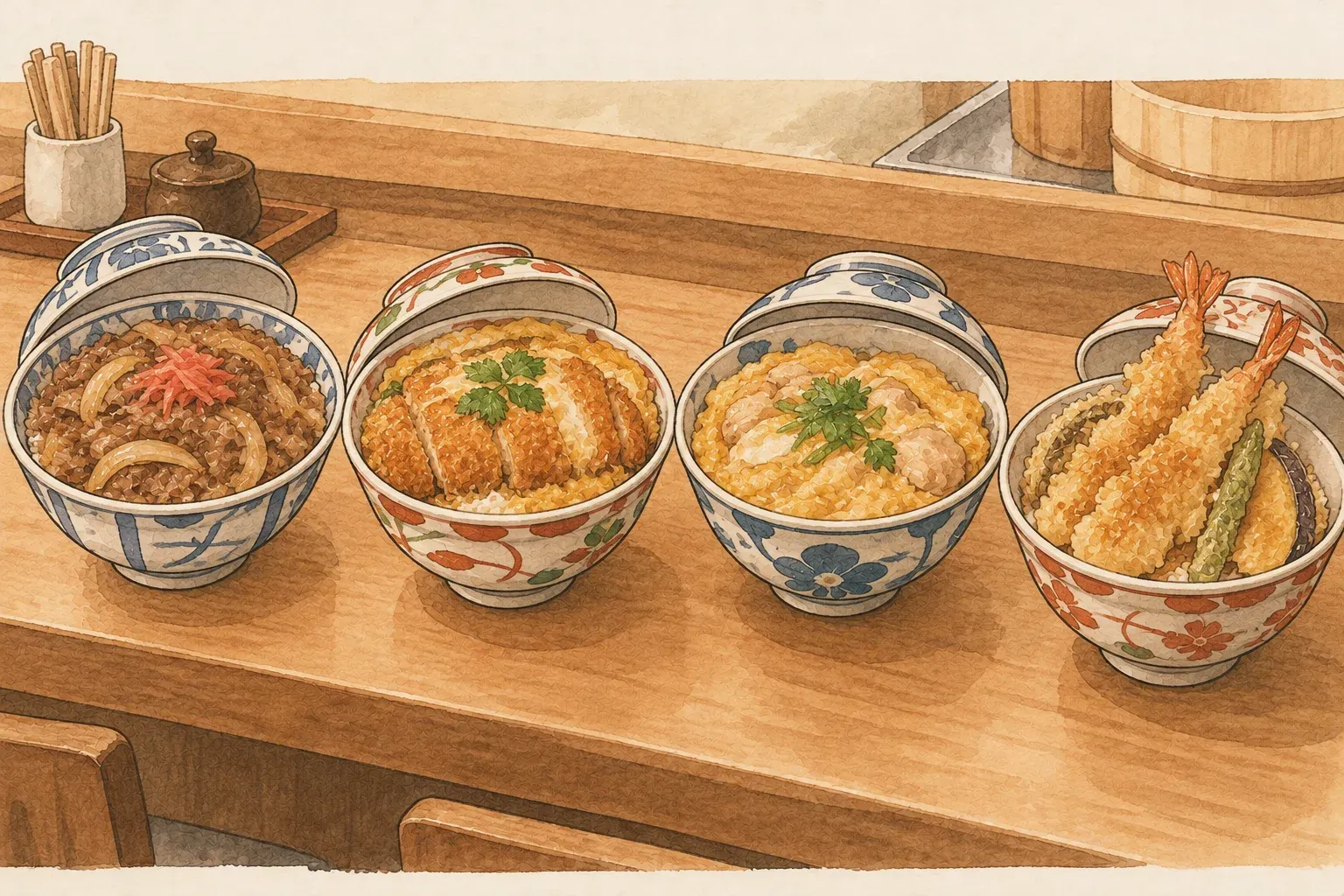
I have not been to every place in this guide. The figures below are taken from the sources listed at the end, with the date each one was published — not measured by me. Where I have been, the article says so.
Donburi is first the name of a bowl, and then of everything served in it: a deep bowl of rice with something on top and a sauce soaking down. It runs from the beef-bowl chains to the cutlet bowls of soba shops. It is also a lesson in how much a word can change between towns. Order katsudon in Tokyo and you get a cutlet simmered with egg; order it in Fukui and you get one dipped in sauce, no egg at all. This page is the map; the lineage pages cover the beef bowl and the cutlet bowl.
What it is
The bowl. A Japanese dictionary defines donburi as a thick, deep ceramic bowl for serving food, and also as short for donburi-mono, dishes served in one. The bowl appears in an essay collection of 1784–1814, served with hot simmered tofu. The word don, as in unadon and tendon, attached to a shortened food name, is first recorded in a dictionary of new words in 1919.
Where the word came from is unclear. One dictionary guesses at the sound of something dropped into a well; an encyclopedia mentions the sound of something thrown into water and says the origin is not certain. The same encyclopedia records the word from the late 17th century and a “Nanking blue-and-white donburi” in a 1781 menu book, and says that as rice topped with eel or tempura (donburi-meshi) spread, donburi-mono became the general name. I could not find an official date for when the rice-bowl dish itself took shape.
Why on rice. The farm ministry’s account of the eel bowl gives one reason: eel and rice were originally served separately, and the eel bowl spread because placing the eel on hot rice kept it warm for delivery.
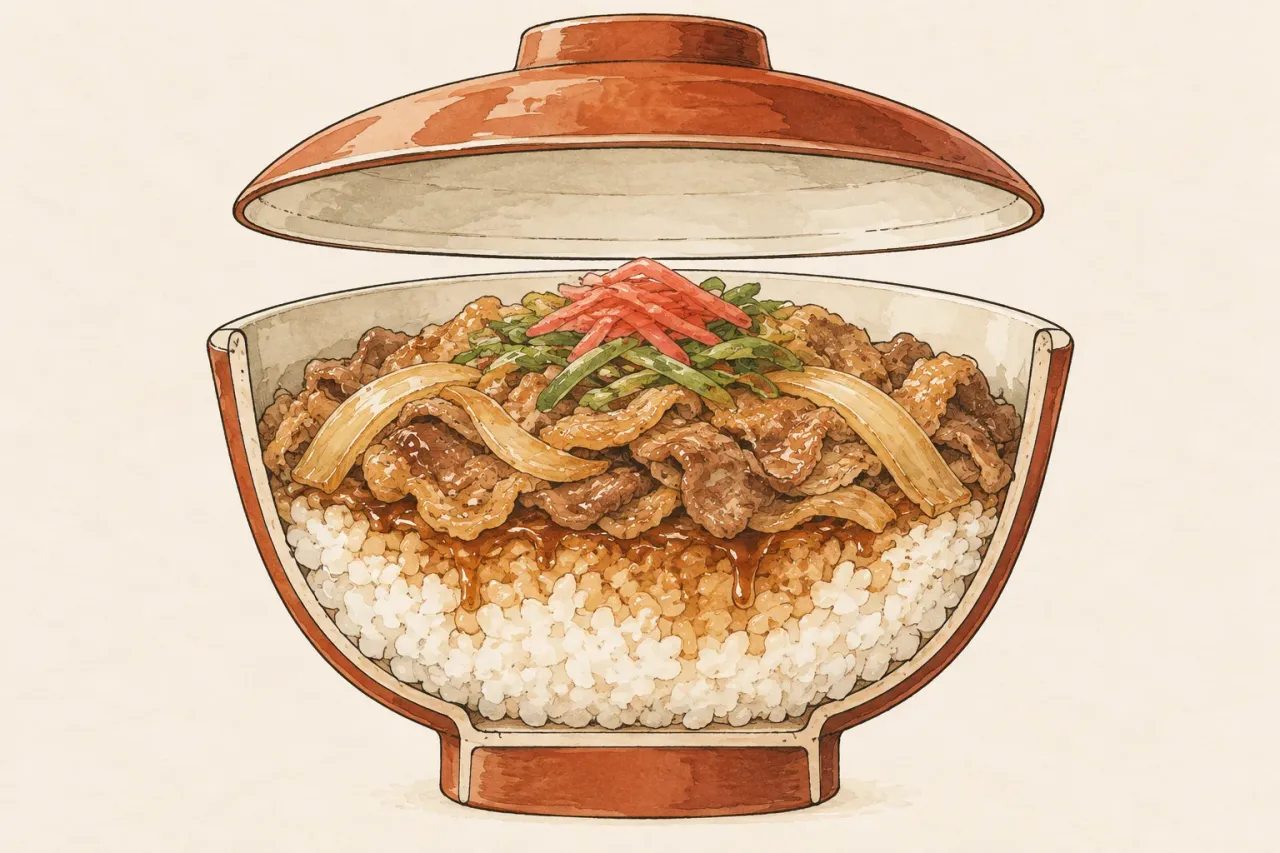
Why it is the way it is
Every donburi is rice + a topping + a way of seasoning it, and the seasoning is where regions split. From the farm ministry’s local-food database:
- Set with egg. The common katsudon. In Yamanashi this is called ni-katsudon and is treated as a separate dish.
- Sauce poured on. Yamanashi’s own katsudon: a cutlet on shredded cabbage, with sauce added just before eating. The ministry says it began at a Meiji-era soba shop in Kōfu whose owner had tasted a cutlet in Tokyo; since soba shops mostly delivered, everything went in one bowl.
- Dipped in sauce. Fukui and Komagane (see the katsudon page).
- Dipped in sweet soy tare. Niigata’s tare-katsudon, with two or more cutlets and no egg, said to date from the early Shōwa era.
- Glazed with sugar-and-soy tare. Obihiro’s butadon, pork loin or belly with shredded leek. The ministry says an Obihiro diner devised it in the early Shōwa era as stamina food for settlers and farmers; it wanted to use eel, found it too dear, and grilled pork over charcoal with an eel-style sauce instead.
What it costs
Gyudon (beef bowl) 牛丼
- Survey
- ¥489 (≈ €3 / $3)牛丼 外食 1杯 · Aug 2026 · 特別区部
- Chains
- ¥460–¥498Beef bowl, regular size · Matsuya, Sukiya, Yoshinoya · tax incl. · checked 2026-10-05
Oyakodon (chicken and egg) 親子丼
- Chains
- ¥480Oyakodon, regular size · Nakau · tax incl. · checked 2026-10-05
- Our guide figure
- ¥780 (≈ €4 / $5)Tokyo, a standard shop · Oct 2026
Katsudon (pork cutlet) カツ丼
- Chains
- ¥650–¥690Katsudon, regular size · Nakau, Katsuya, Matsunoya · tax incl. · checked 2026-10-05
- Our guide figure
- ¥980 (≈ €6 / $6)Tokyo, a standard shop · Oct 2026
Tendon (tempura) 天丼
- Chains
- ¥730The standard tempura bowl · Tenya · tax incl. · checked 2026-10-05
- Our guide figure
- ¥980 (≈ €6 / $6)Tokyo, a standard shop · Oct 2026
Gyudon chain, regular 牛丼チェーン(並)
- Chains
- ¥460–¥498Beef bowl, regular size · Matsuya, Sukiya, Yoshinoya · tax incl. · checked 2026-10-05
- Our guide figure
- ¥490 (≈ €3 / $3)The one case on this page where the survey figure and the street agree almost exactly · Oct 2026
The figures above are kept on the price reference page and update there. Checked on the date at the top of this page, tax included:
- Beef bowl. Yoshinoya, regular ¥498. Sukiya: mini ¥420, regular ¥480, large (tokumori) ¥880, mega ¥1,060. Matsuya posted a price-change notice on 9 October 2026 that I have not read, so its prices are not given here.
- Cutlet bowl. Katsuya: katsudon and sauce-katsudon at the same prices — ume ¥682, take ¥869, matsu ¥1,089, and a “light” version with less rice at ¥649. Takeaway prices are lower for all three (¥669, ¥853 and ¥1,069). The menu does not say why; the gap matches the reduced consumption-tax rate on takeaway food, explained in reading menu prices.
- For comparison, a set meal. Yayoi-ken’s best-selling set meals were ¥890–990.
How ordering works
- Size has names. Sukiya sells mini, regular, tokumori and mega. Katsuya’s ume, take and matsu step up the meat, with “light” for less rice. A Fukui sauce-katsudon shop offers small, medium and large.
- Extras have names. Yoshinoya lists negi-daku (extra onion) and niku-daku (extra meat) as separate menu items. Its history says tsuyu-daku, extra sauce, began as a request from regulars at the Tsukiji fish market.
- Soup is often separate. Katsuya sells pork miso soup as a side (small ¥165, large ¥220). Sukiya offers sets on top of the bowl.
The lineages
The table is kept in one place so that every bowl is described on the same terms. Rows without a link are on the list but not written yet. The eel bowl is on the unagi pages, and the seafood bowl on the market pages.
| Lineage | Origin | On the rice | How it is seasoned | Typical place | How it is ordered |
|---|---|---|---|---|---|
| Gyūdon (beef bowl) 牛丼 | Nihonbashi fish market, TokyoYoshinoya 1899 | Beef and onion | The shop's simmering sauce (tsuyu) | Chains: Yoshinoya, Sukiya, Matsuya (which calls it gyūmeshi) | By size, from mini to mega; extra sauce, onion or meat as named options |
| Katsudon (cutlet bowl) カツ丼 | Waseda, Tokyo (claimed); Fukui, Komagane1913 / 1918 / 1921 (three claims) | Fried pork cutlet | Mostly simmered and set with egg; in Fukui and Komagane, dipped in sauce | Soba shops, diners, cutlet chains; sauce-katsudon specialists in Fukui and Komagane | In Fukui or Komagane, ask for the egg version by name |
| Obihiro butadon (pork bowl)帯広の豚丼 | Obihiro, Hokkaido— | Grilled pork loin or belly, shredded leek | Sweet soy tare, in the style of eel kabayaki | — | — |
| Niigata tare-katsudon新潟のタレかつ丼 | Niigata— | Two or more cutlets | Dipped in sweet soy tare, no egg | — | — |
Lineages without a link are on the list but not written yet. The table is kept in one place so every lineage is described on the same terms.
Where to eat it
- Tokyo — where Yoshinoya’s beef bowl began, at the fish market, and where the katsudon origin claims cluster, around Waseda. Toyosu market has 38 restaurants inside, open to visitors.
- Fukui — sauce-katsudon.
- Komagane, Nagano — sauce-katsudon on cabbage, under a registered regional trademark.
- Niigata, Kōfu, Obihiro — the regional bowls above.
Check fares and journey times with the operator before you travel.
The same name, a different bowl
- “Katsudon” is a different order in different towns. In Fukui and Komagane it means sauce-katsudon; for egg, say so. In Yamanashi the egg version has its own name. In Niigata the cutlet comes in soy tare.
- Even sauce-katsudon differs. Fukui serves rice, thin cutlets and sauce with no cabbage; Komagane lays cabbage under the cutlet and sets rules for it; Yamanashi pours sauce over cutlet on cabbage.
- A national chain lets you choose. Katsuya sells egg-set katsudon and sauce-katsudon side by side at the same price.
What people get wrong
- “Donburi is a dish.” It is a bowl first.
- “Katsudon always has egg.” Not in Fukui, Komagane, Yamanashi’s local version, or Niigata.
- “The beef bowl is a modern chain invention.” Yoshinoya dates itself to 1899, at the Nihonbashi fish market.
- “Ume is the smallest everywhere.” Each chain names its own sizes.
Questions people ask
What does donburi mean?
A thick, deep ceramic bowl for serving food, and by extension any dish of rice with a topping served in one. Short forms such as unadon and tendon use don for the bowl.
Why did I get katsudon with sauce and no egg?
You may be in Fukui or Komagane, where "katsudon" means a cutlet dipped in sauce on rice. In Fukui ask for jō-katsudon or tamago-katsudon for the egg version. In Komagane ask for ni-katsudon or tamago-toji katsudon.
How much is a beef bowl?
At the big chains a regular bowl was ¥498 at Yoshinoya and ¥480 at Sukiya on 10 October 2026, both including tax. Sukiya sells sizes from mini (¥420) to mega (¥1,060).
Sources
Prices are in Japanese yen. Conversions are approximate, at ¥177.30 to the euro and ¥158.23 to the US dollar as of 20 Oct 2026. Rates come from the European Central Bank, which publishes on working days only. Prices checked Oct 2026. What food costs in Japan →