Hokkaido hot springs: the most onsen areas in Japan, the volcanoes behind some of them, and what the count does not tell you
I have not been to every place in this guide. The figures below are taken from the sources listed at the end, with the date each one was published — not measured by me. Where I have been, the article says so.
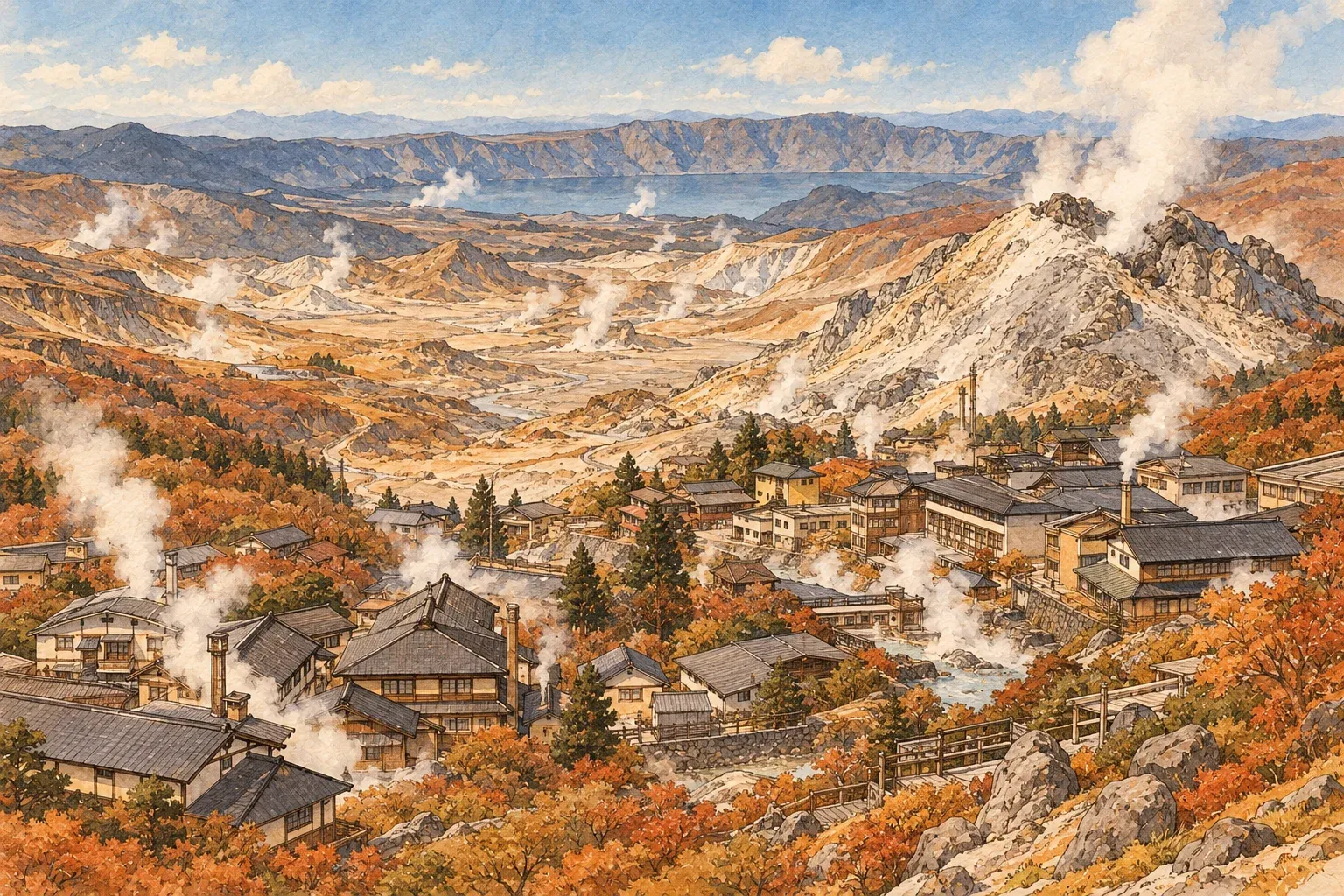
Hokkaido is the prefecture with the most onsen areas in Japan, on the environment ministry’s own figures. It is also where you can see, more plainly than almost anywhere, a hot spring town sitting next to the volcano its water is said to come from. But “Hokkaido is volcanic, so its onsen are volcanic” is not a claim any official source makes. This page sets out what the figures say, which towns explain their water through a volcano and which do not, and how the main towns began. The individual town guides go deeper; for how to read a spring’s name and the sign on the wall, start from the onsen overview.
Where the hot springs are
The environment ministry publishes a yearly table of hot spring use by prefecture. The latest, for fiscal 2024 (as of the end of March 2025), gives Hokkaido:
- 226 onsen areas. The ministry counts a place as an onsen area when it has somewhere to stay.
- 2,249 springs in total. Of those in use, 405 flow naturally and 879 are pumped; another 482 natural and 483 pumped springs are not in use.
- 740 places to stay, with room for 124,348 guests.
- 13,579,988 overnight stays in the year. The ministry marks this figure as a reference value.
- 437 public baths using hot spring water.
The table has no ranking column. Comparing its prefecture figures: Hokkaido has the most onsen areas (226, ahead of Nagano’s 193 and Niigata’s 135) and the most overnight stays (ahead of Shizuoka’s 10,576,818). On springs it is third, behind Oita (5,094) and Kagoshima (2,735). The national totals are 2,839 onsen areas and 27,899 springs.
A count of onsen areas is a count of places with lodging, not a measure of quality. I would not read more into it than that.
Why here
Some of the answer is volcanoes, and the official sources say how much.
The volcanoes. The Sapporo regional office of the Japan Meteorological Agency says Hokkaido has 31 active volcanoes, 11 of them in the Northern Territories. It watches nine around the clock with instruments: Meakandake, Tokachidake, Tarumaesan, Usuzan, Hokkaido-Komagatake, Atosanupuri, Taisetsuzan, Kuttara and Esan. That page does not talk about hot springs.
Noboribetsu and Kuttara. The agency describes Kuttara as a stratovolcano that, roughly 80,000 to 45,000 years ago, erupted repeatedly with pyroclastic flows and formed a round caldera 3 km across. Noboribetsu volcano is a post-caldera volcano on its western foot. Hiyoriyama is a lava dome that still gives off steam and hot water, and Jigokudani (“Hell Valley”) and Oyunuma are a group of craters made by steam explosions. The latest eruption is estimated at about 200 years ago. The agency’s page does not mention Noboribetsu Onsen by name.
The town’s tourism association makes the link itself: it says much of Noboribetsu’s water comes from Jigokudani, which it describes as formed by volcanic activity about 10,000 years ago. That date is the association’s; the agency’s page does not give one for the craters.
Toya. The Lake Toya Onsen tourism association says the hot water of Toyako Onsen and Sobetsu Onsen came up in an eruption in 1910, and that the town was born from it. During that eruption, it says, a seismometer was taken to an erupting volcano for the first time in the world, which is why the area is called “the birthplace of modern volcanology”. Its geopark page ties the springs to the activity of Mt Usu, and its “Know Toya” page adds a second date: the Abuta town history says the first inn opened in 1917, seven years after the eruption. More is in the Toyako guide.
Kawayu. The Lake Mashu tourism association says the water is heated by magma under Mt Io (Atosanupuri) in the middle of the Kussharo caldera, flows through the rock underground and comes up where the town stands. It calls Kawayu “a famous spring born from Japan’s largest caldera”. The name Atosanupuri, it says, means “bare mountain” in Ainu.
Jozankei. Jozankei’s Japanese pages do not explain how its water rises, and do not connect it to a volcano. Its English top page, in summary, describes snowmelt and forest water warmed by geothermal heat; that wording is not confirmed against the page itself. See the Jozankei guide.
Official sources do not give a ministry or prefectural count of which spring types are most common in Hokkaido, and the geological survey material that would map volcanoes to hot springs across the island is not used here. So this page does not describe a Hokkaido-wide pattern.
The towns
These are sketches, not guides. Each town’s own page is the place to go further.
Noboribetsu. The tourism association’s Japanese page says “as many as ten” kinds of spring water, counting Noboribetsu and Karurusu together; the forestry agency, JNTO and others say nine (the Noboribetsu page sets out the counts). The association lists them: sulphur, salt (chloride), alum, Glauber’s salt (sulphate), green vitriol, iron, sodium bicarbonate, radium and simple springs, plus one name whose meaning is unclear. Several of these are older names: salt spring is today’s chloride spring, Glauber’s salt spring is a sodium-sulphate spring, bicarbonate of soda spring is a hydrogen-carbonate spring, and iron spring is today’s iron-bearing spring. “Radium spring” is not one of the ministry’s official categories. So the ten is the association’s count, and it is not the same thing as the ministry’s ten categories.
On history the association gives two starts and does not choose between them. In 1857 Okada Hanbei, a merchant from Ōmi, built a lodging hut for bathers while mining sulphur in Jigokudani. In 1858 Takimoto Kinzō, a carpenter from Edo whose wife had a skin complaint, built a bath hut and, with permission to keep the spring, opened an inn; the association calls him the founder of bathing here. A Yakushi (medicine Buddha) hall followed in 1861. This site does not choose which counts as the opening.
Karurusu, near Noboribetsu, has its own dates on the same timeline: a spring found by Hino Aiki in 1886, a road cut by Hino Kyūkitsu and the spring opened in 1897, and “opened” again in 1899, with no explanation of the difference. The association says the water was known to the Ainu as a medicinal spring long before.
Jozankei. The association describes the water as a sodium chloride spring, neutral, hypotonic and high-temperature, colourless with a mild saltiness. It gives 56 sources, a flow of 8,600 litres a minute and a temperature at the source of 60 to 80°C, which appear to be figures for the whole town. The founder is said to be a mountain ascetic monk, Miizumi Jōzan, who opened the spring in Keiō 2; the association’s home page counts 160 years since. It is “said” that he reached the source with Ainu guides.
Kawayu. The association names the water an acidic, sulphur-bearing, iron(II)-sodium-sulphate-chloride spring of the hydrogen sulphide type, and says it is one of the few volcanic spring types in Japan. About its history it says only that the town has more than a hundred years behind it.
Sounkyo. The Sounkyo tourism association says the Ainu were the first to know this place, passing along the Ishikari river while hunting, and called it Kamuy-mintar, “the garden where the gods play”. Its pages do not tell the history of the spring.
Akan. The Akan tourism association says Ainu tradition is strong on the lakeshore and that visitors can take part in activities at Akan Ainu Kotan. Its pages do not give the history or the water type of the spring.
Tokachigawa. The association calls its water a “moor onsen” that rises from a peat layer and has been chosen as Hokkaido Heritage. It does not give a spring name, and official sources do not define a moor spring as a category.
Hokkaido’s tourism organisation describes some waters in its own words: “rare tea-brown waters” at Teshio and “exceptionally rare oil-bearing waters” at Toyotomi. Those are promotional descriptions. Official sources do not say how the classification treats oil in spring water, so this page does not place Toyotomi in a category.
National health resort onsen. The environment ministry designates a small number of onsen areas as kokumin hoyō onsenchi, places it considers suitable for health and recuperation. Its list shows five in Hokkaido: Karurusu, the Niseko onsen district, Ashibetsu, Naganuma and Toyotomi. The dates beside them on the list are when each area’s plan was drawn up or revised, not when it was designated, and official sources do not give the designation years. Towns that are missing from this list are simply missing from it; that is all the list says.
How people use them
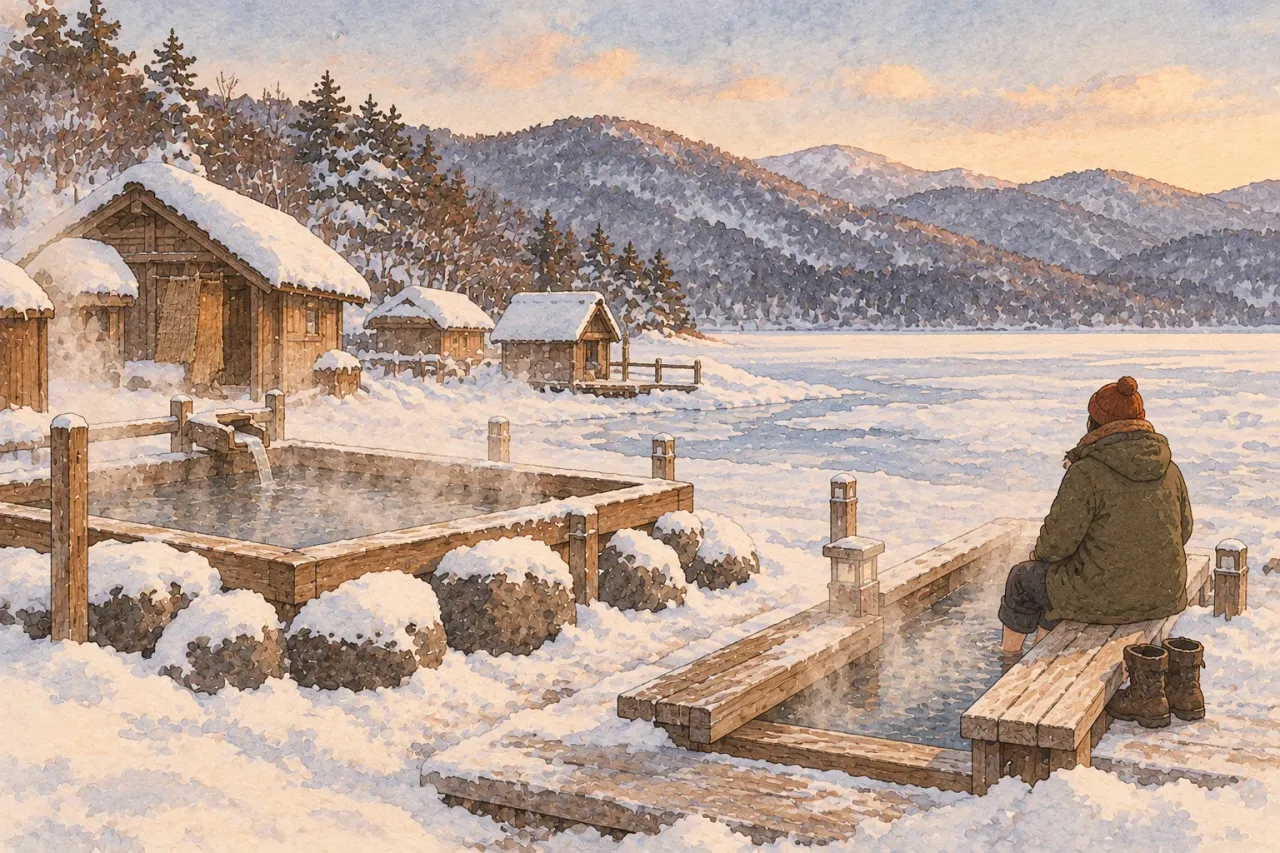
In winter. The tourism organisation’s winter page features an open-air bath and footbath on the ice at Lake Shikaribetsu Kotan in Shikaoi, a village it describes as appearing on the frozen lake each winter; a night walk through the streets of Noboribetsu; and a plan at the roadside station Tappu no Yu in Shinshinotsu that pairs a bath with smelt fishing. Sounkyo holds its Ice Fall Festival in winter; the festival’s own page gave the 51st as 24 January to 8 March 2026 and the 52nd as 23 January to 7 March 2027 (checked 12 October 2026). An older date range still shown on the association’s top page is out of date. More is in the Sounkyo guide. Akan offers frost flowers and walks on the frozen lake. Official sources do not describe snow-viewing baths, so this page does not use the phrase.
With food. Tokachigawa’s tourism association lists butadon, a bowl of grilled pork over rice, among the town’s local food. The farm ministry’s local-food database says butadon is thought to have begun in the early Shōwa era at a diner in Obihiro that put charcoal-grilled pork under a sauce like the one used for grilled eel, that Obihiro is said to be its birthplace, and that it is handed down mainly in the Tokachi area. The ministry does not mention Tokachigawa Onsen, so the honest link is that you can eat a Tokachi dish near a Tokachi onsen, not that the onsen invented it. For the other towns on this page, no dish is named by both the town and the ministry.
Reading the sign. No official Hokkaido source explains how bathing in an onsen town differs from a day spa in a city. What applies everywhere is the national rule that a bath open to the public must post its water’s analysis and say whether, and why, the water is diluted, heated, recirculated or disinfected. Jozankei being about 50 minutes by car from Sapporo is a fact about distance, not about the water.
Getting there
These are the times the towns’ own pages give, checked on 10 October 2026. Every page warns that timetables change, so check the operator before you travel. Fares are not on this page.
- Noboribetsu — From Sapporo by JR limited express about 1 hour 10 minutes, or by intercity bus about 1 hour 20 minutes. From New Chitose Airport by reserved direct bus about 1 hour to 1 hour 15 minutes. From Hakodate by limited express Hokuto about 2 hours 25 minutes. Some air and ferry details on the page are marked as of November 2021.
- Jozankei — By car about 50 minutes from Sapporo. There are buses from Sapporo; check times with the operator, as the association notes that some connections from Makomanai station do not work.
- Toya — From New Chitose Airport by JR limited express about 1 hour 30 minutes to Toya station, then about 20 minutes by bus or taxi. From Sapporo station by reserved Donan bus about 2 hours 45 minutes.
- Sounkyo — From Asahikawa station by Dohoku bus about 110 minutes. From Sapporo, limited express to Asahikawa about 1 hour 25 minutes, on to Kamikawa about 45 minutes, then bus about 35 minutes. Bus times changed in July 2026 and may change without notice.
- Akan — From Kushiro Airport about 65 minutes by direct bus, or about 65 to 70 minutes by Akan Bus’s regular service; the Akan Airport Liner also runs. The page’s summary and detail sections give slightly different times. See the Akan-ko guide.
- Kawayu — There is a JR Kawayu Onsen station on the Senmo line with buses to the town; Hokkaido’s tourism organisation says about 10 minutes by bus. The association gives about an hour or more by car from the airports for the town as a whole; JNTO gives about 70 minutes from Memanbetsu Airport and about 90 from Kushiro Airport. See the Kawayu guide.
- Tokachigawa — From JR Obihiro station by Tokachi bus route 45 about 28 minutes; some runs are weekdays only and need booking. There is no direct bus from Sapporo.
What people get wrong
- “All Hokkaido onsen are volcanic.” Some towns tell their story through a volcano. Jozankei does not, and official sources do not make the general claim.
- “Most onsen areas means the best onsen.” The count is of places with somewhere to stay. On springs Hokkaido is third.
- “Noboribetsu has all ten official spring types.” It has ten names on the association’s list, and they are not the ministry’s ten.
- “Toya’s springs are ancient.” The association dates them to an eruption in 1910.
- “A moor spring is an official category.” It is how Tokachigawa describes its water. The official classification does not list it.
- “The water will treat a condition.” The ministry’s rules list indications by spring type and say treatment at a spa is best done with a doctor’s guidance. This page does not claim any town’s water cures anything.
Questions people ask
Does Hokkaido have the most hot springs in Japan?
It depends what you count. On the environment ministry’s table for fiscal 2024, Hokkaido has the most onsen areas (226) and the most overnight stays, but Oita and Kagoshima have more springs. Hokkaido is third on springs, with 2,249. The table itself has no ranking column; the order comes from comparing its figures.
Are all Hokkaido hot springs volcanic?
Official sources do not say so. Some towns do explain their water through a volcano, such as Noboribetsu, Toya and Kawayu. Jozankei’s Japanese pages do not describe how its water rises or link it to a volcano.
Does Noboribetsu really have ten kinds of spring water?
Nine on most official pages, including the forestry agency, JNTO and Hokkaido’s tourism organisation. The tourism association’s Japanese page says ten, but it covers Noboribetsu and Karurusu together. Several of its names are older names for today’s official categories, and one (radium spring) is not an official category. This site does not choose.
Can I bathe outdoors on a frozen lake?
Hokkaido’s tourism organisation describes an open-air bath and footbath on the ice at Lake Shikaribetsu Kotan, a seasonal village that appears on the frozen lake in winter. Check the official pages for dates before you go.
Sources
- 洞爺湖温泉観光協会「知ろう」
- 北海道観光振興機構「川湯温泉」
- JNTO「Akan-Mashu National Park: How to get there」
- 層雲峡観光協会「層雲峡温泉氷瀑まつり」
- 環境省 自然環境局長通知 平成26年7月1日(禁忌症及び入浴又は飲用上の注意の掲示等の基準)
- 環境省「令和6年度温泉利用状況」(令和7年3月末現在)
- 環境省 温泉に関するデータ
- 環境省 国民保養温泉地
- 札幌管区気象台 北海道の活火山
- 気象庁 倶多楽
- 登別国際観光コンベンション協会 泉質
- 登別国際観光コンベンション協会 登別を知る
- 登別国際観光コンベンション協会 歴史
- 登別国際観光コンベンション協会 アクセス
- 定山渓観光協会 歴史
- 定山渓観光協会 定山渓温泉について
- 定山渓観光協会 泉質
- 定山渓観光協会 アクセス
- 洞爺湖温泉観光協会 ジオパーク
- 洞爺湖温泉観光協会 アクセス
- 摩周湖観光協会
- 摩周湖観光協会 川湯温泉
- 摩周湖観光協会 アクセス
- 層雲峡観光協会
- 層雲峡観光協会 アクセス
- 阿寒観光協会まちづくり推進機構
- 阿寒観光協会まちづくり推進機構 アクセス
- 音更町十勝川温泉観光協会
- 音更町十勝川温泉観光協会 アクセス
- 音更町十勝川温泉観光協会 グルメ
- Hokkaido Tourism Organization, Onsen
- Hokkaido Tourism Organization, 10 Winter Activities
- 農林水産省 うちの郷土料理 北海道
- 農林水産省 うちの郷土料理「豚丼」北海道
Prices are in Japanese yen. Conversions are approximate, at ¥177.30 to the euro and ¥158.23 to the US dollar as of 20 Oct 2026. Rates come from the European Central Bank, which publishes on working days only. Prices checked Oct 2026. What food costs in Japan →