
Noboribetsu Onsen: water from Hell Valley, nine or ten spring types, and a town of steam and sulphur
I have not been to every place in this guide. The figures below are taken from the sources listed at the end, with the date each one was published — not measured by me. Where I have been, the article says so.
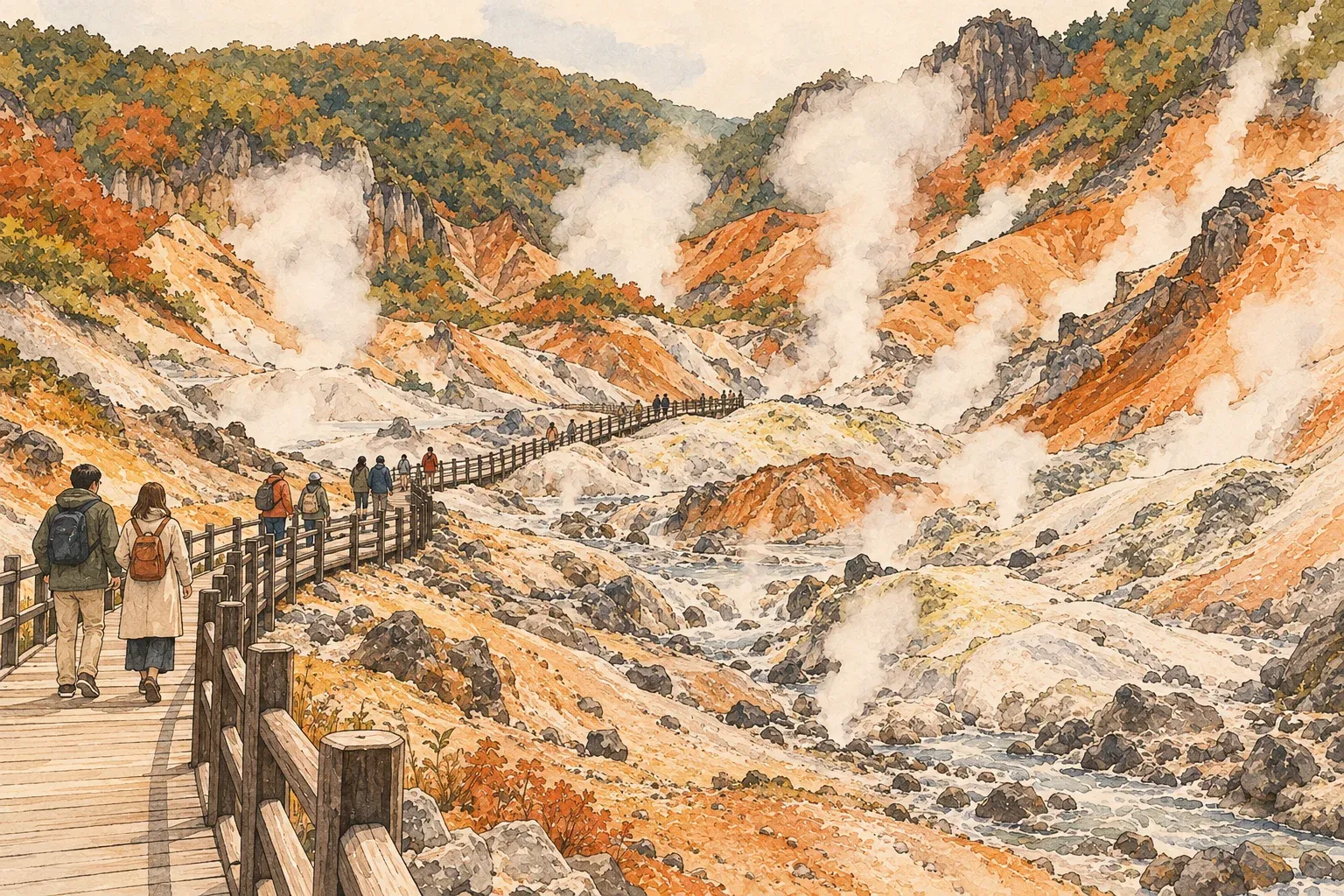
Noboribetsu Onsen is in Hokkaido, and its tourism association describes it as a town where hot water rises all over, much of it from Jigokudani, “Hell Valley”, and is piped to the town’s hotels and inns. It is known for having many kinds of water in one place. This page covers what the association, the city, the forestry agency, the weather agency and the tourism bodies say about the water, why their counts differ, what the town is like to walk around, and how to get there. How to read the sign by the bath is in the guide to onsen water types.
Where it came from
The association’s timeline gives the dates below. It is the association’s account unless another source is named.
- About 1845. Matsuura Takeshirō visits and writes about the springs. The forestry agency also says he visited in 1845 and left a record.
- 1857. Okada Hanbei, a merchant from Ōmi, builds at his own expense a tōji hut for the labourers mining sulphur in Jigokudani.
- 1858. Takimoto Kinzō, a carpenter sent by the shogunate, opens an inn and builds a road. The association calls him the founder of tōji at Noboribetsu.
- 1901. A new road links the onsen with Noboribetsu, and two-horse carriages run on it.
- 1905. Karurusu Onsen, nearby, becomes a convalescent site for soldiers wounded in the Russo-Japanese War. The association says this spread the name of both springs.
- 1915 to 1925. A horse-drawn tramway, then a steam light railway (1918), then an electric line (1925).
- 2004. Jigokudani is selected as a Hokkaido Heritage site. The Iburi regional office of Hokkaido also uses that title.
1857 or 1858. Both men appear in the timeline, and the association does not say which marks the start. It counted its 100th anniversary in 1958 and its 150th in 2008, which counts from 1858, but it does not say 1857 is wrong. This site does not choose.
The Ainu. The forestry agency says the Ainu used the water as a medicinal bath. The association’s timeline says this of Karurusu Onsen, not of Noboribetsu Onsen itself.
The name. Noboribetsu city says the name comes from the Ainu Nupurpet (written ヌプルペッ), meaning “a river of deep colour”. That is the city’s one sentence; I could not open the city’s Ainu culture site, and I found no other account to set beside it.
The water
How much, and how many sources
The association’s Jigokudani page says about 10,000 tonnes of hot water a day well up there and are supplied to the town’s hotels and inns. The forestry agency, the Iburi regional office and Hokkaido’s tourism organisation give the same rough figure; JNTO says more than 10,000 tonnes are supplied, without saying per day. None of these pages says when or by whom it was measured. The forestry agency gives source temperatures of 45 to 90°C.
I could not find the number of sources. It is not on the association’s, the city’s, the forestry agency’s, the Iburi office’s or JNTO’s pages, and the environment ministry’s usage statistics are by prefecture, with no figures for single towns.
Nine or ten
The town is famous for its variety of water, but the count depends on who is counting, and this site does not choose.
- Ten, on the association’s Japanese page. Its title is “the stories of ten waters”, and the text gives ten types for “Noboribetsu Onsen and Karurusu Onsen” together. The tenth entry, simple spring, is about Karurusu.
- Nine and ten, on the association’s English page. The title says ten but the introduction says “nine different types”. It has nine headings (sulphur, saline, alum, mirabilite or Glauber’s salt, melanterite or green vitriol, iron, acidic, sodium bicarbonate and radium), and then describes Karurusu’s simple spring without a heading of its own.
- Nine, everywhere else I looked. The forestry agency, the Iburi regional office, JNTO and Hokkaido’s tourism organisation all say nine.
Read that way, the association’s ten looks like Noboribetsu’s nine plus Karurusu’s simple spring. That is how the pages are laid out; the association itself does not say so, and none of these pages explains how it counts.
The names against the official ten
The association uses older names. The environment ministry’s table of old and new spring names lets some of them be matched to the ten official types:
- Sulphur spring is the official sulphur spring.
- Salt spring (shokuen-sen) is a chloride spring.
- Glauber’s salt spring (bōshō-sen) is a sulphate spring.
- Bicarbonate of soda spring (jūsō-sen) is a hydrogen carbonate spring.
- Iron spring is the official iron-bearing spring.
- Green vitriol spring (ryokuban-sen) falls under iron-bearing springs in the ministry’s table. The association also labels it aluminium-bearing, but its own description says it is mainly iron sulphate.
- Karurusu’s simple spring is the official simple spring.
Three I could not match. Alum spring has no line of its own in the ministry’s table. Radium spring does not appear in the table; the association describes it as containing radon and thoron above a set level, but I found no official statement that it equals the official radioactive spring. The seventh type on the association’s Japanese page is written sansei-sen with characters meaning “agreement”, where the English page has “Acidic” and the Japanese description speaks of hydrogen ions; the ministry’s table has no such word, and no source says why it is written that way.
Hell Valley and the volcano
The sources describe Jigokudani differently, and I give each.
- The tourism association says Jigokudani is the crater of an explosion caused by the eruption of Hiyoriyama, about 450 m across and about 11 hectares, with many vents along the valley. Elsewhere it says the valley was formed by volcanic activity about 10,000 years ago.
- The forestry agency also says it is the remains of an explosion crater about 450 m across.
- The Japan Meteorological Agency describes Jigokudani and Oyunuma as a group of explosion craters from steam-driven (phreatic) eruptions and gives no date for their formation. It describes Kuttara as a stratovolcano that formed a caldera 3 km across in large eruptions about 80,000 to 45,000 years ago, and Hiyoriyama as a lava dome. Its page for Kuttara is titled as a volcano under constant observation, with seismometers, tiltmeters, cameras and other instruments, and a volcanic alert level is set for it. The latest eruption, along a line of craters from Hiyoriyama through Oyunuma to Ura-Jigoku, is estimated at about 200 years ago.
- The geological survey (AIST) gives the same latest eruption, cites a 2013 study counting more than twelve phreatic eruptions around Jigokudani and Oyunuma in the past 8,500 years, and records a small burst of hot water at Taishō Jigoku, south of Hiyoriyama, in November 2016.
The 10,000 years is the association’s figure; the weather agency and AIST do not give it. Neither of them, nor the forestry agency, explains where the water itself comes from, so I do not.
Oyunuma, by the association’s description, is a gourd-shaped lake about 1 km round, formed as an explosion crater of Hiyoriyama. Sulphur water at about 130°C spouts from its bed, and the grey-black surface is about 40 to 50°C.
What you notice in the bath
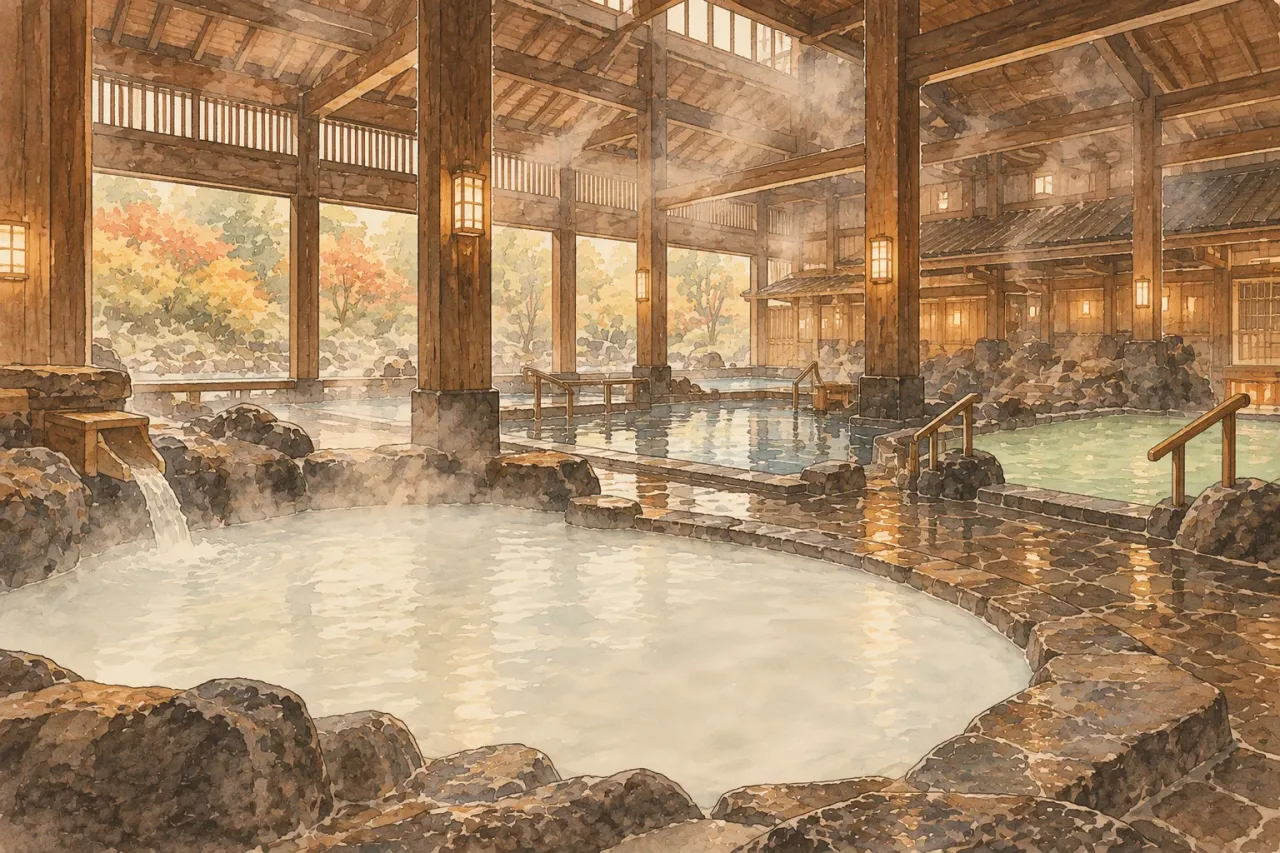
The association’s English page on its waters gives practical notes for bathers. These are notes about bathing, not claims about health.
- In sulphur springs and salt springs, soap does not lather well.
- People with sensitive skin should avoid long soaks in salt, alum and acidic springs.
- Iron springs can turn a white towel reddish.
- After washing your hair in a bicarbonate of soda spring and rinsing with the water, hair feels glossy, the page says.
The same page describes nearby Karurusu Onsen as a Glauber’s salt simple spring containing radium, at 48 to 74°C where it emerges. Those figures are for Karurusu, not Noboribetsu Onsen.
How the town works
Hokkaido’s tourism organisation describes hot springs all over the town, the smell of sulphur, white steam rising from the ground, and statues of oni (ogres) around the streets. It suggests going round the baths of different inns and hotels as one way to enjoy the town. The association’s oni legend says the ogres living in Jigokudani were given the task of guarding the source of the medicinal water as punishment for their misdeeds.
The free places to see, by the association’s pages:
- Jigokudani. Free to visit. JNTO says the boardwalks are about five minutes on foot from the Noboribetsu Onsen bus terminal. The association says there is a wheelchair slope, at most 8 percent, from the park service centre to the Jigokudani viewpoint. There is a paid car park, but the association does not say whether its fee includes tax, so I do not give it.
- Oyunuma. Free.
- The geyser in Sengen Park. A park built around a geyser on the hot river flowing from Jigokudani; it erupts about every three hours, and it is free. The association’s timeline dates the park to 2008.
- The natural footbath on the Oyunuma river. Water overflowing from Oyunuma, close to Taishō Jigoku on the river trail. Free.
The association lists day bathing in three areas — Noboribetsu Onsen, Karurusu Onsen and the wider Noboribetsu area — at inns and at dedicated day facilities.
Bathing there
Day bathing prices. The association’s Japanese and English day-bathing pages list adult prices, but nowhere on either page do the words “tax included”, “tax excluded” or “bathing tax” appear, so I do not give them. Some facilities list a reception time separate from their opening hours; the pages do not explain the difference, so check the last entry time.
Bathing tax. Noboribetsu city charges a bathing tax per person per day: 300 yen for an overnight stay (from 1 April 2020) and 50 yen for a day visit, as checked on 11 October 2026. Children under 12, users of communal and ordinary public baths, and school trips in compulsory education are exempt, and the facility collects it. A one-night stay counts as one day. The association’s pages do not say whether day-bathing prices include it.
Tattoos and manners. I searched the association’s Japanese and English pages, including its day-bathing, access and FAQ pages, for tattoos, manners and etiquette and found nothing. JNTO’s Noboribetsu page and Hokkaido’s tourism organisation’s Jigokudani page do not cover tattoos either. Hokkaido’s tourism organisation suggests checking the facility’s own website or the association (0143-84-3311). I do not say whether you can bathe; ask in advance, and a private bath is one option. The water types guide has what the tourism agency and JNTO say in general.
What it is eaten with
The farm ministry’s list of Hokkaido’s local dishes does not mention Noboribetsu. Its ramen page names Muroran, not Noboribetsu, for curry ramen. So there is no dish that both the ministry and the town tie to Noboribetsu; what follows is the local side’s own account.
- Noboribetsu Enma yakisoba. The association’s restaurant FAQ calls it Noboribetsu’s local dish, served at restaurants in the city, with the look, heat and ingredients differing from shop to shop. The Noboribetsu Brand Promotion Council says it began in 2015, first served on 16 April 2015, and that to use the name a dish must follow three rules: flat noodles of Hokkaido wheat, a spicy, sesame-flavoured sauce “designated by Enma”, the king of hell, as the council puts it, and ingredients from Noboribetsu and nearby.
- Noboribetsu Enma ramen. Listed by the city as a Noboribetsu Brand recommended product (2009 fiscal year), and named by the Iburi regional office among local noodles.
Getting there
Checked on 11 October 2026. Fares are not on this page. The association’s access pages have no update date, and their air and ferry details are marked as of November 2021, so I have not used those.
Bus from New Chitose Airport.
- The association gives the Kōsoku Airport-gō bus as about 1 hour. Dōnan Bus, which runs the Kōsoku Noboribetsu Onsen Airport-gō, gives about 1 hour 15 minutes, and says it is reservation only, booked on its website up to two hours before the first departure.
- Booking. The association’s access page lists phone numbers for reservations. Dōnan Bus announced that from 1 February 2024 the Onsen-gō and the Airport-gō are booked and paid on its website only, and that phone reservations ended on 31 January 2024.
- The Kōsoku Hayabusa-gō: the association gives about 1 hour 15 minutes with a change. Dōnan Bus gives 1 hour 57 minutes for the whole route from the airport to Muroran, reservation only, mentions no change, and does not give the time to Noboribetsu Onsen.
From Sapporo.
- Limited express. The association gives about 1 hour 10 minutes by the Hokuto or Suzuran to Noboribetsu station. JNTO gives 1 hour 30 minutes to 2 hours from Sapporo by train, and about 1.5 hours by express bus or train on its Hell Valley page. I could not open JR Hokkaido’s timetable, so I do not choose. JR Hokkaido says that from the timetable change of 14 March 2026 its limited expresses within Hokkaido are all reserved seating, with no unreserved tickets; the Suzuran (except Nos. 2 and 5) and the Hokuto are on its list.
- Bus. The association gives about 1 hour 20 minutes. The Kōsoku Onsen-gō between Sapporo and Noboribetsu Onsen is web reservation only, as above.
From Noboribetsu station. Dōnan Bus’s page for its station line says 27 minutes, though its timetable shows journeys of about 14 to 25 minutes. Hokkaido’s tourism organisation gives about 15 minutes by bus, and JNTO 15 to 20 minutes by bus or car. IC cards such as Kitaca and Suica are not accepted on any of the line’s buses; the NA and NB services take Visa contactless.
By car. The association says the onsen is about 8 km from Noboribetsu station and about 6 km from the Noboribetsu-Higashi interchange on the Dōō Expressway. Because the interchange name does not include “onsen”, it says to look for the dedicated signs, and for the oni sign after the exit, turning left for the onsen. Hokkaido’s tourism organisation gives about 10 minutes from the interchange and about 60 minutes from New Chitose Airport; the association’s Japanese top page gives about 1 hour 40 minutes from Sapporo and about 1 hour from the airport.
What people get wrong
- “Noboribetsu has ten official spring types.” Most official pages say nine; the association’s ten includes Karurusu. Several of the association’s names, such as radium spring, are not official types.
- “Hell Valley is 10,000 years old, officially.” That is the association’s figure. The weather agency and the geological survey do not give it; they date the latest eruption to about 200 years ago.
- “The volcano is extinct.” The weather agency keeps Kuttara under constant observation and has set a volcanic alert level for it.
- “Book the airport bus by phone.” The bus company moved to web-only booking in February 2024, although the association’s page still lists phone numbers.
- “Curry ramen is Noboribetsu’s dish.” The farm ministry names Muroran for curry ramen. Noboribetsu’s own bodies promote Enma yakisoba and Enma ramen.
- “Tattoos are banned in Noboribetsu.” I could not find an official policy either way.
- “The water treats skin conditions.” The association’s notes are about bathing, such as soap and towels. This page makes no health claims.
Questions people ask
How many kinds of spring water does Noboribetsu have?
Nine on most official pages, including the forestry agency, the Iburi regional office, JNTO and Hokkaido’s tourism organisation. The tourism association’s Japanese page says ten, but it covers Noboribetsu and Karurusu together. Neither side explains how it counts, and this site does not choose.
How much water comes out?
The tourism association, the forestry agency and the Iburi regional office all give about 10,000 tonnes a day. None of them says when or by whom it was measured. I could not find an official count of the sources.
Can I bathe at Noboribetsu with tattoos?
I could not find a tattoo policy on the association’s Japanese or English pages, on JNTO’s page or on Hokkaido’s tourism site. That site suggests checking the facility’s own website or asking the association. Ask in advance, or consider a private bath.
Why did my white towel turn reddish?
The association’s English page on its waters says iron springs can tint a white towel red. It also says soap lathers poorly in sulphur and salt springs.
Sources
- 登別国際観光コンベンション協会「登別を知る」
- Noboribetsu Tourism Association, About
- 登別国際観光コンベンション協会「10の湯のものがたり」
- Noboribetsu Tourism Association, The Ten ONSEN of Noboribetsu
- 登別国際観光コンベンション協会「歴史」(年表)
- 登別国際観光コンベンション協会「地獄の谷の鬼花火」
- 登別国際観光コンベンション協会「登別地獄谷」
- 登別国際観光コンベンション協会「泉源公園の間欠泉」
- 登別国際観光コンベンション協会「大湯沼」
- 登別国際観光コンベンション協会「大湯沼川天然足湯」
- Noboribetsu Tourism Association, Day trip bathing
- 登別国際観光コンベンション協会「日帰り入浴」
- 登別国際観光コンベンション協会「飲食店について」(FAQ)
- 登別国際観光コンベンション協会「アクセス」
- Noboribetsu Tourism Association, Access
- 登別国際観光コンベンション協会「観光スポット・イベント」
- 登別市「登別市の概要」
- 登別市「入湯税」
- 登別市「登別ブランド推奨品」
- 北海道胆振総合振興局「地域別(登別市)」(2026-03-25 更新)
- 林野庁「登別温泉風景林」
- 北海道森林管理局「登別温泉風景林」
- 気象庁「倶多楽」
- 気象庁「活火山とは」
- 産業技術総合研究所「倶多楽・登別火山群」(第四紀火山 C17)
- 環境省「新旧泉質名対照表」
- 農林水産省 うちの郷土料理「北海道」
- 農林水産省 うちの郷土料理「ラーメン」(北海道)
- 登別ブランド推進協議会
- 登別ブランド推進協議会「登別閻魔やきそば」
- 道南バス「高速おんせん号・高速登別温泉エアポート号」WEB予約制のお知らせ(2024-01-29)
- 道南バス「高速登別温泉エアポート号」
- 道南バス「高速はやぶさ号」
- 道南バス「都市間バス」
- 道南バス「登別温泉・登別駅前線」
- JR北海道「特急列車の全車指定席化」
- JNTO, Noboribetsu Onsen
- JNTO, Noboribetsu Hell Valley
- Hokkaido Tourism Organization, Noboribetsu Onsen
- Hokkaido Tourism Organization, Noboribetsu Jigokudani
- Hokkaido Tourism Organization, Onsen
Prices are in Japanese yen. Conversions are approximate, at ¥177.30 to the euro and ¥158.23 to the US dollar as of 20 Oct 2026. Rates come from the European Central Bank, which publishes on working days only. Prices checked Oct 2026. What food costs in Japan →