
Katsudon: three origin claims, two ways to make it, and the towns where it means sauce
I have not been to every place in this guide. The figures below are taken from the sources listed at the end, with the date each one was published — not measured by me. Where I have been, the article says so.
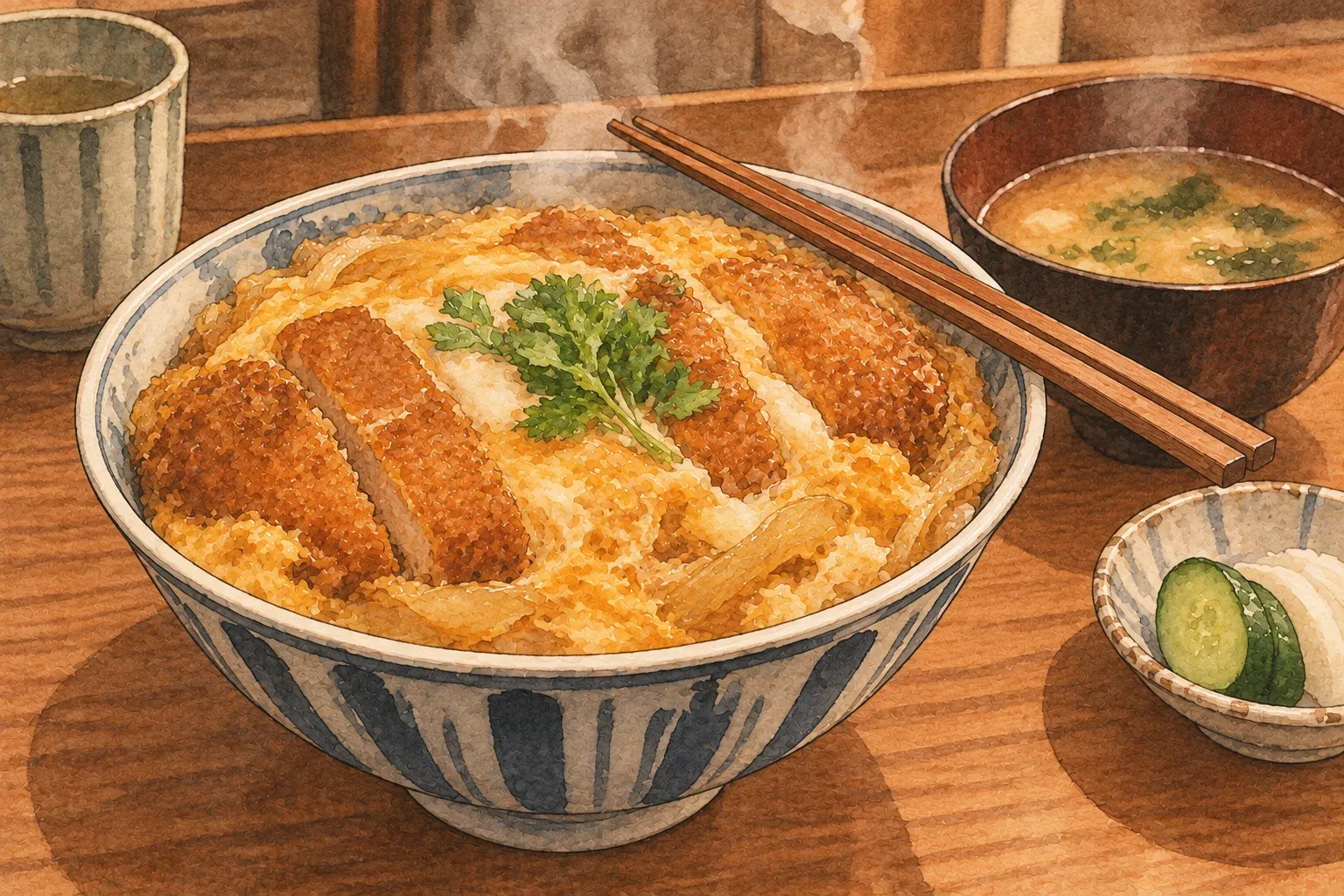
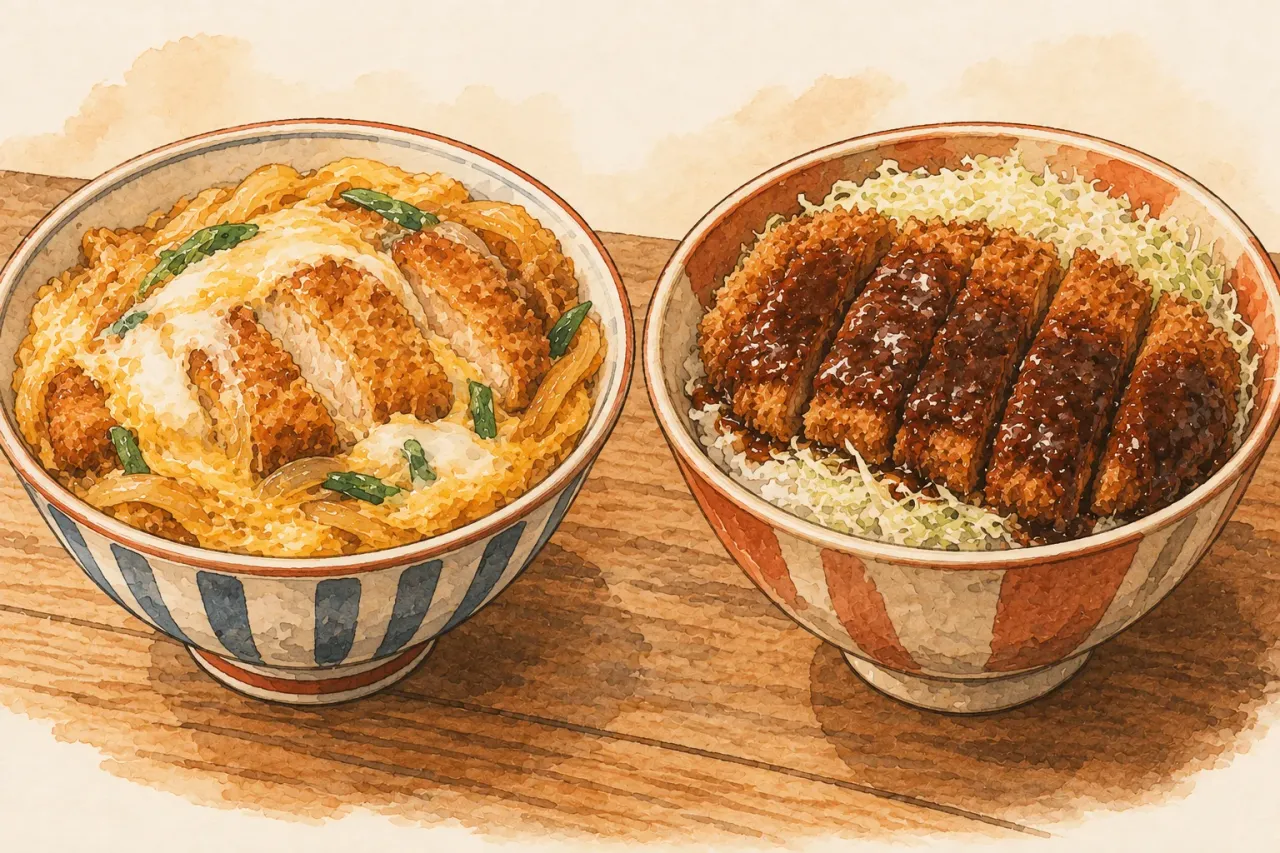
In most of Japan, katsudon is a pork cutlet simmered in broth, set with egg and laid on rice. In Fukui and in Komagane, Nagano, katsudon is something else: a cutlet dipped in Worcestershire-type sauce and laid on rice, no egg. Both towns say theirs is the original. So do several people in Tokyo. This page sets out the claims, the local rules, and what to say when you order.
For rice bowls generally, start from the donburi overview.
Where it came from
A Waseda University feature collects the claims, all from the Waseda district of Tokyo, and does not pretend to settle them.
- Sauce, 1913 — Yōroppa-ken. Takabatake Masutarō, from Fukui, trained for six years in Germany, presented a sauce katsudon at a cooking demonstration in 1913, and on 28 November that year opened Yōroppa-ken in Waseda Tsurumaki-chō. His grandson, the third owner, says the founder never told him he was the originator; he learned it from a magazine interview. The shop is said to have moved to Yokosuka in 1917 and later left Waseda.
- Egg, 1918 — Sanchōan. At this soba shop in Waseda’s Babashita-chō, the story is that founder Katō Asajirō had cutlets left over from a banquet, and on a student’s suggestion simmered them in soba broth and set them in egg. The evidence is the second owner’s book and family tradition; the feature points out that the university history it is often linked to mentions the shop but not katsudon.
- Sauce, 1921 — Nakanishi Keijirō. In February 1921 an 18-year-old Waseda student is said to have put a cutlet on rice in a bowl at a café near Anahachiman shrine and poured over a thick sauce of Worcestershire and flour. The sources are his own 1967 article in a Waseda history bulletin, a 1981 letter to the Asahi newspaper and a 1983 book.
- A witness. Takeuchi Yoshitarō recalled that around 1917 a diner in Tsurumaki-chō served katsudon “with sauce or broth”, no egg — and, elsewhere, that he ate one with egg at another shop near Anahachiman.
The feature itself leans towards Yōroppa-ken. That is its judgement. The Komagane association cites the two sauce claims and says the first katsudon was seasoned with sauce; it does not mention the egg claim.
What makes each kind
Egg (the common katsudon). Cutlet set in egg on rice. Yamanashi calls this ni-katsudon and treats it as a separate dish.
Fukui sauce katsudon. Fukui’s tourism association: thin slices of pork in fine breadcrumbs, fried, dipped in sauce while hot and laid on rice. Usually no cabbage — just rice, cutlet and sauce. It credits Takabatake: he returned from Germany in 1912, adapted German-style Worcestershire sauce to Japanese taste, showed it in Tokyo in 1913, and later went home to Fukui, where the taste has been passed down. How exactly it moved from Waseda to Fukui, the sources I have do not say. The association adds a local rite of passage: Fukui people leaving the prefecture are surprised to be served katsudon with egg.
Komagane sauce katsudon. The local association’s page — read here from a page whose security certificate did not match, so treat details as the association’s own — describes shredded cabbage on rice, topped with a cutlet dipped in a house sauce. It says it has been served in the city since the beginning of Shōwa and that in Komagane “katsudon” means this. Restaurant owners formed the association in 1993. Its rules for customers:
- served in a donburi;
- pork loin as standard, at least 120 g;
- coated in breadcrumbs and fried;
- cabbage finely shredded, soaked in water and drained, laid on the rice;
- fried in oil kept clean of crumbs;
- the association’s sauce as the minimum standard;
- dip then cut, or cut then dip, either is fine;
- no nori or vegetables other than cabbage;
- a lid is optional.
“Komagane sauce katsudon” is a registered regional collective trademark (no. 5942880), held, according to the patent information service, by the Komagane chamber of commerce. The association names Ichinose Shōichi, who opened the café Kiraku, as the pioneer, but its own page gives his start as 1928 in one place and around 1936 in another, from interviews rather than documents.
Yamanashi. Cutlet on shredded cabbage, sauce added before eating.
Niigata. Tare-katsudon: cutlets dipped in sweet soy tare, two or more to a bowl, no egg; said to date from the early Shōwa era.
The shops, and what they charge
Katsudon (pork cutlet) カツ丼
- Chains
- ¥650–¥690Katsudon, regular size · Nakau, Katsuya, Matsunoya · tax incl. · checked 2026-10-05
- Our guide figure
- ¥980 (≈ €6 / $6)Tokyo, a standard shop · Oct 2026
The figures above are kept on the price reference page and update there. Katsuya, a national chain, sells katsudon and sauce katsudon side by side at the same tax-included prices: ume ¥682, take ¥869, matsu ¥1,089, with a “light” version (less rice) at ¥649. Fukui’s tourism site gives a price for Yōroppa-ken’s head shop, but without a date, so it is not used.
How to order it
- In Fukui, plain katsudon is sauce katsudon. For egg, ask for jō-katsudon or tamago-katsudon. Yōroppa-ken’s cutlets spill over the bowl, and the tourism association says Fukui people put one or two on the lid to eat. Grill Yamada offers small, medium and large.
- In Komagane, katsudon is sauce katsudon. For egg, ask for ni-katsudon or tamago-toji katsudon.
- Elsewhere, katsudon means egg; look for sōsu katsudon on the menu.
Not all of Japan’s cutlet bowls are this
- Fukui also has Ōno’s soy-sauce katsudon, with grated radish (from 2010), and Takefu’s Volga rice, whose origin is disputed.
- The Komagane association sorts other towns as it sees them: Fukui and Kiryū with thin sauce and no cabbage, Aizu-Wakamatsu with cabbage and a thicker sauce. That is its classification, not checked here.
Eating it at the source, and getting there
Fukui city for Yōroppa-ken and its sauce katsudon; Komagane for the association’s shops. Check fares and journey times with the operator before you travel.
Katsudon away from home
- The word changes meaning. The same order brings egg in Tokyo, sauce in Fukui and Komagane. Fukui’s tourism association calls the surprise of the egg version outside Fukui a rite of passage.
- The source protects its version. Komagane has rules and a trademark; Fukui has a shop that has kept its founder’s sauce.
- The story leads back to Tokyo. Yōroppa-ken was founded in Waseda in 1913, not in Fukui.
- A chain gives you both. At Katsuya you choose egg or sauce, same price.
What people get wrong
- “Katsudon means egg.” Not in Fukui or Komagane, and not in Yamanashi’s local version or Niigata’s.
- “Someone definitely invented it.” Three claims, from 1913, 1918 and 1921, all from Waseda; none is settled.
- “Fukui and Komagane serve the same thing.” Fukui’s has no cabbage and thin cutlets; Komagane’s sits on cabbage, with a 120 g minimum.
- “Sauce katsudon is a regional novelty.” Two of the three origin claims are sauce versions.
Questions people ask
Who invented katsudon?
Three claims, all around Waseda in Tokyo. Yōroppa-ken's founder showed a sauce katsudon at a cooking demonstration in 1913. The soba shop Sanchōan says its founder set leftover cutlets in egg in 1918. A Waseda student, Nakanishi Keijirō, is said to have poured a thickened Worcestershire sauce over a cutlet on rice in 1921. None is settled.
How do I get katsudon with egg in Fukui?
Fukui's tourism association says to order jō-katsudon or tamago-katsudon. Plain katsudon there is sauce katsudon.
What is Komagane sauce katsudon?
A cutlet dipped in the shop's sauce, laid on shredded cabbage on rice, in a bowl. The local association sets rules, including pork loin of at least 120 g, and the name is a registered regional trademark.
Sources
Prices are in Japanese yen. Conversions are approximate, at ¥177.30 to the euro and ¥158.23 to the US dollar as of 20 Oct 2026. Rates come from the European Central Bank, which publishes on working days only. Prices checked Oct 2026. What food costs in Japan →