
Gero Onsen: one managed supply of alkaline water, a riverside spring you can no longer bathe in, and a town of footbaths
I have not been to every place in this guide. The figures below are taken from the sources listed at the end, with the date each one was published — not measured by me. Where I have been, the article says so.
Gero Onsen is in Gifu prefecture, on the Hida river, and is one of the three springs that writers of the past grouped as Japan’s most famous, with Kusatsu and Arima. Its water is an alkaline simple spring that Gero has piped from shared tanks since 1974; the city now gives 12 sources for that system. Around Gero station, a riverside source, public baths, a hot spring museum and many footbaths sit within walking distance. This page covers the water, how the town tells its history, how the baths, footbaths and bath pass work, and what I could not confirm. It uses the tourism association, Gero city, the inn cooperative and national agencies; where they disagree, I give each. The ten official spring types and how to read the sign by the bath are in the guide to onsen water types; the Honshu overview places Gero alongside the rest of Chubu.
Where it came from
The tourism association’s site (gero-spa.com, run by the Gero Onsen Tourism Association) and Gero city’s tourism pages tell the story in stages. I give each as they do.
- The mountain. The spring is said to have first been found near the summit of Mt Yugamine, 1,067 m high, about 4 km from today’s town. Both the association and the city say Yugamine is considered a volcano formed by an eruption about 100,000 years ago.
- When. There are two accounts, and this site does not choose. One places the discovery in the Tenryaku era (947–957), citing the Hishū-shi, which Gero city says was completed by Hasegawa Tadataka, the seventh Hida intendant, on the order of the shogun Yoshimune. The other places it in the Engi era (901–923), citing the Hida Hennen Shiyō.
- The river. The flow near the summit stopped and was found again on the bank of the Hida river. The association puts the stop before 1265, in the middle of the Kamakura period; Gero city gives 1265. The city’s version of the white heron legend says Yakushi Nyorai, the Buddha of healing, is said to have taken the form of a wounded white heron, healed itself in the Hida river and shown villagers where the source was.
- The visitor. In 1489 the monk Banri Shūku, of Kyoto’s Five Mountains temples, came to Gero and praised the spring. Gero city’s Japanese page gives the year of his visit as “Entoku 1 (1265)”, but Entoku 1 is 1489, and 1265 is the year the same page gives for the rediscovery, so this looks like a slip on the city’s page. I use the association’s 1489.
Onsen-ji
The temple’s own site (which I read in summary, not word for word) says Onsen-ji, of the Rinzai Myōshin-ji school, was founded in 1671, but that a bell inscription of 1507 already names a Yushima Yakushi hall, so a hall stood here earlier. Its main image is a Yakushi Nyorai, hot water still flows in front of the main hall, and a Yakushi festival is held every 8 March. In the temple’s telling, after the flow stopped in 1265 villagers noticed a white heron on the Hida river, followed it, and found a glowing Yakushi image under a pine on Mt Nakane. It holds the Yubumi, a document on the spring’s origin. The only designation the page names is a prefecture-designated historic site, the grave of Hidaya Kyūbei. So the temple dates itself to the 17th century, not to the discovery of the spring. Gifu’s tourism federation describes it as the temple of the white heron Yakushi, about 15 minutes’ walk from JR Gero station (its information for fiscal 2025).
“Three famous springs”
Gero city quotes both writers. In its rendering, Banri Shūku wrote in Baika Mujinzō that every one of the country’s sixty-odd provinces has a sacred spring, and that the foremost are Kusatsu in Kōzuke, Arima, and Yushima (Gero) in Hida. Hayashi Razan, the Edo-period Confucian scholar, named the same three in his collected poems, and added that Arima and Kusatsu were widely known while Yushima, though an old sacred spring, was little known far away. He also wrote that those who bathed there felt its effect; that is his view, not evidence of any effect. The city’s English page says Hayashi’s naming of Gero, Arima and Kusatsu is often given as one reason for Gero’s popularity, and Gifu’s tourism federation counts Gero among the three without saying who chose them. So the grouping comes from writers. I found no government body that chose it.
The city honours both men. Its English pages say a statue of Banri Shūku (born 1428 in Ōmi, today’s Shiga, who trained at Kyoto temples and later lived in Mino) was unveiled on 3 August 2015 at the Gero Onsen Thanksgiving Festival, and that a statue of Hayashi Razan (1583–1657) has stood on Shirasagi bridge, opposite Gero Onsen shrine, since 1992, said to mark more than 1.5 million visitors a year. The thanksgiving festival, in early August each year, honours both.
The name and the railway
Gero city says the place name is thought to come from Shimo-no-tomari, a post station set up in 776 between Mino and Hida according to the Shoku Nihongi, which became Geru and then Gero. The city gives this as “it is said”. It is a story about the name, not about the spring. The city also says the town grew with the opening of Gero station in 1930, the JR Takayama line and the full opening of National Route 41.
The water
Twelve sources and seven tanks
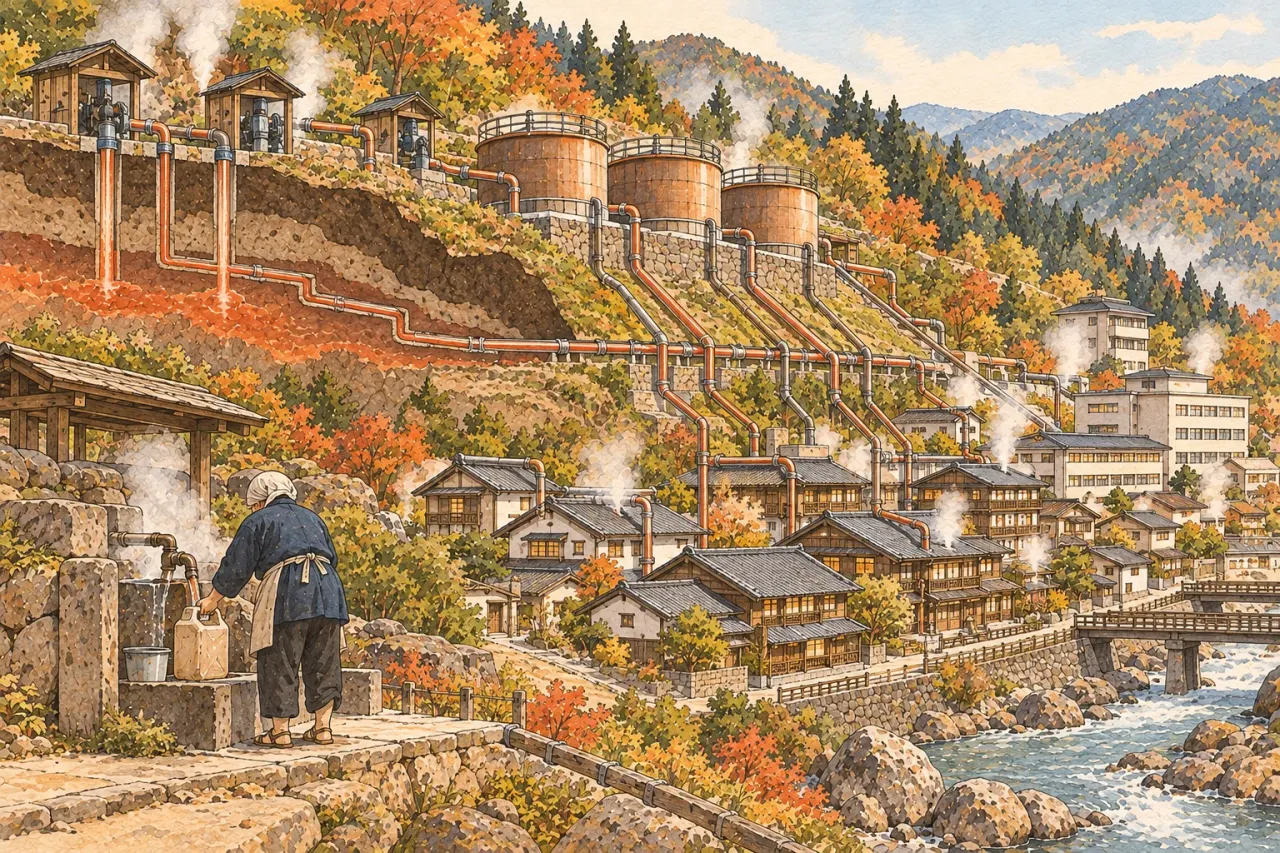
Gero city’s English page on its tank system (updated 30 January 2025) says that in the 1960s visitor numbers rose sharply, inns each drew on their own sources, and the water began to run out quickly. A preservation association was set up in 1969 to study the problem, and since 1974 the city has managed the hot spring through a central tank system: seven tanks of 200 to 300 tonnes each, more than 10,000 m of pipe, and water drawn from 12 sources. The system can supply up to 3,400 litres a minute for commercial and private use. For comparison, the page says that in 1970 more than 7,150 litres a minute were being pumped from 42 sources. It adds that residents can draw water from the nearest tank for home use for a small fee, and that on average more than 100 people a day do so.
The page gives no year for these figures, and does not say whether the 12 sources are every source in town or only those feeding the system. The tourism association says the central management project began in 1971 and has run since 1974. Its diagram of the system shows sources with pumps feeding storage tanks, which feed inns, hotels, dormitories and hospitals, with a separate branch to a hot spring stand; it carries no figures. The Centrip Japan page, an English page the association links to, says the water serves more than 50 inns and hotels.
Spring type and pH
The association gives the spring as a simple spring (alkaline simple spring), pH 9.2. It also links two official analysis tables, both made by a registered laboratory, the Gifu Prefectural Public Health Inspection Center, on 25 November 2013. I read them from scanned images:
| District (pumping station) | Spring type | pH | Temperature at source | Total dissolved matter |
|---|---|---|---|---|
| Yunoshima-Mori | alkaline simple | 8.9 | 56.2°C | 0.387 g/kg |
| Kōda | alkaline simple | 9.5 | 55.5°C | 0.345 g/kg |
Gero city says “pH 9 or above”. So there are three pH figures: 9.2 from the association, 8.9 and 9.5 for two districts in 2013, and “9 or above” from the city. I could not find what the 9.2 was measured on. The 2013 figures fall within the official definition of an alkaline simple spring (under 1,000 mg/kg of dissolved matter, at least 25°C, and pH 8.5 or above at the source); that comparison is mine, not the town’s. Both tables carry the standard lists of indications and contraindications; the official list for each spring type is in the water types guide.
84°C and 55°C
Two temperatures appear on official pages:
- 84°C. The Gero Onsen Ryokan Cooperative’s site, in Japanese and English, says the water rises at 84°C. It does not say which source or when.
- 55°C. Gero city says that, having managed the spring centrally since 1974 to protect it, it now supplies water at 55°C to each inn. The Centrip Japan page gives 84°C at the source and a “final” temperature of 55°C, without defining it.
The 2013 analysis tables give 55.5°C and 56.2°C at the two pumping stations. None of the official pages explains how 84°C water becomes 55°C water, so I do not explain it either.
What heats it
The association and the city both call Mt Yugamine a volcano, but neither connects that eruption to the heat of today’s water. Yugamine is not on the weather agency’s list of active volcanoes. The national geological survey’s literature database lists a 1994 article in the Gero town bulletin titled “Is Yugamine the heat source of Gero Onsen?”; I could only see the listing, not the article, so all I can say is that the town once asked the question. I found no public source that answers it, so I do not call the water volcanic.
Not on the health resort list
The environment ministry designates “national health resort hot springs” (kokumin hoyō onsenchi), 79 as of October 2022. Its list for Gifu has three: Okuhida (Takayama city), Shirakawa-gō Hirase (Shirakawa village) and Osaka Onsen-kyō (小坂, in Gero city, not the city of Osaka), designated on 28 March 1983. Gero Onsen itself is not on the list.
How the town works
The pattern is a compact one: from Gero station, the sources say, you can walk to Funsenchi in about 3 minutes, and to the Sagi-no-Ashiyu footbath and the hot spring museum in about 8.
Funsenchi, the riverside source. The association and Gero city both say bathing at Funsenchi has been banned since 1 December 2021. The city calls it the symbol of Gero Onsen and suggests touching the source water and taking photos; it is cleaned from 7 to 8 in the morning. Neither page gives a reason for the ban. The inn cooperative’s English page still described it as a “free open-air bath” when checked on 11 October 2026. The two Japanese pages agree and give the date, so I follow them, but I note the English page.
Public baths. The association’s site lists Funsenchi, Shirasagi-no-Yu, the Kur Garden open-air bath and Sachi-no-Yu under hot springs. The Centrip Japan page speaks of “three public baths and Funsenchi”. I could not find these described as kyōdōyu, community baths run by residents in the way some other towns run theirs.
- Shirasagi-no-Yu. Its operator, Gero Onsen Co., gives 10:00 to 20:45 (last entry 20:00), closed on Wednesdays (Fridays when Wednesday is a public holiday). There is no shampoo or body soap, no towel rental (towels are sold), and no cashless payment for now. Gero city’s 2020 page says local people have used it since 1926; its 2021 page says only “for a long time”.
- Kur Garden open-air bath. The operator gives 8:00 to 20:45 (last entry 20:00), closed on Thursdays. You cannot use only the rest area; the full fee is charged even if you do not bathe. Food and drink may be brought in, but not into the changing room or bath, and there is no cashless payment.
- Sachi-no-Yu. A public bath attached to an inn. Gero city’s page (updated October 2020) gives 14:00 to 21:00, closed on Mondays and Tuesdays (open on public holidays), with seven kinds of bath including a sauna and a waterfall bath.
Footbaths. The inn cooperative lists the town’s footbaths, many of them free, each with its own hours:
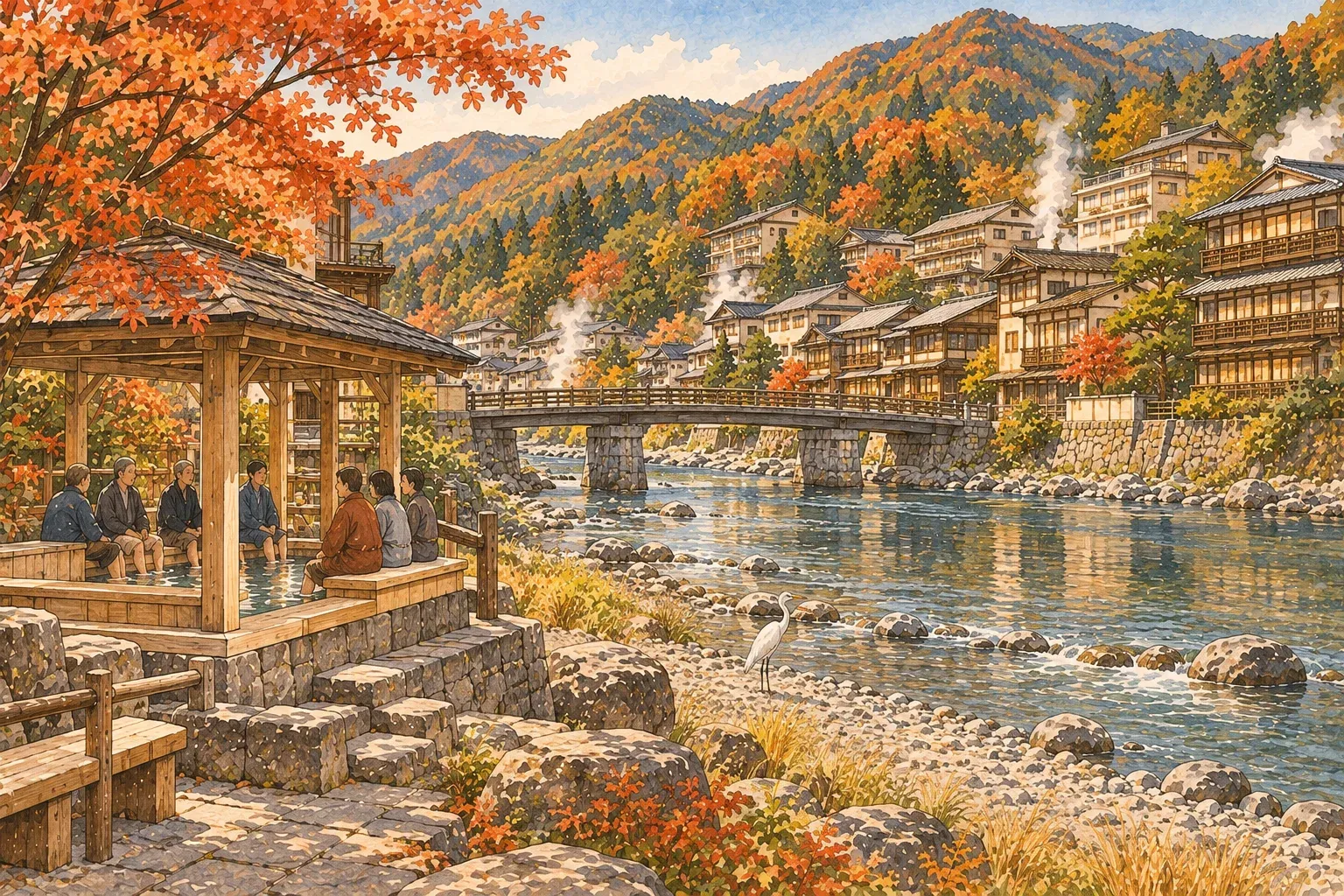
- Sagi-no-Ashiyu — 24 hours, free, next to the central car park. The association says it is made of hinoki cypress, seats five side by side, has a roof, and was the town’s first footbath.
- Venus no Ashiyu — in front of Shirasagi-no-Yu, 10:00 to 21:00.
- Yuamiya no Ashiyu — ground floor of the Ryokan Kaikan, 9:00 to 18:30, with changes.
- Tanokami no Ashiyu — in the park beside Gero city hall, 24 hours, free.
- Gasshō no Ashiyu — inside Gasshō-mura (Gasshō Village); the footbath is free but entry to the village is charged.
- The museum footbath — at the hot spring museum, which charges admission.
The list also includes Miyabi no Ashiyu and the Sarubobo Ōgon footbath. It gives no manners.
The hot spring museum. Gero Hakken Onsen Hakubutsukan presents hot springs from the side of chemistry and of culture, has a footbath, and is arranged in five sections: the science of hot springs, the culture of hot springs, welcome to Gero Onsen, the hot spring doctor’s room, and fun hot spring challenges. It lists an admission price but does not say whether tax is included, so I do not give it.
Bathing there
Yumeguri tegata
The inn cooperative sells a yumeguri tegata, a pass for touring baths, at ¥2,500 including tax (checked 11 October 2026). It is valid for six months from purchase and lets you bathe at three of the member inns. Gero city’s page (updated 1 October 2025) gives the same price including tax and says it comes with a towel and a drawstring bag. It is sold at member inns, souvenir shops and convenience stores, among other places.
Each inn sets its own hours for pass holders, and some take them only on certain days or turn them away when busy. The cooperative’s pass page links to a system for checking how crowded the baths are and to notices of days when bathing is restricted, so check those before you go.
Children. The cooperative says children aged 3 and under bathe free, and children aged 4 to 12 need a sticker of their own from a pass (two children can use two stickers from one adult’s pass at the same time). The association’s pass page gives the same price, without saying it includes tax, and describes children differently: it has children aged 4 to 6 entering on an adult’s pass. I follow the cooperative, which sells the pass.
Member inns. I could not get a single count. Gero city’s 2021 page says about 15, the cooperative’s list appears to have about 19, and an older city page from 2020 says about 25, alongside a price of ¥1,500 that is out of date. Use the cooperative’s current list.
The pass rules. The cooperative’s rules for the pass say: bathing only, with no resting; bring your own bath towel; no refunds once bought; and please bathe quietly, mokuyoku, so that talking does not disturb others. In the summary I read, they also say you may be refused on busy weekends and holidays, family and private baths may not be included, many inns do not let pass holders use their car parks, you should wash before getting in and keep your towel out of the water, no food or drink may be brought in, and the inns are not responsible for accidents or theft.
Tattoos
The same rules say that people with tattoos are firmly refused when bathing with the pass. That is the cooperative’s rule for pass holders at member inns; it says nothing about the public baths, the footbaths, or each inn’s rules for its own staying guests. I found no tattoo policy on the pages for Shirasagi-no-Yu, the Kur Garden, Sachi-no-Yu or the footbaths, and none in English. Ask the facility in advance; a private bath is one option. The water types guide has what the tourism agency and JNTO say in general.
In English
I could not find an official English guide to bathing in Gero. Gero city’s foreign language page links to Google Translate. The city does have English pages on its history and its tank system. The Centrip Japan page gives two lines of advice: the bath water can be very hot, and do not drain the bathtub water. The inn cooperative’s English page says nothing about how to bathe; the washing rules above are in Japanese, in the pass rules.
Public bath prices
Shirasagi-no-Yu, the Kur Garden and Sachi-no-Yu list prices, but none says whether they include tax, so I do not give them. They also differ between pages: Gero city’s 2020 page gives a lower adult price for the Kur Garden than the association and the operator do.
Things to check
Funsenchi is no longer for bathing. Each public bath has its own closing day. Footbath hours differ from one to the next, and two of them are inside places that charge entry.
Food
The farm ministry’s Our Local Cuisines lists keichan for Gifu: chicken and vegetables stir-fried in a special sauce, with Gujō, Gero and the southern part of Takayama as the main areas where it is handed down. The ministry says it is thought to have been modelled around 1950 on the jingisukan eaten in parts of Gifu, began as a way to eat household hens that had stopped laying as a valuable source of protein, and that the name has two explanations — one from a name for grilled pork offal, one from keijan, “chicken sauce”. It does not mention the hot spring.
Gero city’s tourism pages (updated 2017) call keichan a Gero speciality: chicken and cabbage with a special sauce, grilled on an iron plate or a jingisukan pan, seasoned with soy sauce, miso or salt. One city page gives both naming explanations; another gives only the pork one. The city publishes a map of shops in the Gero City Keichan Council and notes that other shops serve it too. The city calls it a speciality of Gero, not of the hot spring. The only dish its pages tie to the hot spring is tomato-don, a rice bowl made with the area’s summer-to-autumn tomatoes, which it calls a new speciality of Gero Onsen.
Hida beef and hoba miso. The farm ministry lists hoba miso, miso grilled on a hoba magnolia leaf, with Hida and Takayama as its main areas; it does not name Gero. Gero city’s specialities page, separately, says Hida beef grilled with hoba miso can be eaten at restaurants and inns in the city. So the ministry places the dish in Hida and Takayama, and the city says you can eat it in Gero; neither calls it a dish of Gero Onsen.
The same city pages list river fish (ayu, amago and iwana), konnyaku and mushrooms, and as local dishes hoba-zushi in early summer, nezushi and anekaeshi. The gourmet site run by the Gero chamber of commerce lists keichan, Nattoku pork, Hida beef (including Hida beef hitsumabushi), seared meat sushi, local sake tasting, lunches and sweets. The city’s food pages are from 2017, and I did not check any shop.
Getting there
Times as given on the official pages, checked on 11 October 2026. Fares are not on this page.
- From Nagoya. The association gives about 1 hour 30 minutes from Nagoya station on the JR Takayama line, and its sample timetable has a train taking about 1 hour 34 minutes; it says every train, including the limited express Hida, stops at Gero. The inn cooperative’s route diagram, which carries no date and uses the train’s older name, Wide View Hida, gives 1 hour 27 minutes. Times vary by train; plan on about an hour and a half.
- From Osaka. The association gives about 3 hours 30 minutes; the cooperative’s diagram gives 3 hours 24 minutes by the Hida.
- From Tokyo. The cooperative’s diagram shows the shinkansen to Nagoya, 1 hour 37 minutes by Nozomi or 1 hour 48 minutes by Hikari, then the Hida.
- Direct bus for inn guests. The inn cooperative runs a bus between Nagoya and Gero Onsen, one round trip a day: it leaves Nagoya at 14:00 and reaches Gero around 16:30, and leaves Gero at 10:30 and reaches Nagoya around 13:00. It is only for guests of member inns and must be booked between two months and two days ahead. From 6 September to 26 October 2026 the Nagoya boarding point changes because of the Asian Games. The cooperative’s pages give different fares, so I do not give any.
- From Gero station. About 3 minutes on foot to Funsenchi, about 8 minutes to the Sagi-no-Ashiyu and the museum, about 6 minutes by bus to Gasshō-mura, and about 1 hour by train to Takayama.
I could not open JR Central’s own pages for the Hida or its timetable, the local bus company’s site gives no Gero routes or times, and the JNTO page I tried for Gero did not open.
What people get wrong
- “You can bathe in the river pool for free.” You could once. The association and the city say bathing has been banned since 1 December 2021, though an English page still says otherwise.
- “The three famous springs is an official title.” It comes from writers of the Muromachi and Edo periods, whom the city now honours with statues and a festival.
- “Gero’s water is volcanic.” The association and the city say Mt Yugamine is considered a volcano. I found no public source that connects it to the heat of the water.
- “Gero was founded in 947.” That is one of two accounts; the other says the Engi era, 901–923.
- “The water comes out of the ground at 84°C and that is what you bathe in.” The cooperative gives 84°C; the city says it supplies the inns at 55°C, and the 2013 analysis tables give about 55–56°C at the pumping stations.
- “Onsen-ji is as old as the spring.” The temple gives 1671 as its founding, with an earlier Yakushi hall recorded in 1507.
- “Gero is a designated health resort.” The ministry’s list includes Osaka Onsen-kyō in Gero city, not Gero Onsen.
- “Every footbath is free.” Most are, but two are inside places that charge entry.
- “Tattoos are fine everywhere” or “banned everywhere.” The pass rules refuse tattooed bathers at member inns; I found nothing for the public baths or footbaths.
Questions people ask
Can I still bathe in the open riverside pool at Gero?
No. The tourism association and Gero city both say bathing at Funsenchi has been banned since 1 December 2021 and that it is now a place to see and touch the source. The inn cooperative’s English page still called it a free open-air bath when checked on 11 October 2026, so treat older English descriptions with care.
Who named Gero one of Japan’s three famous springs?
Writers, not a government body. The tourism association and Gero city trace it to the monk Banri Shūku in the Muromachi period and the scholar Hayashi Razan in the Edo period, who each named Gero with Kusatsu and Arima. The city honours both at a festival every August and has statues of them.
What is a yumeguri tegata?
A pass sold by the Gero inn cooperative that lets you bathe at three of its member inns, for day bathing only. It costs ¥2,500 including tax and is valid for six months from purchase, as checked on 11 October 2026.
Can I bathe at Gero with tattoos?
The inn cooperative’s rules for the yumeguri tegata say that people with tattoos are firmly refused when bathing with the pass. I found no tattoo policy for the public baths or footbaths, and none in English. Ask the facility in advance, or consider a private bath.
Sources
- 下呂温泉観光協会系サイト「下呂温泉を知る」
- 下呂温泉観光協会「下呂温泉の集中管理システム」(図、PDF)
- 下呂温泉観光協会 温泉分析表(湯之島・森地区、2013年11月25日分析、PDF)
- 下呂温泉観光協会 温泉分析表(幸田地区、2013年11月25日分析、PDF)
- Centrip Japan「Gero Onsen」(下呂温泉観光協会系サイトが案内する英語ページ)
- 下呂温泉観光協会系サイト 温泉カテゴリ
- 下呂温泉観光協会系サイト「噴泉池」
- 下呂温泉観光協会系サイト「白鷺乃湯」
- 下呂温泉観光協会系サイト「クアガーデン露天風呂」
- 下呂温泉観光協会系サイト「幸乃湯」
- 下呂温泉観光協会系サイト「鷺の足湯」
- 下呂温泉観光協会系サイト「下呂発温泉博物館」
- 下呂温泉観光協会系サイト「湯めぐり手形」
- 下呂温泉観光協会系サイト「泊まる」
- 下呂市 げろたび「下呂温泉の紹介」
- 下呂市「Onsen Tank System」
- 下呂市「林羅山の像」(英語)
- 下呂市「万里集九の像」(英語)
- 下呂市「下呂温泉の日帰り入浴施設」(古い料金表記を含む)
- 下呂市「湯名人 湯めぐり手形セット」
- 下呂市「下呂の郷土料理」
- 下呂市「鶏ちゃん食べつくしマップ」
- 下呂市「特産品」
- 下呂市「外国語への対応」
- 下呂温泉株式会社「白鷺乃湯」
- 下呂温泉株式会社「クアガーデン露天風呂」
- 下呂温泉旅館協同組合 公式(湯めぐり手形・泉温)
- 下呂温泉旅館協同組合「湯めぐり手形」
- 下呂温泉旅館協同組合「湯めぐり手形 諸々心得」
- Gero Onsen Ryokan Cooperative, English
- 下呂温泉旅館協同組合「アクセス」(経路図)
- 下呂温泉旅館協同組合「足湯」
- 下呂温泉旅館協同組合「名古屋・下呂直行バス」
- 温泉寺「温泉寺とは」
- 岐阜県観光連盟 岐阜の旅ガイド「温泉寺周辺紅葉ライトアップ」
- 岐阜県観光連盟 岐阜の旅ガイド「下呂温泉」
- 環境省「国民保養温泉地」
- 環境省 国民保養温泉地一覧表(令和4年10月現在、PDF)
- 産総研 地質文献データベース『広報げろ』1994年5号「下呂温泉の熱源は湯ヶ峰か?」(書誌のみ)
- 農林水産省 うちの郷土料理「鶏ちゃん」岐阜県
- 農林水産省 うちの郷土料理「朴葉味噌」岐阜県
- 下呂商工会「げろぐる」グルメ
Prices are in Japanese yen. Conversions are approximate, at ¥177.30 to the euro and ¥158.23 to the US dollar as of 20 Oct 2026. Rates come from the European Central Bank, which publishes on working days only. Prices checked Oct 2026. What food costs in Japan →