
Kusatsu Onsen: strongly acidic water, the Yubatake, and the paddles that cool the bath
I have not been to every place in this guide. The figures below are taken from the sources listed at the end, with the date each one was published — not measured by me. Where I have been, the article says so.
Kusatsu, in the mountains of Gunma, is built around one open-air source in the middle of town. The water comes out of the ground hot and strongly acidic, and most of what makes the town distinctive — the wooden channels, the paddles, the short timed baths — is a way of dealing with that. This page explains how the town works using the town office, Gunma prefecture, the tourism association, the ryokan association’s site and national agencies. Where they give different numbers, each is given with its source. It does not rate any bath.
For what pH, spring types and the long chemical names on the sign mean in general, see the separate guide to onsen water types; for the posted notices about added water, heating and disinfection, see the piece on kakenagashi.
Where it came from
The legends
The town office lists founding legends tied to Yamato Takeru, the monk Gyōki and Minamoto no Yoritomo, and says no specific founding year is recorded. The tourism association’s chronology gives the same three as things that are “handed down”: Yamato Takeru in the Kofun period, Gyōki in the Nara period, and Yoritomo in 1193, during a hunt at the foot of Mount Asama. The ryokan association’s English history page gives the same three, putting Yamato Takeru more than 1,800 years ago and Yoritomo in 1193. None of them gives evidence for any of the three, and this page does not choose one.
The tourism association’s chronology has other dates, but some of its era-to-year conversions do not match, so this page does not use years that appear only there.
The town says many warlords came to bathe during the Warring States period, that in the Bunka and Bunsei years of the late Edo period more than 10,000 visitors a year are said to have come, and that the shogun Tokugawa Yoshimune is said to have had the water carried to Edo Castle.
The name
The tourism association offers two explanations. One traces it to a line in the Daihannya sutra that mentions a hot spring called Kusatsu in the south. The other says the smell of hydrogen sulphide made it kusa-uzu, “stinking water”, which became Kusatsu. It does not choose between them.
Winter
The tourism association’s culture page records that in the past the inns closed from 9 October to 7 April and residents moved down to lower ground for the hard winter.
The “three famous springs”
Kusatsu’s tourism association calls it one of Japan’s three famous springs, alongside Gero and Arima, without saying who chose them. The National Diet Library’s landmarks page also calls Kusatsu one of the three, again without naming who chose. Official sources name no body that did.
The grouping goes back to two writers. Gero city’s tourism page (updated 1 December 2021) quotes both:
- Banri Shūku, a Muromachi-era monk, in Baika Mujinzō: every province of Japan has its healing springs, and the foremost are Kusatsu in Kōzuke, Arima in Settsu and Yushima — Gero — in Hida.
- Hayashi Razan, an Edo-era Confucian scholar: of Japan’s many hot springs, the most notable three are Arima, Kusatsu and Yushima.
The two lists name the same three springs. The dates for Banri’s line differ between Gero city’s page and Kusatsu’s chronology, and Gero’s page pairs an era name with a year that do not match, so this page gives no year. The National Diet Library holds the original texts only as images. So “three famous springs” is a name from a monk and a scholar, not an official selection.
The water
How much, and from where
The town says the springs come out at “several tens” of places, a few of them privately owned and most owned and managed by the town, and that all of them flow naturally rather than being pumped. Six are the main sources: Bandai, Yubatake, Shirahata, Jizō, Sainokawara and Nikawa. Both the town and the tourism association say Kusatsu has the largest natural flow in Japan. The ryokan association’s site says that besides the six there are more sources than can be counted. Official sources do not give a total count of sources; Gunma prefecture’s hot spring page (updated 1 July 2026) gives 459 sources across 29 municipalities in the prefecture, with no figure for Kusatsu.
The flow figures do not agree, and this page does not reconcile them.
- The tourism association gives more than 32,300 litres a minute, about 230,000 drums a day, with no survey year.
- The ryokan association’s site gives the same 32,300 litres a minute, or about 46 million litres a day, citing a 1995 hot-spring statistics feature in Onsen, the Japan Hot Spring Association’s journal, and the town’s 2018 yearbook. It ranks the top five natural flows as Kusatsu, Beppu, Okuhida, Isawa-Kasugai and Nasu.
- JNTO, in an article from January 2022, gives 5,000 litres a minute.
- An English site run by Kusatsu’s ryokan cooperative gives roughly 32,300 litres “each day” — a day rather than a minute.
The ryokan association’s site also gives a table by source. The table gives no year of its own; the sources it cites are the 1995 statistics and the 2018 yearbook, so the figures may be that old. The temperature column has no unit.
| Source | Temperature | pH | Flow (L/min) |
|---|---|---|---|
| Yubatake | 52.7 | 2.1 | 4,040 |
| Shirahata | 52.2 | 2.1 | 659 |
| Sainokawara | 44.9 | 2.1 | 1,073 |
| Jizō | 49.9 | 2.2 | 252 |
| Nikawa | 48.5 | 2.1 | 817 |
| Bandai | 94.5 | 1.6 | 6,200 |
| Others | — | — | 18,961 |
| Total | — | — | 32,300 |
The rows add up to 32,002, about 300 short of the stated total; the gap is in the table itself. For the Yubatake alone, the town and the tourism association both say 4,000 litres a minute.
The town says the Bandai source comes out at about 94.5°C, so it is passed through a heat exchanger and used in baths at about 60°C, while the other sources come out at around 50°C. The ryokan association’s English site puts the sources at about 50°C to nearly 90°C.
How acidic
| Source of the figure | pH |
|---|---|
| Town office | Around 2.0 |
| Tourism association (Yubatake source) | 2.1 |
| Ryokan association site, table above | 1.6–2.2 by source |
| Ryokan association site, English page on the water’s acidity (no source or year) | 1.6–2.1 |
| Kusatsu’s three-bath official site | 2.05 |
| Gozanoyu’s own site | 1.7–2.1 |
Every figure is in the acidic band (under pH 3). The tourism association gives the full name of the Yubatake source as an acidic, sulphur-bearing aluminium-sulphate-chloride spring (hydrogen sulphide type), hypotonic, acidic, high-temperature. How to take that name apart is explained in the water types guide; the association itself does not explain it.
Why it is like this
Two explanations, from different kinds of source.
- The national geological survey (AIST’s explanatory notes for the Kusatsu-Shirane volcano map, a synthesis of older research) says water soaks into the ground on the east flank of Kusatsu-Shirane, picks up heat and acidic components from volcanic gas as it passes beneath steaming ground such as Sesshōgawara, mixes with cooler, more dilute groundwater from the north, and comes out near the town. The notes say they draw on older studies and may differ from the latest findings.
- The tourism association says rain and snow falling on Shirane soak deep underground, are warmed by magma and dissolve minerals on the way down, a journey said to take more than 30 years, which is why the flow changes little. It adds a note that “there are various theories”. The ryokan association’s site calls Kusatsu-Shirane, 2,160 m high, the springs’ “parent”.
The Japan Meteorological Agency describes Kusatsu-Shirane as a stratovolcano rich in fumaroles and hot springs, “Kusatsu Onsen among them”, with steaming activity that gives off hydrogen sulphide.
How the town works
The Yubatake
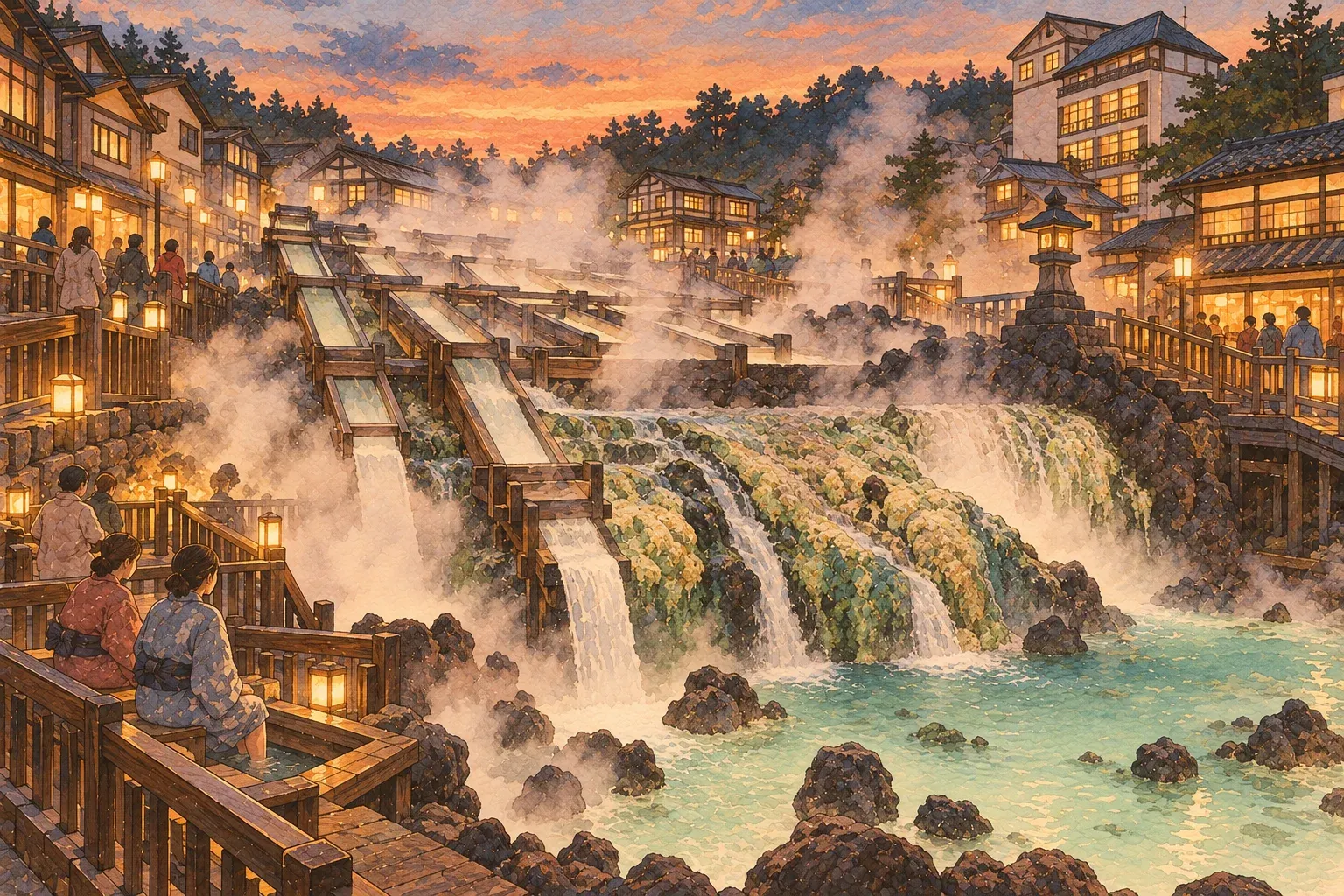
The Yubatake, “hot-water field”, is the source in the middle of town, where the water runs through wooden channels (yutoi) before it is piped on. The town says it flows at 4,000 litres a minute, was chosen as one of Japan’s 100 scent landscapes in 2002 and designated a national Place of Scenic Beauty in 2017; the ryokan association’s English site gives the designation date as 13 October 2017. JNTO describes the water as about 55°C and strongly acidic, cooled in the wooden channels.
The tourism association says there are seven wooden channels, which cool the water before it reaches the baths. The ryokan association’s English site adds that yunohana, mineral deposits, crystallise as the water cools; that the water then drops down a cascade, lit up at night; that about every two months the flow is stopped and the deposits are swept up; and that they are packed into about 6,000 small containers of about 95 g. The town’s hot spring department also gives 95 g packs and says they are sold in shops, hotels and inns in town. No price is given here, because official pages do not confirm one with its tax status. The same site says the artist Tarō Okamoto oversaw the design of the Yubatake and its surroundings, and that in 2000, the town’s centenary, the names of a hundred people connected with Kusatsu were carved into the stone fence around it.
The Yubatake source feeds baths around it; the tourism association’s page for Chiyo no Yu gives its source as the Yubatake.
Yumomi and jikan-yu
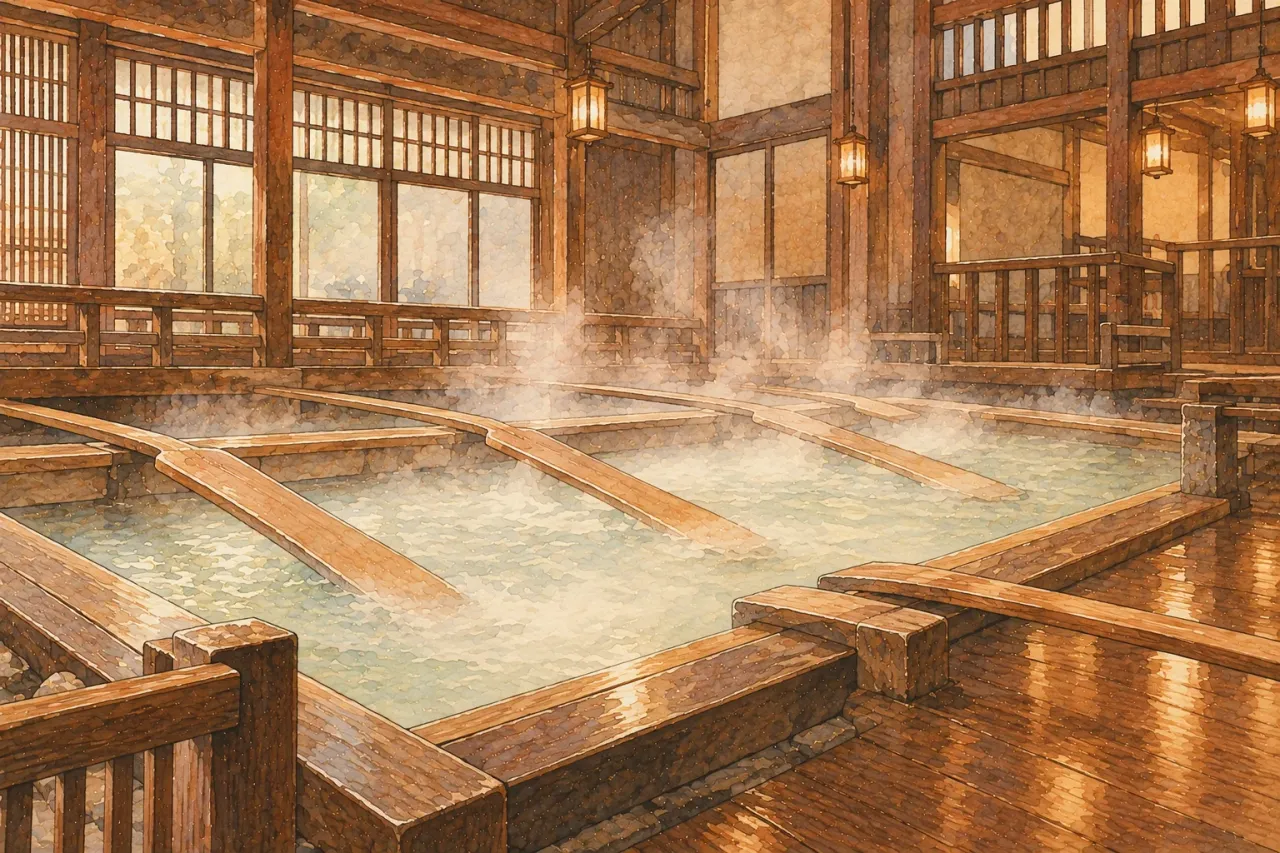
Yumomi is stirring the bath with long boards. The tourism association’s page for the Netsunoyu hall gives the reason: Kusatsu’s water is around 50°C, diluting it with water is said to weaken it, so it is cooled by stirring with boards about 180 cm long, which also softens the water and serves as a warm-up. That “weakens it” is the association’s and the ryokan association’s explanation; official sources give no test of it.
The same page describes jikan-yu, “timed bathing”, as follows (in summary):
- Since the Edo period, bathers went into the hot water together and came out together, so as not to disturb it.
- In the Meiji era this became a fixed, timed method, the “traditional bath”.
- A bath master, the yuchō, calls when to get in and out.
- Bathers pour at least 30 scoops over their heads first to avoid feeling faint, stay in for three minutes, and bathe four times a day.
- At its height it was done at six bathhouses.
The ryokan association’s English site describes the same stirring and the same reason for it.
Netsunoyu stopped holding jikan-yu in 1957. Its yumomi show began in 1960; the building was rebuilt as a tourist facility in 1968, closed in 2014, and reopened in April 2015 in a Taishō-style building. The page says jikan-yu now takes place at Chiyo no Yu, but the page gives no date. The town’s notice says jikan-yu at Jizō no Yu closed on 30 March 2021; the reason is not in the notice text. That fits the Netsunoyu page naming Chiyo no Yu alone. Gunma prefecture calls jikan-yu a bathing method unique to Kusatsu, and says Netsunoyu offers a yumomi experience modelled on it but no bathing, on a page last updated in 2011.
When it all began depends on the source. The town calls yumomi a communal bathing custom handed down from the Edo period, and JNTO also dates it to the Edo period. The Netsunoyu page puts communal bathing in the Edo period and the timed method in Meiji. The tourism association’s chronology gives a Meiji-era year for when the method was completed, but because of the date problems in that chronology noted under the legends, this page does not use it. The ryokan association’s English site says the custom is said to date from Meiji but the stirring itself goes back to Edo. What they share is an Edo-period origin and a timed method settled in Meiji. This page does not pick a year.
The songs sung while stirring — Kusatsu-bushi, Kusatsu yumomi-uta and Kusatsu kouta — are known together as yumomi-uta. The tourism association gives one origin story for the best known, Kusatsu-bushi: a geisha known as Takeji (Ōshima Tami), born in Meiji 30 (1897), set bathers’ calls to the shamisen. Its chronology also says a work by the poet Hirai Banson is said to be its basis. Two origins, both from the association.
The association’s home page listed an October 2026 schedule for the yumomi and dance show (posted 1 October 2026). The price is not given here, because it is not confirmed to include tax.
Sainokawara
The town describes Sainokawara park as a place where hot water rises all over, sends up steam and flows away as a stream, once called the “demon’s spring”. It has place names such as the “demon’s kettle”, a legend that you must not shout there, and memorial stones to the German physician Erwin Bälz and the poet Saitō Mokichi among others. The town’s page gives no temperature or flow for the park’s spring; the ryokan association’s table above gives the Sainokawara source as 44.9, pH 2.1 and 1,073 litres a minute.
The free public baths
The tourism association’s list of places to bathe has, besides the three large baths and the footbaths, three free public baths (kyōdō-yu, shared baths). As checked on 11 October 2026:
| Bath | Fee | Hours |
|---|---|---|
| Chiyo no Yu | Free | 6:00–23:00 |
| Shirahata no Yu | Free | 8:00–23:00 |
| Jizō no Yu | Free | 8:00–22:00 |
The association calls Shirahata no Yu the largest shared bath in Kusatsu and puts Chiyo no Yu about two minutes’ walk from the Yubatake. None of the three pages gives a closing day, so it is not confirmed that they are open every day, and none mentions tattoos.
The association gives the same notes for each: shared baths were set up for local people’s daily lives and are used and looked after by them; follow the manners; there are no lockers with keys, so do not bring valuables; and there are cleaning times, mostly in the morning, when you cannot bathe. The town’s page for shared-bath users points to the tourism association for details. These notes do not appear in an official English version.
How many shared baths there are depends on whom you ask. JNTO’s 2022 article says 13 free public baths; the ryokan association’s English site says three — Shirahata no Yu, Chiyo no Yu and Jizō no Yu — are open to visitors; the tourism association lists the same three. The sources do not say whether they are counting the same thing, and this page gives no total.
There are also free footbaths. The association lists the footbath at Onsenmon Square, with a channel modelled on the Yubatake, and others in front of the bus terminal and Jizō no Yu.
The three large baths
Kusatsu’s three larger bathhouses for visitors are Ōtaki no Yu, Gozanoyu and Sainokawara Open-air Bath, which the tourism association links to as “onsen”. Their official site says all three are gensen kakenagashi, and sells a pass for one bath at each with no expiry date. Their own pages give these hours:
- Ōtaki no Yu — 9:00–21:00, last entry 20:00.
- Gozanoyu — 7:00–21:00 from 1 April to 30 November, 8:00–21:00 from 1 December to 31 March, last entry 20:30.
- Sainokawara Open-air Bath — its own page gives 7:00–20:00 from 1 April to 30 November and 9:00–20:00 from 1 December to 31 March, last entry 19:30. On 26 July 2026, though, the tourism association posted a notice of changed hours, and it is not confirmed whether these are current.
None of the three pages gives a closing day. Admission fees for these three, for the pass and for the yumomi show are not given here, because none of the pages says whether the prices include tax.
Bathing there
Two sets of advice, both in Japanese.
- The tourism association says the water is very hot, so it is cooled by the air before use; pour water over yourself first and get in from the feet; take about three baths a day at most; and expect that clothing can discolour or deteriorate.
- The three-bath site says rest at least two hours after drinking alcohol, 30 minutes to an hour after eating and 30 minutes after exercise; bathe no more than three times a day; pour water over yourself and start half-immersed, for 5 to 10 minutes at first; keep the final rinse short; and wear a yukata afterwards if you can, because the sulphur damages fabric.
The English cooperative site’s FAQ suggests first immersing the lower half of your body and getting out when sweat appears on your forehead or nose. Its English page on the Yubatake also reads as allowing you to add some cold water at a public bath with the agreement of others there; no other source supports that.
Tattoos. Official sources give no policy for Kusatsu as a whole, and the town and tourism association pages do not mention tattoos. Two English pages from the town point in opposite directions. The ryokan cooperative’s English FAQ says almost all lodgings do not allow tattooed guests in the large shared baths and suggests a lodging with a private bath. Ōtaki no Yu’s English site says most inns and baths in Kusatsu welcome guests with tattoos that are not gang-related. The second is one facility’s site, not a town policy. Ask each inn or bath in advance, and a private bath is an option where there is one.
What it is eaten with
JNTO names onsen manjū, steamed buns, and onsen tamago, soft-cooked eggs, as things to eat while walking around the Yubatake, and the tourism association’s food-walk list includes several shops selling onsen manjū. The farm ministry’s list of Gunma’s local dishes does not include them, and the shop pages give no history of them.
The one link that both the ministry and the town side share is hana-ingen, the large runner bean. The farm ministry lists simmered hana-ingen as a local dish handed down in Nakanojō, Tsumagoi, Kusatsu and Naganohara. It says the large beans are grown in the highland towns of the Agatsuma area, in places 900 to 1,300 m up with cool summers, and are called “highland hanamame”; they are usually simmered, and served at New Year and on special occasions. The tourism association, on a 2015 shop page, recommends sweets made mainly from the bean — monaka wafers filled with sugared beans, yōkan and dorayaki — as souvenirs. The ministry describes simmered beans, the association sweets; what they share is the bean, and this page does not call it Kusatsu’s signature dish.
Getting there
As checked on 11 October 2026. None of these pages gives an update date.
- Limited express and bus. The tourism association gives about 2 hours 33 minutes by the JR limited express Kusatsu-Shima from Ueno to Naganohara-Kusatsuguchi, then about 25 minutes by JR bus — about three hours in all. JNTO gives about 2 hours 30 minutes and 25 minutes for the same route.
- Local trains and bus. The tourism association also gives Ueno to Takasaki by the Takasaki line in about 1 hour 45 minutes, then the Agatsuma line to Naganohara-Kusatsuguchi in about 1 hour 30 minutes, then the same 25-minute bus.
- Via Karuizawa. The tourism association gives Tokyo to Karuizawa by the Hokuriku shinkansen in about 1 hour 10 minutes, then a Kusatsu Kankō or Seibu Kankō bus to Kusatsu. The bus time is not given here.
- Direct bus. JNTO says the Joshu Yumeguri bus runs daily from Busta Shinjuku in about 3 hours 45 minutes. JR Bus Kantō says its Yumeguri buses run daily from Busta Shinjuku and Tokyo Station to Ikaho and Kusatsu, without a journey time. The tourism association lists highway buses from Tokyo Station, Busta Shinjuku, Shibuya, Ikebukuro, Kichijōji and elsewhere, also without journey times.
- Car. JNTO says about 3 hours from Tokyo. The same JNTO page also gives about 1 hour 30 minutes from the shinkansen station at Takasaki. The tourism association gives two routes from Tokyo, by the Kan-etsu expressway to Shibukawa-Ikaho or by the Jōshin-etsu expressway, with distances but no times.
Fares are not on this page. The tourism association’s home page carried notices about the reopening of National Route 292 and restrictions on entry near Kusatsu-Shirane (posted 22 May 2026) and a trial reopening of part of a trail near the Yugama crater lake (posted 9 October 2026); check its notices before you go, especially in winter, when services change.
What people get wrong
- “Kusatsu’s flow figure is an official measurement.” The 32,300 litres a minute comes from the tourism and ryokan associations; the tourism association gives no survey year, and the ryokan association cites a 1995 statistics feature and the town’s 2018 yearbook. JNTO has published 5,000. No public measurement is confirmed.
- “Yumomi is a show.” It began as a way of cooling water without diluting it, tied to the timed communal bath. The show is a later form, from 1960 at Netsunoyu.
- “The free shared baths are tourist facilities.” The tourism association describes them as baths for local daily life, run by locals, with no lockers and cleaning times.
- “There are dozens of free baths.” Depending on the source it is 13 or three. This page gives no number.
- “Kusatsu is officially one of Japan’s three best springs.” The phrase is used locally, but no official body chose the three; it goes back to the writings of the monk Banri Shūku and the scholar Hayashi Razan.
- “The Yubatake is just a pretty view.” Its seven wooden channels cool the water before it is piped to baths, and yunohana deposits are swept from them about every two months.
- “The water cures things.” This page does not say so. The tourism association lists conditions it says the water is “generally said” to help. The official list of indications for acidic and sulphur springs is in the water types guide, along with the environment ministry’s note that spa therapy is best done under a doctor’s guidance.
Questions people ask
How acidic is the water at Kusatsu?
Strongly. The town gives a pH of around 2.0, the tourism association gives 2.1 for the Yubatake source, and a table on the ryokan association’s site runs from 1.6 to 2.2 depending on the source. All of these fall in the acidic band, under pH 3.
Are the public baths in Kusatsu free?
Three are, according to the tourism association, Chiyo no Yu (6:00–23:00), Shirahata no Yu (8:00–23:00) and Jizo no Yu (8:00–22:00), as checked on 11 October 2026. The association says they were built for local people’s daily lives and are run by them, have no lockers, and close for cleaning at times, mostly in the morning. It gives no closing days.
Why do people stir the water with boards?
This is yumomi. The tourism association says the water is around 50°C and too hot, that diluting it with water is said to weaken it, so it is cooled by stirring with boards about 180 cm long. The stirring also serves as a warm-up before bathing.
Can I bathe in Kusatsu with tattoos?
It depends on the place. Official sources give no town-wide policy, and two English pages from the town’s own operators point in opposite directions. Check with each inn or bath before you go, and consider a private bath.
Sources
- 草津温泉観光協会 トップページ(お知らせ)
- 草津町「草津温泉について」
- 草津町「湯畑」
- 草津町「湯もみと踊り」
- 草津町「地蔵の湯時間湯閉鎖について」
- 草津町「西の河原公園」
- 草津町「湯の花」
- 草津町「『共同浴場』をご利用される皆様へ」
- 群馬県「温泉状況」
- 群馬県「熱の湯湯長」
- 草津温泉観光協会「天下の名湯」
- 草津温泉観光協会「源泉」
- 草津温泉観光協会「温泉に入る」
- 草津温泉観光協会「泉質、効能、正しい入浴法」
- 草津温泉観光協会「草津のなりたち」
- 草津温泉観光協会「名前の由来」
- 草津温泉観光協会「歴史」
- 草津温泉観光協会「文化・芸能」
- 草津温泉観光協会「湯もみの歴史|熱乃湯」
- 草津温泉観光協会「千代の湯」
- 草津温泉観光協会「白旗の湯」
- 草津温泉観光協会「地蔵の湯」
- 草津温泉観光協会「温泉門広場・足湯」
- 草津温泉観光協会「電車」
- 草津温泉観光協会「高速バス」
- 草津温泉観光協会「車」
- 草津温泉観光協会「菓匠清月堂」(花いんげん)
- 草津温泉旅館組合サイト「泉質主義」湧出量(出典は『温泉』通巻795号 1995年、草津町勢要覧2018)
- 草津温泉旅館組合サイト「泉質主義」湧出量(英語)
- 草津温泉旅館組合サイト「泉質主義」湯畑(英語)
- 草津温泉旅館組合サイト「泉質主義」湯もみ(英語)
- 草津温泉旅館組合サイト「泉質主義」歴史(英語)
- 草津温泉旅館組合サイト「泉質主義」殺菌力(英語)
- 草津温泉旅館組合サイト「泉質主義」歴史
- 草津三湯 公式サイト(大滝乃湯・御座之湯・西の河原露天風呂)
- 草津三湯「大滝乃湯 ご利用案内」
- 草津三湯「御座之湯 ご利用案内」
- 草津三湯「西の河原露天風呂 ご利用案内」
- Kusatsu Onsen accommodations(旅館協同組合系の英語サイト)FAQ
- Kusatsu Onsen accommodations(旅館協同組合系の英語サイト)About Kusatsu Onsen
- 大滝乃湯 施設サイト(英語)
- 産総研 地質調査総合センター 草津白根火山地質図解説「草津白根火山の地球化学」
- 気象庁 草津白根山
- 農水省 うちの郷土料理「花いんげんの煮豆」
- JRバス関東 長野原支店
- 下呂市「下呂温泉の紹介」
- 国立国会図書館「Landmarks: Kusatsu Onsen」
- JNTO「Kusatsu」
- JNTO「Kusatsu Onsen」
- JNTO「Cooling hot thermal waters with paddle and song」
Prices are in Japanese yen. Conversions are approximate, at ¥177.30 to the euro and ¥158.23 to the US dollar as of 20 Oct 2026. Rates come from the European Central Bank, which publishes on working days only. Prices checked Oct 2026. What food costs in Japan →