Dōgo Onsen: blended water from many sources, three public bathhouses, and a main building still in use
I have not been to every place in this guide. The figures below are taken from the sources listed at the end, with the date each one was published — not measured by me. Where I have been, the article says so.
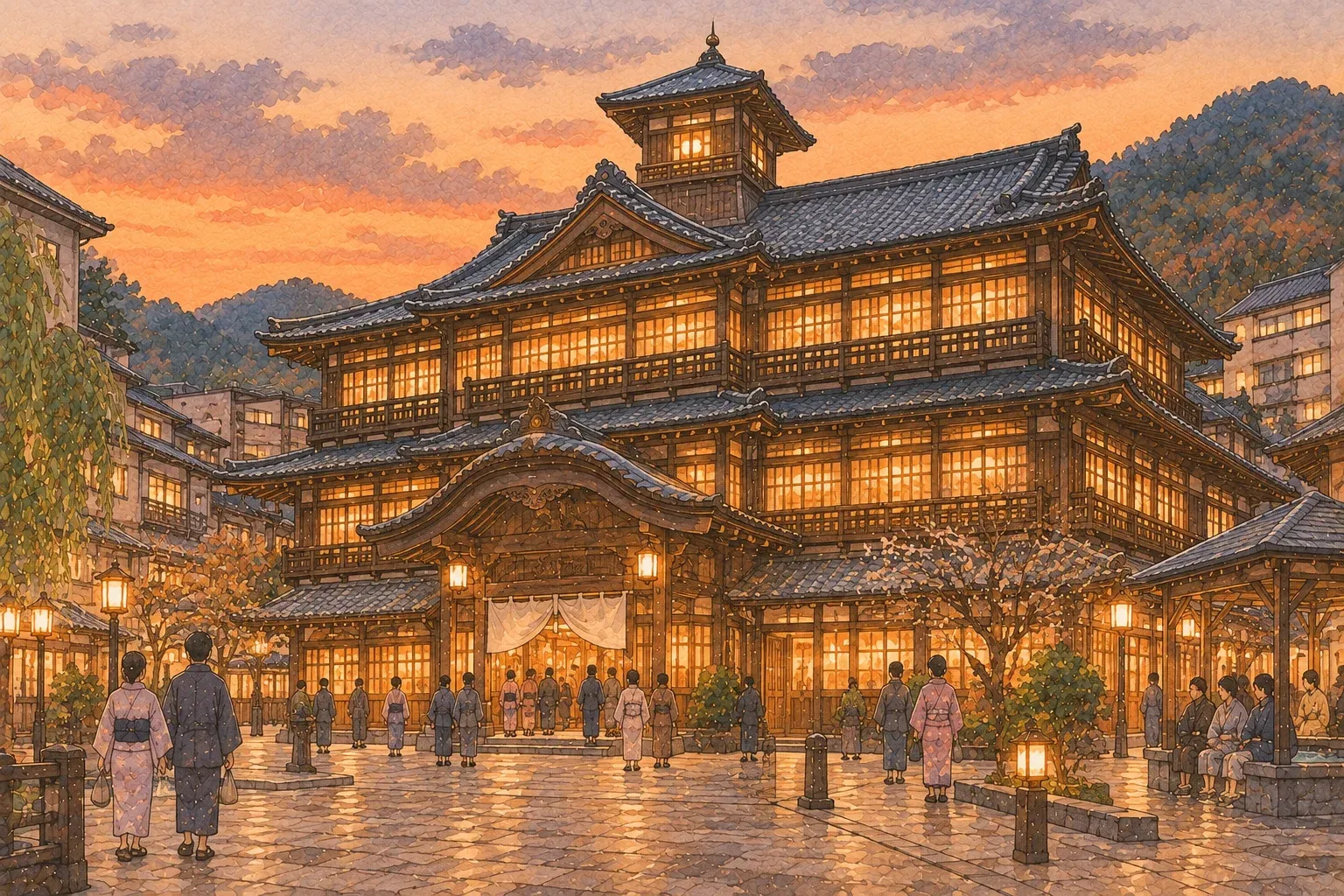
Dōgo Onsen is in Matsuyama, Ehime, and its centre is a public bathhouse rather than a single inn: a wooden main building from 1894, still in use, and two newer bathhouses that share the town’s water. The water itself is simple, soft and alkaline, and it reaches the baths through a city-run system that blends hot and cooler sources. This page covers how that system works, how the sources are counted, how the three bathhouses are used, and what is not confirmed. How Dōgo tells its age — the “3,000 years” and the “three ancient springs” — is set out in the Shikoku overview; the ten official spring types are in the guide to onsen water types, and what kakenagashi means in the piece on free-flowing water.
Where it came from
The official site and Matsuyama city tell the early history through legends and old texts. This page gives them as the sources do.
- The Iyo Fudoki. The official English site says a surviving fragment of the Iyo Fudoki tells of the god Ōkuninushi bathing the sick Sukunahikona in the spring, after which Sukunahikona recovered and danced on a stone, the Tama-no-ishi.
- Prince Shōtoku. The official site says he is said to have bathed here in 596 with the monk Eji and others, praised the spring and its scenery, and set up a stone monument on the hill. A city leaflet lists his visit in 596 and Empress Saimei’s in 661.
- The Nihon Shoki. An Ehime University bulletin (2014) opens by saying Dōgo appears in the Nihon Shoki as “the hot spring of Iyo”. This page has not matched individual emperors to particular passages.
- The Man’yōshū. The official site calls the anthology Japan’s oldest collection of poems, made around the eighth century, and says only five hot spring places appear in it. A poem from 661 is said by some to be by Nukata no Ōkimi, and in 713 the poet Yamabe no Akahito came to Dōgo and wrote a long poem that recalls Prince Shōtoku’s monument and earlier imperial visits.
- The main bathhouse. Matsuyama city’s timeline says Isaniwa Yukiya, the first mayor of Dōgo-Yunomachi, rebuilt the main bathhouse in 1894, and that the Tama-no-Yu and the Yūshinden, a bath built for the imperial family, were added in 1899. The Tsubaki-no-Yu opened in 1953 and the Asuka-no-Yu in 2017.
- Natsume Sōseki. Matsuyama city says the future novelist arrived on 9 April 1895, the year after the rebuilding, to teach English at Matsuyama Middle School, and called the bathhouse “a very fine building” in a letter to a friend the next month. He lived with the poet Masaoka Shiki for more than 50 days and went to Dōgo with Shiki and with Takahama Kyoshi, then left for Kumamoto in April 1896, after about a year. His novel Botchan, published in the haiku magazine Hototogisu in 1906, has the hero bathe every day at “Sumita Onsen”, which the city says is said to be modelled on Dōgo. The city links two things in the building to the book: a “no swimming” notice in the hero’s name posted in the Kami-no-Yu, and the red towels the main bathhouse rents and sells, which come from a passage in the book. In 1966, the centenary of Shiki’s and others’ births, a third-floor room was set aside as the Botchan Room, named by Sōseki’s son-in-law Matsuoka Yuzuru.
JNTO also writes that the main bathhouse is “believed” to have inspired the bathhouse in Spirited Away. No official source confirms it.
“One of Japan’s three oldest springs.” The official site groups Dōgo with Arima and Shirahama under this name, and a city leaflet calls Dōgo one of the three, but neither says who made the grouping. No body is named as having done so.
An Important Cultural Property. The Agency for Cultural Affairs database lists Dōgo Onsen Honkan as an Important Cultural Property designated on 27 December 1994, owned by Matsuyama city. Its entry is recorded building by building, and it describes the property as a group of buildings: the 1894 Kami-no-Yu main building, the Yūshinden and Tama-no-Yu wing of 1899, and the south wing and entrance wing of 1924, designed by Sakamoto Matahachirō. The official site and the city say it was the first public bathhouse to be so designated.
Restoration. Matsuyama city says conservation work began on 15 January 2019, with the bathhouse kept open, and that the whole building reopened at 6:00 on 11 July 2024, about five and a half years later, with the upstairs rest rooms back in use and new private rooms. The official site gives the completion of the work as 20 December 2024, about six years in all. Both dates are the sources’ own, and they describe different things: full reopening, then completion. Part of the bathing and viewing fees goes to the conservation work, the official site says.
The water
What the analysis says
Matsuyama city gives the spring type as alkaline simple onsen (hypotonic, alkaline, high temperature), about 42°C, on a page updated in April 2024. The page itself gives no pH or flow; the figures are in the analysis the city publishes as a PDF, carried out on 6 December 2023 by the Ehime Prefectural Institute of Public Health and Environmental Science. The figures below are from that analysis.
- Main bathhouse (Kami-no-Yu and Tama-no-Yu) — source named “Dōgo Onsen No. 2 distribution station”. 48.7°C at source, 42.0°C where used, pH 9.0, 0.2734 g of dissolved matter per kilogram. Sodium is the main positive ion; hydrogen carbonate, chloride, sulphate and fluoride are among the negative ions, with metasilicic acid.
- Tsubaki-no-Yu and Asuka-no-Yu — source named “No. 1 distribution station”. 48.1°C at source, 42.0°C where used, pH 9.0, about 0.27 g of dissolved matter per kilogram.
- Treatment. The boxes for added water, heating and recirculation are blank. Under disinfection the sheet says chlorine-based chemicals are used to meet Matsuyama city’s hygiene standards for public baths.
A city leaflet on the water describes it as pH about 9 and “extremely soft”, with almost no calcium or magnesium. The city also posts the indications and contraindications for the spring type, decided on 10 January 2024. This page does not repeat them as claims; the water types guide explains the official list and the environment ministry’s note that spa treatment is best done under a doctor’s guidance.
Official sources, including the analysis, the city’s pages and the environment ministry’s and prefecture’s material, do not give the flow rate. Figures on other websites could not be traced to a first-hand source, so they are not here.
How many sources
The sources do not give one number, and this site does not choose.
- 29 developed, 19 registered. Matsuyama city’s page on the sources, updated February 2025, says 29 sources (numbered 1 to 29 in order of development) have been drilled and 19 are registered with Ehime prefecture. It also says No. 1 is no longer pumped.
- 18 in use. The city’s history leaflet says the 29th source was drilled by 2013 and water is pumped from the 18 that can be used. The city’s water leaflet and the official Dōgo Onsen site also say 18.
Official sources do not explain which registered source is not pumped, or whether No. 1 is the reason for the difference between 19 and 18.
How it is blended
Matsuyama city says each source sends its water through underground pipes to four distribution stations (bun’yujō). At the main bathhouse, staff mix high- and low-temperature water according to the number of bathers, the season and the time of day, adjusting the temperature without heating or adding water. The water leaflet shows cooler sources of about 20–30°C and hotter ones of about 43–50°C blended in tanks to about 42°C before the baths, with temperatures between 20 and 55°C across all sources. The city’s history leaflet says a distribution station, collecting the sources and sending water to bathhouses and inns, was completed in 1956. The No. 4 station was rebuilt in November 2017 and has a hand bath and a viewing room the city opens in the daytime.
JNTO says the Tsubaki-no-Yu uses the same water as the main bathhouse. The city’s analysis names a different distribution station for each (No. 2 for the main bathhouse, No. 1 for the Tsubaki-no-Yu and Asuka-no-Yu). This page gives both and does not say whether the water differs.
Why here, and earthquakes
The city’s, the prefecture’s and the official site’s material that could be opened gives no explanation of what heats Dōgo’s water or where it comes from. The Shikoku overview covers what the national sources say about non-volcanic springs in general.
What the records do show is that the spring responds to earthquakes:
- An Ehime University bulletin (2014) reviewed old records. An earlier study (1950) had listed 14 times the spring stopped, but the bulletin says many old records were written later and are doubtful. Checking against damaging earthquakes, it counts four Nankai earthquakes that certainly stopped the flow: 684, 1707, 1854 and 1946.
- A lecture abstract by researchers from the national Geological Survey of Japan (2005) says that in the 1946 Nankai earthquake the water level at a Dōgo source fell by 11 m. The survey began measuring that source’s water level with the city’s help in June 2003. The authors write that in four of the past eight or nine Nankai earthquakes the water level or flow at Dōgo fell, that these drops can be “thought of” as caused by the increase in volumetric strain that came with the earthquakes, and that it is not clear whether the drops began before or after each quake.
Neither source is an explanation of where the water comes from; they record how it has behaved.
How the town works
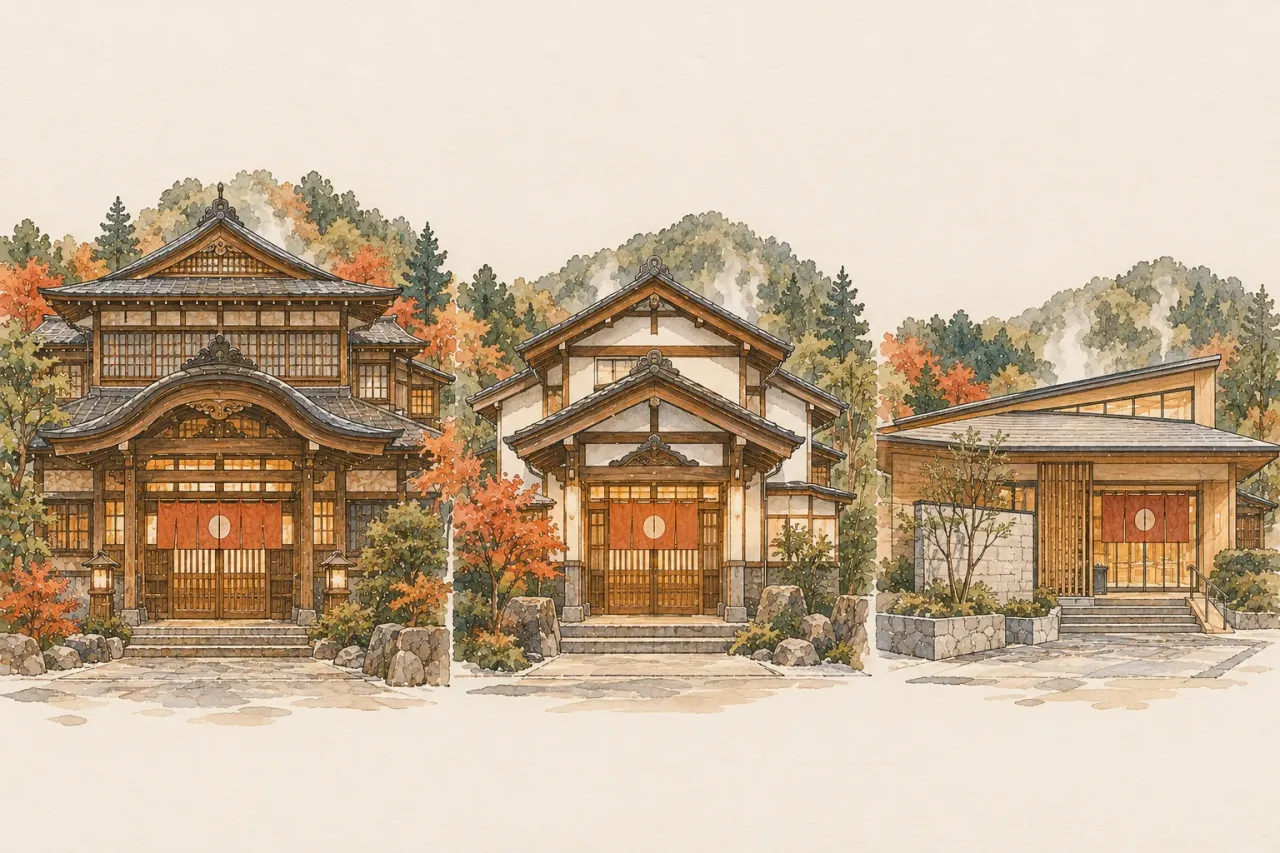
Dōgo has three public bathhouses, sotoyu, run by Matsuyama city as public baths. JNTO says most inns are within ten minutes’ walk of them.
- Dōgo Onsen Honkan — the 1894 main building. Two baths, the Kami-no-Yu and the Tama-no-Yu, with rest rooms upstairs and the Yūshinden. A drum is beaten at 6:00, noon and 18:00, the city says.
- Tsubaki-no-Yu — opened in 1953, rebuilt in 1984. The official site describes it as the bath local people use every day, with a high ceiling.
- Asuka-no-Yu — opened 26 September 2017. The official site mentions projection mapping on Tobe-ware ceramic murals, and tea and sweets after bathing.
How you get in. The official English guide explains each:
- Honkan. Buy a ticket at the window outside, show it again at reception. Shoe lockers have free locks and changing lockers are free. In the guide’s wording, the Tama-no-Yu course includes a rental yukata, sash, towel and bath towel, and the Kami-no-Yu course a yukata and sash only. Show your ticket at the stairs to go up. When busy, numbered tickets are handed out, and once the “today’s reception closed” sign goes up only ticket holders are admitted.
- Asuka-no-Yu. Buy at the window outside; the shoe locker takes a ¥100 coin that is returned. In the special second-floor bath, soap cannot be used, so wash in the ground-floor bath. The guide gives 90 minutes for bathing and resting together.
- Tsubaki-no-Yu. Buy from the ticket machine inside. Lockers cost ¥10 and the hair dryer ¥10 for three minutes.
The official site also sells a ticket covering one visit each to the three bathhouses’ basic baths, valid two days. Neither the official nor the city’s pages say whether its price includes tax, so the price is not here.
Bathing there
Prices below are from the official main bathhouse page, whose table is headed “prices (tax included)”, and match Matsuyama city’s page, checked on 11 October 2026. Adults are 12 and over, children 2 to 11.
| Main bathhouse course | What it includes | Hours (last entry) | Time | Adult / child |
|---|---|---|---|---|
| Kami-no-Yu, ground floor | Kami-no-Yu only | 6:00–23:00 (22:30) | 60 min | ¥700 / ¥350 |
| Kami-no-Yu, second floor | Kami-no-Yu and second-floor rest room | 6:00–22:00 (21:00) | 60 min | ¥1,300 / ¥650 |
| Tama-no-Yu, second floor | both baths, second-floor rest room, Yūshinden | 6:00–22:00 (21:00) | 60 min | ¥2,000 / ¥1,000 |
| Tama-no-Yu, third-floor room | both baths, private room, Yūshinden | 6:00–22:00 (20:30) | 90 min | ¥2,500 / ¥1,250 |
There are also two private rooms booked for a fixed charge per group plus a per-person fee, five groups a day each, and a guided viewing of the Yūshinden alone. The ground-floor Kami-no-Yu cannot be booked; the private rooms and the Yūshinden are by reservation (the English site says the third-floor rooms too), through the booking site until 22:00 the day before or by phone on the day. The city’s FAQ says bookings open three months ahead. The official site and the city write the private rooms’ hours differently, so they are not given here.
At the Asuka-no-Yu, the official page states that all prices include tax: ¥610 adult and ¥300 child for the ground-floor bath, ¥1,280 / ¥630 with the second-floor hall, and ¥1,690 / ¥830 with a second-floor private room, open 6:00–23:00 (last entry 22:30). Its second-floor special bath, a family bath limited to eight groups a day, is ¥2,040 per group plus ¥1,690 adult and ¥830 child, on the same tax-included page. The Tsubaki-no-Yu page does not say whether its prices include tax, so they are not given here; the same goes for the three-bathhouse ticket above.
Bathing garments. Matsuyama city sells a bathing garment for people who want to cover scars from surgery, such as after breast cancer, at ¥500 including tax, at all three bathhouses (checked 11 October 2026). The city says wearing one does not break the bylaws. Underwear and swimsuits are not allowed.
Closures. Once a year, in December, each building closes for a day of cleaning. For 2026 the city lists Tuesday 1 December for the main bathhouse and Wednesday 2 December for the Asuka-no-Yu and Tsubaki-no-Yu. The distribution stations are cleaned on the same days: No. 2, which supplies the main bathhouse, and No. 4 (morning only) on 1 December, and No. 1, which supplies the other two, on 2 December. New Year is normal opening.
Eating. The main bathhouse has no food service and asks you not to bring food or drink in. Those who take a rest-room course are served tea and a sweet, the city says, and no alcohol is served.
Manners. The official site publishes its bathing manners in Japanese and English, with the same content. Among them: do not bathe after drinking alcohol; no photos in the changing rooms or baths; lock your locker and wear the key band on your wrist; wash before getting in; tie up long hair; do not dive or swim; do not put towels in the bath; no swimsuits or towels worn in the bath; do not wash at the spout or dye or cut hair; do not use the shower standing (press the tap and it runs for a set time, then stops); dry off before going back to the changing room; rinse and return your stool and basin; drink water afterwards; no phones in the changing rooms or baths.
Tattoos. None of the official site’s Japanese and English manners pages, its English FAQ, top page, About and Honkan pages, Matsuyama city’s FAQ and facility pages, or JNTO states a tattoo policy. JNTO suggests asking the bathhouse. This page does not say whether you can bathe; ask in advance, and a private room is one option. The water types guide has what the tourism agency and JNTO say in general.
Food nearby
The farm ministry’s list of Ehime’s local dishes has 25 entries, among them tai-meshi (sea bream rice), jakoten (fried fish paste) and taruto, which it calls a sweet that represents Matsuyama. Its taruto page says the lord of Matsuyama, Matsudaira Sadayuki, met the tart, a nanban sweet, in Nagasaki in 1647 and brought the method home. None of these entries mentions Dōgo, and the list does not include Botchan dango.
Ehime’s tourism site, on an undated page, names three things to eat while walking Dōgo Haikara-dōri, the 250 m street in front of the main bathhouse: Botchan dango, which it says began in Dōgo; taruto; and jakoten, which it calls a traditional Ehime fish-paste product. Another page on the same site says the three-coloured Botchan dango was devised from a dumpling Sōseki ate. JNTO lists Botchan dango after bathing, tai-meshi, mandarin ice cream, beer and juice, taruto and Dōgo beer. So taruto and jakoten appear both on the ministry’s list and on the prefecture’s tourism pages for Dōgo, but the link to Dōgo itself comes only from the tourism side; Botchan dango is on the tourism side alone.
Getting there
Times from the official pages, checked on 10 and 11 October 2026. The sources differ, so the range is given with who says what.
- Matsuyama Airport to Dōgo — the official site and Matsuyama city’s FAQ say about 43 minutes by limousine bus to Dōgo Onsen station (the official site adds about 30 by taxi); the official English FAQ says about 40. Allow about 40 to 45 minutes.
- JR Matsuyama station to Dōgo — the official site says about 25 minutes by city tram; Matsuyama city’s FAQ says about 20 minutes by tram (about 25 by bus); JNTO says about 30 minutes on tram line 5. Allow about 20 to 30 minutes. From Matsuyama-shi station the official site gives about 20 minutes by tram.
- From the ports — the official site gives about 43 minutes by limousine bus from Matsuyama Kankō port and about 35 minutes by Iyotetsu bus from Mitsuhama port.
- From the tram stop — JNTO says about 5 minutes on foot through the shopping street to the main bathhouse; the city says about 3 to 5.
- From Takamatsu — Ehime’s tourism site gives about 2 hours 20 minutes to Matsuyama station by limited express Ishizuchi, about 2 hours 30 minutes by the daytime highway bus, and about 2 hours 5 minutes by car.
- From Okayama — the same site gives about 2 hours 40 minutes by limited express Shiokaze, about 3 hours by the daytime highway bus, and by car about 2 hours 40 minutes over the Seto Ōhashi bridge or about 3 hours by the Shimanami Kaidō.
- From Tokyo — Matsuyama city’s sightseeing site gives about 90 minutes (ANA) or 85 minutes (JAL) from Haneda to Matsuyama Airport, about 100 minutes (Jetstar) from Narita, about 6 hours 10 minutes from Tokyo station by JR, changing at Okayama, and about 12 hours by bus.
These are not added up into door-to-door times, because the sources’ figures do not agree. Whether the highway buses are currently running has not been checked. Fares are not on this page: Iyotetsu’s airport limousine page lists fares without saying whether they include tax, and the Takamatsu and Okayama pages give none.
What people get wrong
- “Dōgo has 18 sources.” That is the number in use, by the official site and a city leaflet. The city also says 29 have been drilled and 19 are registered.
- “No heating or added water means nothing is done to it.” The water is blended from several sources to about 42°C, and the city’s analysis says chlorine is used for hygiene. Neither is a mark against it; the kakenagashi piece explains why baths post these things.
- “Dōgo is a volcanic spring.” No official source says what heats it.
- “Dōgo was officially named one of Japan’s three oldest springs.” The official site uses the phrase, but neither it nor the city says who chose the three.
- “The main bathhouse is a ryokan.” It is a day bathhouse; you cannot stay there.
- “The bathhouse was closed for repairs.” It stayed open during the work and reopened fully in July 2024. Some older pages, including an undated one on Ehime’s tourism site, still describe the work as ongoing.
- “Tattoos are banned at Dōgo.” Official sources give no policy either way.
Questions people ask
How many hot spring sources does Dōgo have?
It depends on what is counted. Matsuyama city says 29 sources have been developed and 19 are registered with Ehime prefecture. The official Dōgo Onsen site and a city leaflet say water is drawn from 18. Official sources do not explain the gap between 19 and 18, so this site does not choose.
Is the water at Dōgo heated or diluted?
Matsuyama city and the official site say no. Hot and cooler sources are blended at distribution stations to about 42°C instead. The analysis the city publishes, dated 6 December 2023, also says chlorine-based disinfectant is used to meet the city’s hygiene standard for public baths.
Can I bathe at Dōgo with tattoos?
The official site’s Japanese and English pages, Matsuyama city’s FAQ and JNTO’s Dōgo page give no tattoo policy. JNTO suggests asking the bathhouse. Check before you go, or consider a private room.
Can I stay overnight at Dōgo Onsen Honkan?
No. Matsuyama city says the main bathhouse is a day-use facility. The inns of the town are separate.
Sources
- 松山市 道後温泉の源泉
- 松山市 温泉の成分、禁忌症、適応症など
- 松山市 温泉成分表(PDF)
- 松山市 道後温泉源泉の秘密を知る 泉質編(PDF)
- 松山市 道後温泉源泉の秘密を知る 歴史編(PDF)
- 松山市 営業時間と料金案内
- 松山市 休館日(令和8年度)
- 松山市 道後温泉 よくあるご質問
- 松山市 外湯3館の施設概要
- 松山市 夏目漱石と坊っちゃん
- 松山市 道後温泉の歴史年表
- 松山市 報道発表 道後温泉本館の全館営業再開
- 松山市FAQ 道後温泉本館
- 道後温泉 公式 本館(料金・保存修理)
- 道後温泉 公式 3つの外湯
- 道後温泉 公式 飛鳥乃湯泉(料金)
- 道後温泉 公式 歴史・泉質
- 道後温泉 公式 万葉集と道後温泉
- 道後温泉 公式 入浴マナー
- Dogo Onsen official, Bathing Manners
- Dogo Onsen official, How to use the facilities
- Dogo Onsen official, Honkan
- Dogo Onsen official, About
- Dogo Onsen official, FAQ
- Dogo Onsen official, English top page
- 道後温泉 公式 椿の湯
- 道後温泉 公式 アクセス
- 伊予鉄 空港リムジンバス
- 文化庁 国指定文化財等データベース 道後温泉本館
- 小泉尚嗣・佐藤努・中林憲一『歴史地震』第20号 講演要旨
- 高橋治郎「地震と道後温泉」愛媛大学教育学部紀要 第61巻
- 農林水産省 うちの郷土料理 愛媛県
- 農林水産省 うちの郷土料理「タルト」愛媛県
- 愛媛県観光サイト いよ観ネット 湯上がりの散策
- 愛媛県観光サイト いよ観ネット 愛媛おやつ
- 愛媛県観光サイト いよ観ネット 高松から松山駅
- 愛媛県観光サイト いよ観ネット 岡山から松山駅
- 松山市公式観光情報サイト 東京から
- JNTO, Dogo Onsen
Prices are in Japanese yen. Conversions are approximate, at ¥177.30 to the euro and ¥158.23 to the US dollar as of 20 Oct 2026. Rates come from the European Central Bank, which publishes on working days only. Prices checked Oct 2026. What food costs in Japan →