
Sashimi: how it is cut, what the garnishes do and do not do, and what the label tells you
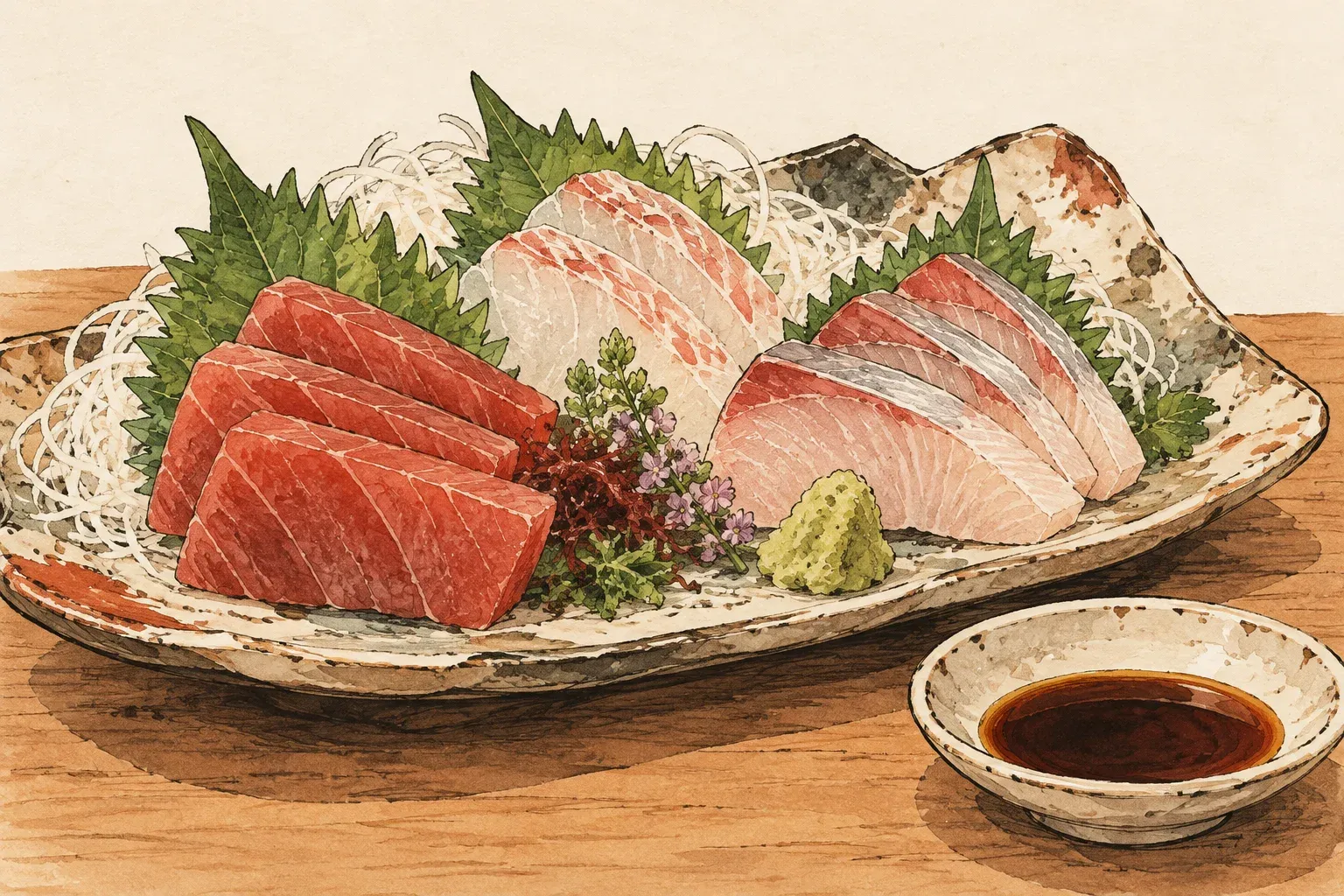
I have not been to every place in this guide. The figures below are taken from the sources listed at the end, with the date each one was published — not measured by me. Where I have been, the article says so.
Sashimi is the simplest-sounding dish in Japanese cooking: raw fish, sliced, with soy sauce and wasabi. Almost every part of that sentence has a history or a rule behind it. The cut depends on the fish. Soy sauce arrived late. The garnishes are often explained as protection, which is only partly true and dangerously misleading in one respect. And the label on the fish follows national rules that tell you more than visitors expect. This page is the map. The lineage pages cover fish that change their names as they grow, and fish cured with kombu or vinegar.
What it is
Kikkoman’s glossary defines sashimi as boned raw fish sliced to an easy size, eaten mainly with soy sauce and wasabi to taste. I could not find an official definition, or a reliable official history of the word and its origins, so this page does not give one.
How it is cut
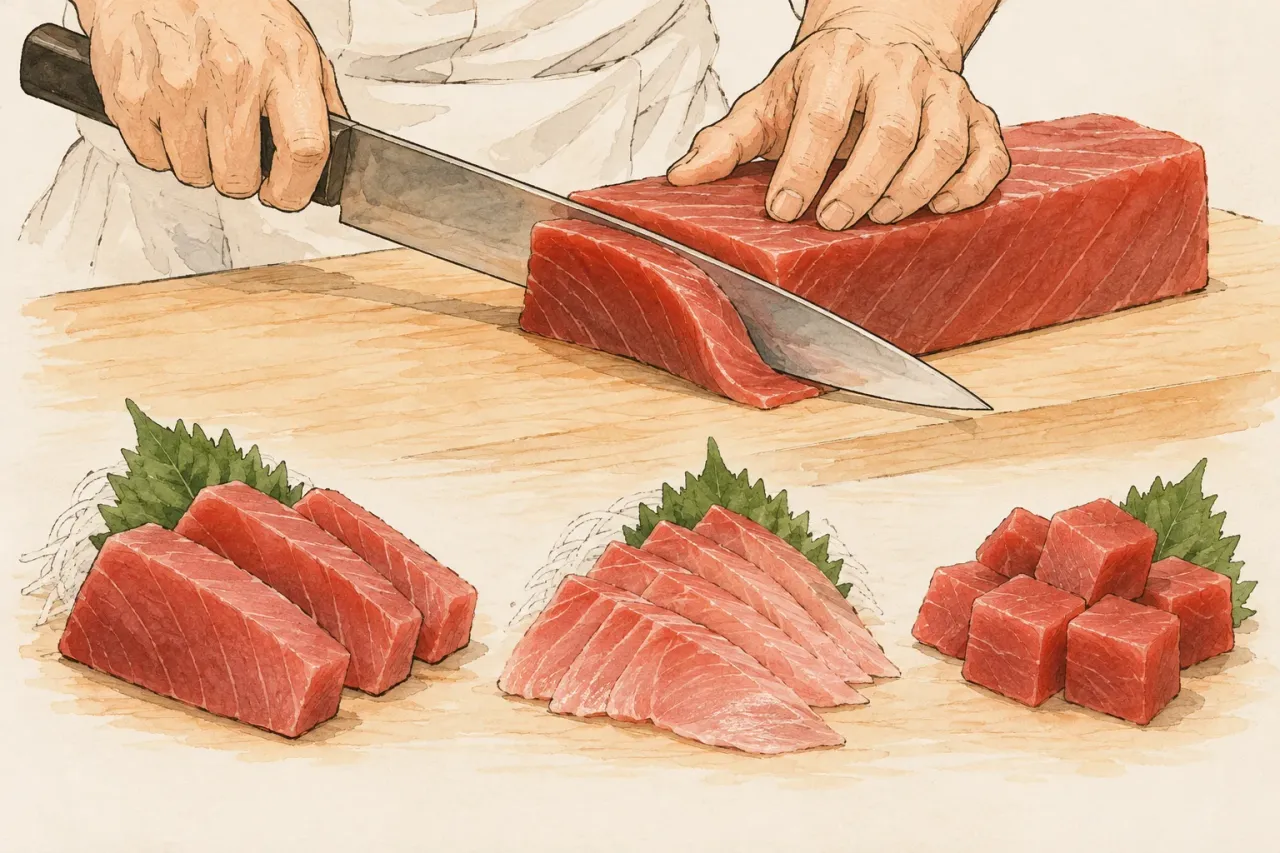
Kikkoman’s home-cooking guide gives four basic cuts:
- Hira-zukuri — the standard cut, drawing the knife towards you. For thick-fleshed fish: tuna, bonito, yellowtail, salmon.
- Sogi-zukuri — the blade held at an angle. For firm white fish such as sea bream and flounder, to make the most of their bite.
- Hoso-zukuri (ito-zukuri) — using only the tip of the blade. For thin fish such as halfbeak and squid.
- Kaku-zukuri — cubes of about 1.5 cm. For soft, thick fish such as tuna and bonito.
Tuna and bonito appear under two cuts each: the choice depends on the thickness and firmness of the flesh, not only on the species.
What the garnishes do, and do not do
- The radish (tsuma). A grower of shredded radish, interviewed in the farm ministry’s magazine, calls it old kitchen wisdom: radish’s antibacterial action to keep sashimi from spoiling. That is a producer’s statement, not a demonstration.
- Wasabi. The farm ministry’s magazine says its pungent compound, allyl isothiocyanate, is antibacterial and insect-repellent and has long been used against food poisoning. Wasabi cultivation is said to have begun in the early Edo period, at Utōgi in what is now Shizuoka city.
- Garlic with bonito. In Kōchi, katsuo no tataki is always served with sliced garlic, which the farm ministry describes as ancestral wisdom about its sterilising effect.
The important caveat. None of this makes raw fish safe from parasites. The health ministry and the farm ministry state plainly that anisakis larvae are not killed by vinegar, salt, soy sauce or wasabi.
Soy sauce came late
Soy sauce appears in Japanese records from the Muromachi period, the farm ministry says, but not with sashimi for a long time. A Kikkoman research journal’s analysis of Edo cookbooks found that in early Edo, sashimi was eaten with irizake, a sake-based seasoning, or ginger vinegar: of 28 sashimi recipes in Ryōri Monogatari, 11 used irizake, 9 ginger vinegar and 3 vinegar, and none soy. Soy first appears with sashimi in a cookbook of 1785. In the late Edo period soy rose to 34% of sashimi recipes — but 80% of those were whale sashimi in a single book of 1832.
Safety: what kills parasites and what does not
- Anisakis. The health ministry: freezing at -20°C for 24 hours or more, or heating to 70°C or more (60°C for one minute), kills the larvae. Ordinary vinegar, salting, soy sauce and wasabi do not. Its advice to consumers: choose fresh fish, gut whole fish promptly, do not eat the guts raw, and look for and remove larvae.
- Which fish. The farm ministry lists sashimi of mackerel, saury, horse mackerel, sardine, flounder, bonito and squid, and unfrozen shimesaba. Symptoms — pain in the pit of the stomach, nausea, vomiting — come a few hours to a dozen or so hours after eating. No deaths are recorded; rarely, an allergic reaction.
- Other risks. The Japan Fisheries Association notes that Vibrio parahaemolyticus multiplies quickly at room temperature, so keep fish cold and rinse it in fresh water; that firefly squid and river fish should not be eaten raw; and that fresh fish can still carry anisakis. Hokkaido’s research institute warns that histamine poisoning, mainly from red-fleshed fish such as mackerel, tuna and yellowtail, cannot be detected by smell or appearance and is not destroyed by cooking.
What the label tells you
At a fish counter, the national rules require the name and origin of fresh fish. Origin is the sea area for domestic catch (or the prefecture of the main farm), and the country for imports — for example, octopus “off Akashi”, tiger puffer “Nagasaki”, bigeye tuna “Korea (North Pacific)”. A landing port may stand in when the sea area is hard to name.
- Farmed. The consumer agency defines farming as feeding young fish to raise their weight or quality until shipment. Fish raised that way must be labelled farmed. That does not mean anything else may automatically be called wild, though a factual “wild” label is allowed. Shellfish and seaweed that are not fed are not farmed.
- Several farms. The origin is basically where the fish spent longest.
- Thawed. Frozen fish sold from a chilled case must be labelled as thawed — the agency’s example is a block of tuna.
- Sliced in store. Cutting fish into fillets or sashimi in the shop does not exempt it from labelling.
- Restaurants. Whether restaurants must show farmed or wild, I could not establish from the sources I read.
Fresh, or rested?
The Japan Fisheries Association explains the umami of sashimi as inosinate, which forms as the fish’s energy compound breaks down after death — and then breaks down further over time. Once rigor mortis passes, sashimi becomes softer; fish in supermarkets are around that point. Its conclusion: for umami and softness, choose fish that has rested a little; for firmness and bite, choose very fresh fish. It is a matter of taste. The lineage pages go into how fish is killed and handled.
What it costs
I could not find verified tax-included prices for sashimi set meals or specialist restaurants. One izakaya chain, Isomaru Suisan, launched a boat-shaped sashimi platter (funamori) at ¥2,639 including tax in its April 2026 menu, at all its shops except its shokudō format, without listing the contents; its menu notes that prices differ by shop. I found no official explanation of how sashimi prices are set.
The lineages
The table is kept in one place so that every kind is described on the same terms. Rows without a link are on the list but not written yet.
| Lineage | Origin | What it is | Why it is done | Regional difference | Safety note |
|---|---|---|---|---|---|
| Promotion fish (buri, suzuki) 出世魚(ブリ・スズキ) | Nationwide, names by region— | Fish renamed as they grow: inada, warasa, buri; seigo, fukko, suzuki | Size and age change the fish, and the market names follow | Kantō says inada, Kansai hamachi; Toyama has up to five stages | — |
| Cured fish (kobujime, shimesaba) 〆(昆布〆・酢〆) | Toyama (kobujime)kobujime from the Edo period | Raw fish pressed between kombu, or cured in vinegar | Kombu draws out water and adds umami; the fish firms up | Toyama is the kobujime prefecture; swordfish is its standard | Vinegar does not kill anisakis; shimesaba needs freezing |
| Katsuo no tatakiかつおのたたき | Kōchi— | Bonito with citrus-vinegar and soy dressing | — | Always with sliced garlic in Kōchi | — |
Lineages without a link are on the list but not written yet. The table is kept in one place so every lineage is described on the same terms.
The same fish, a different place
No official source compares sashimi at a fishing port with sashimi in Tokyo, so this page does not say one is better. What the sources do describe is time. At Hamada in Shimane, the fishing grounds are one to two hours from port, and small mackerel landed there have a freshness index (K value) of about 3% on average. Hokkaido’s research institute gives 20% or less as the guide for eating raw. As fish travels, it moves through rigor and softening; the fisheries association says which point is best depends on whether you want bite or softness, and on the fish.
What people get wrong
- “Wasabi and soy make sashimi safe.” They do not kill anisakis; freezing or cooking does.
- “Sashimi has always been eaten with soy.” Early Edo cooks used irizake and ginger vinegar.
- “Fresher is always better.” Very fresh fish is firmer; rested fish is softer and has more umami. It depends on what you want.
- “Not labelled farmed means wild.” The rules do not say that.
Questions people ask
Does wasabi make raw fish safe?
No. The health ministry says anisakis larvae are not killed by ordinary vinegar, salting, soy sauce or wasabi. They die when frozen at -20°C for 24 hours or more, or heated to 70°C (or 60°C for a minute). Wasabi does contain an antibacterial compound, but that is not the same thing.
Was sashimi always eaten with soy sauce?
No. A Kikkoman research journal's analysis of Edo-period cookbooks found that early Edo sashimi was eaten with irizake, a seasoned sake, or ginger vinegar. Soy first appears with sashimi in a cookbook of 1785.
What does "farmed" mean on a fish label?
The consumer agency defines farming as feeding young fish to raise their weight or quality until they are shipped. Fish raised that way must be labelled as farmed. Shellfish and seaweed that are not fed are not counted as farmed.
How much is a sashimi platter?
One izakaya chain, Isomaru Suisan, launched a boat-shaped platter at ¥2,639 including tax in April 2026, and says prices differ by shop. I could not find verified tax-included prices for sashimi set meals or specialist restaurants.
Sources
- キッコーマン Glossary「Sashimi」(企業サイト)
- キッコーマン ホームクッキング「刺身の切り方」(企業サイト)
- キッコーマン国際食文化研究センター FOOD CULTURE No.33
- 農林水産省「みそ」と「しょうゆ」で簡単江戸料理
- 農林水産省 aff 2017年10月号(つま生産者)
- 農林水産省 aff 2020年12月号 達人レシピ「わさび」
- 厚生労働省「アニサキスによる食中毒を予防しましょう」
- 農林水産省「アニサキス」
- 大日本水産会 魚食普及推進センター「刺身用で食べられる魚の見分け方」
- 大日本水産会 魚食普及推進センター「魚の旨味と鮮度」
- 大阪府「生鮮食品の表示:水産物」
- 消費者庁 食品表示基準Q&A 第3章 生鮮食品
- 水産庁「魚介類の生産水域等の表示について」
- 北海道立総合研究機構・北海道水産林務部「ブリ・サバ鮮度保持マニュアル」
- 島根県水産技術センター「とびっくす」No.82
- 農林水産省 うちの郷土料理「かつおのたたき」高知県
- 農林水産省 にっぽん伝統食図鑑「カツオのたたき」
- 磯丸水産 公式ニュース(グランドメニュー刷新)
- 磯丸水産 公式メニュー
Prices are in Japanese yen. Conversions are approximate, at ¥177.30 to the euro and ¥158.23 to the US dollar as of 20 Oct 2026. Rates come from the European Central Bank, which publishes on working days only. Prices checked Oct 2026. What food costs in Japan →