Promotion fish: why yellowtail and sea bass change their names as they grow, and why the names differ by region
I have not been to every place in this guide. The figures below are taken from the sources listed at the end, with the date each one was published — not measured by me. Where I have been, the article says so.
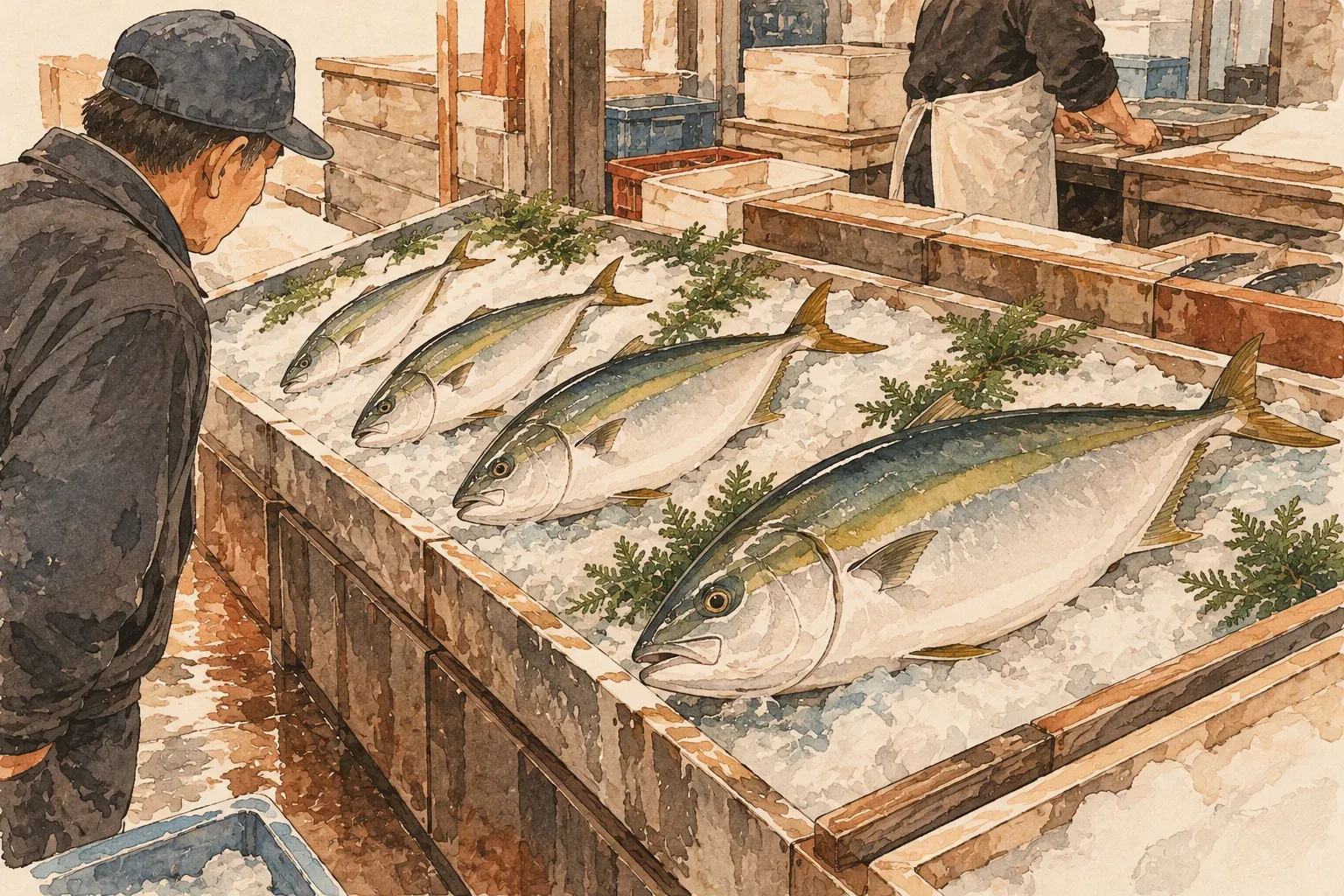
On a Japanese menu the same fish can appear under several names, and not because of a translation problem. Buri (Japanese amberjack, often called yellowtail) and suzuki (Japanese sea bass) are shusse-uo, “promotion fish”: like a man rising through the ranks, they take a new name at each size. The names differ by region, and so do the official accounts of when the fish is at its best.
For sashimi in general — cuts, labels, safety — start from the sashimi overview.
The names
Buri. Chiba prefecture calls it a promotion fish, like suzuki:
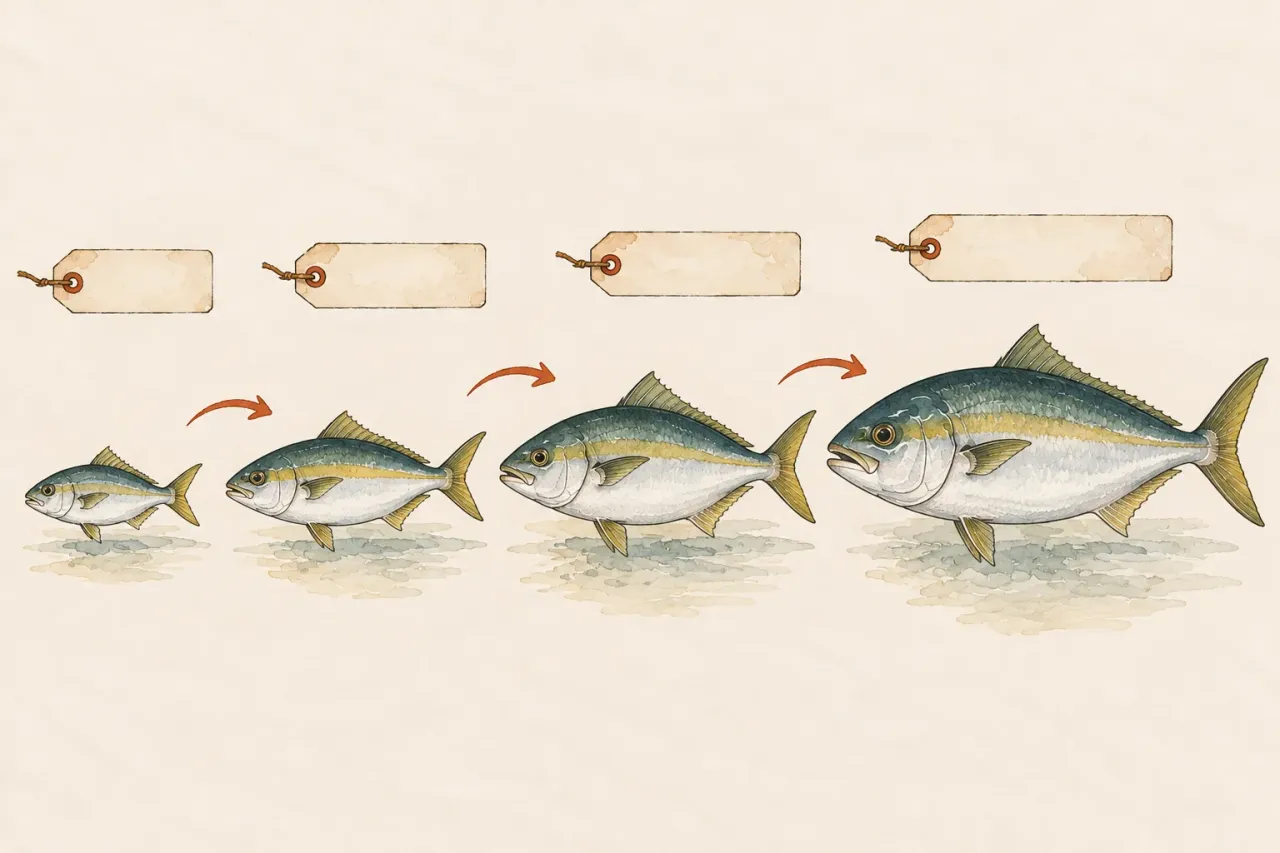
- Kantō: wakashi → inada → warasa → buri.
- Kansai: tsubasu → hamachi → mejiro → buri.
Mie prefecture names it by age: inada at one year, warasa at two, buri at three.
Toyama has more. A 2015 column in the Sasakawa Peace Foundation’s Ocean Newsletter by Nakai Seiichi, a professor at the University of Toyama, maps them: in eastern Toyama, tsubaiso → fukuragi → ganto → buri (or tsubaiso → fukuragi → hamachi → buri); in the west, kozukura → fukuragi → ganto → buri; at Nadaura in Himi, five stages — kozukura → fukuragi → nimaizuru → ganto → buri. Inland, three stages are common; in the mountains, one or two (fukuragi → buri, or just buri). The line between ganto and buri is given as 5 kg. That is a researcher’s column, not an official source.
Suzuki. Chiba gives seigo → fukko → suzuki. It says Tokyo Bay leads Japan’s landings at 2,000 tonnes a year, and that suzuki is famous in summer as arai.
What hamachi means
In the Kansai sequence, hamachi is a young buri. The consumer agency’s labelling Q&A uses “tuna (wild) and hamachi (farmed)” as an example of a mixed platter, and that example is sometimes read as “hamachi means farmed”. I found no official source saying so, and the regional naming above shows hamachi is first a size name. Ask, or read the label.
When it is best
The sources disagree, and this page leaves them side by side:
- Chiba: winter, as kan-buri, “cold-season buri”, is when it is fattest; summer’s inada has less fat but a lighter taste.
- Mie: in western Japan, including the Kumano coast, spring is the season; wild buri are caught from February to April, and farmed buri all year. Its main dishes are sashimi, teriyaki, buri with radish, and salt-grilled.
Handling the fish
Hokkaido’s research institute explains why handling matters for buri and mackerel. Ikejime is the general term for treating a live fish to keep its quality after death; its example cuts the spinal cord to kill at once and cuts the gills to bleed it, on board. Nojime is letting the catch die untreated, for example in iced holds. Killing at once avoids the muscle activity of a struggling death, saves the fish’s energy compound and delays rigor, it says. Its freshness guide: a K value of 20% or less for eating raw, though the rate of change differs greatly between species.
What it costs
I could not find official tax-included prices for buri or suzuki sashimi at specialist restaurants. For a chain example, Isomaru Suisan’s April 2026 boat platter was ¥2,639 including tax, contents unlisted.
The same fish, a different name
- Order by local name. The same fish is inada in Tokyo and hamachi in Osaka at a similar size, and Toyama has names of its own.
- Season depends on the source. A winter fish in Chiba, a spring one on Mie’s coast.
- No official ranking. No source compares buri eaten at Himi with buri eaten in Tokyo, so this page does not.
What people get wrong
- “Hamachi and buri are different fish.” Hamachi is a stage of buri in the Kansai names.
- “Hamachi always means farmed.” No official source I found says so.
- “Buri is only good in winter.” Chiba says winter; Mie says spring.
- “The names are the same everywhere.” Toyama alone has several sequences.
Questions people ask
What are the names of buri as it grows?
Chiba prefecture gives wakashi, inada, warasa, buri for Kantō, and tsubasu, hamachi, mejiro, buri for Kansai. Mie names them by age, inada at one year, warasa at two, buri at three. Toyama has several regional sequences of three to five names.
Is hamachi the same as buri?
It is buri at a younger stage, in the Kansai sequence of names. Japan's consumer agency also uses "hamachi (farmed)" as an example in its labelling guidance, but I found no official source saying hamachi always means farmed.
When is buri in season?
Sources differ. Chiba says winter, when kan-buri is fattest. Mie says spring is the season in western Japan, with wild buri caught from February to April and farmed fish all year.
Sources
Prices are in Japanese yen. Conversions are approximate, at ¥177.30 to the euro and ¥158.23 to the US dollar as of 20 Oct 2026. Rates come from the European Central Bank, which publishes on working days only. Prices checked Oct 2026. What food costs in Japan →