
Kobujime and shimesaba: raw fish cured with kombu or vinegar, and what curing does not do
I have not been to every place in this guide. The figures below are taken from the sources listed at the end, with the date each one was published — not measured by me. Where I have been, the article says so.
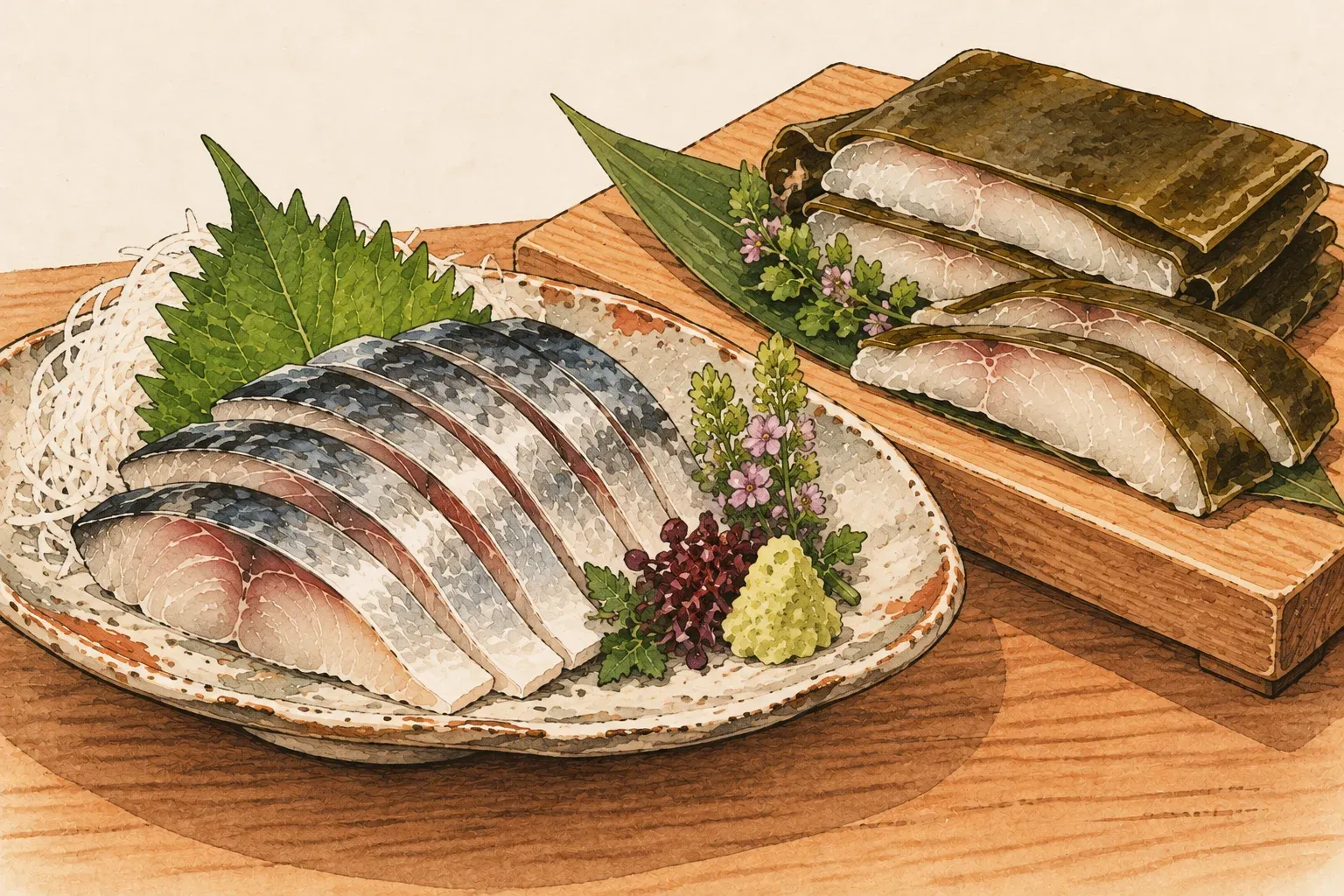
Not all raw fish in Japan is served as it comes from the knife. Some is cured first: pressed between sheets of kombu (kobujime), or cured in salt and vinegar, as with mackerel (shimesaba). Both began as ways to keep fish before refrigerators, and both change the taste and texture. One thing curing does not do is make fish safe from parasites, and the farm ministry says so directly.
For sashimi in general, start from the sashimi overview.
Kobujime: where it came from
The farm ministry’s local-food entries place it in Toyama. In the Edo period, kombu from Hokkaido, carried by kitamae trading ships, met fish from Toyama Bay. Without refrigeration, people looked for ways to keep raw fish, and pressing it between kombu to draw out excess water was one.
Why kombu works
The ministry’s explanation:
- Kombu absorbs excess water, which helps the fish keep longer.
- Kombu’s umami soaks into the fish, and the flesh matures to a pleasant firmness.
- Time changes it — how long it rests changes the flavour and the bite.
The fish. Swordfish, which Toyama people call sasu, is the standard. Sea bream, flounder and other white fish, white shrimp and firefly squid are used too, and recently meat, vegetables, tofu and mountain greens.
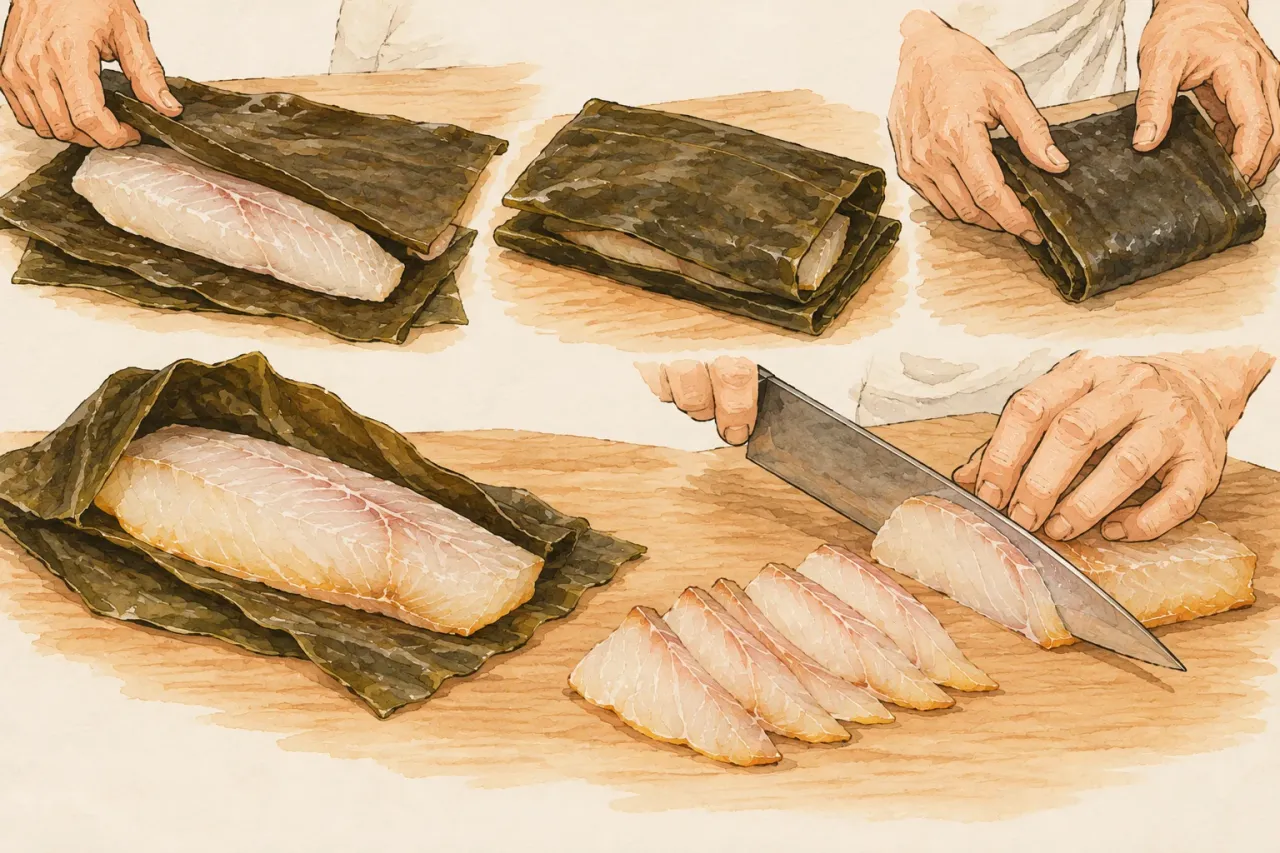
The method. The ministry describes brushing vinegar on one side of the kombu, laying sashimi-cut fish and shredded ginger on it, covering with another sheet, weighting lightly and resting overnight. Its printed recipe on the same page, though, is for whelk, so I give only the principle: fish pressed between kombu and rested.
Shimesaba and the safety rule
The farm ministry lists unfrozen shimesaba among the main causes of anisakis poisoning, with the sashimi of mackerel, sardine, horse mackerel, bonito, squid and others. Its rule: freeze the mackerel before or after curing it in vinegar. The health ministry is explicit that vinegar, salting, soy and wasabi do not kill anisakis; freezing at -20°C for 24 hours or more, or cooking to 70°C (60°C for a minute), does.
I found no official source on whether kobujime has the same issue, and no official history of vinegar curing, so I give neither.
A cousin: katsuo no tataki
Kōchi’s bonito tataki is not cured in kombu or vinegar, and its origin is told several ways. The farm ministry says one story is that before modern storage, fishermen on board pounded (tataku) bonito that had lost freshness with salt to cut the smell; another, that it was fishermen’s own meal. Some date its spread to after the Battle of Sekigahara in 1600, or link it to the lord Yamauchi Kazutoyo ordering people to cook fish rather than eat it raw, to prevent food poisoning. The dressing is citrus vinegar and soy; sliced garlic is essential, with shiso, garlic leaves or konatsu peel in some areas.
Time and taste
The Japan Fisheries Association explains why rested fish tastes different: the fish’s energy compound breaks down into inosinate, the umami of fish, which then breaks down further over time, and the flesh softens after rigor passes. Shimane’s fisheries centre adds, of mackerel landed at Hamada, that inosinate peaks around full rigor. Curing is one more way cooks have managed that change.
Eating it there
- Toyama — kobujime of sasu, white fish, white shrimp or firefly squid.
- Kōchi — bonito tataki with garlic.
Check fares and journey times with the operator before you travel.
Away from home
- The method travels; the ingredients came from afar to begin with. Kobujime itself was born from Hokkaido kombu shipped to Toyama.
- The freezing rule is national. Wherever you eat shimesaba, the farm ministry’s guidance is that the fish should have been frozen.
- No official comparison of cured fish at the source and elsewhere exists, so this page makes none.
What people get wrong
- “Curing makes fish safe.” Vinegar and salt do not kill anisakis; freezing does.
- “Kobujime is only fish.” Toyama now makes it with meat, vegetables and tofu as well.
- “Kombu is just a wrapper.” It draws out water and adds umami.
- “Tataki has one origin.” Kōchi tells several.
Questions people ask
What is kobujime?
Raw fish pressed between sheets of kombu and left to rest. The farm ministry says it was born in the Edo period in Toyama, from Hokkaido kombu carried by kitamae ships and fish from Toyama Bay, as a way to keep fish without refrigeration.
Does vinegar make shimesaba safe from parasites?
No. The farm ministry lists unfrozen shimesaba as a cause of anisakis poisoning and says the mackerel must be frozen before or after curing. Vinegar and salt do not kill the larvae.
What fish is used for kobujime?
In Toyama the standard is swordfish, which locals call sasu. Sea bream, flounder, white shrimp and firefly squid are used too, and recently meat, vegetables, tofu and mountain greens.
Sources
Prices are in Japanese yen. Conversions are approximate, at ¥177.30 to the euro and ¥158.23 to the US dollar as of 20 Oct 2026. Rates come from the European Central Bank, which publishes on working days only. Prices checked Oct 2026. What food costs in Japan →