Beppu Onsen: eight bath towns, hells you look at, and a hundred neighbourhood baths
I have not been to every place in this guide. The figures below are taken from the sources listed at the end, with the date each one was published — not measured by me. Where I have been, the article says so.
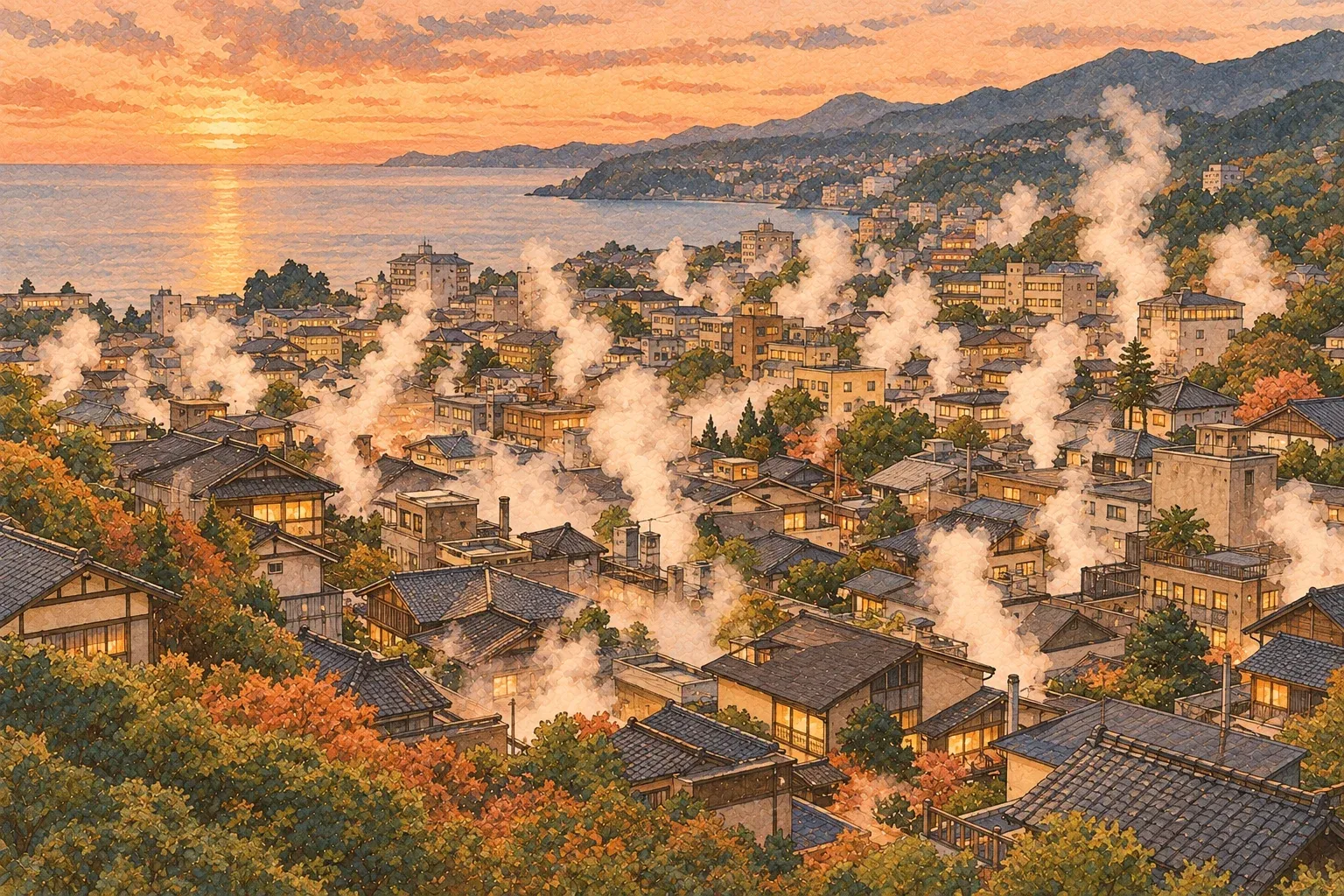
Beppu, on the Oita coast, is not one hot spring town but eight, grown together into a city. Its prefecture, Oita, has more springs than any other on the environment ministry’s table, and Beppu uses the water for far more than bathing: steam for cooking, steam for crystals, pools of boiling water that people pay to look at. This page explains how Beppu works using the city office, the city’s official tourism site (run with the tourism association), the environment ministry, Oita prefecture and national agencies. Where two sources disagree, I give both and do not choose. It does not rate any bath.
For how Beppu compares with the rest of Kyushu, start from the Kyushu hot springs overview. For what the spring names and pH on the sign mean, see the guide to onsen water types; for the notices about added water, heating, recirculation and disinfection, see the piece on kakenagashi.
Where it came from
Eight towns, once ten
The city’s guide to the Beppu Hattō, the “eight baths of Beppu”, lists Hamawaki, Beppu, Kamegawa, Kannawa, Kankaiji, Horita, Shibaseki and Myōban. It says they were originally separate bath towns. In the Taishō era the group was called the Beppu Jittō, ten baths, with Yufuin and Tsukahara added; after municipal mergers, the name Beppu Hattō is said to have settled by 1924, when Beppu became a city. The environment ministry’s 2020 plan for Kannawa, Myōban and Shibaseki says that especially since the high-growth years, the city has built its tourism on the eight together.
The city gives each a sketch (I read its guide in summary):
- Hamawaki — called the birthplace of Beppu Onsen; a shrine was founded here in the early Kamakura period, and it grew as a port in the Edo period. The city built Yutopia Hamawaki here in 1991.
- Beppu — the “Hayami spring” of the Iyo Fudoki; it grew with the harbour, railway and trams after the Meiji era, and holds a hot spring festival every April.
- Kamegawa — mentioned in an Edo-period travel account; known for natural sand baths on the shore and as Beppu’s northern gateway. The city’s guide writes this in the past tense; see the note under bathing below.
- Kannawa — the monk Ippen is said to have opened up a “hell” here in the Kamakura period; the area centres on the steam bath, with steam plumes and inns that rent rooms to bathers.
- Kankaiji — said to have been found in the Kamakura period; at 150 m above sea level, the highest of the eight. Rebuilt after a fire in 1931, it has large resort hotels.
- Horita — opened as a place to take the waters in the Edo period; sulphurous gas rises from fields and valleys, and its water is piped into the city.
- Shibaseki — the emperors Daigo and Go-Reizei are said to have bathed here in 895 and 1044; its municipal bath opened in April 1997.
- Myōban — said to have been Japan’s leading source of alum in the Edo period, in both quality and quantity; known now for yu-no-hana.
The tourism association’s English home page adds a few details of its own: Myōban for acidic sulphur springs, mud baths and steamed pudding, with the nickname “shampoo spring”; Horita as a junction on the roads towards Yufuin, Hita and Dazaifu; and Shibaseki’s name as coming from fossilised brushwood found there.
The oldest mentions, and the stories that compete
The city’s history page says the eighth-century Iyo Fudoki records a myth in which the god Ōkuninushi laid a pipe under the sea to carry Beppu’s water to Dōgo in Shikoku, to heal the sick god Sukunahikona; that the Bungo Fudoki mentions a “red hot spring”, today’s Chi-no-ike hell; that in the Kamakura period Ōtomo Yoriyasu set up places of treatment at Beppu, Kannawa and Hamawaki for warriors wounded in the Mongol invasions; and that in 1694 the scholar Kaibara Ekiken described the bustle of the bath towns.
Several origins sit side by side, and this page does not choose.
- The earliest mention. The city and tourism association point to the “Hayami spring” of the Iyo Fudoki; the city also points to the “red hot spring” of the Bungo Fudoki.
- Kannawa. The ministry’s plan calls it a place of hot springs and hells since the ancient Bungo Fudoki. The city’s guide, and the plan too, tie it to a legend of the monk Ippen in the Kamakura period; the plan says Beppu still holds a bathing festival in his memory, and that the name Kannawa is said to come from an “iron ring hell” in a Buddhist tale.
- Shibaseki. The city’s guide gives the imperial visits of 895 and 1044 as tradition. The ministry’s plan says a local temple’s record carries stories from the Heian period, but that Shibaseki hardly appears in Edo-period travel writing, Kaibara Ekiken’s included, and was long described as a quiet hermit’s retreat.
From drilling to tourism
In the Edo period, the ministry’s plan says, alum from Myōban was made by two producers, one under the Mori domain and one on shogunate land, and was known across Japan as “Bungo alum”. The plan also says that in the early Meiji years Kannawa’s bathers were mostly people staying cheaply to take the waters, and that its baths were probably not yet well developed.
The city says a well-drilling method from Kazusa spread in the Meiji era and set off rapid development, with about 1,000 drilled wells said to exist by late Meiji; development surged again in the 1950s and 60s. The ministry’s plan adds that in 1876 Kannawa village recorded 34 inns and more than 3,000 bathers a year, and that in 1950 a national law named Beppu an “international tourist hot spring culture city”. The plan says the law’s two main projects were an international tourist port and the Trans-Kyushu road, which opened in 1964; that Beppu came to receive 10 million visitors, 5 million of them staying overnight; and that Kannawa’s inns reached 60 by the end of 1961. It names the end of high growth, more Japanese travelling abroad with the strong yen, and school trips shifting from sightseeing to hands-on activities as later turning points.
The water
How much
The city’s data page, as of the end of March 2025, gives 2,831 springs and a total flow of 101,856 litres a minute, citing the Oita Eastern Health Centre’s report for fiscal 2025. A table from that health centre for the end of fiscal 2024 gives the same two totals, broken down like this:
- In use — 372 flowing naturally, 1,538 pumped. Not in use — 259 flowing naturally, 662 pumped.
- By temperature — 4 under 25°C, 228 from 25 to under 42°C, 2,224 at 42°C or more, and 375 steam vents.
- Flow — 28,892 litres a minute from natural springs, 72,964 from pumped ones.
The district has 2,903 active springs, close to half of the prefecture’s, and Beppu holds 97.5% of them. I did not see the document’s title page, so I take the table and the city’s figures as the same statistics because the totals match, not because the document says so. The same document’s text says Beppu’s water is volcanic, heated by the active volcanoes Tsurumidake and Garandake, with 374 steam vents and 91.8% of active springs at 42°C or above. The table says 375 and the text 374; the difference is in the document itself. It also counts 448 facilities licensed to use hot spring water for bathing and 27 for drinking.
The city’s resource survey, carried out with the prefecture from fiscal 2018 to 2020, counted 2,856 springs as of 31 March 2020. That is a different year and a different source from the 2,831, so I do not read the two as a decline.
Which kinds
Of the ten spring types used on official signs, seven have been found in Beppu: simple, chloride, hydrogen carbonate, sulphate, iron-bearing, sulphur and acidic. Carbon dioxide, iodine and radioactive springs have not. Two official sources agree on this, the city’s data page (as of March 2025) and the ministry’s 2020 plan. The plan alone adds that by full spring name, 43 kinds are found in the city; its appendix lists 32 examples, and I have not seen the other eleven.
I found no official count of springs or spring types for each of the eight areas. The closest is a list in the ministry’s plan of springs whose operators publish an analysis, for three areas only. It is an extract, not a total:
| Area | Springs in the list | Temperature (°C) | Spring names that appear |
|---|---|---|---|
| Kannawa | 33 | 52.3–99.7 | Mostly sodium chloride; also simple, simple sulphur, acidic sodium chloride-sulphate and others |
| Myōban | 13 | 39.9–98.8 | Simple, simple sulphur, simple acidic, acidic sulphur-bearing simple, acidic iron-bearing sulphate, sodium chloride |
| Shibaseki | 22 | 43.2–85.9 | Mostly sodium chloride-sulphate; also simple, sodium chloride-hydrogen carbonate and others |
Why here
The city’s explanation: the land from Beppu Bay through Kujū and Aso to the Shimabara peninsula is a sinking rift zone, where volcanic activity that became lively about 30,000 years ago brought heat and hot springs. Faults and the volcanoes Tsurumidake and Garandake affect each other, and several thousand metres down there are pockets of hot, high-pressure water. Rain soaks in, is heated there, and picks up minerals on the way back up.
The ministry’s plan places Beppu at the eastern end of the Shimabara–Beppu rift, between the Kanaegoe fault to the north and the Asamigawa fault to the south, with a line of volcanoes led by Tsurumidake (1,375 m) and including Garandake (1,045 m) behind the city. The Japan Meteorological Agency watches both around the clock; it gives Tsurumidake’s last eruption as 867 and Garandake’s as more than a thousand years ago.
Not a bottomless supply
The resource survey was carried out jointly by Oita prefecture and the city from fiscal 2018 to 2020. The city says it found falling temperatures, deeper drilling and fewer steam vents and boiling springs, and that a simulation for 2120, a hundred years on, predicts lower spring temperatures than now. From 1 April 2022 it designated two new special protection areas, the Western and Minamitateishi areas. I give the direction the city describes, not the detailed figures for particular places.
How the town works
The hells (jigoku)
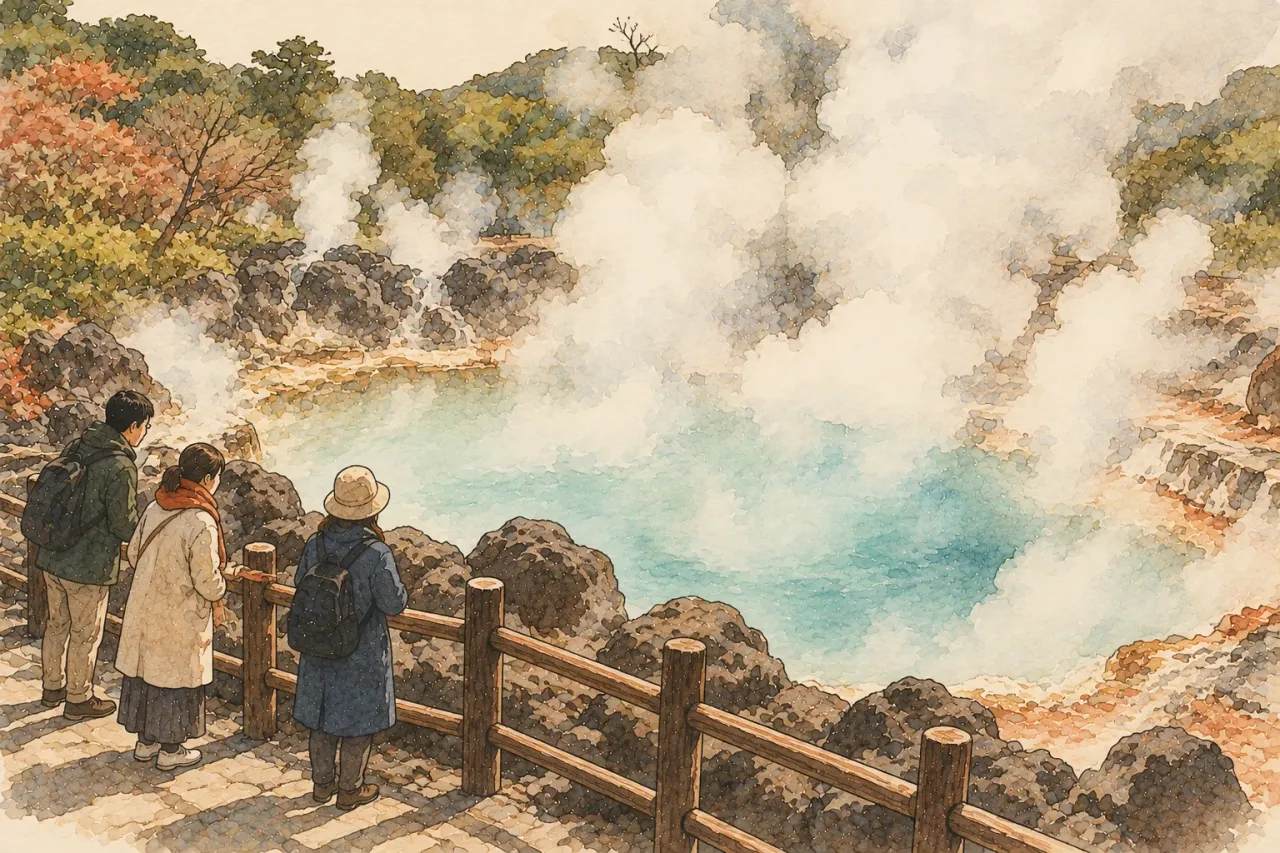
The jigoku are pools of boiling water, mud and steam. The Japan Tourism Agency says they are for looking at, not for bathing in; that some were used for bathing water from the Edo period on; and that by 1937 ten had been developed as sights.
The ministry’s plan says that until the Meiji era the hells were treated as a nuisance, because of damage from the scalding water. In the Taishō era one man leased Umi Jigoku and began charging admission, and with Chi-no-ike and Bōzu formed the “Enma-kai”, the forerunner of today’s hell union. Cars replaced rickshaws for hell-viewing in the same era, and in 1928 the Kamenoi company began guided tours in 25-seat buses with women conductors. The tourism association’s English page also dates its “Ganso Jigoku Meguri” bus tour to 1928.
The tourism association lists seven hells on the tour: Umi, Oniishibōzu, Kamado, Oniyama, Shiraike, Chi-no-ike and Tatsumaki. It describes them as two groups, each walkable, with the second (Chi-no-ike and Tatsumaki) about ten minutes by bus from the Kannawa bus stop. A combined ticket covers all seven, is valid for two days and can be bought at any of them. The hell union gives the hours as 8:00 to 17:00, open every day. Prices for single hells are not on the association’s page, which points to each hell’s own site or a phone call. The association’s English page also mentions a “Beppu Round Tour Passport” that covers 17 facilities with entry by QR code, without a price or validity. I have not given the ticket price, because none of the pages says whether it includes tax.
A few features the association gives, as a description of how the hells work rather than a guide to each: Oniyama is said to have been the first place in Japan to keep crocodiles using hot spring heat; Kamado is a group of pools named 1-chōme to 6-chōme, like street blocks; Tatsumaki erupts about every 30 to 40 minutes, with an announcement beforehand; and Chi-no-ike is described as Japan’s oldest natural hell, the “red hot spring” of the Bungo Fudoki.
How long it takes depends on which page you read. The tourism association’s Japanese page says about three to three and a half hours; its English page says about two. Neither has a date, so I give the range, about two to three and a half hours, and do not pick one.
Four of the hells, Umi and Shiraike in Kannawa and Chi-no-ike and Tatsumaki in Shibaseki, were designated together as a national Place of Scenic Beauty, “the hells of Beppu”, on 23 July 2009. That does not cover all seven on the tour.
Steam
The steam bath. Kannawa centres on its mushi-yu. The ministry’s plan says it has been a stone chamber since the Meiji era, with a stone pillar in the middle and stones at the four corners, 16 stone pillows and room for 16 people at a time; at one time the queue lasted for hours. The city gives the steam at Kannawa as 75 to 80°C and at Shibaseki around 55°C, and suggests about ten minutes.
Yu-no-hana. At Myōban, crystals are collected in huts floored with blue clay, through which hell steam is passed. The plan says the technique was designated a national Important Intangible Folk Cultural Property on 15 March 2006.
The landscape. Parts of Kannawa and Myōban were selected on 19 September 2012 as an Important Cultural Landscape, the plan says, the first hot spring area in Japan to be chosen. The plan puts about 30% of the city’s steam plumes in Kannawa and about 20% in Myōban. Boiling springs are passed through separators: the water is piped to houses, the steam is let off as plumes.
Other uses. For fiscal 2024, the health centre’s document counts Beppu springs used for farming and horticulture (51), heating (8), yu-no-hana (70), viewing (17), power generation (27) and fish farming (2), with some springs counted more than once.
Neighbourhood baths and municipal baths
The city’s page for people who want to use them (updated 10 September 2026) says there are “about 100” kyōdō onsen, communal baths, in the city, counting the municipal ones. It gives no year for the count, and I found no other official total. They are run by neighbourhood associations or spring unions, and many have the bath on the ground floor and the local community hall upstairs. Some are open to anyone; others are for union members only and cannot be used by visitors, and on the city’s bath facility map these are shown in green. The city says hours, closing days and prices are on its communal bath map on Google Maps. The page says nothing about contributions, manners or visitors, and I found no official guide to those, so this page does not give one. It also says the custom of sharing natural springs in simple buildings has been handed down, and the ministry’s plan explains why: homes had no bath, so people near a source bathed together, and as the population grew, unions and associations built facilities.
The city’s municipal bath page (updated 24 June 2026) lists 17 municipal baths:
- Beppu — Nagaishi, Takegawara, Furōsen, Ta-no-yu, Kaimonji, Shibai-no-yu
- Kamegawa — Hamada, Kiyōsen, Keirin
- Myōban — Kakujusen, Jizōsen
- Hamawaki — Hamawaki, Yutopia Hamawaki
- Kannawa — Kannawa Mushi-yu, Netsu-no-yu
- Shibaseki and Horita — one each
Kankaiji has none. The city publishes a fee table for them as of 1 April 2026, but it does not say whether the prices include tax, so I have not given them; the two Myōban baths are not on that table. The city’s FAQ says multi-visit tickets, and residents’ tickets, are sold at each bath’s counter.
For its municipal baths the city labels the water as gensen or hikiyu and as kakenagashi or junkan. Those are the city’s own definitions, explained in the Kyushu overview and the kakenagashi guide; neither is a grade.
Onsendō, the bath passport
The Beppu Hattō Onsendō is a stamp rally run by a secretariat inside the tourism association. About 150 baths take part, by the association’s page, which gives no year for the figure; you collect stamps from 88 of them in a book called the “Spaport”, can apply for a rank in each of the eight areas, and at 88 baths become an “Onsendō master”, with a certificate and a towel. The most numerous participants are neighbourhood baths. The page advises that if you are not used to bathing, two or three baths a day is safe. The Onsendō’s own site says rank applications go to the secretariat by post or in person. I found no price, start year or date for the figures on the official pages. The city’s own hot spring pages have no page on the Onsendō.
Bathing there
The city’s advice
The city’s page on bathing (in Japanese only, with a machine-translation link) suggests 3 to 10 minutes at first for an ordinary bath, 10 to 15 minutes once a day for a sand bath, and about 10 minutes in a steam bath. It also says not to get suddenly into hot water and to avoid bathing after eating or drinking alcohol.
“Beppu style”, from the tourism association
The tourism association’s English page on Takegawara Onsen sets out manners for a public bath:
- Greet the people there when you come in, and again when you leave.
- Pour water over yourself before getting in.
- Do not add cold water yourself; ask the local bathers first.
- Do not sit on the edge of the bath.
- Keep your towel out of the water, and tie up long hair.
- In a group, a phone may be allowed one at a time; ask the staff.
It also says many public baths in Beppu have no showers, soap, shampoo or towels, so bring your own. For the sand bath, you wear a special yukata, lie for about 15 minutes, then wash the sand off in the bath next door, and ask staff before taking photographs.
Takegawara Onsen
The tourism association says Takegawara was founded in 1879 as a municipal bath and that the present building, with its curved gable roof, dates from 1938. The city’s page gives these hours, checked on 11 October 2026: ordinary bath 6:30 to 22:30; sand bath 8:00 to 22:30, last entry 21:30, earlier when busy; closed on the third Wednesday of the month (the next day if that is a holiday). It says a shampoo and soap set is sold there, and describes the sand bath: you lie on the sand in a yukata while staff cover you with sand warmed by the spring water. JNTO puts it ten minutes’ walk from Beppu station. I have not given the fees, because the city’s pages do not say whether they include tax.
The Kamegawa sand bath
The two tourism association pages disagree. Its Japanese page on the city’s attractions notes that the Beppu Beach Sand Bath in Kamegawa closed on 31 March 2023; its English home page still lists the beach sand bath. I could not confirm which is current, so check its present state before you plan around it. Takegawara’s sand bath is on the city’s own page with current hours.
Bathing garments and tattoos
The city says bathing garments, made for people with scars from surgery such as for breast cancer or skin grafts, can be worn at its municipal baths, with rental at some.
Tattoos. I found no policy for Beppu as a whole on the city, tourism association or JNTO pages I read. The tourism association’s English home page suggests checking each facility’s site or a tourist information office. Ask each bath in advance, and consider a private bath where there is one; the city lists family baths at Shibaseki.
What it is eaten with
- Jigoku-mushi. The city describes the “hell kettle”: strong steam from the hells is directed into a kettle to cook eggs, vegetables, rice and the like; it cooks quickly, so the flavour stays in, and a faint smell of the spring passes into the food. The tourism association’s English page says there is almost no rule about what goes in, from seafood and meat to potatoes and eggs, eaten with salt, soy sauce or ponzu. The ministry’s plan notes jigoku-mushi is recorded in Edo-period documents. The association also names a steamed pudding as a feature of Myōban.
- Toriten. The farm ministry says chicken tempura is said to have started at Tōyōken in Beppu, the first restaurant in the prefecture, in the early Shōwa era, when boneless thigh meat was cut small and fried like tempura. The tourism association says it is traced to the prefecture’s first restaurant, in Beppu, in the Taishō era. This page does not choose. Neither source connects it to the hot springs, so neither do I.
- Beppu reimen. The tourism association’s English home page says cold noodles began after the Second World War, when people returning from Manchuria made Korean-style noodles in Beppu, which became a local dish with a Japanese-style broth, grilled beef and a kimchi made from ordinary cabbage. Its Japanese page on the city’s attractions also says Beppu reimen took shape after people from Manchuria settled in Beppu after the war. Both are from the Beppu side; the farm ministry’s list of 30 Oita dishes does not include it, nor jigoku-mushi.
Getting there
As checked on 10 and 11 October 2026. Timetables change, so check the operator before you travel.
- From Oita Airport by bus. The airport’s own page gives Ōita Kōtsū buses to Beppu: 47 minutes to Beppu Kitahama on one route, and 50 minutes to Kitahama and 53 minutes to Beppu station on another. The tourism association says about 50 to 55 minutes to Kitahama; JNTO says 45 minutes. I give all three.
- From Fukuoka by bus. Nishitetsu’s page for the Toyonokuni express to Beppu, run with Kamenoi Bus, gives about 2 hours 49 minutes from Tenjin to Beppu Kitahama, 12 round trips a day at intervals of 60 to 90 minutes, with reserved seats that must be booked.
- From Hakata by train. The tourism association and JNTO both say about 2 hours by limited express. JR Kyushu’s page for the Sonic train gives no journey time, only a timetable.
- By car. The tourism association says about 2 hours from central Fukuoka.
Once there, JNTO says all eight areas can be reached by public transport from Beppu station, the nearest two minutes’ walk away and the farthest about 30 minutes by bus. JNTO also says the tourist information office at Beppu station has English-speaking staff, open 8:30 to 17:30.
Fares are not on this page. The airport page and Nishitetsu’s page do not say whether their fares include tax, so I do not give the amounts.
What people get wrong
- “Beppu is one hot spring.” It is eight areas, each with its own history and water, and the city says each was once a separate town.
- “You can bathe in the hells.” They are for looking at. Bathing is in the municipal and neighbourhood baths.
- “All seven hells are a national monument.” Four were designated, in 2009.
- “Every neighbourhood bath is open to visitors.” Some are for union members only, marked green on the city’s map.
- “Public baths provide soap and towels.” The tourism association says many in Beppu do not.
- “The springs will last for ever.” The city’s own survey found falling temperatures and fewer steam vents, and set new protection areas in 2022.
- “Toriten is a hot spring food.” It is said to have begun in Beppu, but no source I read links it to the water.
- “The water cures things.” This page does not say so. The official list of indications by spring type is in the water types guide, along with the environment ministry’s note that spa therapy is best done under a doctor’s guidance.
Questions people ask
What are the eight areas of Beppu?
Beppu, Hamawaki, Kankaiji, Horita, Kannawa, Shibaseki, Myōban and Kamegawa, together called the Beppu Hattō. The city says they were once separate bath towns, that in the Taishō era the group was called the Beppu Jittō, ten baths including Yufuin and Tsukahara, and that the name Beppu Hattō had settled by the time Beppu became a city in 1924.
Can I bathe in the Beppu hells?
No. The Japan Tourism Agency’s English explanation says the hells are for looking at, not for bathing in. For bathing there are the city’s municipal baths and the neighbourhood baths, about a hundred in all according to the city.
Can anyone use a neighbourhood bath in Beppu?
Not all of them. The city says some neighbourhood baths are open to the public and some are for members of the local spring union only. On the city’s bath facility map, members-only baths are shown in green, and you cannot drop in.
Can I bathe in Beppu with tattoos?
I found no policy for Beppu as a whole on the city, tourism association or JNTO pages I read. The tourism association’s English site points you to each facility’s own site or a tourist information office. Ask the bath in advance, and consider a private bath where there is one.
Sources
- 別府市 別府八湯ガイド
- 別府市 温泉データ(令和7年3月末現在)
- 別府市 別府温泉のなぞと歴史
- 別府市 正しい温泉の入り方
- 別府市 いろいろな温泉の活用法
- 別府市 市営温泉
- 別府市 竹瓦温泉
- 別府市 共同温泉を利用したい方へ
- 別府市 温泉資源量調査の結果
- 別府市 温泉資源量調査の結果(PDF)
- 別府市 市営温泉入浴料表(令和8年4月1日現在)
- 別府市 温泉 よくあるお問い合わせ
- 別府市 入浴着を着用した入浴のご理解・ご配慮のお願い
- 別府市 「源泉」「引湯」「かけ流し」「循環」について
- 大分県 東部保健所「温泉」(令和6年度末現在)
- 環境省 鉄輪・明礬・柴石温泉 国民保養温泉地計画書
- 観光庁 地域観光資源の多言語解説文 海地獄(英語)
- 気象庁 九州の活火山
- 別府市公式観光情報Web(別府市観光協会)日本語トップ
- 別府市公式観光情報Web(別府市観光協会)別府市の魅力
- 別府市公式観光情報Web(別府市観光協会)英語トップ
- 別府市公式観光情報Web(別府市観光協会)地獄めぐり
- 別府市公式観光情報Web(別府市観光協会)Jigoku Meguri Features(英語)
- 別府市公式観光情報Web(別府市観光協会)地獄蒸し(英語)
- 別府市公式観光情報Web(別府市観光協会)竹瓦温泉と別府式の入浴(英語)
- 別府市公式観光情報Web(別府市観光協会)別府八湯温泉道
- 別府八湯温泉道 公式サイト(別府八湯温泉道事務局)
- 別府市公式観光情報Web(別府市観光協会)アクセス
- 別府地獄組合
- 農水省 うちの郷土料理「とり天」大分県
- 農水省 うちの郷土料理 大分県
- 大分空港 バス
- 西日本鉄道 高速バス 福岡・福岡空港〜別府(とよのくに号 別府線)
- JR九州 ソニック(英語)
- JNTO, Beppu and Yufuin area
- JNTO, Beppu Onsen
- JNTO, Beppu Station tourist information
- JNTO, Takegawara Onsen
Prices are in Japanese yen. Conversions are approximate, at ¥177.30 to the euro and ¥158.23 to the US dollar as of 20 Oct 2026. Rates come from the European Central Bank, which publishes on working days only. Prices checked Oct 2026. What food costs in Japan →