Kurokawa Onsen: thirty inns, one entry pass, and an open-air bath tour that remade a valley town
I have not been to every place in this guide. The figures below are taken from the sources listed at the end, with the date each one was published — not measured by me. Where I have been, the article says so.
Kurokawa is a small hot spring town in a river valley in the highlands of north-eastern Kumamoto. What makes it different is not one famous bath but an arrangement: the open-air baths of the inns can be toured with a single pass. This page explains how that works using the environment ministry’s plan for the Minamioguni onsen district, the Kurokawa Onsen ryokan association (the inns’ own body), Minamioguni town, the Aso Geopark and JNTO. Much of the history and practical detail comes from the inns’ association, and I say so where it does. It does not rate any bath or inn.
For how Kurokawa compares with the rest of Kyushu, start from the Kyushu hot springs overview. For what the spring names on the sign mean, see the guide to onsen water types; for the notices about added water, heating and disinfection, see the piece on kakenagashi.
Where it came from
The district
Kurokawa is in Minamioguni, a town the ministry’s plan (dated March 2020) places at the north-eastern tip of Kumamoto prefecture, on a plateau at the foot of the Aso outer rim and the Kujū mountains, 430 to 945 m above sea level. It is in the headwaters of the Chikugo river, and 85% of the town is forest and open land; part of it lies in the Aso-Kujū national park. Three hot spring towns, Kurokawa, Tanohara and Manganji, were designated a national health resort onsen (kokumin hoyō onsenchi) in 1964, and the plan later grew to cover the whole town, adding Oda, Shirakawa and others.
The plan also says the Aso outer rim and its surroundings, including the Oguni area, joined the Global Geoparks Network in 2014, became the Aso UNESCO Global Geopark in 2015, and that the Minamioguni springs are part of its Oguni-gō onsen geosite.
Founding stories
The sources give several accounts that do not agree, and this page does not choose.
- The ministry’s plan, in one place, says Manganji’s spring is “said” to have been opened by the monk Kōbō Daishi in 848. In another it says Tanohara and Manganji are said to have opened in the Kamakura period, and that Kurokawa is said to have had inns by the Edo period.
- The inns’ association tells a legend with no date: a headless jizō statue being carried through Kurokawa asked to be enshrined there, and when a hall was built for it, hot water sprang up. It says the statue is still enshrined in the centre of the town. It also says that by the mid-Edo period Kurokawa was known as a place for long-stay bathing (tōji), near the border of the Hosokawa domain, where domain officials stayed.
- The Aso Geopark says it is also said to have been a stopping place for lords travelling to and from Edo.
For Tanohara, the plan says the water once rose from the riverbed, and the river was diverted to secure the source. From around 1996 the natural springs began to dry up, and the communal bath closed; the building is still there.
1961 to 1986
The inns’ association’s own history runs like this. The association was founded in 1961 by six inns. The Yamanami Highway opened in 1964 and visitors rose for a while, then levelled off. In the 1970s, sons and sons-in-law of the inn families came back from the cities and looked for a new shape for the town.
In 1986, the association says, it reorganised itself into teams. One removed about 200 mismatched signs and put up shared ones. Another pruned and planted trees in what it calls a bleak landscape of cedar. A third came up with the entry pass, to help two inns that had no room to build an open-air bath.
The ministry’s plan agrees on the date: it dates Kurokawa’s rise to the open-air bath tour, rotenburo meguri, which began in 1986. Because the valley has little flat land, hot spring development spread to the plateau away from the old town, and the area of the onsen grew with it.
After 1986
The association gives overnight stays rising from 170,000 in 1989, when its count began, to 300,000 in 1999, and a peak in 2003 of 400,000 overnight stays and an estimated 1.2 million visitors. It does not say where these figures come from. Around the 1990s, it says, it began to describe the town as Kurokawa Onsen ichi-ryokan, “one inn”: the inns are its rooms, the lanes its corridors and the trees its garden. After the 2016 Kumamoto earthquakes some inns closed for a long time, and the association says visitor numbers had largely recovered by 2018.
The water
The ministry’s plan (March 2020) says 15 sources in the Kurokawa area are used by 30 inns and two public baths. It gives the main types as sodium chloride-sulphate springs and simple springs, and says almost all the sources are 42°C or hotter. An earlier version of this page gave the main types as chloride-hydrogen carbonate; on a page-by-page reading of the plan, its text says chloride-sulphate, and I have corrected it.
The plan’s table of sources does not match its text: it has 30 rows, not 15, and does not say why. Reading the whole table, by my own count:
- Temperatures run from 29.4°C to 95.1°C. Apart from the one row at 29.4°C, all are 49°C or above.
- Flow is given for only 15 rows, from 50 to 236 litres a minute. There is no total.
- All 30 sources are privately owned. One is a drilled well that flows on its own; the rest are pumped.
- By spring name, 17 rows are simple springs of one kind or another, and 13 are salt-type springs.
I could not find a more recent count from the town or the prefecture.
The inns’ association says almost all of Kurokawa’s inns use kakenagashi, water flowing straight from the source, and that because the source water is hot, many add water to bring it to a comfortable temperature, around 40 to 43°C. That is the association’s description, not an official certification.
Why here. The Aso Geopark, run by a council that includes the local towns and universities, says hot spring water in active volcanic areas often has some heated water and gas of volcanic origin mixed in, but that it is a small share, and most is groundwater that has soaked in from the surface. It says Kurokawa and nearby Tsuetate are thought to be related to the Kujū volcano, and its page on the Oguni-gō geosite says the many springs from Minamioguni to Oguni are thought to be heated by Kujū. These are the geopark’s explanations, given as “thought to be”; I found no meteorological agency, geological survey or university source on how Kurokawa’s water forms.
The Japan Meteorological Agency lists Asosan (1,592 m) and Kujūsan (1,791 m) as active volcanoes under constant watch. For Kujūsan’s latest eruption, the agency’s Kyushu list as read for the first version of this page gave 1996; its own Kujūsan page gives 11 October 1995. I give both.
How the town works
The entry pass
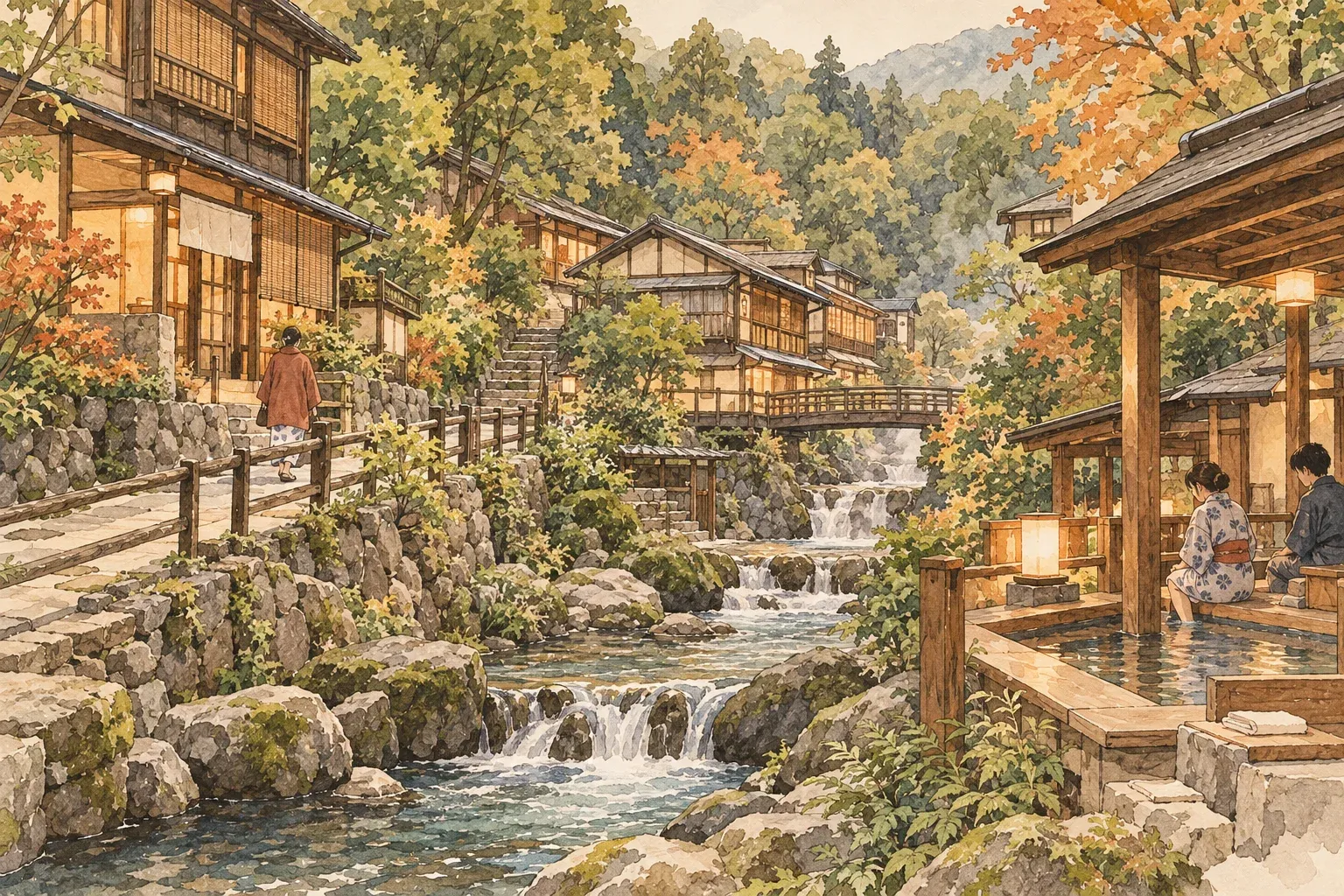
The plan describes Kurokawa’s streets as wooden inns and shops along the Tanohara river, in a Japanese style. Each inn has set up its own distinctive open-air bath, and the inns’ association issues an entry pass, the nyūtō tegata. The association says, on its pass page:
- One pass lets you choose three of 25 open-air baths. You can use one of the three for food or souvenirs at participating shops instead.
- It is valid for six months from purchase, so you can come back to use it. One pass per person; it cannot be shared.
- The baths can be used with the pass from 8:30 to 21:00, though hours and numbers may be limited for maintenance.
- It is sold at the inns and at the association’s tourist information office, Kaze no Ya, open 9:00 to 17:00. Inns can run out, so the association suggests the office if you want to be sure.
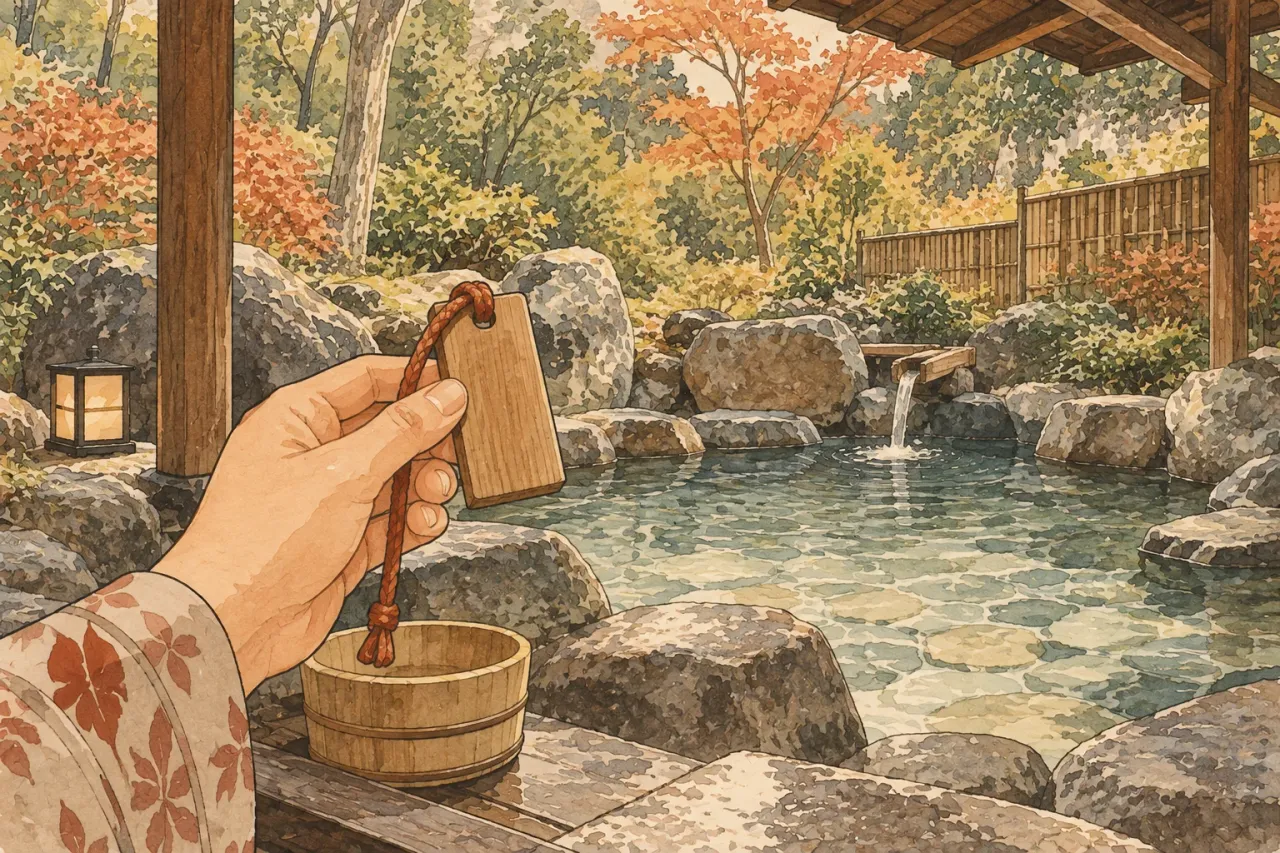
- The pass is made from thinned cedar and cypress from the Oguni area, and 1% of sales goes to the landscape and the natural environment.
- Photography is not allowed in the open-air baths, and you cannot bring in food or drink.
The number of baths differs between pages: 25 on the pass page and the prefecture’s tourism site, about 25 in the association’s FAQ, 24 for the association’s complete-tour award, and 28 on JNTO’s page.
Minamioguni town says the pass has been sold for more than 30 years and that sales passed three million in 2019. The association says it was renewed in June 2022 so that it can also be used at shops and restaurants. A 40th-anniversary design went on sale on 1 July 2026, with 50,000 planned, until about March 2027 or until they run out.
The association’s current page gives a price for the pass, but does not say whether it includes tax. The town and JNTO give a lower figure, with no date or tax status, and I could not find when it changed. So I have not given a price. Without a pass, you can pay at each inn for its bath; the association’s figure for that does not state tax either.
Yukata in the street
The plan says day visitors can also rent colourful yukata, so many bathers walk through the town in them between baths. In winter, lanterns made of local bamboo, yu-akari, are set along the river and elsewhere. The association says the town is small enough to walk around in 15 to 20 minutes.
Public baths, and water in daily life
The plan counts two public baths in Kurokawa, and its table lists one, Anayu. Minamioguni town describes Jizō-yu as a communal bath known as Kurokawa’s original spring, and gives the inns’ association as its contact. I could not find official prices or hours for either. The association says there are several footbaths in the town, some free and some paid.
At Manganji nearby, the plan describes the riverside kawa-yu bath with a washing place beside it, fed by hot spring water and used for washing vegetables and dishes, as a sign that the springs are still part of daily life.
Bathing there
I found no official prices for baths in Kurokawa whose tax status I could confirm, so none are given.
The inns’ association’s FAQ, in Japanese and English, says:
- Tattoos. “Tattoo policies vary by ryokan and are handled on a case-by-case basis.” It asks you to use its contact form and give details such as size, and says private baths are an option.
- Mixed bathing. Because of a change in Kumamoto prefecture’s rules, the open-air baths are not mixed; families and couples can use private baths. Some inns offer private baths to day visitors; they generally cannot be booked, so ask the inn whether one is free.
- Hours. Day bathing is generally 8:30 to 21:00, last entry 20:30, varying by inn. A daily status of which baths are open is updated around 9:00. After 15:00, staying guests take priority.
- Towels. There is no towel rental; bring one or buy one in town. Do not put your towel in the water.
- Photos. Not allowed in the baths or changing rooms; the streets are fine.
- Water. Please do not take spring water home.
JNTO’s advice is similar: most baths are separated by sex and you bathe naked, wash well first, and tie up long hair. It says guests with tattoos are often refused at public baths unless the tattoos are covered, and suggests checking with the tourist information office or your inn, and a private bath as an option. The plan says the town intends to post bathing instructions at the baths and hand out leaflets for foreign visitors.
What it is eaten with
I could not find one in official sources. The farm ministry’s list of Kumamoto dishes includes nothing named for Kurokawa, Minamioguni, Oguni or hot springs. The ministry’s plan mentions forestry (Oguni cedar) and the grazing of red cattle and sheep on the Aso grasslands, but does not pair any of it with the hot springs.
The inns’ association has its own project, started in February 2021, to serve akaushi, red cattle raised in Minamioguni, at the town’s inns and restaurants, as a way of keeping the grazed Aso grasslands going. That is the association’s initiative, not a dish listed by the ministry, the prefecture or the town.
Getting there
As checked on 11 October 2026. Timetables change, so check the operator before you travel.
After the July 2026 earthquake. The inns’ association says a magnitude 7.1 earthquake struck the Kumamoto region on 28 July 2026, that Kurokawa felt it at intensity 4 with no major damage in the town, and that it was open as normal from 29 July. Its notice of 29 July also said some expressway sections in the prefecture were closed and roads near the epicentre, towards Kumamoto city and the airport, were badly affected. I have not checked this against other official sources, or what has changed since. Check road and bus conditions before you go.
- By bus. There is no railway to Kurokawa. The inns’ association says buses run from Kumamoto, Yufuin and Hakata, three a day, and must be booked by the day before. The sources give different journey times:
| From | Inns’ association (Japanese page) | Inns’ association (English page) | Kumamoto prefecture tourism site |
|---|---|---|---|
| Hakata, highway bus | 2 hr 45 min | 3 hr | About 180 min (from Fukuoka city) |
| Yufuin station, Kyushu Ōdan bus | 1 hr 37 min | 1 hr 37 min | About 100 min |
| Kumamoto, Kyushu Ōdan bus | 3 hr (the diagram does not make clear whether from the station or the airport) | — | About 150 min (from Kumamoto city or airport) |
- By train and local bus. The association’s page also shows a route from Kumamoto: JR Hōhi line to Higo-Ōzu (40 min), limited express to Aso (53 min), a local bus to the Minamioguni town office (53 min), then about 10 minutes by car. JNTO says the same in outline: Aso station, then a taxi or bus.
- By car. The prefecture’s tourism site gives about 2 hours from Kumamoto city or Fukuoka city. Minamioguni town gives times to the town, not to Kurokawa itself: about 1 hour from Kumamoto Airport by the Milk Road, about 1 hour 45 minutes from Fukuoka Airport and about 1 hour 30 minutes from Oita Airport. JNTO says the roads are narrow and winding, inn car parks are for staying guests first, and day visitors should use the public car parks; the association says there are about 280 spaces.
- On arrival. The association says the bus stop is about 10 minutes’ walk (about 600 m) from the tourist information office, with a slope to the centre, that many inns will collect staying guests if asked in advance, and that there is no cash machine in the town; the nearest is about 15 minutes away by car.
Fares are not on this page.
What people get wrong
- “Kurokawa is one big bathhouse.” It is a town of inns, each with its own open-air bath, and two public baths. The pass is what ties them together, and the inns’ association calls the whole town “one inn”.
- “The pass covers every bath.” It covers three of your choice, from about 25, and one of the three can go on food or souvenirs instead.
- “Kurokawa’s water comes from Aso.” The Aso Geopark links Kurokawa to the Kujū volcano, not Aso, and says it with a hedge. It also says most of the water is groundwater.
- “Kurokawa is an ancient hot spring town.” The plan says Kurokawa had inns by the Edo period, and dates its growth to the 1986 bath tour. The older dates, 848 or the Kamakura period, are told of neighbouring Manganji and Tanohara. The inns’ association’s own origin story is an undated legend.
- “The water cures things.” This page does not say so. The official list of indications by spring type is in the water types guide, along with the environment ministry’s note that spa therapy is best done under a doctor’s guidance.
Questions people ask
What is the Kurokawa entry pass?
The nyūtō tegata is a pass issued by the inns’ association. It lets you bathe in any three of about 25 open-air baths at the inns, or use one of the three for food or souvenirs instead. The association says it is valid for six months from purchase, one pass per person, and sold at the inns and at its tourist information office.
How much is the entry pass?
The inns’ association’s own page gives one price, and the town and JNTO give an older, lower one. None of them says whether tax is included, so I have not given a figure here. Check at the tourist information office.
Is Kurokawa a volcanic hot spring?
The Aso Geopark, a council of local towns and universities, says Kurokawa’s springs are thought to be related to the Kujū volcano. It also says most of the water in springs like these is groundwater from the surface, with only a small share of volcanic origin. That is the geopark’s explanation, given with a hedge, and I found no government or academic source going further.
Can I bathe in Kurokawa with tattoos?
The inns’ association says tattoo policies vary by inn and are handled case by case, asks you to contact it with details such as size, and points to private baths as an option. JNTO gives similar advice. There is no town-wide policy.
Sources
- 環境省 南小国温泉郷 国民保養温泉地計画書
- 黒川温泉観光旅館協同組合 黒川温泉とは
- 黒川温泉観光旅館協同組合 入湯手形
- 黒川温泉観光旅館協同組合 入湯手形40周年プロジェクト
- 黒川温泉観光旅館協同組合 よくあるご質問
- Kurokawa Onsen Ryokan Association, FAQ (English)
- 黒川温泉観光旅館協同組合 交通アクセス
- Kurokawa Onsen Ryokan Association, Access (English)
- 黒川温泉観光旅館協同組合 熊本地震に伴う黒川温泉の状況と交通アクセス
- 黒川温泉観光旅館協同組合 つぐもプロジェクト
- 南小国町 黒川温泉
- 南小国町 地蔵湯
- 南小国町 アクセス
- 熊本県観光サイト もっと、もーっと!くまもっと。 黒川温泉
- 阿蘇ジオパーク 温泉
- 阿蘇ジオパーク 小国郷温泉ジオサイト
- JNTO, Kurokawa Onsen
- 気象庁 九州の活火山
- 気象庁 九重山
- 農水省 うちの郷土料理 熊本県
Prices are in Japanese yen. Conversions are approximate, at ¥177.30 to the euro and ¥158.23 to the US dollar as of 20 Oct 2026. Rates come from the European Central Bank, which publishes on working days only. Prices checked Oct 2026. What food costs in Japan →