
Meal ticket machines: why some Japanese restaurants make you pay before you sit
I have not been to every place in this guide. The figures below are taken from the sources listed at the end, with the date each one was published — not measured by me. Where I have been, the article says so.
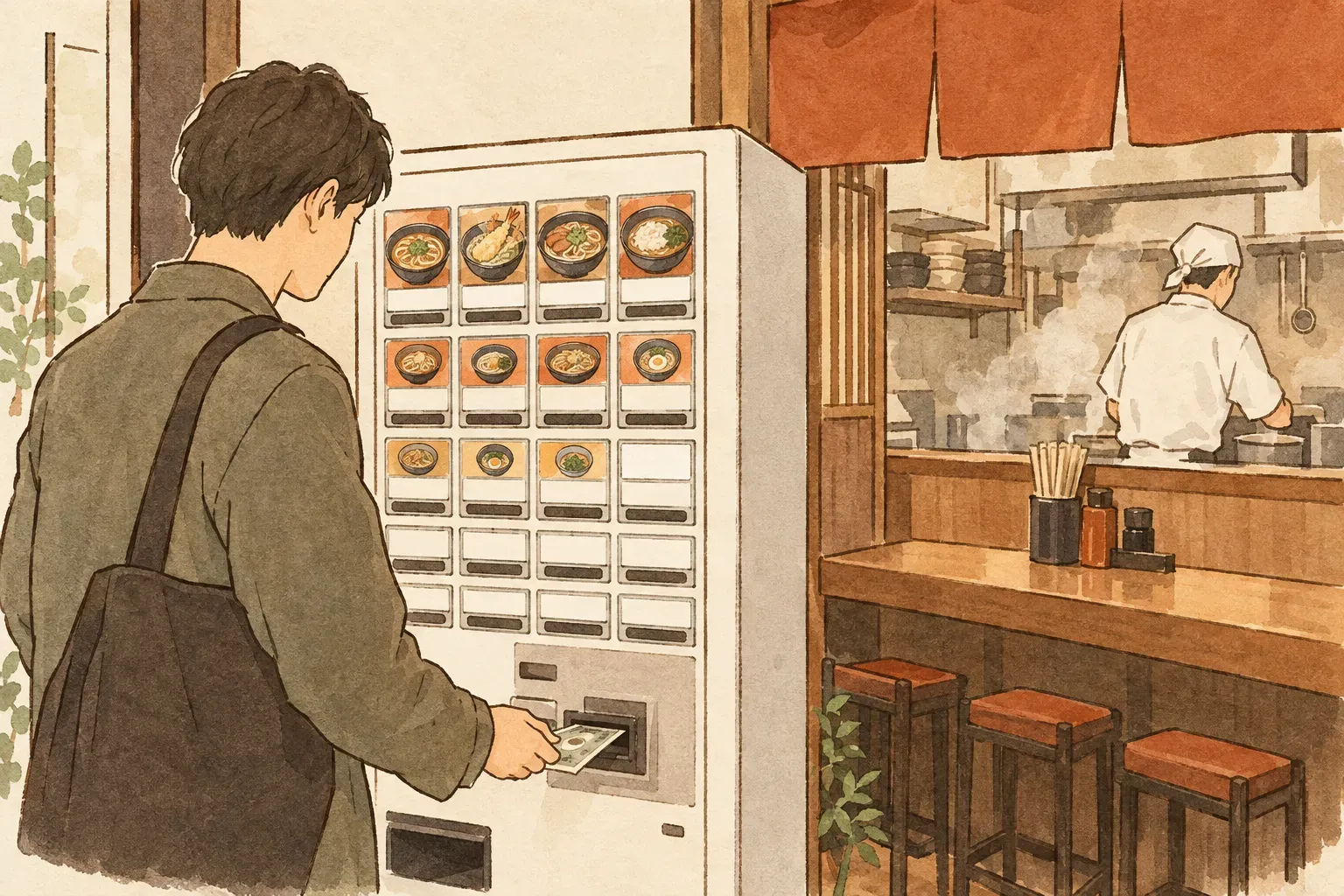
Walk into many ramen shops in Japan and the first thing you meet is not a person but a machine: a panel of buttons by the door, each with a dish name and a price. You pay the machine, take a paper ticket, hand it to the cook, and sit. Nobody takes your order at the table and nobody brings a bill. It is simple once you know the sequence, and the reasons for it are mostly about the kitchen.
What happens
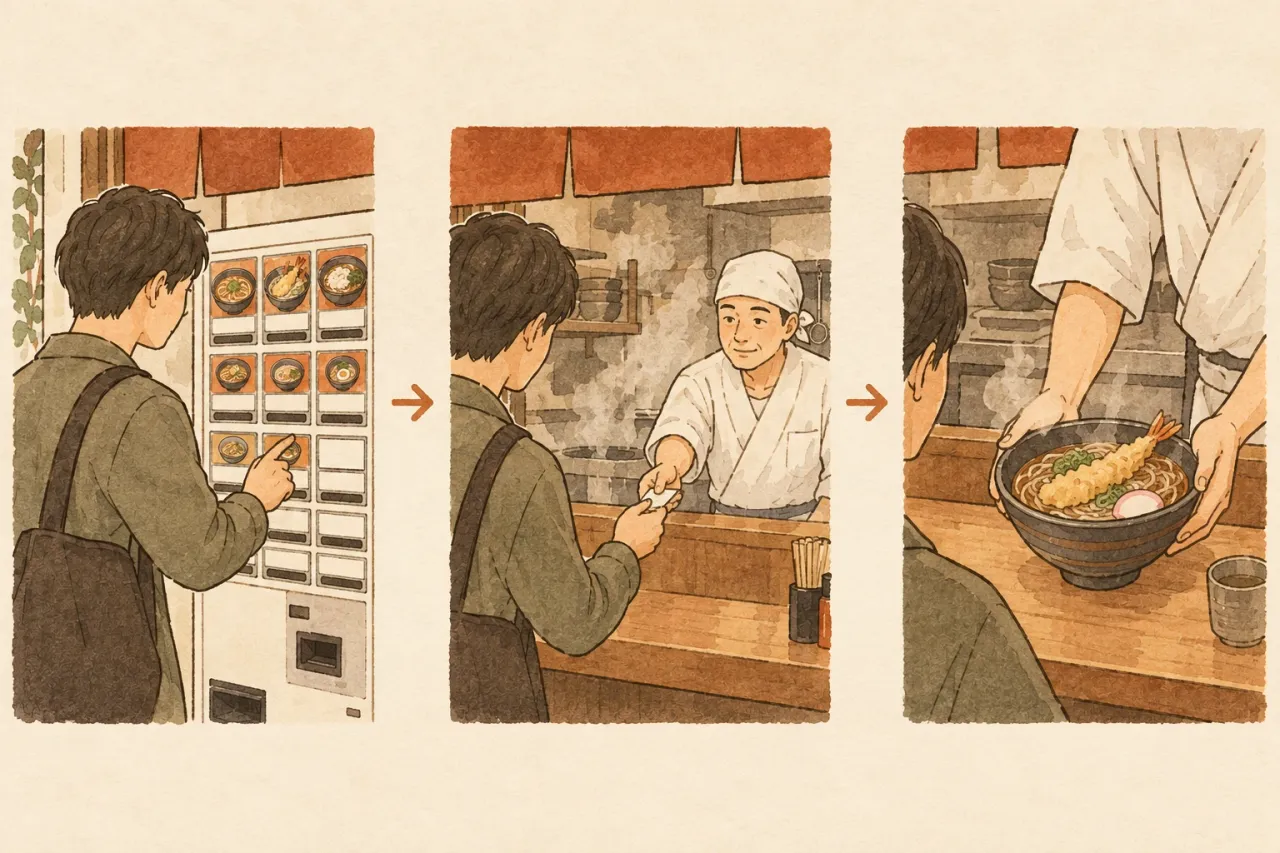
Japan’s national tourism organisation sets out the steps in its ramen guide:
- Pay first. Put money in the machine.
- Choose. Press the buttons for your ramen, drinks and any sides.
- Take your change and the printed tickets.
- Hand the tickets to staff, then sit and wait.
Tokyo’s official tourism site describes the same: at ramen shops and other casual places there may be a machine near the entrance; buy your ticket first, hand it to staff, then sit where you are shown. Many shops have multilingual menus. Exactly when you hand the ticket over — before you are seated, or once you are — differs from shop to shop.
Not every shop uses one. Both sources note that some take your order from staff in the usual way.
What the machine accepts
This is where visitors get stuck, and the honest answer is that it depends on the machine.
- Cash. JNTO’s guide says only “put money in”. The product page for one major maker’s model, Glory’s VT-T21, lists recycling units for ¥10,000, ¥5,000 and ¥1,000 notes.
- Cards and phones. The same page lists electronic money, such as transport IC cards, and QR-code reading as options, with the usable brands to be confirmed. So one shop’s machine may take Suica and the next shop’s only cash.
- Language. The same model can display English, Korean, and simplified and traditional Chinese. That is one model’s specification; I could not find how many shops’ machines do.
In the Japan Tourism Agency’s latest survey of foreign visitors (4,110 responses, winter 2025–26), 10.7% named using credit or debit cards as a problem during their trip, and 10.9% too few or unclear multilingual signs. Those figures cover the whole trip, not ticket machines in particular.
Why shops use them
The clearest explanation comes from a maker, and should be read as a maker’s case. Glory’s 2025 article for restaurant owners argues that with the customer operating a machine for ordering and payment, staff can concentrate on cooking and serving — which helps with labour shortages; orders entered by customers themselves mean fewer mistakes; simple operation helps turnover at busy times; and no cash changes hands between staff and customers, which it presents as more hygienic. It is a sales argument, not an independent study.
An early example. Omron’s company history records that in 1963 it delivered a meal-ticket vending machine to a department store — a multi-function ticket machine at the Daimaru store in Kyoto. I have not found a reliable source for which machine was Japan’s first, so I do not call it that. I could not find statistics on how many restaurants use ticket machines.
How Japanese customers use them
Buy at the entrance before sitting, hand over the ticket, and wait. That is all the official sources describe. If a machine has no English, ask staff.
What people get wrong
- “You order at the table and pay later.” At a ticket-machine shop, you pay the machine first.
- “Every machine takes cards.” Card and IC payment are options on the machine; some machines may be cash only.
- “Every machine has English.” Some models do; not all shops’ machines.
- “Every ramen shop has one.” Some take orders in person.
Questions people ask
How do I use a meal ticket machine?
JNTO's ramen guide describes it. Pay first by putting money in the machine, press the buttons for your ramen, drinks and sides, take your change and printed tickets, hand the tickets to staff, then sit and wait. Tokyo's tourism site says to hand over the ticket and sit where you are shown.
Does the machine take cards?
It depends on the machine. One major maker's model takes notes as standard and offers electronic money and QR-code reading as options. So some machines are cash only and some take IC cards. Look at the machine, or ask.
Is the screen in English?
Sometimes. One maker's model can show English, Korean and Chinese, but that is one model, not every machine in every shop.
Do all ramen shops use machines?
No. Both JNTO and Tokyo's tourism site note that some shops take your order at the counter or table instead.
Sources
Prices are in Japanese yen. Conversions are approximate, at ¥177.30 to the euro and ¥158.23 to the US dollar as of 20 Oct 2026. Rates come from the European Central Bank, which publishes on working days only. Prices checked Oct 2026. What food costs in Japan →