
Chopsticks in Japan: why only chopsticks, the five moves called bad form, and what the official sources say about why
I have not been to every place in this guide. The figures below are taken from the sources listed at the end, with the date each one was published — not measured by me. Where I have been, the article says so.
The farm ministry makes a striking claim: many countries eat with chopsticks, but only Japan eats with chopsticks alone. Much of what visitors are told about Japanese table manners follows from that — why you lift your bowl, why soup is drunk from it, and why certain chopstick moves are frowned on. This column sets out what the official sources say, in their own terms. They describe some moves as “considered bad form”. They do not claim a single correct way.
Only chopsticks
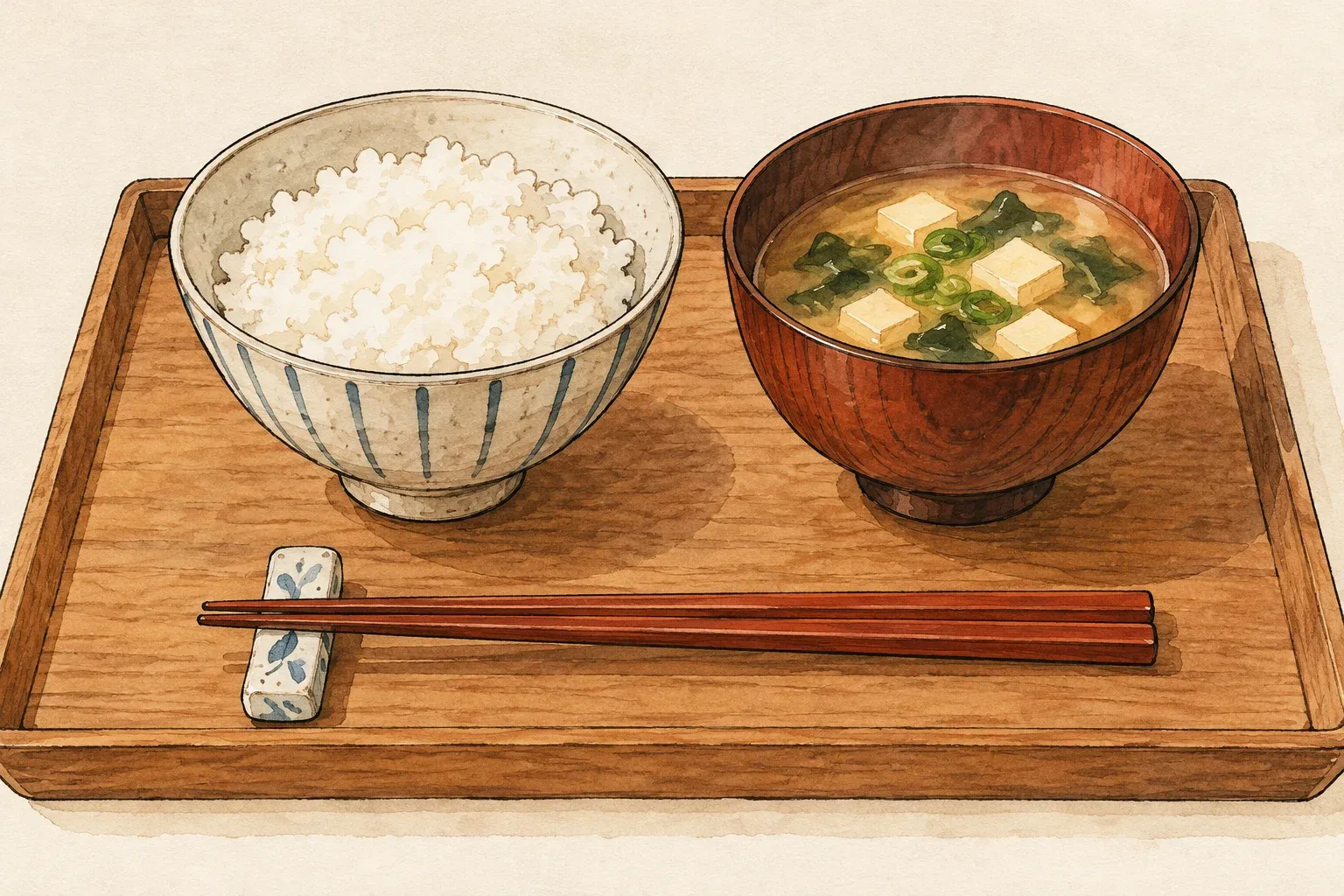
The ministry says most of South-east Asia uses a spoon or ladle alongside chopsticks; its washoku guidebook adds that in Japan chopsticks and bowls are personal and no spoon is used.
Why the spoon disappeared. The ministry says spoons dropped out after the Nara period, and one reason was the bowl: a lacquered wooden bowl does not conduct heat, so you can hold it full of hot soup and drink straight from it. Personal bowls and chopsticks came with that change.
When chopsticks arrived. The sources describe different moments, and this column does not pick one:
- First use. The farm ministry’s magazine estimates they came into use between the Yayoi and Asuka periods (3rd–7th centuries). Ogura Tomoko of the Japan Chopstick Culture Association, interviewed there, says early chopsticks were probably sacred implements rather than eating tools — a single bent bamboo piece like tweezers, perhaps to avoid touching offerings to the gods.
- Spread. The same magazine says that in the 7th century Japanese envoys to Sui China were entertained with chopsticks, and when a Sui embassy visited Japan the Japanese side ate with chopsticks in its manner, which is thought to have helped them spread.
- Common use. The Nara National Research Institute for Cultural Properties notes many chopsticks found at the Heijō palace site and says their use is thought to have flourished in the Nara period.
Kinds of chopsticks
- By use. Shokubashi for eating, usually personal and sized to the user; toribashi for serving from shared dishes; saibashi for cooking.
- By shape. Square, square with rounded edges, five- to eight-sided, shaved; in cedar, cypress, bamboo and more.
- The ministry’s eight examples. Lacquered (everyday, personal); genroku (the common disposable kind, with chamfered head and a central groove); kuromoji (from the spicebush); rikyū (tapered at both ends, for kaiseki); green bamboo serving chopsticks; tensoge (mid- to high-grade disposables); willow (for celebrations); and chōroku, a plain disposable pair whose name is linked to a length of six sun, about 18 cm.
Disposable chopsticks (waribashi), the ministry’s magazine says, began in the Meiji era as a way to use offcuts of cedar from barrel-making, and spread with restaurants. Today they are made from thinnings and offcuts, and are being reconsidered for environmental and economic reasons — while cheap imports have left the domestic industry in decline.
The five moves called bad form
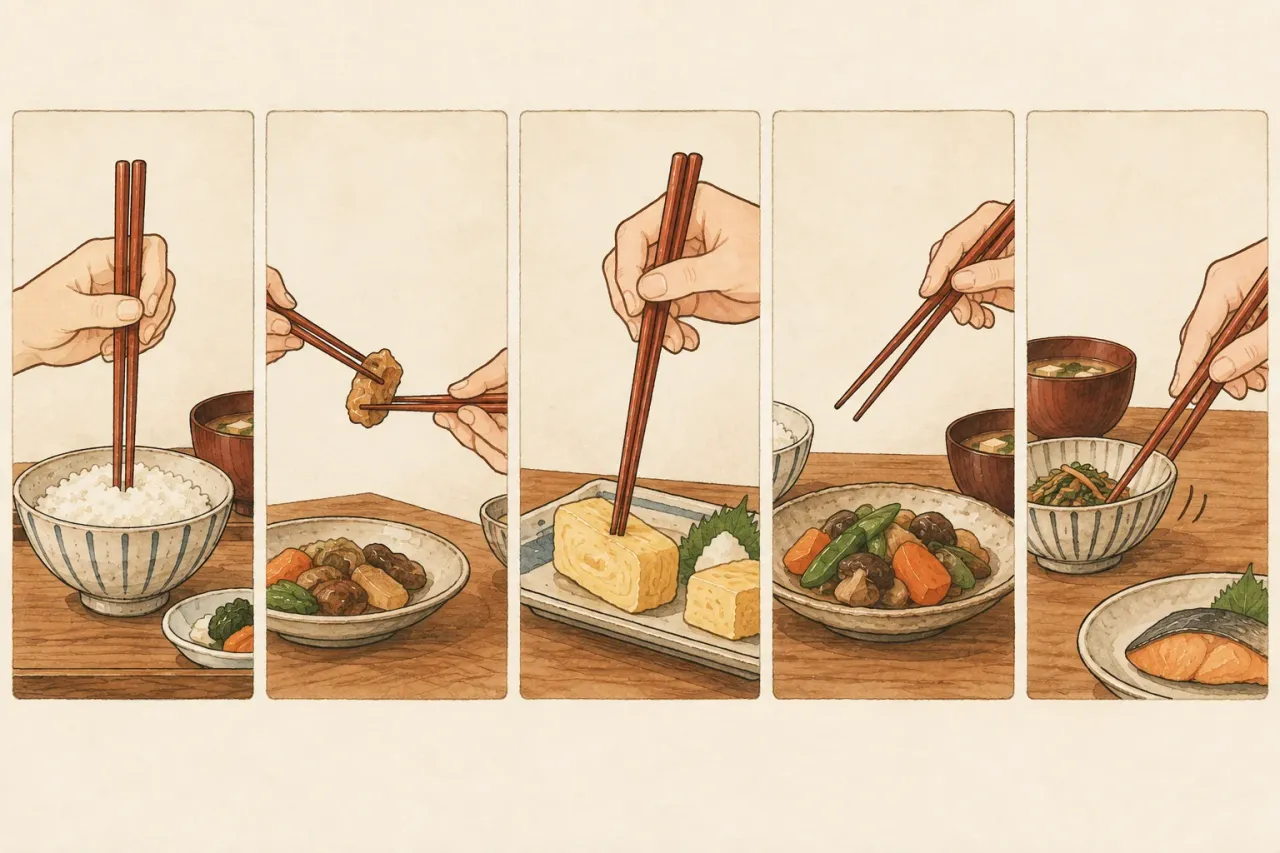
The farm ministry lists five uses of chopsticks considered bad form, known together as kirai-bashi:
- Utsuri-bashi — starting to take one dish, then moving to another.
- Mayoi-bashi — hovering over the dishes, undecided.
- Sashi-bashi (指し箸) — pointing at people or things with chopsticks.
- Watashi-bashi — resting chopsticks across a bowl during the meal.
- Yose-bashi — pulling a distant dish towards you with chopsticks.
Two more, from the tourism bodies. JNTO calls sticking chopsticks upright in rice and passing food from chopsticks to chopsticks the “biggest no-nos”, and says chopsticks are not for skewering food. Tokyo’s tourism site lists hashi-watashi (passing food), sashi-bashi (刺し箸, skewering) and mayoi-bashi.
Watch the names. The same sounds name different things. The ministry’s watashi-bashi is resting chopsticks across a bowl; JNTO’s concern is passing food between chopsticks, which Tokyo’s site calls hashi-watashi. The ministry’s sashi-bashi means pointing (指); skewering (刺) appears only in the tourism sources.
Why
The official sources give three kinds of explanation, and only these:
- How Japanese meals are eaten. The farm ministry lists the five as bad form against the background that a Japanese meal is properly eaten by always taking rice between mouthfuls of side dish or soup. It does not explain each move.
- Funerals. A JNTO blog post says passing food between chopsticks recalls a ritual at funerals, and that chopsticks stuck upright in rice resemble rice offered at a memorial tablet. Tokyo’s tourism site gives the funeral association too.
- Appearance. Tokyo’s tourism site adds that these moves simply do not look nice.
The ministry’s magazine introduces them as moves that are “embarrassing in front of others”. I found no survey of how many people observe them, and no official account of when each name arose.
Practical points
- Holding them. The ministry’s advice: hold about two-thirds of the way from the tips, like a pencil; keep the lower chopstick still and move only the upper. It says adults can still learn.
- Resting them. Use the chopstick rest during the meal and return them to it at the end, Tokyo’s site says. When drinking only the broth, the ministry’s magazine says you may leave them on the rest.
- Shared dishes. Use the serving chopsticks, which are separate from your own.
- Sushi. JNTO says chopsticks or hands are both fine; it is not a strict rule, and many Japanese people use both.
- If you cannot use chopsticks. A 2008 government manual advised businesses to prepare forks, knives and spoons on request, since not every foreign guest can use chopsticks. It is advice to businesses; whether a given restaurant does so is its own choice.
What people get wrong
- “There is one correct way, and everyone follows it.” The ministry lists moves considered bad form. It does not survey behaviour.
- “Watashi-bashi means passing food.” In the ministry’s list it means resting chopsticks across a bowl.
- “Sushi must be eaten with chopsticks.” JNTO says hands are fine.
- “Chopsticks came to Japan with the Nara court.” That is when they flourished; the ministry’s magazine dates first use earlier.
Questions people ask
What are the chopstick taboos in Japan?
The farm ministry lists five moves considered bad form. Moving to another dish after starting to take one, hovering over dishes, pointing with chopsticks, resting them across a bowl mid-meal, and pulling a dish towards you with them. JNTO adds sticking chopsticks upright in rice and passing food from chopstick to chopstick.
Why is passing food chopstick to chopstick avoided?
A JNTO blog post says it recalls a ritual at funerals, and that chopsticks stuck upright in rice resemble rice offered at a memorial tablet. Tokyo's tourism site gives the same funeral association and adds that it does not look nice.
Can I ask for a fork?
A 2008 government manual for businesses advised preparing forks, knives and spoons on request, since not every foreign guest can use chopsticks. Whether a given restaurant does so is up to the restaurant.
Can I eat sushi with my hands?
Yes. JNTO says chopsticks or hands are both fine, it is not a strict rule, and many Japanese people use both.
Sources
- 農林水産省「『和食』を支える日本の箸文化」
- 農林水産省 消費者の部屋「箸の正しい使い方(作法)について」
- 農林水産省 aff 2016年5月号 特集「お箸のはなし(1)」
- 農林水産省 aff 2016年5月号 特集「お箸のはなし(2)」
- 農林水産省「親子で楽しくお箸の使い方を学ぼう」
- 農林水産省 和食ガイドブック
- 文化庁 月刊文化財「奈良の都の食事情」(奈良文化財研究所)
- JNTO「Japanese Food Etiquette」
- JNTO ブログ「Table Manners in Japan」
- JNTO「Japanese Manners Do’s and Don’ts」
- GO TOKYO グルメ「和食の作法」
- 国土交通省「多様な食文化・食習慣を有する外国人客への対応マニュアル」
Prices are in Japanese yen. Conversions are approximate, at ¥177.30 to the euro and ¥158.23 to the US dollar as of 20 Oct 2026. Rates come from the European Central Bank, which publishes on working days only. Prices checked Oct 2026. What food costs in Japan →