
Eating out with children in Japan: family restaurants, the okosama lunch, allergy labels, and what Japanese children eat at school
I have not been to every place in this guide. The figures below are taken from the sources listed at the end, with the date each one was published — not measured by me. Where I have been, the article says so.
Japan has a whole genre of restaurant built around families, a children’s plate with a flag on top that two department stores take part in the story of, a national list of allergens that just grew by one, and a school lunch system written into law. This column sets out what the official and company sources say about each. Where they disagree, both versions are given.
Where families eat
JNTO, the national tourism organisation, says that outside high-end or very formal restaurants, places generally welcome children and try to accommodate them. It singles out two kinds of restaurant.
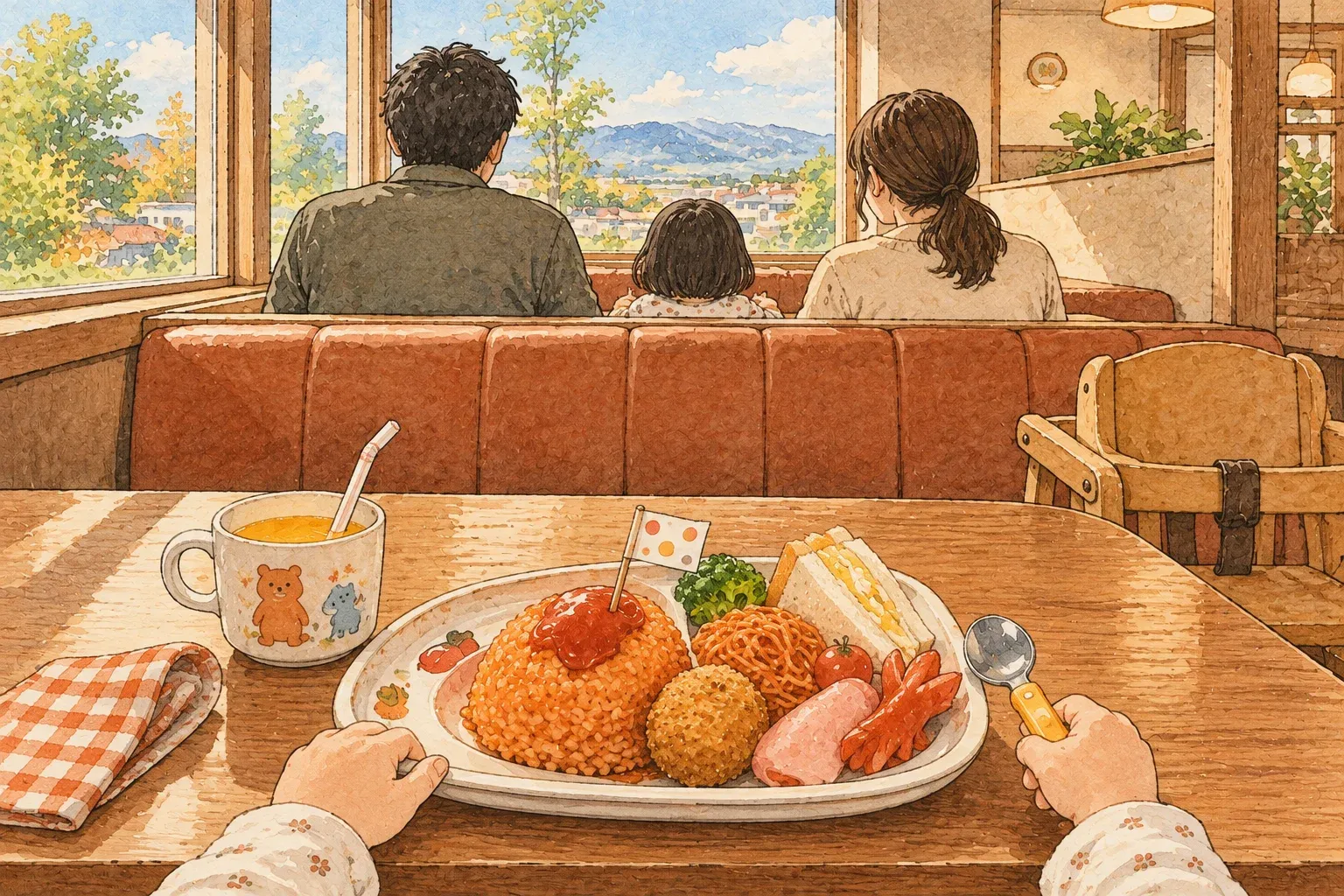
Family restaurants. JNTO describes the famiresu as a genre of casual family dining with reasonable prices, quick service, and touches such as toys, colouring sheets and character menus. It names Saizeriya, Gusto, Denny’s, Sushiro and Hamazushi as examples, and mentions character plates and juice packs for fussy eaters. A second JNTO page says family restaurants have large tables or booths, a menu that mixes Western and Japanese dishes such as omuraisu, and usually a children’s menu.
Conveyor-belt sushi. JNTO says it suits children because you order one plate at a time, so you can try small amounts. There are also chips, noodles, salads and desserts, ordering is by tablet with pictures, and high chairs and other things for children are often available.
One chain in detail. Gusto, run by Skylark, lists on its English family page: kids’ chairs (except some shops), baby food may be brought in (some shops only), and nappy-changing tables (except some shops). Its kids’ menu is for children up to elementary-school age and comes with a kids’ drink bar. The page’s examples are a mini cheese-filled hamburg steak, kids’ udon and kids’ ramen, plus a capsule-toy coin with a “lucky set” and an Anpanman point card with some kids’ menus. That is one company’s page about its own shops, and it says which items vary by shop.
Ryokan. JNTO says dinner and breakfast are usually included, the food is mostly traditional fish and vegetables, and families with picky eaters should check the menu in advance. It adds that tatami rooms have space for children to play.
What is not confirmed. No official source checked for this page, whether JNTO, the tourism agency, local government or company, says anything about eating in tatami-floored rooms or private rooms with children, about small plates for sharing, or how many restaurants keep high chairs. Sushiro’s children’s page showed only a heading. These things vary by restaurant, and the honest advice is to ask.
The okosama lunch
Okosama ranchi, the children’s lunch, is described in the sources below as several small dishes on one plate, with a little flag on a mound of rice. Two department stores appear in its origin story, and the sources tell it as two separate starting points.
Mitsukoshi, 1930. A column by the Ajinomoto Foundation for Dietary Culture says it is said that the first was the okosama yōshoku, children’s Western food, served in 1930 by the dining department of Mitsukoshi’s Nihonbashi store. The column lists chicken rice, croquette, ham, spaghetti and sandwiches on one plate, with the chicken rice shaped into a mountain topped with Mitsukoshi’s company flag, later replaced by national flags such as the Japanese one.
A 2008 article in Nihon Shokuryō Shinbun, a food-industry newspaper, credits the dining department’s head, Andō Tarō. It says he thought of a children’s menu after seeing patterned plates a tableware maker had brought in, and lists spaghetti, croquette, ham, sandwiches, bonbons and rice in the shape of Mount Fuji, white rice on top as snow, with a small flag on the ketchup rice. It gives the original price as 30 sen, and says he wanted to give children something bright in the years of depression after the 1929 crash. The two sources describe the flag differently, one as the company flag and one as a flag on the summit of Mount Fuji, and both are given here.
Matsuzakaya and the name. The Ajinomoto column says that three months after Mitsukoshi, the dining room at Matsuzakaya’s Ueno store served it as okosama ranchi, and that this is the name that spread. Matsuzakaya’s own archive dates the addition of okosama ranchi to the dining-room menu to 1931.
So one story begins with a dish at Mitsukoshi in 1930 and the other with a name at Matsuzakaya in 1931. This site does not choose which is the birth of the okosama lunch. Mitsukoshi’s own page could not be opened, so this page has no current price or account from Mitsukoshi itself.
Allergen labelling
The Consumer Affairs Agency requires packaged processed food to show if it contains any of the tokutei genzairyō, the specified ingredients. The list is set using national surveys of the number and seriousness of cases.
How the list has grown, from the agency’s own material:
- 2001: the system began with five: milk, egg, wheat, buckwheat and peanut.
- 2008: prawn and crab were added, making seven.
- 2023: walnut was added, in force from 9 March 2023, making eight, with a transition period to 31 March 2025.
- 1 April 2026: cashew nut was added, with a two-year transition from that date.
That makes nine. The agency material checked for this page does not state the number nine in so many words, but Gusto’s English page describes a low-allergen menu made without “nine major allergens” and lists those same nine.
The agency’s call for comments gave two reasons for adding cashew: the share of tree-nut cases involving cashew had grown in its 2024 national survey and did not look temporary, and an official testing method was in sight.
There is also a second, recommended tier, ingredients treated as equivalent to the specified ones. Pistachio was added to it in a notice dated 1 April 2026. The agency’s 2023 material put that tier at 20 items; the current total could not be counted from the material checked for this page.
Two gaps matter for visitors. The rules described here are for packaged processed food; how they apply to restaurant food was not in the material checked for this page. And JNTO’s page on travelling with children says nothing about food allergies, and no official guide for visitors on how to explain an allergy in a Japanese restaurant was found for this page.
School lunch
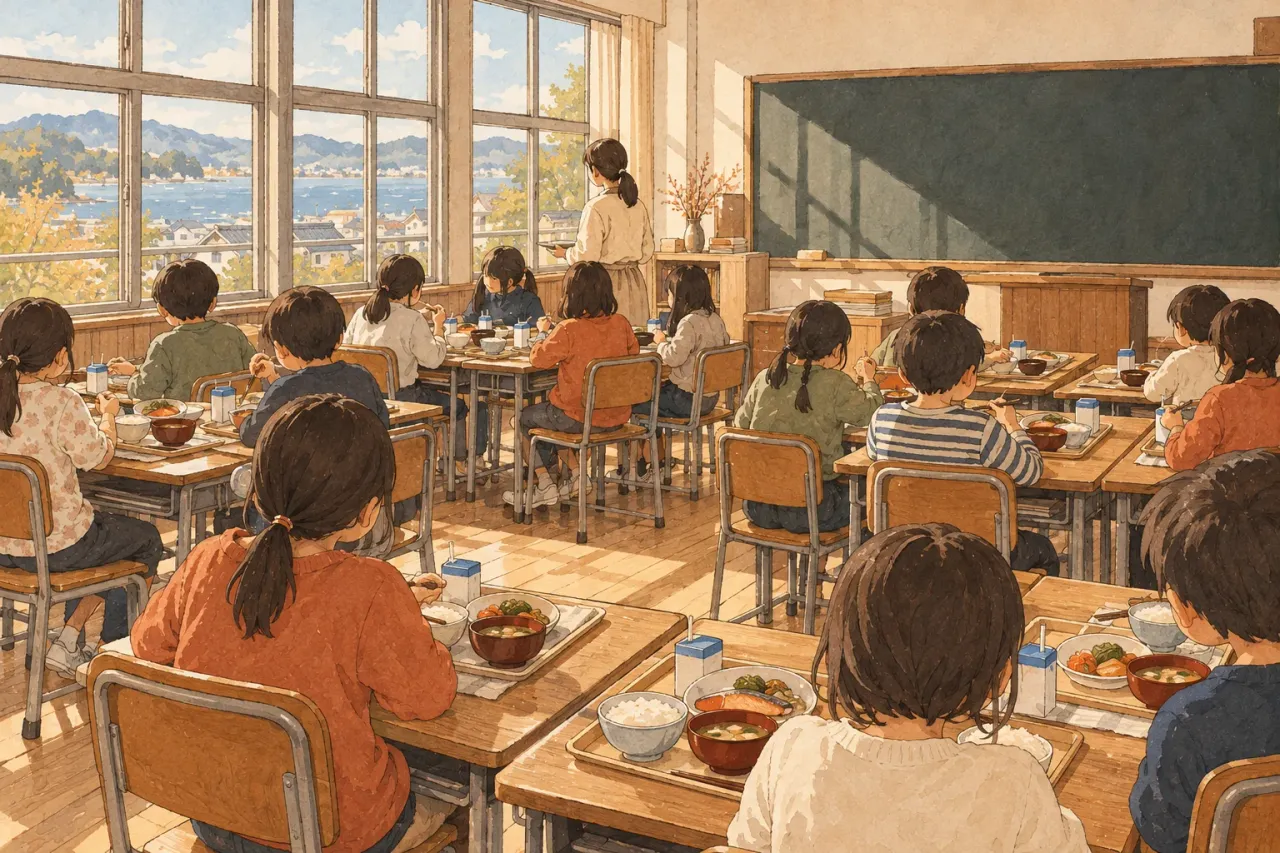
Kyūshoku, school lunch, is described here for what it shows about how Japanese children are taught about food. The government is explicit that teaching is part of its purpose.
The law. The education ministry says school lunch is governed by the School Lunch Act, which aims at safe, nutritionally balanced meals. Each school’s operator runs it and pays for facilities and staff; parents mainly pay for the ingredients.
Seven goals. The ministry lists them: health through proper nutrition; understanding of food and good eating habits; sociability and cooperation; understanding of nature’s gifts and the environment; gratitude to the people whose work supports our food; understanding of traditional food culture; and understanding of how food is produced, distributed and consumed. It calls school lunch a “living teaching material” for learning about local food culture.
Where it began. Both the education ministry and the farm ministry say it is thought to have started in 1889 in Tsuruoka, Yamagata, for children from poor families. The farm ministry names a private primary school, Chūai, and says the lunch was free. The School Lunch Act followed in 1954. The two ministries give different years for the change that put food education at its centre, 2008 in the education ministry’s material and 2009 in the farm ministry’s. Whether that is the difference between a law being passed and coming into force is not confirmed, so both are given. They also differ on the start of national support: the education ministry says state subsidy began in 1932, while the farm ministry says the state encouraged school lunch in 1923. Those are not the same thing, and both are given.
How many schools. The education ministry says nearly all primary schools and over 90 per cent of junior high schools served it in fiscal 2021. Diet and nutrition teachers were created as a post in fiscal 2005, and there were 6,843 of them across every prefecture on 1 May 2022.
What goes in it. The education ministry’s standards, under Article 8 of the act, set intake per child per meal as a national average, to be applied flexibly to local conditions; the latest revision took effect on 1 April 2021. The farm ministry says a school lunch is designed to provide about a third of a day’s nutrients. It traces the menu over time: bread rolls, fried whale and powdered skim milk in the early to middle Shōwa years, rice formally introduced in 1976, and local dishes, seasonal festival food and locally grown produce in the Heisei and Reiwa years.
On allergies, the education ministry’s material mentions only that pupils with food allergies are among those individual guidance is meant for. What schools actually do is not confirmed.
What people get wrong
- “Restaurants in Japan do not want children.” JNTO says the opposite, outside high-end and formal places.
- “The okosama lunch has one inventor.” The sources describe a dish at Mitsukoshi in 1930 and a name at Matsuzakaya in 1931.
- “Japan labels eight allergens.” Cashew nut became the ninth on 1 April 2026, with a two-year transition.
- “School lunch is just a meal.” By law it has seven goals, from nutrition to food culture.
Questions people ask
Are children welcome in Japanese restaurants?
JNTO says that, outside high-end or very formal places, restaurants generally welcome children and try to accommodate them. It points families to family restaurants and conveyor-belt sushi in particular.
Who invented the okosama lunch?
There are two starting points. A children’s Western plate served at Mitsukoshi’s Nihonbashi store in 1930, and the name okosama ranchi, which Matsuzakaya’s archive dates on its menu to 1931. This site does not pick one as the origin.
Which allergens must be labelled in Japan?
On packaged processed food, the Consumer Affairs Agency requires labelling for egg, milk, wheat, buckwheat, peanut, prawn, crab and walnut, and cashew nut was added on 1 April 2026 with a two-year transition. The rules for restaurant food were not covered by the sources used here.
Can visitors eat Japanese school lunch?
This column does not suggest that. School lunch is described here for what it shows about how Japanese children are taught to eat.
Sources
- JNTO 訪日旅行公式サイト「Traveling With Children」
- JNTO「Travelling in Japan with Kids」
- すかいらーく ガスト 英語 家族向けページ(企業公式)
- 味の素食の文化センター コラム「お子さまランチ」
- 日本食糧新聞 日本橋三越本店「お子様ランチ」(業界紙)
- 松坂屋史料室 Vol.40 江戸・東京における松坂屋ヒストリー(企業の資料室)
- 消費者庁 食物アレルギー表示に関する情報
- 消費者庁 食品表示基準の一部改正案に関する意見募集(カシューナッツ)
- 消費者庁 食品表示基準についての一部改正通知
- 消費者庁 くるみの特定原材料への追加等について
- 文部科学省「日本の学校給食と食育」
- 文部科学省「学校給食実施基準の一部改正について」
- 農林水産省 aff「学校給食の歴史」
Prices are in Japanese yen. Conversions are approximate, at ¥177.30 to the euro and ¥158.23 to the US dollar as of 20 Oct 2026. Rates come from the European Central Bank, which publishes on working days only. Prices checked Oct 2026. What food costs in Japan →