
Udon: the plain wheat noodle that every region of Japan eats differently
I have not been to every place in this guide. The figures below are taken from the sources listed at the end, with the date each one was published — not measured by me. Where I have been, the article says so.
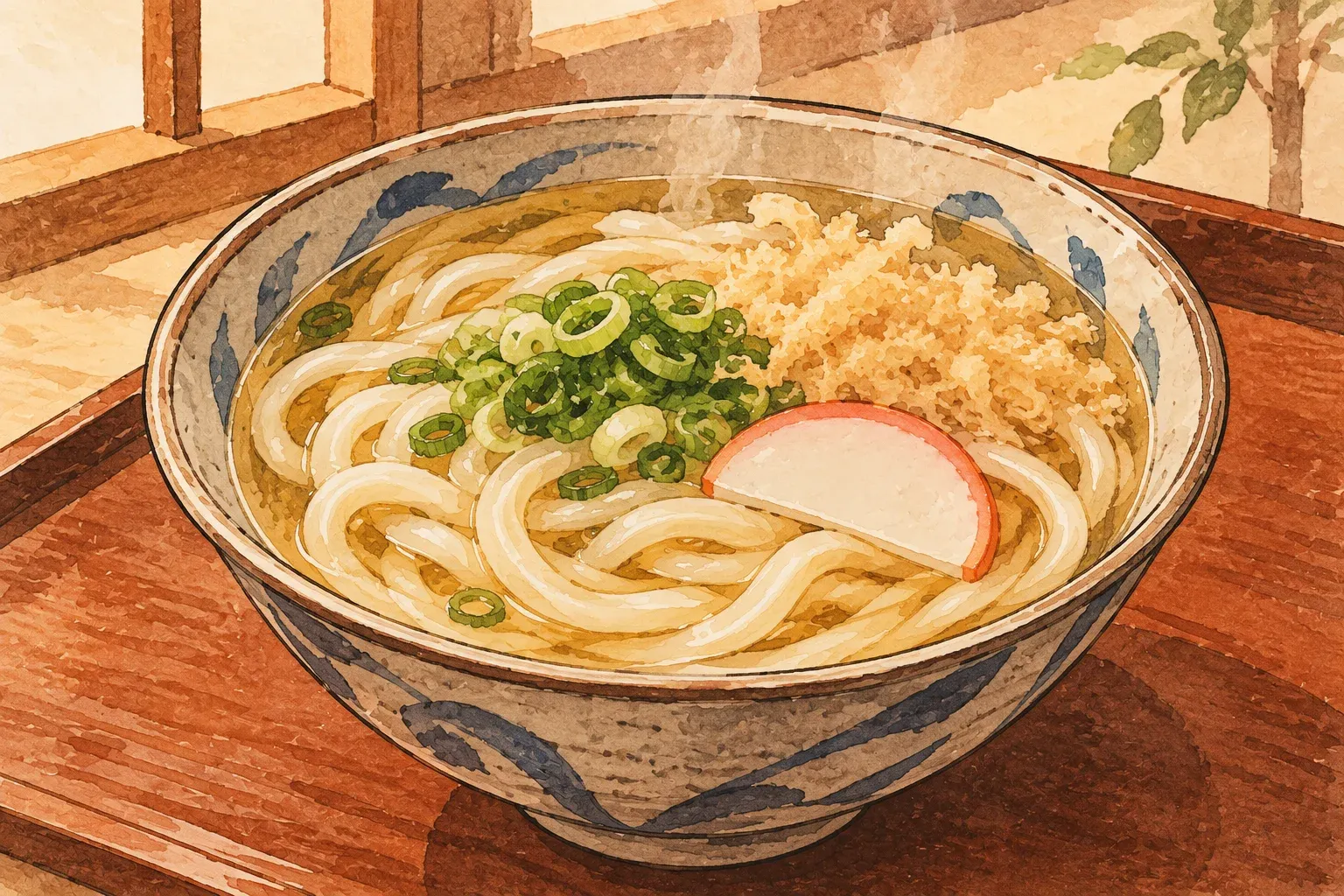
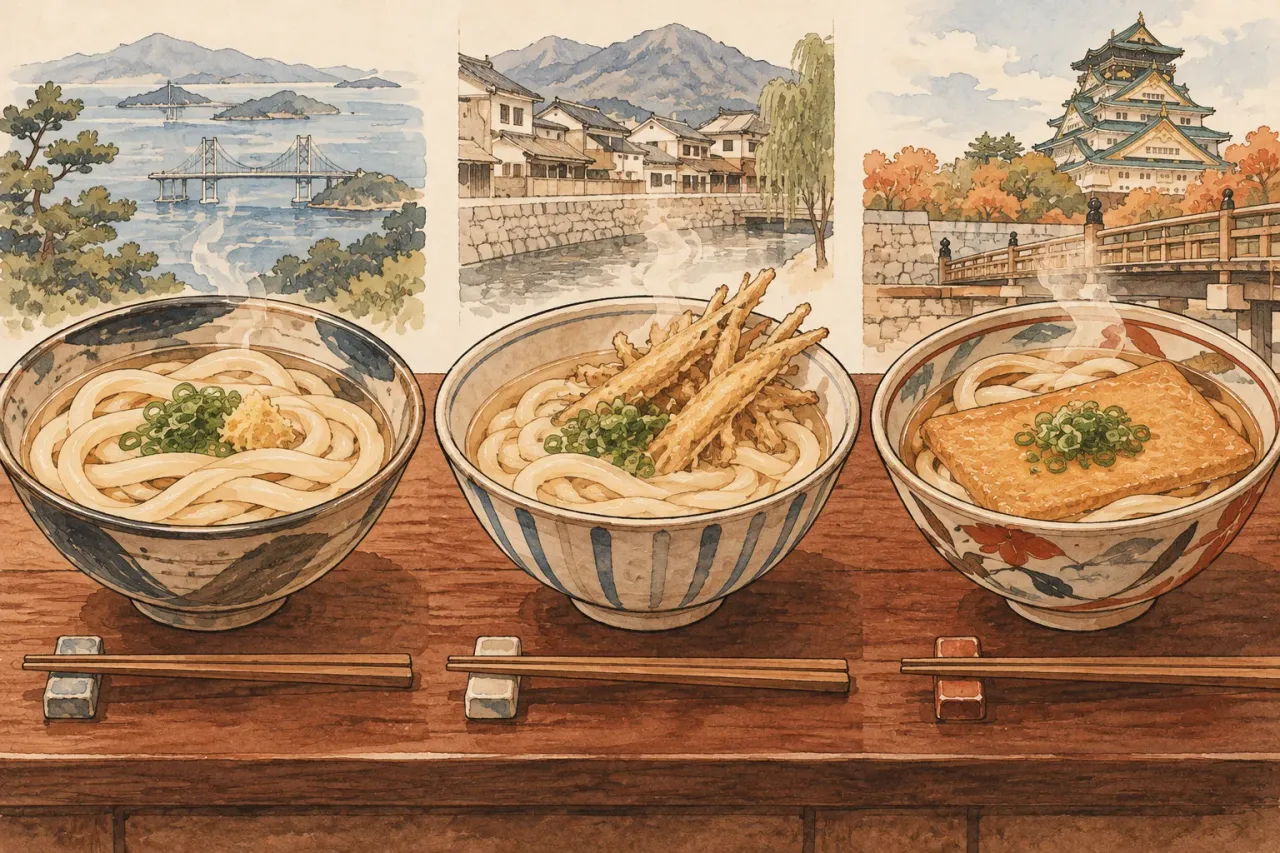
Udon is wheat flour, water and salt, cut into a thick noodle. That is the entire recipe, and it is why a word so simple covers dishes that have almost nothing in common: the hard, chewy Sanuki noodle in a clear anchovy broth; the soft Hakata noodle under a slab of burdock tempura; Osaka’s pale kelp broth with a sweet pillow of fried tofu; Ise’s enormous soft noodle with no broth at all, just a spoonful of black soy. Japanese people argue about which is real udon. The honest answer is that udon is a method, and every region finished the sentence its own way.
What it is
The word is old and the origin is contested. The dictionaries trace udon to a sound shift from undon, and ultimately to a Chinese dumpling-like confection (konton) brought to Japan in the Nara period; the earliest written forms are a diary entry of 1465 (“utón”) and a Portuguese–Japanese dictionary of 1603–04 (“Vndon”). Two cities claim the noodle itself. Fukuoka says the monk Enni brought milling technology back from Song China in 1241 and taught the city to make udon, soba and steamed buns, and a stone in his temple’s grounds says so. Kagawa says the monk Kūkai brought it from Tang China four centuries earlier and his nephew served it to the family in Takinomiya — a story the agriculture ministry files, gently, under legend. What is documented is that udon shops existed in the Edo period, and that by then the regional styles were already diverging.
There is no legal definition of how thick udon must be when a shop serves it to you. The only standards are for packaged noodles: dried machine-made udon must be at least 1.7 mm across (thinner is hiyamugi, thinner still is sōmen), and the labelling rules for fresh noodles define udon simply as any noodle made from wheat flour and water, whatever its shape. Everything else — thickness, bite, broth — is custom.
Why it is the way it is
The noodle follows the water and the wheat. Kagawa had wheat fields that grow through its mild winters, salt pans on a shallow coast, dried anchovies from the Inland Sea and soy sauce from Shōdoshima — the ministry’s summary is that everything udon needs was within reach, and the result was a hard, salted, rested noodle. Osaka had the Kitamae shipping route bringing kelp from Hokkaido, and soft water that suited a kelp broth; its noodle was made soft to carry that broth. Fukuoka’s account of its own soft noodle is that merchants were in a hurry, so the noodles were boiled ahead.
East and west split over the broth. The ministry’s own description: Kanto makes its noodle broth mostly from bonito, Osaka from kelp with bonito added, because the kelp came by sea to Osaka and the local water was soft. The two broths are different colours — dark in the east, pale in the west — and the biggest instant-noodle brand ships two recipes. Nissin’s Donbei kitsune udon comes in an East version (bonito and sōda-bonito stock, dark soy, red-chilli shichimi) and a West version (bonito and kelp stock, pale soy, shichimi with Japanese pepper); Hokkaido gets a third.
Even the names change at the border. In Osaka, kitsune is udon with fried tofu and tanuki is soba with fried tofu; tempura crumbs make it haikara. In Tokyo, tanuki means the tempura crumbs. Order a tanuki in the wrong city and you will get a different dish, and the person serving you will not think anything is odd.
What it costs
Udon うどん
- Survey
- ¥818 (≈ €5 / $5)うどん 外食 1杯 · Aug 2026 · 特別区部
- Chains
- ¥360–¥440Plain kake udon, regular · Hanamaru Udon, Sukesan Udon, Marugame Seimen · tax incl. · checked 2026-10-05
The gap between the chain bowl (¥360–440 for plain kake, tax included as the chains list it) and the survey bowl in Tokyo’s 23 wards (¥818, a survey price that includes tax) is the gap between a self-service counter and a sit-down shop. In Kagawa a bowl at a seimenjo — a noodle factory with a few seats — is cheaper still, which is one reason the household survey shows Takamatsu spending ¥17,704 a year per household on soba and udon eaten out, 2.4 times the national average of ¥7,467 and far ahead of second-placed Shizuoka at ¥11,718. Osaka, the home of kitsune udon, is 46th of 52 cities at ¥6,078: Osakans eat their udon, but they do not eat out for it the way Kagawa does.
The lineages
| Lineage | Origin | Noodle | Broth | On top | How it is eaten |
|---|---|---|---|---|---|
| Sanuki (Kagawa) 讃岐うどん | KagawaEdo period; legend from the 9th c. | Thick, square-cut, foot-kneaded, firm and springy; 40%+ water, 3%+ salt, rested 2 hours (the 'Honba Sanuki' standard) | Iriko (dried anchovy) from the Inland Sea, light soy from Shōdoshima | Spring onion, ginger, tempura you pick yourself | Self-service: warm your own noodles, choose hot/cold noodle and broth (atsu-atsu, hiya-atsu…), kake, bukkake, kama-age, kama-tama |
| Hakata (Fukuoka) 博多うどん | Fukuoka1241 (legend of the temple Jōtenji) | Soft, pre-boiled, little bite | 'Sume': kelp and bonito with flying fish or anchovy, light soy, slightly sweet | Gobō-ten (burdock tempura), maru-ten (fish-cake disc) | Fast; a merchant's lunch. Some chains let you choose softness |
| Osaka 大阪うどん | Osaka (Senba)kitsune udon 1893 | Soft, chewy, not too thick — made to carry the broth | Ma-kombu kelp and dried fish, light soy; pale and clear | Sweet-simmered fried tofu (kitsune); 'tanuki' here means that tofu on soba | Drink the broth; udon-suki hotpot in winter |
| Ise (Mie)伊勢うどん | IseEdo period; named 1972 | About three times the usual thickness, boiled an hour, very soft | No broth: a small pool of dark tamari-soy sauce with bonito | Chopped spring onion only | Mix and eat; the pilgrim's quick meal at the shrine |
| Inaniwa (Akita) 稲庭うどん | Inaniwa, Yuzawa, AkitaEarly Edo period (founder and dates differ by source) | Dried, thin and flat; hand-twisted on two rods, pressed flat and stretched by hand over 3–4 days; no oil. Method made public in 1972 | Strong soy dip with bonito stock, or sesame-miso; also hot broth | — | Rinsed in cold water, then cold with a dip or hot; locally, short 'mago-udon' for babies and the elderly |
| Mizusawa (Gunma)水沢うどん | Ikaho, Gunma— | — | — | — | — |
| Gotō (Nagasaki) 五島うどん | Kami-Gotō islands, NagasakiSaid to have come with the envoy ships to Tang China (unproven) | Dried, hand-stretched, round, about 1.7 mm; camellia oil brushed on while stretching | Ago (flying-fish) stock dip, often with egg and soy | Spring onion, bonito flakes, raw egg; yuzu-koshō, ginger | Jigoku-daki: lifted straight from a bubbling iron pot into the dip; chilled zaru in summer |
| Miso-nikomi (Nagoya)味噌煮込みうどん | Nagoya— | — | — | — | — |
| Yoshida (Yamanashi)吉田のうどん | Fujiyoshida— | — | — | — | — |
| Kishimen (Aichi) きしめん | Aichi— | Flat, about 1 mm thick and 7–8 mm wide | Traditionally muroaji fish stock and tamari; now dashi and soy | Nagoya's red fish cake; curry or mochi versions | All year; cold 'koro' in summer |
| Hōtō (Yamanashi) ほうとう | Yamanashipopular from the Edo period | Wide, flat, not rested, simmered raw | Miso with niboshi stock; the flour thickens it | Pumpkin and seasonal vegetables, meat | Big pot at home, an iron pot per person in restaurants |
| Dagojiru (Kumamoto) and dangojiru (Ōita) だご汁・だんご汁 | Kumamoto / Ōita— | Torn or stretched flour dumplings; noodle-like 'nobe-dago' in Aso | Miso or soy (Kumamoto); barley miso (Ōita) | Burdock, radish, carrot; often sweet potato in Kumamoto | Everyday home food; especially autumn and winter |
Lineages without a link are on the list but not written yet. The table is kept in one place so every lineage is described on the same terms.
Three things the table cannot show:
- Kagawa is the only place with a written standard. The fresh-noodle labelling code allows “Honba (authentic) Sanuki udon” only on noodles made in Kagawa, hand-cut or hand-style, with at least 40% water and 3% salt by flour weight, rested at least two hours. It applies to packaged noodles, not to what a restaurant puts in a bowl — so a shop anywhere can call its dish Sanuki udon, and many do.
- The two soft noodles are soft for different reasons. Hakata’s is boiled ahead for speed; Ise’s is boiled for an hour on purpose, three times the usual thickness, and eaten with a dark tamari sauce rather than a broth. Ise’s name was only standardised in 1972, when the city’s noodle-shop association agreed on it.
- Inaniwa is the odd one out: a hand-stretched, dried, thin flat noodle from Akita, whose early-Edo beginnings are dated and credited differently by the farm ministry, the city, the cooperative and the makers, and whose method was made public in 1972. See Inaniwa udon.
Where to eat it
- Sanuki — Takamatsu and the Kotohira pilgrim road; airport bus to Takamatsu station 45 minutes; from Okayama the Marine Liner rapid across the Seto bridge.
- Hakata — Fukuoka; the airport is on the subway, a few stops from Hakata and Tenjin.
- Osaka — Senba, where kitsune udon began in 1893, and the station stand-up counters.
- Ise — the approach to the Grand Shrine; Inaniwa — Yuzawa, in southern Akita.
What people get wrong
- “Udon is soft.” In Kagawa it is the opposite, and Kagawa eats more of it than anyone.
- “Udon is firm.” In Fukuoka and Ise, softness is the point.
- “Sanuki udon on a sign means it was made in Kagawa.” Only on a packet, and only with the word “Honba” or “authentic”. On a restaurant sign it is a style.
- “Kitsune and tanuki are the same everywhere.” They swap meaning between Osaka and Tokyo.
- “Osaka is the udon capital.” Osaka made kitsune udon; Takamatsu eats udon. The household survey puts Osaka city near the bottom of the country for noodles eaten out.
Questions people ask
What is the difference between udon and soba?
Udon is a thick wheat noodle; soba is a thinner buckwheat noodle. Udon is the western and southern noodle of Japan, soba the eastern and mountain one, though both are everywhere now. The government survey prices a bowl of udon in central Tokyo at ¥818 and soba at ¥788, tax included (August 2026).
Why is udon soft in Fukuoka and firm in Kagawa?
Two different ideas of a good noodle. Kagawa's Sanuki udon is kneaded by foot, rested and boiled to a firm spring; Fukuoka's Hakata udon is boiled ahead and served soft, by local account so that busy merchants could be served in seconds. Neither is "correct".
What does a bowl of udon cost?
¥360–440 including tax for plain kake udon at the national chains, and ¥818 including tax for the statistical bowl in central Tokyo (August 2026). In Kagawa a bowl at a noodle-factory shop is cheaper still.
Sources
- 農林水産省 aff 2016年11月号「ニッポン麺探訪 讃岐うどん」
- 農林水産省「うちの郷土料理」AREA STORIES 大阪府(だしの東西)
- 農林水産省「うちの郷土料理」きつねうどん(大阪府)
- 国土交通省 観光多言語解説文DB「さぬきうどん発祥の地」
- 福岡市「うどんも、そばも、まんじゅうも博多発祥」
- コトバンク「饂飩」(日本国語大辞典・世界大百科事典)
- 全国乾麺協同組合連合会「ひやむぎとそうめんの違い」(太さの規格)
- 全国生めん類公正取引協議会「生めん類の表示に関する公正競争規約・施行規則」
- 総務省統計局 家計調査 品目別都道府県庁所在市ランキング 外食「日本そば・うどん」(2023〜2025年平均)
- 香川県統計調査課 うどん県統計情報コーナー「そば・うどん店」の事業所数
- 日清食品 どん兵衛 きつねうどん[東][西]商品ページ
- 文春オンライン「きつね・たぬきの東西」(坂崎仁紀)
- 伊勢市「伊勢うどん」
- 佐藤養助 公式「歴代佐藤養助の軌跡」
Prices are in Japanese yen. Conversions are approximate, at ¥177.30 to the euro and ¥158.23 to the US dollar as of 20 Oct 2026. Rates come from the European Central Bank, which publishes on working days only. Prices checked Oct 2026. What food costs in Japan →