
Gotō udon: the islands’ thin, round, camellia-oiled noodle and jigoku-daki from the pot
I have not been to every place in this guide. The figures below are taken from the sources listed at the end, with the date each one was published — not measured by me. Where I have been, the article says so.
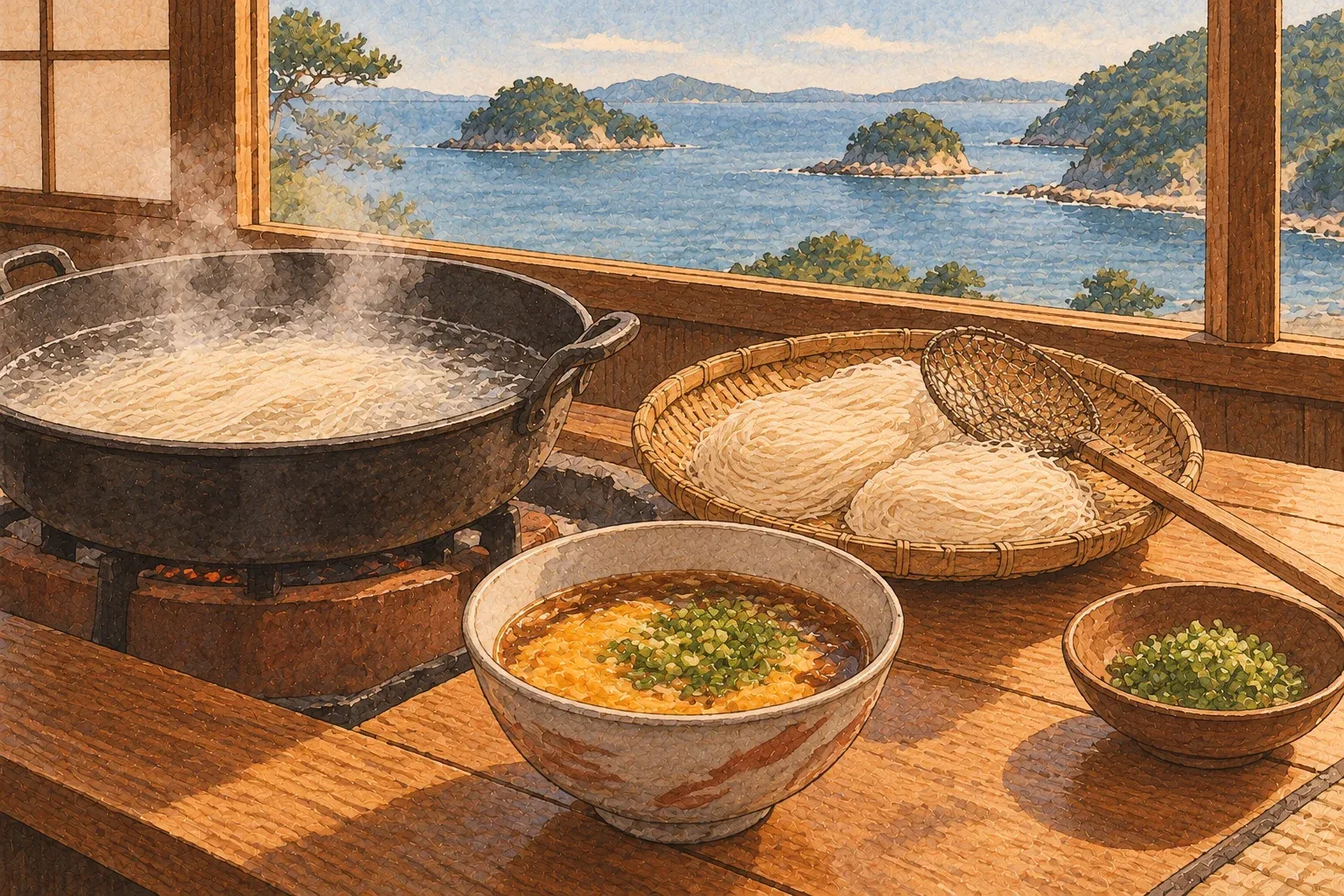
The Gotō islands lie off the far western edge of Nagasaki, and their udon is the opposite of the thick, square noodle most of Japan now thinks of as udon. It is dried, hand-stretched, round and thin — about 1.7 mm, says the Japan Tourism Agency — and it is brushed with camellia oil as it is stretched. On the islands it is eaten as jigoku-daki: boiled in an iron pot on the table and dipped, hot, into flying-fish stock with egg. The farm ministry says about 80% of what is made now leaves the islands, so most of it is eaten somewhere else.
Where it came from
The story is the same everywhere; how firmly it is told is not.
- The farm ministry: Gotō was a port of call for Japan’s envoy ships to Tang China, and the envoys, who studied many things in China, are said to have brought the original form. Recent research has produced the theory that its roots lie in a suomian noodle of Yantan, in Yongjia county, Zhejiang, made in a very similar way.
- The Cultural Agency, which named it a 100-year food in fiscal 2024, in its “traditional” category: about 1,200 years ago Kami-Gotō, known as a port of call for the envoy ships, received culture from the continent, and Gotō udon too is said to have come with the envoys.
- Shin-Kamigotō town: “there are various theories” about its origin; because Kami-Gotō was a port for the envoy ships, it is said to have been brought back from Tang. Nagasaki prefecture’s tourism site likewise says the continent’s noodle-making first reached Kami-Gotō in the envoys’ time, adding “there are various theories”.
- The Gotō te-nobe udon cooperative: its origin is becoming clear as going back to the Nara and Heian periods, and because the Yantan suomian is made in a very similar way, the theory that the envoys brought the method to Kami-Gotō first is “regarded as the most likely”. It says over a thousand years.
None of the pages I read cites a document for the envoy story, and none offers a different one. This page does not choose.
The phantom noodle. The town says that because it was all made by hand, it was called the “phantom udon” and eaten only at celebrations. The cooperative says it was called that because so little was made. The town’s tourism association says the Funasaki district, which some call its birthplace, still makes it by hand.
The cooperative. Founded on 31 January 1984 by twelve udon makers from the five towns of Kami-Gotō; it registered the shared brand Nami no Ito in 1986.
What makes it Gotō udon
The noodle. The patent office’s description, written by the trademark holder, says it is thicker than hiyamugi and thin for an udon, and that in Gotō “udon” once meant this noodle. The tourism agency says it is about 1.7 mm and round, thinner than ordinary square-cut udon. Under Japan’s labelling standard, a dried noodle 1.7 mm or more across may be called udon; Gotō’s packets say te-nobe udon, hand-stretched udon.
The making, as the cooperative describes it:
- Flour is kneaded with the island’s water and sea salt from the Gotō-nada, the salt adjusted to the day’s temperature and humidity.
- The dough is trodden underfoot about 500 times, on a stand made of sendan wood among others; this, it says, is where the bite comes from.
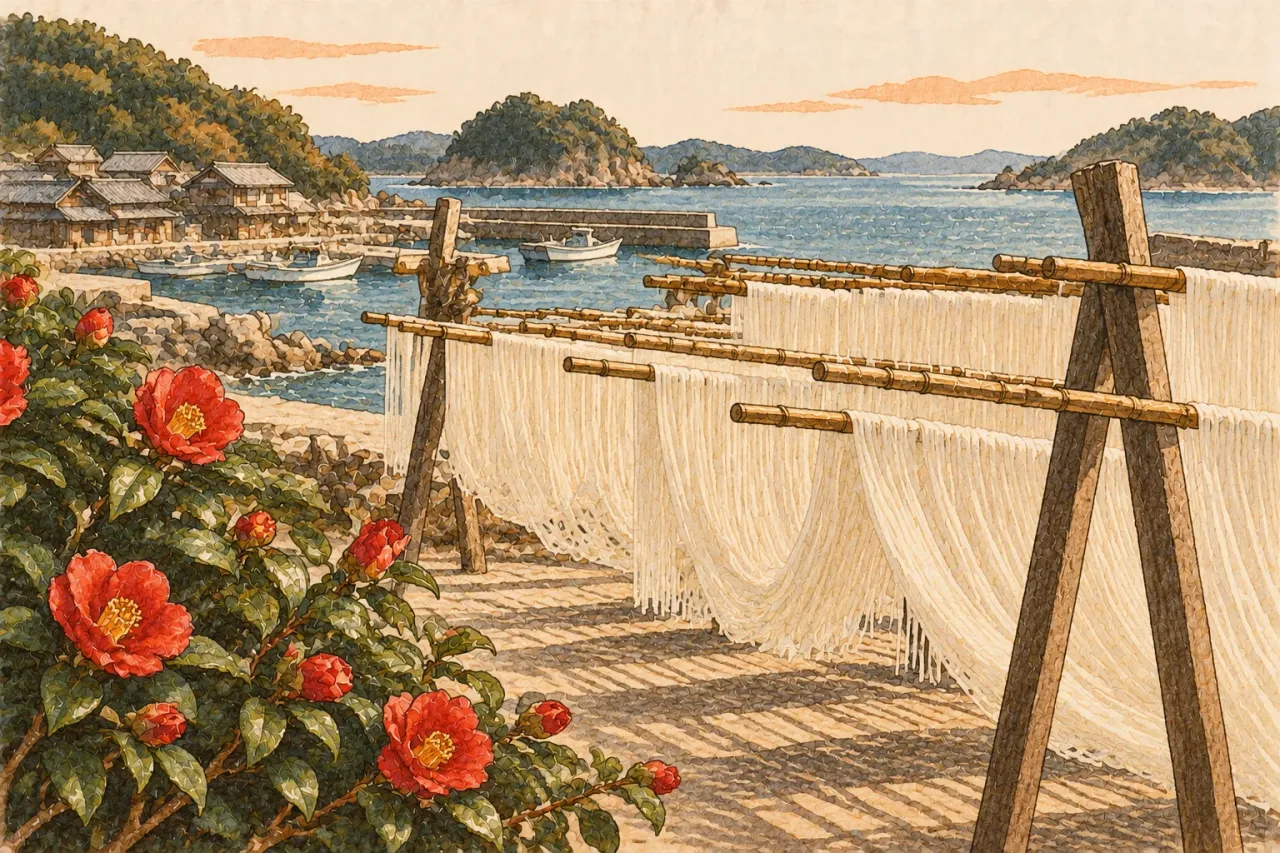
- The disc of dough is cut in a spiral into a rope and coiled in a tub, with camellia oil brushed on each layer. A rope about 40 mm across is called ōmaki.
- It is worked down by hand to about 10 mm, oiled again so it does not stick, and rested.
- It is hung in a figure of eight on two bamboo poles and rested again in a muro box.
- It is stretched and hung on a hata frame to dry. The northwesterly wind that blows over Kami-Gotō from late autumn to early spring was essential to the drying.
- It is cut into eight and bagged.
The cooperative adds that part of the process is now done by machine.
The camellia oil. The cooperative says the oil stops the strands sticking as they are stretched, and that camellia oil, rich in oleic acid, is also said to slow oxidation. The tourism association says noodles coated in it stay firm when boiled. The tourism agency says the step is called migaki, that the oil keeps the noodle from breaking and gives a silky bite with spring, and that the noodles are finally dried in the sea wind.
But not only camellia. The cooperative’s own standard label lists flour (made in Japan), salt, rapeseed oil, soybean oil and camellia oil. Per 100 g dry, 338 kcal and 3.7 g salt equivalent (estimated from a sample). Best before one year from manufacture. Wheat and soy are the declared allergens.
This is how Inaniwa udon differs most: Inaniwa uses no oil and is pressed flat. Both hang the noodle in a figure of eight on two poles. For hand-stretched sōmen, see sōmen.
Jigoku-daki and other ways to eat it
From the pot. The farm ministry calls jigoku-daki the standard local way. The dried noodles go into a bubbling iron pot and are eaten with ago stock from flying fish caught off Gotō; for a change, they are dipped into egg beaten with spring onion, bonito flakes and soy sauce. A scoop stick (udon-sukui-bō) lifts the noodles, because chopsticks find them hard to catch. It is also food for gatherings round a big pot. The ministry’s recipe makes the dip from water, granulated ago stock, mirin, soy sauce and tamari, with yuzu-koshō, grated radish with chilli, ginger, spring onion and raw egg on the side. For ago, see iriko and ago.
Hot or cold. The tourism agency says it can be eaten hot or cold, and that flying-fish stock is the usual dip locally. The town says chilled zaru udon in the hot months, jigoku-daki once the weather turns cool, and that some locals dip it in the liquid from simmered fish.
The name. The cooperative gives one story, and calls it something that is said: a traveller tasting it for the first time praised it as shigoku oishii, “utterly delicious”, and was misheard as jigoku oishii, “hellishly delicious”. The farm ministry’s page gives no origin for the name. No source I read connects it with the volcanic “hells” of Unzen.
Boiling. The cooperative’s jigoku-daki recipe boils 80–100 g a person in plenty of water for six to seven minutes. It also sells a thinner “three-minute” noodle, whose developer, the product page says, prefers it cold.
I found no official source for adding camellia oil at the table.
What it costs
Udon うどん
- Survey
- ¥818 (≈ €5 / $5)うどん 外食 1杯 · Aug 2026 · 特別区部
- Chains
- ¥360–¥440Plain kake udon, regular · Hanamaru Udon, Sukesan Udon, Marugame Seimen · tax incl. · checked 2026-10-05
Those are chain prices for fresh kake udon, for comparison. The cooperative’s online shop, tax included, checked on 13 October 2026:
- Gotō te-nobe udon with dietary fibre, 200 g: ¥480.
- Quick-boil three-minute noodle (thin), 200 g: ¥480.
- Nami no Ito “Kiwami”, 200 g × 30 bags: ¥11,800.
- Delivery: ¥980 flat anywhere in Japan, up to 20 kg (some premium items include delivery).
Prices are about to rise. The cooperative announced on 1 October 2026 that from orders placed on 1 November 2026, almost every product goes up by 10–15%. Nami no Ito in black washi paper keeps its price but drops from 300 g to 250 g. The figures above are the pre-rise ones.
On the islands
The cooperative runs Udon Chaya Yūmen Zanmai, five minutes’ walk from Arikawa port, with 52 seats, open 11:00–14:30, closed irregularly. Its menu page did not open, so I have no prices. At the Funasaki Udon Denshōkan in Shin-Kamigotō you can try three stages — kakeba, kobiki and hatakake — and the Japan Heritage site says to book a week ahead.
Gotō udon away from the islands
The name is protected; the dish is not a GI. “Gotō udon” (registration no. 5079155, for Gotō-made udon noodles) and “Gotō te-nobe udon” (no. 5079156, for Gotō-made hand-stretched udon noodles) are regional collective trademarks held by the cooperative, filed in May 2006 and registered on 21 September 2007, still in force. It is not among the farm ministry’s geographical indications; Nagasaki’s two are Taishū soba and Nagasaki karasumi. This is the reverse of Inaniwa, which has neither.
Most of it leaves. About 80% is shipped off the islands, the farm ministry says.
In Tokyo. Nagasaki’s showroom, Nihonbashi Nagasaki-kan, did not mention Gotō udon on its home page when I checked, so I do not know whether it stocks it.
The lists. Jigoku-daki (Gotō udon and Shimabara sōmen) is one of the 30 dishes on the farm ministry’s Nagasaki list. Gotō udon is a 100-year food (fiscal 2024), and Shin-Kamigotō’s Gotō udon appears among the cultural properties of the Japan Heritage story “Border islands Iki, Tsushima and Gotō”. The cooperative says it was added in 2025; I could not confirm the year on the Heritage site. For Nagasaki’s other dishes, see Kyushu’s local dishes.
What people get wrong
- “The envoy story is proven.” Every source calls it said, a theory, or the most likely; none cites a record.
- “It is made only with camellia oil.” The label lists rapeseed and soybean oil too.
- “Jigoku means the hot springs.” No source ties it to Unzen; the cooperative’s one story is a misheard compliment.
- “It is one of the three great udon.” Nagasaki’s tourism site and the cooperative say so; the farm ministry’s Gunma page names Mizusawa as the third instead.
Questions people ask
What is jigoku-daki?
The usual way Gotō udon is eaten locally, according to the farm ministry. The dried noodles are boiled in an iron pot and lifted straight out into a dip made with ago, flying-fish stock, often with a beaten egg, spring onion, bonito flakes and soy sauce. A scoop stick is used because chopsticks struggle.
Where did Gotō udon come from?
The farm ministry, the Cultural Agency, the town and the cooperative all repeat the same story, that the method came with Japan's envoy ships to Tang China, which called at the islands. Each of them calls it something that is said or a theory, and none cites a document. A newer theory points to a similar noodle in Zhejiang.
Is Gotō udon made with camellia oil?
Yes, camellia oil is brushed on during stretching to stop the strands sticking. The cooperative's standard label also lists rapeseed and soybean oil, so camellia is not the only oil in the packet.
Is Gotō udon a protected name?
The names Gotō udon and Gotō te-nobe udon are regional collective trademarks held by the island cooperative, registered on 21 September 2007 and limited to noodles made in Gotō. It is not a geographical indication.
Sources
- 農林水産省「うちの郷土料理」地獄炊き(五島うどん/島原そうめん)長崎県
- 農林水産省「うちの郷土料理」長崎県
- 文化庁「100年フード」長崎県
- 新上五島町「新上五島町の特産品」
- 長崎県「ながおし」五島地区
- 観光庁 観光多言語解説文データベース「五島の食文化」
- 日本遺産「国境の島 壱岐・対馬・五島」構成文化財紹介
- 新上五島町観光物産協会「船崎うどん伝承館」
- 新上五島町観光物産協会「自慢の島グルメ」
- 五島手延うどん協同組合「五島手延うどんの歴史」
- 五島手延うどん協同組合「五島うどんの特長」
- 五島手延うどん協同組合「製造工程」
- 五島手延うどん協同組合「美味しい食べ方」
- 五島手延うどん協同組合「組合概要」(沿革・配送料・直営店)
- 五島手延うどん協同組合 公式オンラインショップ(税込表示)
- 五島手延うどん協同組合「早茹で3分麺」
- 五島手延うどん協同組合「食物繊維入り五島手延うどん」
- 五島手延うどん協同組合「手延べうどん 原材料名・栄養成分・アレルゲン」
- 五島手延うどん協同組合「価格改定のお知らせ」
- 特許庁 地域団体商標 商標登録第5079155号「五島うどん」
- J-PlatPat 商標検索(「五島うどん」「五島手延うどん」、2026年10月13日検索)
- 農林水産省「地理的表示保護制度 登録産品一覧」
- 農林水産省「うちの郷土料理」群馬のうどん
- e-Gov法令検索 食品表示基準(平成27年内閣府令第10号)
- 日本橋 長崎館 公式
Prices are in Japanese yen. Conversions are approximate, at ¥177.30 to the euro and ¥158.23 to the US dollar as of 20 Oct 2026. Rates come from the European Central Bank, which publishes on working days only. Prices checked Oct 2026. What food costs in Japan →