
Kishimen: Aichi’s flat udon, its strong broth, and the cold “koro” of summer
I have not been to every place in this guide. The figures below are taken from the sources listed at the end, with the date each one was published — not measured by me. Where I have been, the article says so.
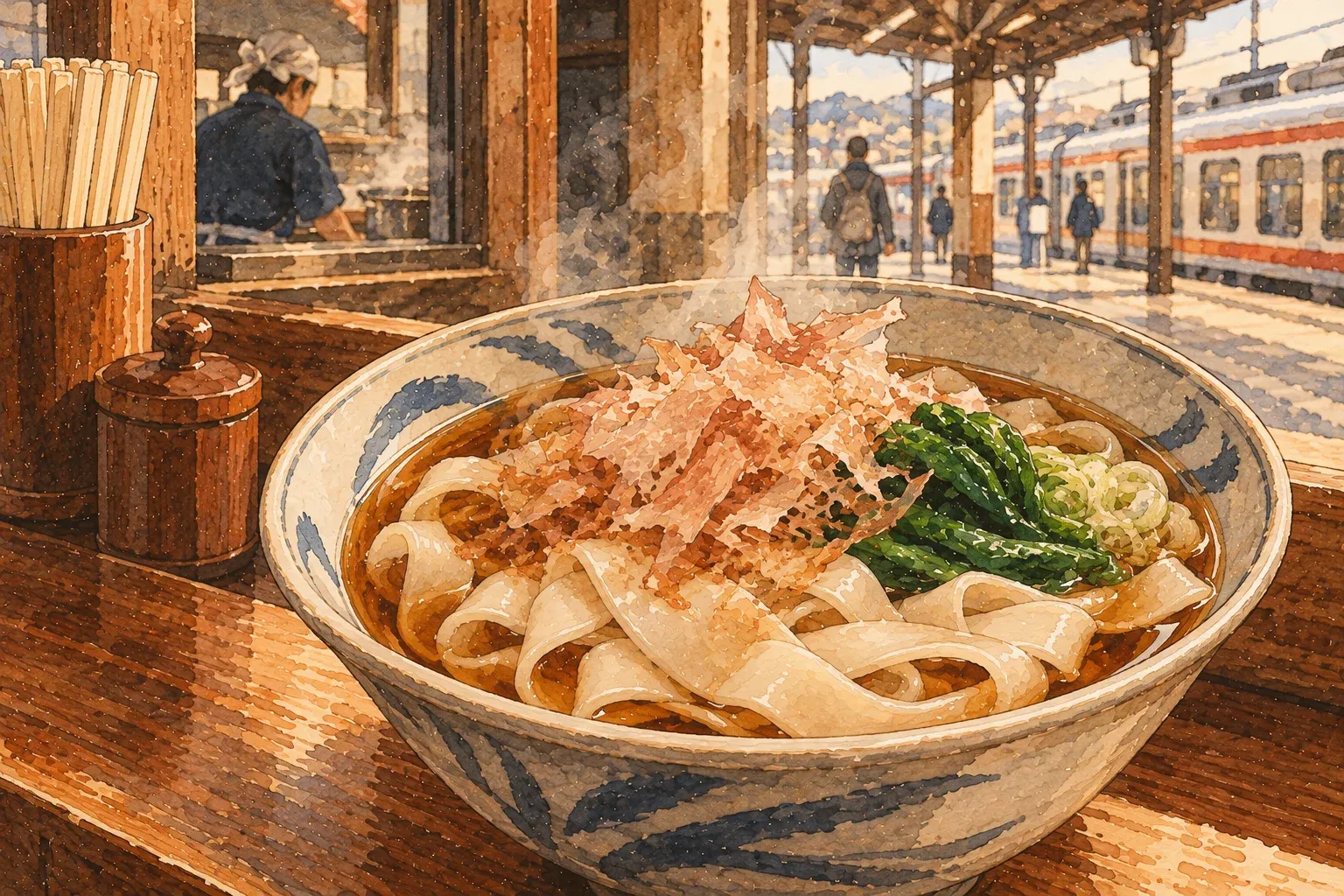
Kishimen is udon rolled flat: a ribbon of a noodle that the farm ministry calls Aichi’s soul food, eaten across the whole prefecture. Its shape explains its broth, and its summer form explains why Nagoya eats it in August as well as January.
For udon in general, start from the udon overview.
What it is
The farm ministry’s local-food entry: a flat udon about 1 mm thick and 7–8 mm wide, eaten throughout Aichi. Dried and frozen kishimen are sold in supermarkets, and it appears in school lunches.
Why the broth is strong
The traditional broth was seasoned with stock from muroaji (mackerel scad) and tamari soy. The ministry’s explanation: flat noodles tend to taste thin, so the broth needed to be stronger. Today most broth is dashi and soy. The noodle also takes up broth more readily than udon, which the ministry says suited the local taste for well-seasoned food and helped it spread.
Where it came from
Two suggestions in the farm ministry’s entry:
- A local origin. It is said to derive from the flat udon called himokawa, once a specialty of what is now Kariya.
- A Chinese name. One theory traces the name to goishi-men, a Chinese sweet made by rolling dough flat, cutting it into go-stone shapes with a bamboo tube, boiling it and dusting it with soybean flour.
Other name theories exist, but I could not confirm them, so they are not given.
How it is eaten
- All year, as everyday food.
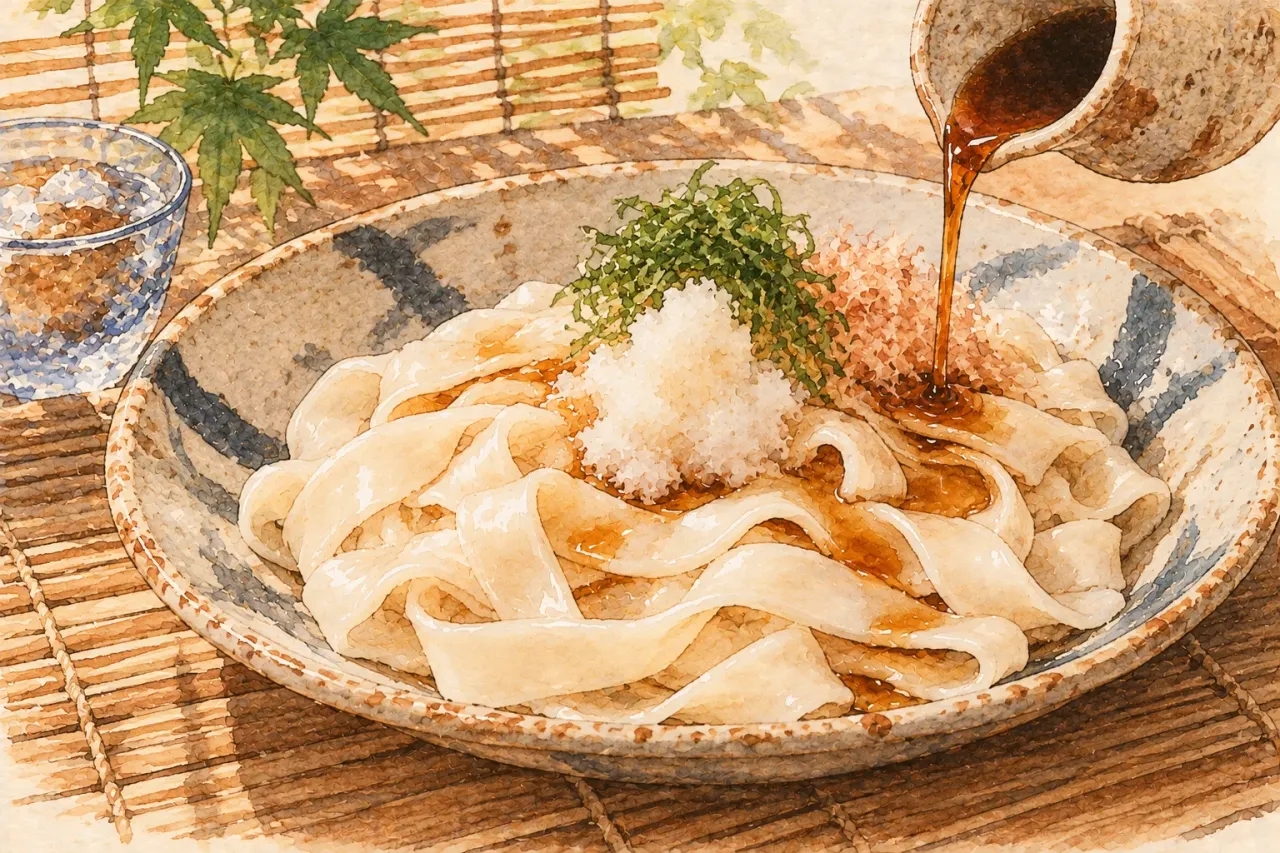
- Koro — noodles and broth both chilled — in summer, when appetites flag.
- Nagoya’s red fish cake on top makes it look local.
- Variations: curry kishimen, and chikara kishimen with rice cake.
- Cook it briefly; the thin noodle cooks quickly.
Not all of Japan’s flat noodles are this
Yamanashi’s hōtō is also flat and wide, but it is simmered raw in miso with vegetables. See the hōtō page.
Kishimen away from Aichi
No official source compares kishimen in Nagoya with kishimen elsewhere. What the farm ministry does record is that dried and frozen kishimen are sold in supermarkets, so the noodle travels more easily than the restaurant broth.
What people get wrong
- “Kishimen is a different food from udon.” It is a flat udon.
- “It is a winter dish.” It is eaten all year, cold in summer.
- “The name has one origin.” The ministry gives a local root and a Chinese-name theory.
Questions people ask
How is kishimen different from udon?
It is a flat udon. The farm ministry describes it as about 1 mm thick and 7 to 8 mm wide. Because it is flat, it takes up broth more readily than round udon.
Why is kishimen broth so strong?
The farm ministry says flat noodles tend to taste thin, so the broth had to be stronger. The traditional broth used muroaji fish stock and tamari; today dashi and soy are more common.
Is kishimen eaten cold?
Yes, in summer. "Koro" kishimen has both noodles and broth chilled. The dish is eaten all year.
Sources
Prices are in Japanese yen. Conversions are approximate, at ¥177.30 to the euro and ¥158.23 to the US dollar as of 20 Oct 2026. Rates come from the European Central Bank, which publishes on working days only. Prices checked Oct 2026. What food costs in Japan →