
Osaka udon: the pale kelp broth, the fried tofu that started it, and why tanuki means something else here
I have not been to every place in this guide. The figures below are taken from the sources listed at the end, with the date each one was published — not measured by me. Where I have been, the article says so.
Osaka’s udon is the one you drink. The noodle is soft and unassertive; the thing the city cares about is the broth, pale gold, clear enough to see the bottom of the bowl, tasting first of kelp and then of fish, and seasoned with light soy sauce so that it stays that colour. Osakans finish it to the last spoonful and judge a shop by it. The city also invented the single most-ordered udon dish in Japan, kitsune udon, by accident, in 1893.
Where it came from
The agriculture ministry’s record of Osaka’s regional food tells it plainly. In 1893 (Meiji 26), at an udon shop called Matsubaya in Senba, the merchants’ quarter, fried tofu was served as a side dish; customers took to putting it into their plain udon, and kitsune udon was born. The shop survives as Usamitei Matsubaya and supplied the ministry’s recipe. The same record pushes udon in Osaka back further — to the “Sunaba”, the sand yard where Hideyoshi’s castle builders ate at noodle stalls in the 1580s — and notes that udon became general in the mid-Edo period, when the Kitamae ships brought kelp, flour and salt into the city and noodle factories began supplying shops with ready-made noodles. The habit of buying noodles from a factory rather than making them in the shop is an Osaka habit before it was anyone else’s.
What makes it Osaka udon
The broth. Ma-kombu kelp from Hokkaido with mixed dried fish (zatsubushi, often mackerel), seasoned with light soy sauce. The ministry’s explanation for why this is Osaka’s broth and not Tokyo’s: the kelp arrived here by the western sea route, and the city’s soft water draws flavour from kelp in a way hard water does not. Osaka favours ma-kombu; Kyoto, next door, favours Rishiri kelp — the broth changes between two cities an hour apart.
The noodle. Soft, chewy, not too thick — made, in the ministry’s phrase, to go with the broth rather than to be the point. It is the opposite philosophy from Kagawa, and Osaka has recently produced a hybrid the tourism board calls “Osaka Sanuki”: a firm Kagawa-style noodle in an Osaka broth, sold at specialist shops that have multiplied in the last few years.
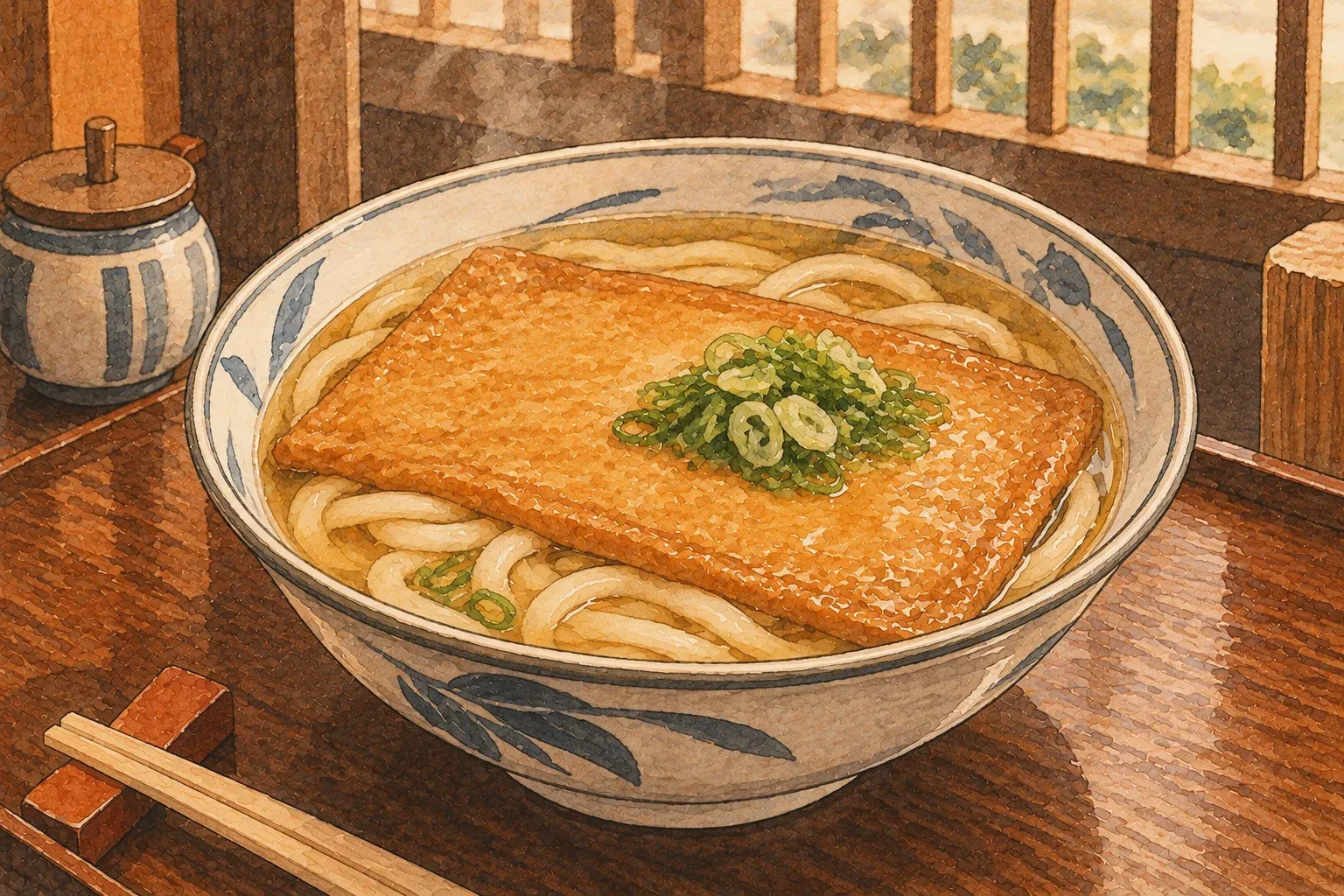
The tofu. The kitsune is a square of deep-fried tofu simmered in sweet soy until it is a soft, dripping pillow. The ministry calls kitsune udon the udon dish Osakans love most.
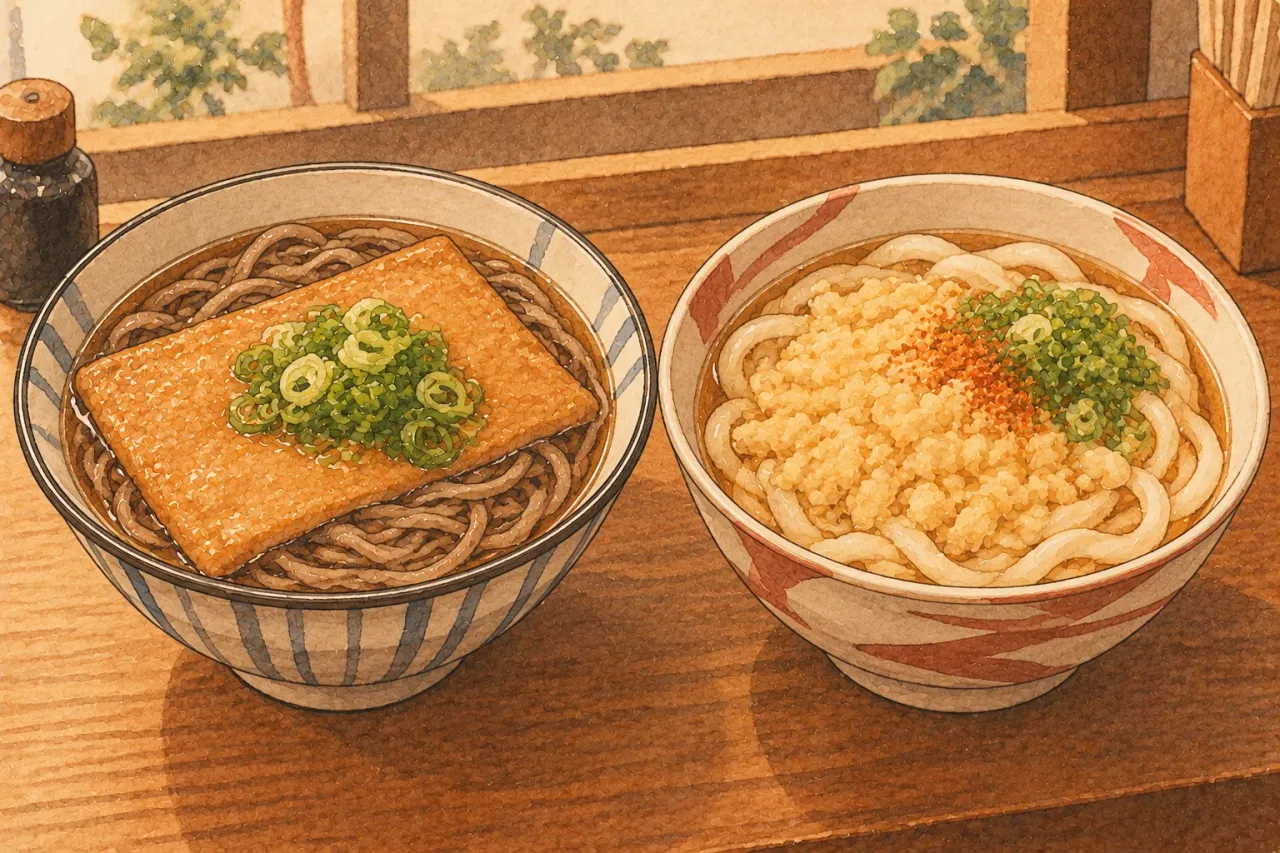
The words. Kitsune is udon with that tofu. Tanuki, in Osaka, is soba with the same tofu. Tempura crumbs in either make the dish haikara. In Tokyo, tanuki means the crumbs, and the soba with fried tofu is simply kitsune soba. A food writer traces Tokyo’s usage to borrowing the Kansai word for a different dish; whatever the route, the two cities use the same word for two things and each thinks the other is odd.
Why Osaka
Trade and water. Osaka was the kitchen of Edo-period Japan, the port where the Kitamae ships from Hokkaido unloaded kelp — the “kelp road” — and the merchants’ city with the cash and the appetite to turn it into a daily broth. The soft water did the rest. The merchant culture also explains the station counter and the factory noodle: this is a city that has always wanted its lunch fast and good at the same time.
The shops, and what they charge
Udon うどん
- Survey
- ¥818 (≈ €5 / $5)うどん 外食 1杯 · Aug 2026 · 特別区部
- Chains
- ¥360–¥440Plain kake udon, regular · Hanamaru Udon, Sukesan Udon, Marugame Seimen · tax incl. · checked 2026-10-05
In Osaka itself the price landscape runs from the station counter to the hotpot restaurant.
- Usamitei Matsubaya, Senba, where kitsune udon began. It does not publish prices online, so none are given.
- Mimiu. The house that trademarked udon-suki — a hotpot of udon, seafood and vegetables in a kelp broth, finished at the table. The company says it descends from a Sakai restaurant with 200 years of history and makes its broth from Rishiri kelp, sōda-bonito and honkarebushi over two hours in every shop; a 2018 magazine profile dates the Osaka shop to 1925 and the dish to a cook finishing a beef hotpot with udon. Prices are not on the company’s site.
- The station counter. Hankyū Soba opened at Jūsō station in April 1967 as the first standing noodle shop on a private railway in Kansai, and reached 20 shops by its fiftieth anniversary. In 2019 the railway sold the business to a noodle company and the shops were renamed Wakana Soba. The format — a bowl at a counter inside the ticket gate, eaten in minutes — is as Osakan as the broth.
Osaka city sits 46th of 52 in the household survey for noodles eaten out (¥6,078 a year), just above Kobe and far below Takamatsu. The explanation Osaka gives is that it eats its udon at home and at the station counter, neither of which the survey counts as a restaurant meal in the same way.
How it is eaten
Drink the broth. Kitsune udon is eaten with chopsticks for the noodle and tofu and the bowl lifted for the rest; leaving a clear broth is the one thing an Osaka shop will notice. In winter, udon-suki is a dinner for a table, and the noodles go in last.
Osaka udon away from Osaka
The broth does not travel, because the water does not. The ministry’s explanation for the kelp broth — soft Osaka water — is also the reason a Tokyo “Kansai-style” bowl tastes different even with the same kelp: the water is harder. The industrial version of the border is Nissin’s Donbei, which sells a West recipe (kelp and bonito, pale soy, pepper-leaf shichimi) and an East recipe (bonito-led, dark soy, chilli shichimi) as different products, and does not sell the West version east of the line. The words travel worst of all: order a tanuki in Tokyo expecting tofu and you will get tempura crumbs.
Getting there
Senba is in the centre, between Yodoyabashi and Honmachi stations on the Midōsuji subway line; Kansai Airport to Namba is on the Nankai line. The station counters are everywhere there is a station.
What people get wrong
- “Udon is about the noodle.” In Osaka it is about the broth, and the noodle is made to carry it.
- “Tanuki is tempura crumbs.” In Tokyo. In Osaka it is tofu on soba, and the crumbs are haikara.
- “Kitsune udon is ancient.” 1893, Senba, by accident.
- “Osaka is the udon capital.” It made the dish Japan eats most; it is near the bottom of the table for eating noodles out.
Questions people ask
What is kitsune udon?
Udon in a pale kelp-and-bonito broth with a square of sweet-simmered fried tofu on top. The agriculture ministry records that it began at Matsubaya in Osaka's Senba district in 1893, when customers started putting the fried tofu served on the side into the bowl.
What is a tanuki in Osaka?
Soba with fried tofu — the soba version of kitsune. In Tokyo, tanuki means tempura crumbs. In Osaka, tempura crumbs make the dish "haikara".
Why is the broth so pale?
It is made from ma-kombu kelp with dried fish and seasoned with light soy sauce. Kelp came to Osaka by sea from Hokkaido in the Edo period, and Osaka's soft water suits a kelp broth; Tokyo's broth is bonito-led and dark.
Sources
Prices are in Japanese yen. Conversions are approximate, at ¥177.30 to the euro and ¥158.23 to the US dollar as of 20 Oct 2026. Rates come from the European Central Bank, which publishes on working days only. Prices checked Oct 2026. What food costs in Japan →