
Hakata udon: the soft noodle Fukuoka eats instead of ramen, with burdock on top
I have not been to every place in this guide. The figures below are taken from the sources listed at the end, with the date each one was published — not measured by me. Where I have been, the article says so.
Fukuoka is famous abroad for ramen and at home, just as much, for udon. The two are opposites in every way the city could manage: the ramen noodle is hair-thin, dry and ordered hard; the udon noodle is thick, wet and served so soft it barely resists the teeth. Visitors who have learned to say barikata at a ramen counter arrive at an udon shop and ask for firm noodles, and the staff smile. Soft is the point.
Where it came from
The city’s claim is specific and carved in stone. In 1241 the monk Enni (Shōichi Kokushi) returned from Song China and founded the temple Jōtenji in Hakata; by the city’s account he brought back milling technology and taught the making of udon, soba and steamed buns, from which the flour foods of Japan spread. A stone in the temple grounds reads “Birthplace of udon and soba”. The temple is not generally open to the public, but every 7 October, on the founder’s memorial day, udon is served as an offering. The agriculture ministry records the claim as “one theory” and notes that udon’s origin is disputed; Kagawa has its own story. What nobody disputes is that Fukuoka has eaten udon for a very long time, and eaten it its own way.
What makes it Hakata udon
The noodle. Soft, “fluffy” in the city’s own word, with little of the chew that Kagawa prizes. The ministry’s description is precise: not boiled to collapse like Ise udon, but a thick noodle boiled a little longer than usual. Older shops mostly use imported wheat; newer ones have moved to local flour, since the Chikugo plain south of the city is one of Japan’s main wheat areas. The ministry also notes a recent trend toward noodles with a little more bite, somewhere between Hakata and Sanuki.
The broth. Called sume here: kelp and bonito with flying fish (ago) or dried anchovy (iriko) from the Genkai Sea, light soy sauce, a touch sweet. Pale and clear.
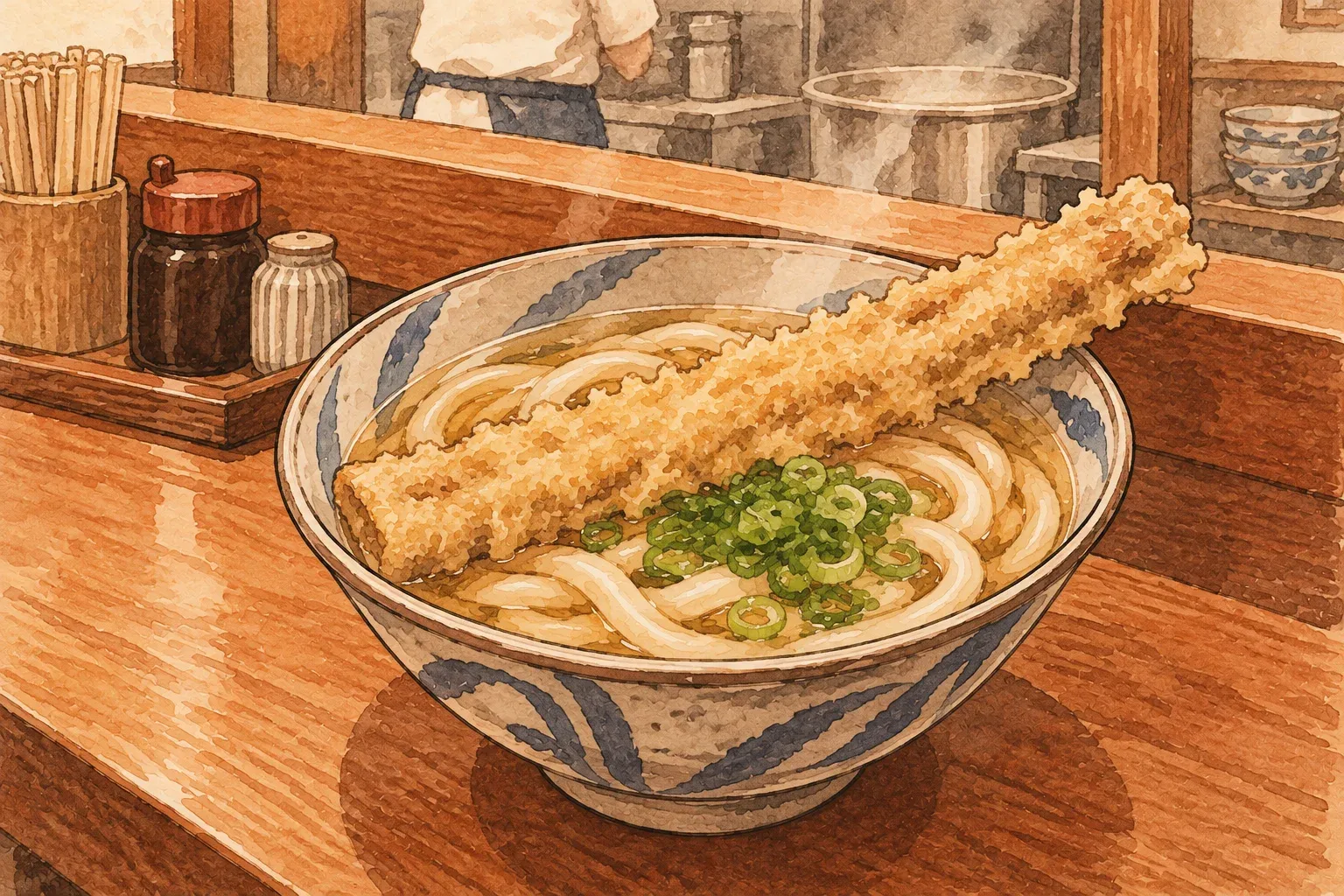
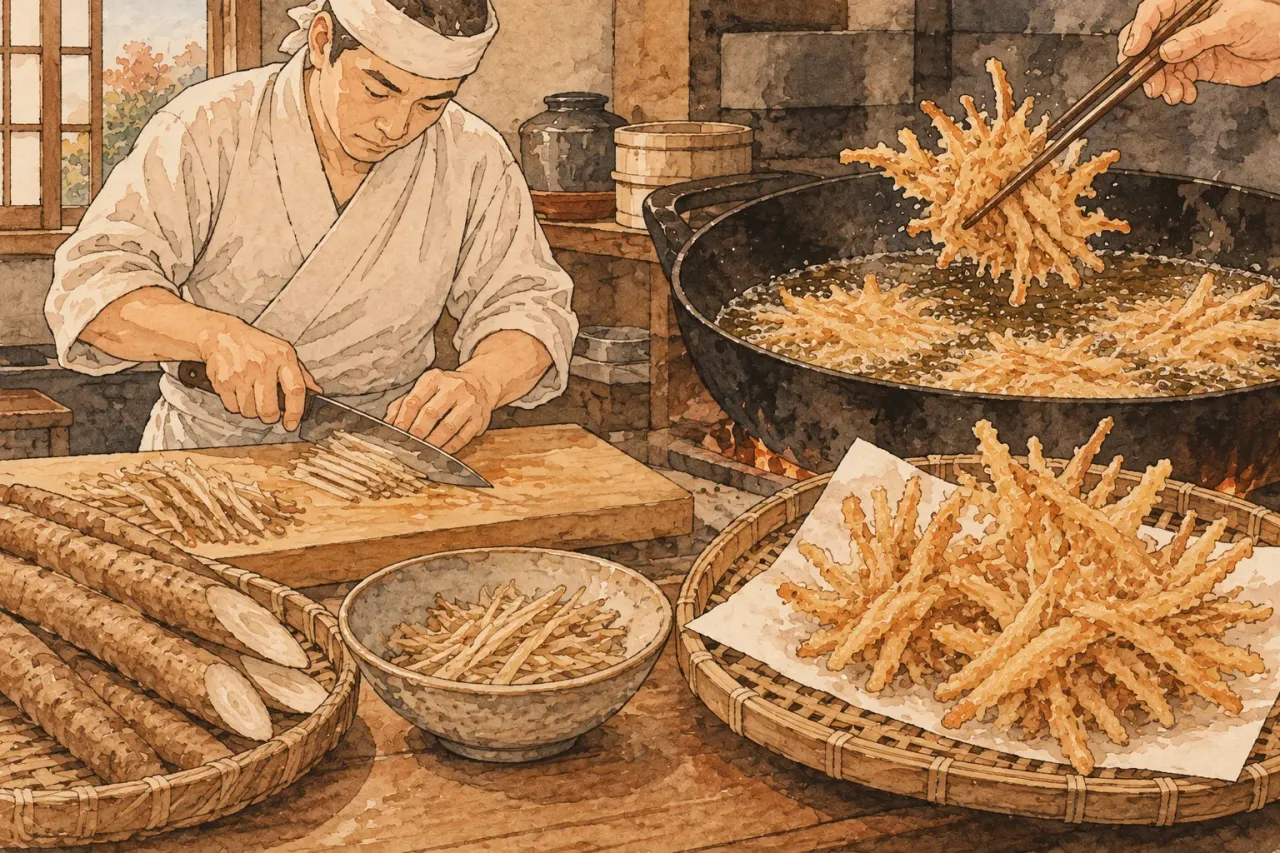
On top. Gobō-ten, burdock root in batter — cut into batons or as a loose fritter — and maru-ten, a round flat disc of fried fish paste. One or both is the default order, and the burdock soaking up broth is the taste of the city.
Why Fukuoka
The explanation Fukuoka gives for its own soft noodle is speed. The tourism office says the noodles were boiled ahead so that busy merchants could be served the moment they sat down, and that pre-boiling softens them to the core; a second telling credits the impatient Hakata temperament directly. Whether cause or folklore, it fits a merchant city that also invented the ramen refill so that market workers would not have to wait. The ago and iriko in the broth are Genkai Sea fish, and the wheat is from the plain to the south.
The shops, and what they charge
Udon うどん
- Survey
- ¥818 (≈ €5 / $5)うどん 外食 1杯 · Aug 2026 · 特別区部
- Chains
- ¥360–¥440Plain kake udon, regular · Hanamaru Udon, Sukesan Udon, Marugame Seimen · tax incl. · checked 2026-10-05
In Fukuoka itself:
- Maki no Udon. The city’s best-known chain, more than fifty years old, with about eighteen shops in 2022, famous for a noodle that keeps absorbing broth in the bowl so that a pot of extra broth comes to the table. Its menu lists kake ¥390, gobō-ten ¥490, maru-ten ¥520, meat ¥650, kama-age with dipping sauce ¥500, chicken rice ¥210; the bus-terminal shop is priced differently and the menu does not state whether tax is included. You can ask for the noodle hard, medium or soft. Its broth is made at a central kitchen and delivered twice a day.
- West. Founded 1966; its noodles are cooked to order rather than boiled ahead, and the prefecture’s tourism office quotes the company as saying they are firmer than Hakata udon generally. Prices on its site are by shop and the Kanto shops are priced differently, so none are given here; in March 2022 gobō-ten udon was ¥430.
- Sukesan Udon. From Tobata in Kitakyushu, 1976, and now national; its gobō-ten is a 14 cm length of burdock split lengthwise, and it sells 4.5 million botamochi rice cakes a year. Kake is ¥438 on its current menu.
- Ichigo (因幡うどん), founded 1951, kake ¥380, listed by the city’s tourism office. Kaka no Uron, the shop most guidebooks name, does not publish prices.
Fukuoka city ranks 24th of 52 in the household survey for noodles eaten out, at ¥7,967 a year — above the national average, and above Osaka.
How it is eaten
Quickly, and without ceremony. Order at the counter or the table — gobō-ten udon is the sentence you need — and eat it while the burdock is still crisp at the edges. At Maki no Udon the noodles swell in the bowl, so eat from the start rather than letting it sit; that is what the extra pot of broth is for. Rice balls or chicken rice on the side are normal for a lunch.
Hakata udon away from Fukuoka
The ministry observed in 2017 that shops hanging out a “Hakata udon” sign were multiplying in Tokyo, and Sukesan has since gone national from Kitakyushu. Two things travel badly. The first is the softness itself: outside Fukuoka a soft noodle reads as overcooked, and shops tend to firm it up — West, inside Fukuoka, already does. The second is the local sign that you are eating the real thing, which is not the noodle at all but the burdock: a Hakata udon without gobō-ten on the menu is a Hakata udon in name. Fukuoka’s own account of the style notes that even at home it is not uniform — Maki no Udon lets you choose the firmness, West cooks to order, the new shops use local wheat — so the right expectation for a Tokyo bowl is a cousin, not a copy.
Getting there
The airport is on the city subway: 5 minutes to Hakata station, 11 to Tenjin, ¥260. Maki no Udon’s shops are suburban and roadside; West and Sukesan are in the centre; Jōtenji is a short walk from Hakata station, though you can only see it from the gate.
What people get wrong
- “Fukuoka is a ramen city.” It is both, and udon is older. The city claims it as the birthplace.
- “The noodles are overcooked.” They are cooked the way the city likes them, for a reason the city can tell you.
- “Order it firm.” You can at Maki no Udon. Most places, don’t.
- “Gobō-ten is a side dish.” It is the topping that defines the bowl.
Questions people ask
Why is Hakata udon so soft?
Local accounts say the noodles were boiled in advance so that busy merchants could be served at once, and the pre-boiled noodle is soft to the core. Whether that is the real reason or a story told afterwards, the softness is deliberate and the city likes it.
What is gobō-ten?
Burdock root, cut into strips or batons, battered and fried, laid across the bowl. With maru-ten — a flat disc of fried fish paste — it is the standard Hakata topping.
How much is a bowl?
At Maki no Udon, the city's best-known chain, plain kake is ¥390 and gobō-ten udon ¥490. At Ichigo, a shop from 1951 listed by the city tourism office, kake is ¥380. The national Sukesan chain, from Kitakyushu, is ¥438.
Sources
Prices are in Japanese yen. Conversions are approximate, at ¥177.30 to the euro and ¥158.23 to the US dollar as of 20 Oct 2026. Rates come from the European Central Bank, which publishes on working days only. Prices checked Oct 2026. What food costs in Japan →