
Inaniwa udon: Akita’s flat, hand-twisted dried noodle, and the dates the sources tell differently
I have not been to every place in this guide. The figures below are taken from the sources listed at the end, with the date each one was published — not measured by me. Where I have been, the article says so.
Inaniwa udon is the udon most visitors meet in a gift box rather than a bowl. It is a dried noodle from Inaniwa, a district of Yuzawa in southern Akita: thin, pressed flat, twisted and stretched by hand over three or four days, and made without the oil that hand-stretched sōmen uses. The farm ministry describes a firm bite and an easy slide down the throat. The history behind it is told in several versions, and they do not line up. This page sets them side by side.
Where it came from
Every source puts the start in the early Edo period, in Inaniwa’s Ozawa settlement. After that they part company.
- The farm ministry (its magazine, July 2016): the methods of Satō Ichibei, who made various noodles in Ozawa, were taken over and improved by the first Inaniwa (Satō) Kichizaemon, who is said to have settled the method in 1665 (Kanbun 5). About a century later, in 1752 (Hōreki 2), it became a supplier to the Satake lords of the Akita domain.
- The trade ministry’s Tōhoku bureau (August 2016): there is a record of it being made in 1665; in 1752 it became a domain supplier and was given the name Inaniwa hoshi-udon; in the Meiji era the Imperial Household Ministry bought it. The bureau adds, as something “presumed”, that wheat was grown to get through the heavy snow and the noodle was worked carefully so that it would keep.
- Yuzawa city, citing a local history written by Satō Seiji in 1904 and now a city cultural property: the trade began with the family of Satō Ichibei in Ozawa, which became a supplier to the lord in 1690 (Genroku 3). His descendants later gave it up; at the same time Satō Kichizaemon started his own dried-udon business.
- The cooperative (the Akita Inaniwa udon cooperative): it began with Satō Ichibei making dried udon from local flour, about 350 years ago.
- Satō Yōsuke, the best-known maker, in its company timeline: 1665, Kichizaemon founds the business; 1690, domain supplier; 1829, a seal from the domain’s Edo elder forbids anyone but Kichizaemon from using the name; 1860 (Man’en 1), the second Satō Yōsuke is taught the one-heir method so it will not die out, and starts making udon.
So 1665 is the year the method was settled (farm ministry), the year it was recorded (trade ministry) or the year a business was founded (the company). The founder is Satō Ichibei (city, cooperative) or Satō Kichizaemon (farm ministry, company). The domain appointment is 1690 (city, company) or 1752 (both ministries). This page does not choose.
From a family secret to an industry. On this the sources agree. The farm ministry says it was long made by only two businesses, handed down to one heir and kept from outsiders, until 1972, when the seventh Satō Yōsuke made the method public to build up local industry. The cooperative says the trade then moved from households to companies. A council of makers formed in 1976, and the present cooperative in October 2001; it says it was set up because imitations and poor copies were harming the name. It has 17 member companies.
What makes it Inaniwa udon
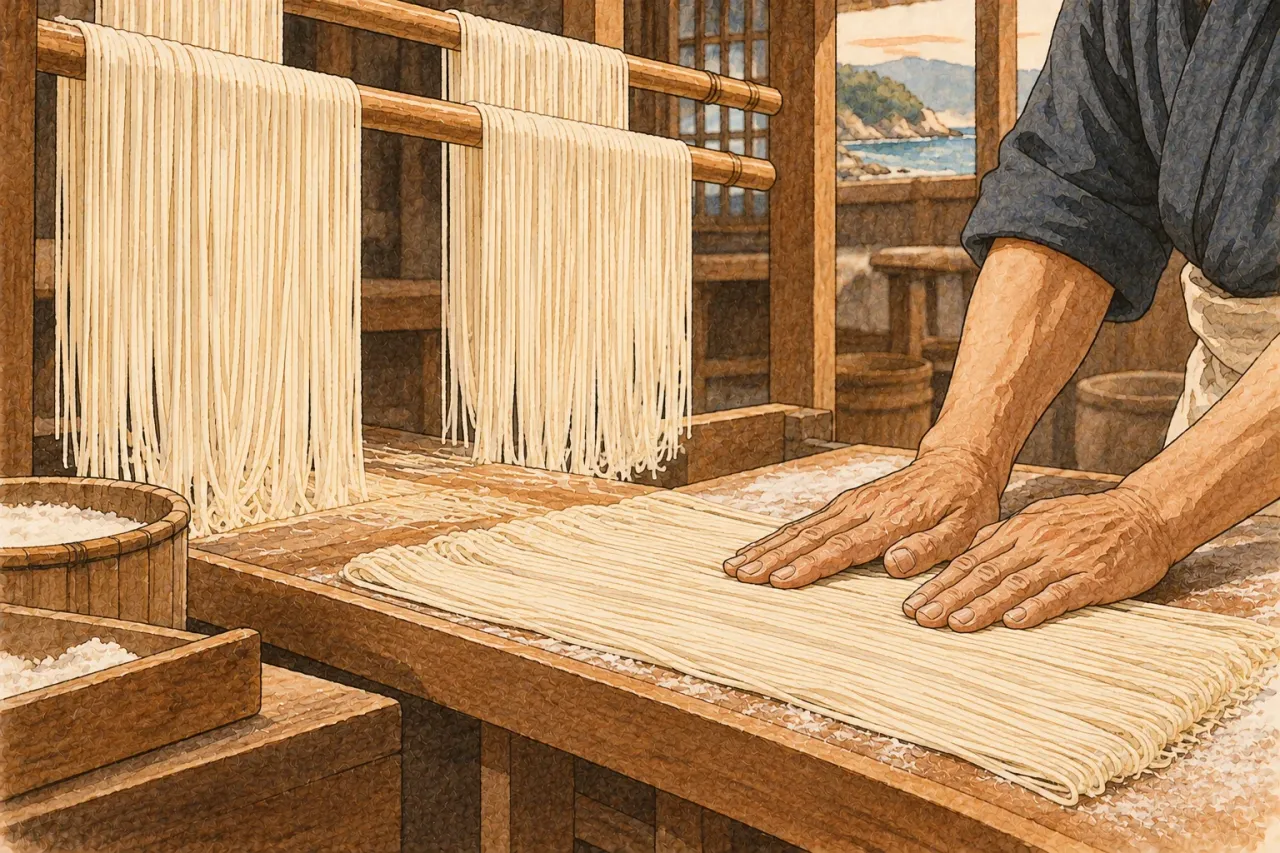
The noodle. The cooperative’s production rules list flour, salt and starch (for dusting), with salt water at 55% or more of the flour weight. The steps are kneading, cutting the sheet into strips, rolling them into cords coiled round a tub, hand-twisting (te-nai) in a figure of eight around two rods, pressing flat, and stretching and drying. By the calendar in the rules, the dough rests overnight on day one; on day two it is twisted, rested about an hour, pressed, rested about an hour more and stretched by hand; days three and four are for drying. The cooperative says the water and salt are adjusted to each day’s temperature and humidity, and that working the dough and letting it rest over three or four days is what gives it its bite. Satō Yōsuke says the noodle is stretched by hand to about 120 cm.
Flat, not round. The pressing (tsubushi) is what gives Inaniwa its shape. The cooperative calls the result a flat noodle; the farm ministry calls it flat and thin.
How it differs from hand-stretched sōmen. The ministry says it is made in a similar way to sōmen, but the bite is clearly different, and it does not use oil. Gotō udon, by contrast, is coated with camellia oil (see Gotō udon). The figure-of-eight hanging on two rods is shared with Gotō; the pressing flat is not. I have not seen what an Inaniwa packet gives as its legal name, so I do not say whether it is sold as “hand-stretched”.
How it is eaten
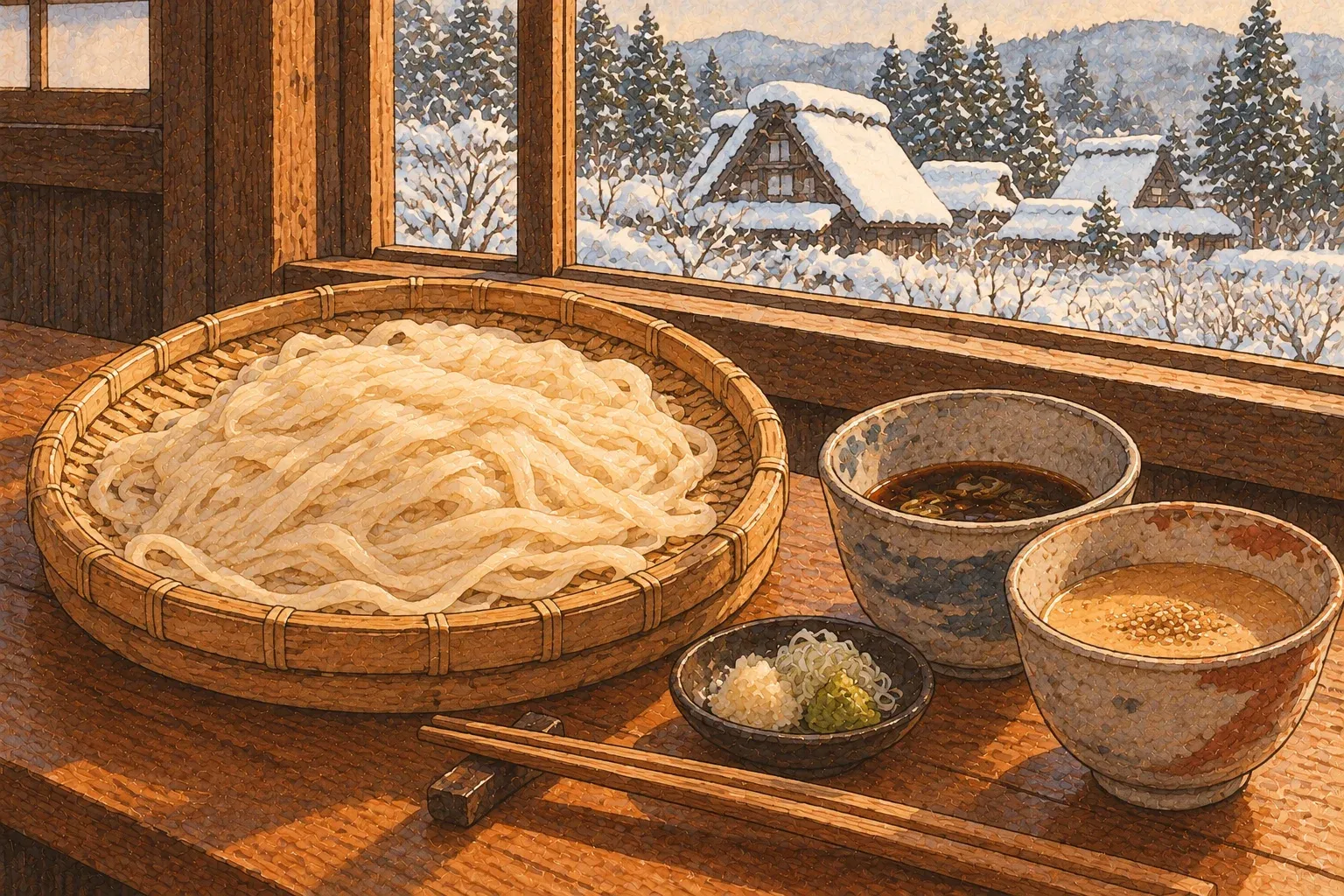
The farm ministry’s writer suggests hot broth is fine but recommends it cold, zaru style, dipped in a strong soy sauce with bonito stock; there is also a sesame-miso dip. The writer likes it boiled firm, like al dente pasta. The cooperative says it is rinsed in cold water after boiling and then served hot or with a dip. Satō Yōsuke’s head shop serves seiro (cold noodles) with soy, sesame-miso or both dips, hot udon, and a Thai curry dip.
The local habit. The cooperative notes that outside Akita it is seen as a gift, but locally it is eaten when someone has a cold and no appetite, and short broken pieces, mago-udon, are fed to babies and the elderly.
How to boil it
The cooperative’s method:
- About 3 litres of water to one 100 g portion. Too little water, or too long, can spoil the flavour.
- Let the noodles move freely in the pot. If it threatens to boil over, turn the heat down; do not add cold water.
- When the noodles turn milky white, drain them.
- Rinse quickly in cold water to remove the sliminess; the cooperative says this brings out the bite and the shine.
Mago-udon take about three minutes and are drained when they turn translucent. The cooperative gives no time for the main noodle, so use the packet. The national dried-noodle federation’s general advice also says to follow the packet and not to add cold water, but it skips the rinse for hot udon; the Inaniwa cooperative rinses first. For dried noodles in general, see udon.
What it costs
Udon うどん
- Survey
- ¥818 (≈ €5 / $5)うどん 外食 1杯 · Aug 2026 · 特別区部
- Chains
- ¥360–¥440Plain kake udon, regular · Hanamaru Udon, Sukesan Udon, Marugame Seimen · tax incl. · checked 2026-10-05
Those are chain prices for fresh kake udon, for comparison. Satō Yōsuke’s own figures, tax included, checked on 13 October 2026:
- Home-use dried udon, 140 g (27 cm lengths): ¥621.
- Off-cuts (kiriotoshi), 270 g, 16–17 cm, “uneven in length and thickness”: ¥702. Best before 730 days from manufacture.
- Two-flavour seiro at the head shop in Yuzawa: ¥1,000. The Ginza shop’s two-flavour seiro is ¥1,400, with a 10% service charge after 17:00. I have not checked whether the portions are the same, so this is one company’s two prices, not a rule about Tokyo.
- Hands-on noodle-making at the head shop, about 60 minutes: ¥3,300 adults, ¥2,200 primary-school age and under.
In Inaniwa
Satō Yōsuke’s head shop in Inaniwa has a restaurant, a shop, a factory tour and the hands-on course. The factory tour with craftsmen at work does not run at weekends or on public holidays; panels show the process instead. Inaniwa Udon Denshō no Sato Kanbun Gonendō has a restaurant, a shop and a gallery. Yuzawa city says both let you watch the factory through glass. On 5 August 2016 the city declared Inaniwa udon its furusato meibutsu, hometown speciality.
Inaniwa udon away from Akita
The name has no registered protection that I could find. The farm ministry’s 2016 article says other noodles cannot call themselves Inaniwa udon, but I found nothing behind it. Inaniwa udon is not on the patent office’s list of regional collective trademarks (latest registrations as of 31 August 2026); Akita’s only entry in its noodles-and-grains section is Yokote yakisoba. A trademark search on 13 October 2026 found two marks containing the words, both composite marks of individual companies. Nor is it on the farm ministry’s list of geographical indications (as of 10 July 2026). Whether the cooperative ever applied, I cannot tell.
The labelling rule. Japan’s food labelling standard bars place names on dried noodles unless they were packed where they were made, or the packet says “made in” that place, in large type, near the product name. I found no official explanation of how that applies to the word “Inaniwa”.
Where you can eat it in Tokyo. Satō Yōsuke runs shops in Ginza (its first in the capital, “over 20 years” ago, it says), Hibiya and Asakusa, with gift counters. Akita’s own showroom, Akita Bisaikan in Takanawa, serves it too; see Akita’s local dishes.
The lists it is on and off. Akita prefecture records it among the “100 local dishes of farming, mountain and fishing villages” chosen in 2007. It is not among the 29 dishes on the farm ministry’s Akita list, and not among the Cultural Agency’s 100-year foods for Akita.
What people get wrong
- “Inaniwa began in 1665.” That year means three different things in three sources, and two other years compete for the domain appointment.
- “It is a sōmen.” It is made in a similar way, says the ministry, but without oil, pressed flat, and with a different bite.
- “Inaniwa is a protected name.” No regional trademark or GI that I could find.
- “The three great udon are fixed.” Nagasaki’s tourism site counts Sanuki, Inaniwa and Gotō; the farm ministry’s Gunma page counts Inaniwa, Sanuki and Mizusawa.
Questions people ask
How old is Inaniwa udon?
The sources agree on the early Edo period and disagree on the details. The year 1665 appears as the year the method was settled (farm ministry), the year it is recorded as being made (trade ministry) and the year a family business was founded (the maker Satō Yōsuke). This page does not pick one.
Is Inaniwa udon a protected name?
Not that I could find. It is not on the patent office's list of regional collective trademarks and not on the farm ministry's list of geographical indications. A 2016 ministry magazine says other noodles cannot use the name, but gives no legal basis.
How do I boil dried Inaniwa udon?
The Akita Inaniwa udon cooperative says about 3 litres of water to 100 g, turn the heat down rather than adding cold water when it threatens to boil over, drain when the noodles turn milky white, and rinse quickly in cold water. It gives no time in minutes, so follow the packet.
Does Inaniwa udon contain oil?
The farm ministry says it is made without the oil used for sōmen. The cooperative lists flour, salt and starch for dusting.
Sources
- 農林水産省 aff 2016年7月号「ニッポン麺探訪 稲庭うどん」
- 経済産業省 東北経済産業局「ふるさと名物 秋田県湯沢市 稲庭うどん」
- 湯沢市「稲庭うどん御用版木」
- 湯沢市「稲庭古今事蹟誌」
- 湯沢市「ふるさと名物応援宣言(稲庭うどん)」
- 湯沢市「全国的に知名度の高い稲庭うどん」
- 秋田県稲庭うどん協同組合「稲庭うどんとは」
- 秋田県稲庭うどん協同組合「手づくりの魅力」(製法規定)
- 秋田県稲庭うどん協同組合「おいしい食べ方」
- 秋田県稲庭うどん協同組合「組合概要」
- 秋田県稲庭うどん協同組合「産地で食べる・体験する」
- 佐藤養助商店「歴代佐藤養助の軌跡」
- 佐藤養助商店「稲庭うどんの製造工程」
- 佐藤養助商店 通販「ご家庭用」(税込表示)
- 佐藤養助 総本店(税込価格)
- 銀座 佐藤養助(税込価格)
- 佐藤養助 日比谷店
- 特許庁「地域団体商標登録案件一覧(五十音順)」
- 特許庁「地域団体商標 登録案件一覧リスト」(Excel)
- J-PlatPat 商標検索(「稲庭うどん」、2026年10月13日検索)
- 農林水産省「地理的表示保護制度 登録産品一覧」
- 農林水産省「うちの郷土料理」秋田県
- 秋田県「農山漁村の郷土料理百選の結果」
- 文化庁「100年フード」秋田県
- 秋田県「稲庭うどん」
- 農林水産省「うちの郷土料理」群馬のうどん
- 長崎県「ながおし」五島地区
- e-Gov法令検索 食品表示基準(平成27年内閣府令第10号)
- 全国乾麺協同組合連合会「基本的な茹で方」
Prices are in Japanese yen. Conversions are approximate, at ¥177.30 to the euro and ¥158.23 to the US dollar as of 20 Oct 2026. Rates come from the European Central Bank, which publishes on working days only. Prices checked Oct 2026. What food costs in Japan →