
Sanuki udon: the udon with a written standard for "authentic", and the prefecture that calls itself Udon-ken
I have not been to every place in this guide. The figures below are taken from the sources listed at the end, with the date each one was published — not measured by me. Where I have been, the article says so.
Kagawa is the smallest prefecture in Japan and the one that eats the most noodles. It has 5.08 soba-and-udon shops per 10,000 people against a national average of 1.99; the town of Kotohira has 13.3. Its capital, Takamatsu, spends ¥17,704 a year per household on soba and udon eaten out (household survey, 2023–25 average), about 2.4 times the national figure. In 2011 the prefecture ran a campaign announcing it had renamed itself “Udon Prefecture”, and the website crashed on launch day. None of this is a joke to the people who live there. Sanuki udon — Sanuki being the old name of the province — is the hard, square, springy wheat noodle that the rest of Japan now calls udon by default, and the labelling code for packaged fresh noodles sets out what may call itself authentic Sanuki udon.
Where it came from
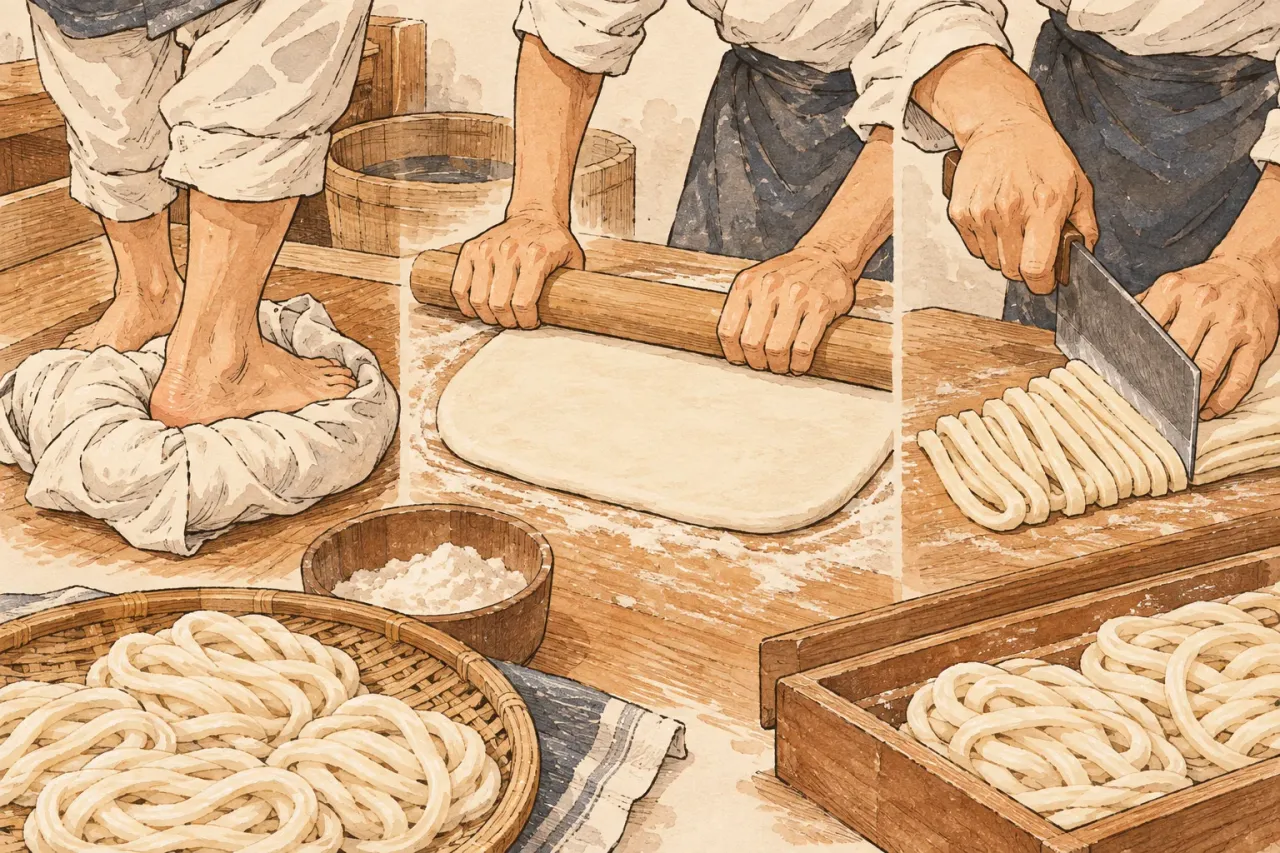
The legend is Kūkai, the monk who founded Shingon Buddhism, bringing the noodle back from Tang China in the ninth century; the Takinomiya district of Ayagawa calls itself the birthplace, says his nephew served it to the family there, and holds a noodle-offering ceremony every 24 April. The agriculture ministry notes the story with a raised eyebrow and points out that the ninth-century dish would have been torn flat pieces of dough, not a long noodle. What is documented is Edo-period udon: a folding screen of the Kotohira shrine festival, painted around 1703, shows udon being kneaded, rolled and cut at three places along the pilgrim road, and the town’s noodle shops now promote it as proof that the udon shop began here. Kagawa’s version of the noodle has been fed to pilgrims for at least three hundred years.
What makes it Sanuki udon
The noodle. Thick, square-cut, kneaded by foot and rested, with a hard, elastic chew that Kagawa calls koshi. The labelling code for packaged noodles gives the numbers: at least 40% water by flour weight, at least 3% salt, rested at least two hours, boiled about fifteen minutes. The ministry adds a detail the prefecture does not advertise: most Sanuki udon today is made from Australian wheat, and shops using the local variety, Sanuki no Yume, are a labelled minority.
The broth. Iriko — dried anchovy from Ibuki island in the Inland Sea — with light soy sauce, much of it from Shōdoshima. It is thin, salty and faintly fishy, and in a Sanuki bowl it is secondary to the noodle.
On top. Spring onion, grated ginger, and whatever tempura you took from the tray.
The ways to eat it. Kake (hot broth), bukkake (a little concentrated broth poured over), shōyu (soy sauce only), kama-age (straight from the pot in its cooking water, dipped), kama-tama (hot noodles with a raw egg and soy). Kagawa also has a vocabulary for temperature: atsu-atsu (hot noodle, hot broth), hiya-atsu (cold noodle, hot broth), atsu-hiya, hiya-hiya. Noodle first, broth second.
Why Kagawa
The ministry’s answer is geography: mild winters that let wheat grow, shallow coasts where salt was made, anchovies from the Inland Sea, spring onion grown across the prefecture, and soy sauce from Shōdoshima. Everything a bowl needs was within a day’s cart ride. The pilgrim traffic to Kotohira supplied the customers, and the habit never left. The prefecture now leads the country in flour used for udon, in noodle-making establishments, and in household spending on noodles.
The shops, and what they charge
Udon うどん
- Survey
- ¥818 (≈ €5 / $5)うどん 外食 1杯 · Aug 2026 · 特別区部
- Chains
- ¥360–¥440Plain kake udon, regular · Hanamaru Udon, Sukesan Udon, Marugame Seimen · tax incl. · checked 2026-10-05
Those are the national chains. In Kagawa the picture is different, and harder to price.
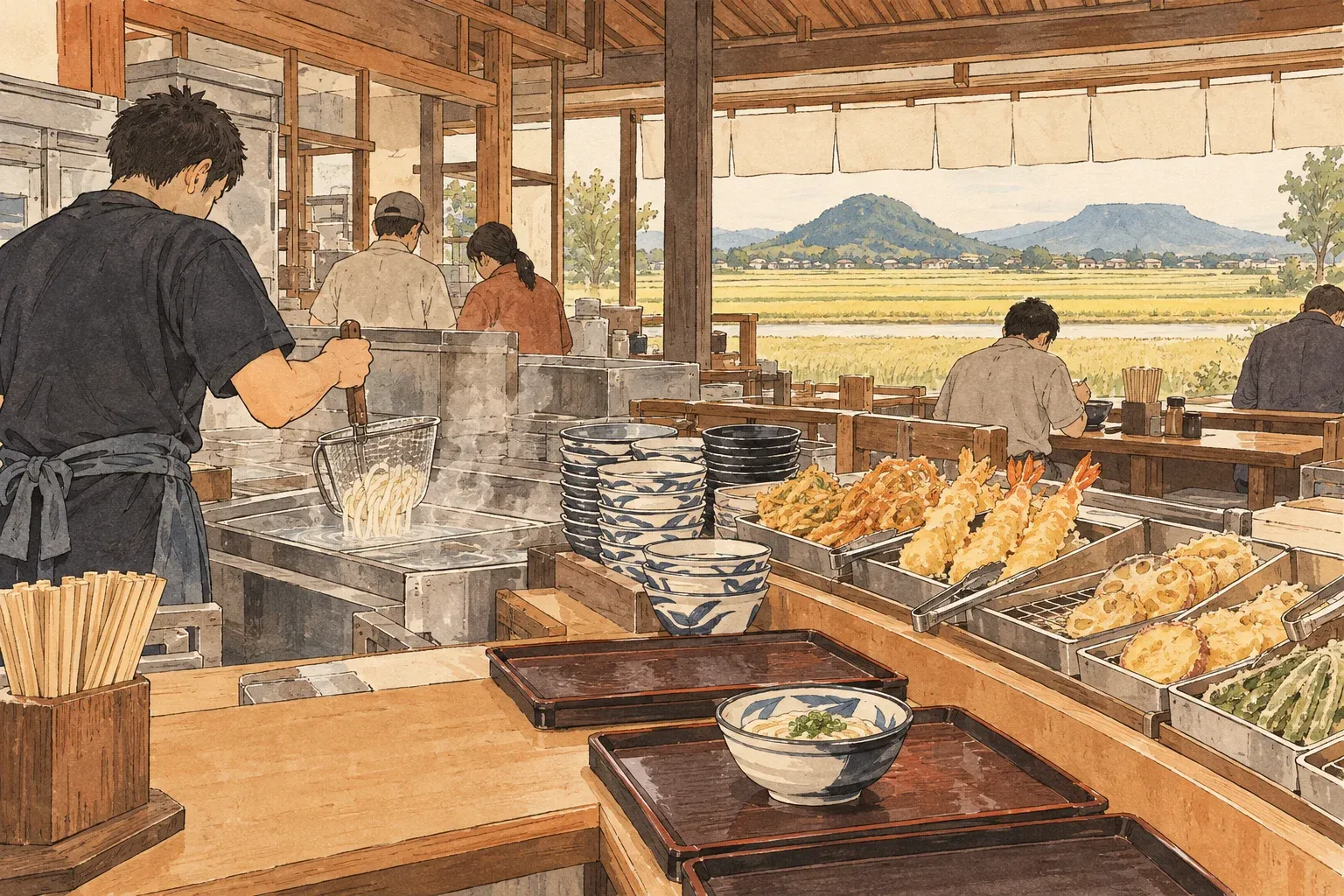
Three kinds of shop. The prefecture’s tourism office divides them neatly. General shops take your order at the table; oden and sushi on the counter are self-serve and declared at the till. Self-service shops hand you a bowl of noodles when you say how many portions you want; you warm them in the hot water yourself, add broth from the tap, pick tempura, pay, add condiments, and return the bowl — though the office notes most shops now do the warming and broth for you, a format Kagawa calls “half-self”. Noodle factories (seimenjo) have a few seats, their own rules, and close when the noodles run out, which can be before noon.
Prices. The famous shops do not, as a rule, publish them. Udon Baka Ichidai in Takamatsu — open 06:00 to 18:00, closed only on New Year’s Day — states on its site that it has no shops outside the prefecture “and never will”, but lists no prices; Yamagoe and Gamō likewise. This page therefore quotes none for them. What can be said is that Hanamaru, which began in Takamatsu, charges ¥360 for a small plain kake and Marugame Seimen, which began in Hyōgo, ¥440 for a regular, tax included as the chains list it, and that a factory shop in Kagawa is generally cheaper than either.
How to order it
- Decide how many portions (tama) and hot or cold, before you reach the counter. “Kake, hiya-atsu, hitotama” is a complete order.
- If the shop is true self-service, there is a basket and a tank of hot water: dunk the noodles for ten seconds, drain, add broth from the dispenser.
- Tempura and rice balls are on trays. Take what you want; the till counts it.
- Spring onion, ginger and sesame are free, after you pay.
- Return your bowl. Leaving it is the one thing locals will notice.
- Go early. The factories sell out.
Sanuki udon away from Kagawa
This is the lineage where the gap between the original and the version most people eat is widest, and where the people who made the gap have started to say so.
The word is unprotected in a restaurant. The labelling code reserves “Honba (authentic) Sanuki udon” and similar phrases for packaged fresh noodles made in Kagawa to the standard above. It explicitly excludes noodles cooked and served in a restaurant. A shop in Tokyo can call its bowl Sanuki udon, and no one can stop it.
The two chains that carried it are not Kagawa shops any more — and one of them is worried about that. Hanamaru was founded in Takamatsu in May 2000, opened in Tokyo in 2002, moved its head office to Tokyo in 2016, and moved it back to Takamatsu in January 2025; it has 418 shops. Its own press release that month said that every udon shop in Kagawa has its own definition of Sanuki udon, that the style’s charm is “a mass of diversity”, and that this had failed to come across nationally — its marketing head was quoted as concerned that a uniform image of Sanuki udon had spread. The company says its factories adjust the water to match Takamatsu’s, and plans to use Kagawa wheat in its Kagawa shops. Marugame Seimen’s first shop opened in Kakogawa, Hyōgo, in November 2000; by February 2022 it had a single shop left in Kagawa, and local reporting recorded complaints that it was dearer than the local shops and, from one of the province’s best-known udon writers, that it showed “no respect” for the original. Marugame’s answer is in its own notices: it makes noodles in every one of its 800-plus shops from 100% domestic wheat — which, given that most Sanuki udon in Kagawa is made from Australian wheat, is a different noodle by design.
The ritual is simplified. Marugame’s own ordering guide has you order, collect, pick tempura, pay, add condiments and return the tray. It does not have you warm your own noodles. The temperature vocabulary is gone. Osaka, meanwhile, has produced a hybrid the tourism board calls “Osaka Sanuki” — a Kagawa-style noodle in an Osaka kelp broth.
Who eats it. Takamatsu is first in the country for noodles eaten out by a wide margin. The chains’ home markets — Tokyo (22nd) and Osaka (46th) — are not.
Getting there
Takamatsu Airport to Takamatsu station by Kotoden limousine bus, about 45 minutes. From Okayama on the Honshu side, JR’s Marine Liner rapid crosses the Seto bridge to Takamatsu; a reserved seat costs extra. Kotohira, with the densest noodle shops in Japan, is on the JR Dosan line and the Kotoden line from Takamatsu.
What people get wrong
- “Marugame is from Kagawa.” Hyōgo, 2000. One shop in Kagawa as of 2022.
- “Sanuki udon on the sign means Kagawa.” Only on a packet, with the word Honba. In a restaurant it is a style.
- “It is made from Kagawa wheat.” Mostly Australian, says the ministry; the local-wheat shops are labelled.
- “Udon is soft.” Not here. If it is soft, it is not Sanuki, whatever the sign says.
- “The famous shops are open for lunch.” Many open at six and close when the noodles are gone.
Questions people ask
Is Marugame Seimen Sanuki udon?
It calls itself a Sanuki udon specialist and it is the chain most people meet. Its first shop opened in Kakogawa, Hyōgo, in 2000, not in Kagawa; by 2022 it had one shop left in Kagawa. The "Honba Sanuki" labelling standard applies to packaged noodles, not restaurants, so nothing stops the name.
What do I do at a self-service udon shop?
Tell the counter how many portions you want, take your bowl, warm the noodles yourself in the hot water if the shop expects it, add broth, pick tempura or rice balls from the trays, pay at the till, add spring onion and ginger, and return the bowl when you are done. Most shops now warm the noodles and add broth for you — what Kagawa calls "half-self".
How much does a bowl cost in Kagawa?
The famous shops mostly do not publish prices online, so this page does not quote them. The two big national chains, Hanamaru (founded in Takamatsu) and Marugame Seimen (founded in Hyōgo), charge ¥360–440 including tax for plain kake; a noodle-factory shop in Kagawa is usually less than that.
Sources
- 国土交通省 観光多言語解説文DB「さぬきうどん発祥の地」
- 国土交通省 観光多言語解説文DB「Sanuki Udon」
- 農林水産省「うちの郷土料理」AREA STORIES 香川県
- 農林水産省 aff 2016年11月号「ニッポン麺探訪 讃岐うどん」
- KSB瀬戸内海放送「金毘羅祭礼図屛風とこんぴら會」
- 全国生めん類公正取引協議会「生めん類の表示に関する公正競争規約・施行規則」(別表 さぬきうどん)
- 香川県観光協会 うどん県旅ネット「お店のタイプを知ろう」
- 香川県統計調査課 うどん県統計情報コーナー「そば・うどん店」の事業所数(令和3年経済センサス)
- 総務省統計局 家計調査 品目別都道府県庁所在市ランキング 外食「日本そば・うどん」(2023〜2025年平均)
- AdverTimes「うどん県」キャンペーン
- 手打十段うどんバカ一代 公式
- はなまる 公式「概要・沿革」
- はなまる プレスリリース「おいでまい!さぬきプロジェクト」
- 丸亀製麺「価格改定のお知らせ」(国産小麦、店舗数)
- 丸亀製麺「丸亀製麺の楽しみ方」(注文の手順)
- J-CAST「丸亀製麺が本場香川で苦戦」
- 高松空港 公式 アクセス(リムジンバス)
- KSB「マリンライナー料金改定」(JR西日本・JR四国発表)
Prices are in Japanese yen. Conversions are approximate, at ¥177.30 to the euro and ¥158.23 to the US dollar as of 20 Oct 2026. Rates come from the European Central Bank, which publishes on working days only. Prices checked Oct 2026. What food costs in Japan →