
Sushi: a fermented fish that became a street snack, a conveyor belt, and the most expensive meal in Japan
I have not been to every place in this guide. The figures below are taken from the sources listed at the end, with the date each one was published — not measured by me. Where I have been, the article says so.
Sushi is the Japanese dish the world thinks it knows, and the one Japan itself argues about most. Tokyo means a hand-pressed nigiri at a counter; Osaka means fish pressed on rice in a wooden box; Shiga means a carp fermented for two years that smells like cheese; most of the country, most of the time, means a plate going past on a belt for ¥110. All of them are sushi. What they share is not raw fish — most sushi for most of its history has not been raw — but sour rice.
What it is
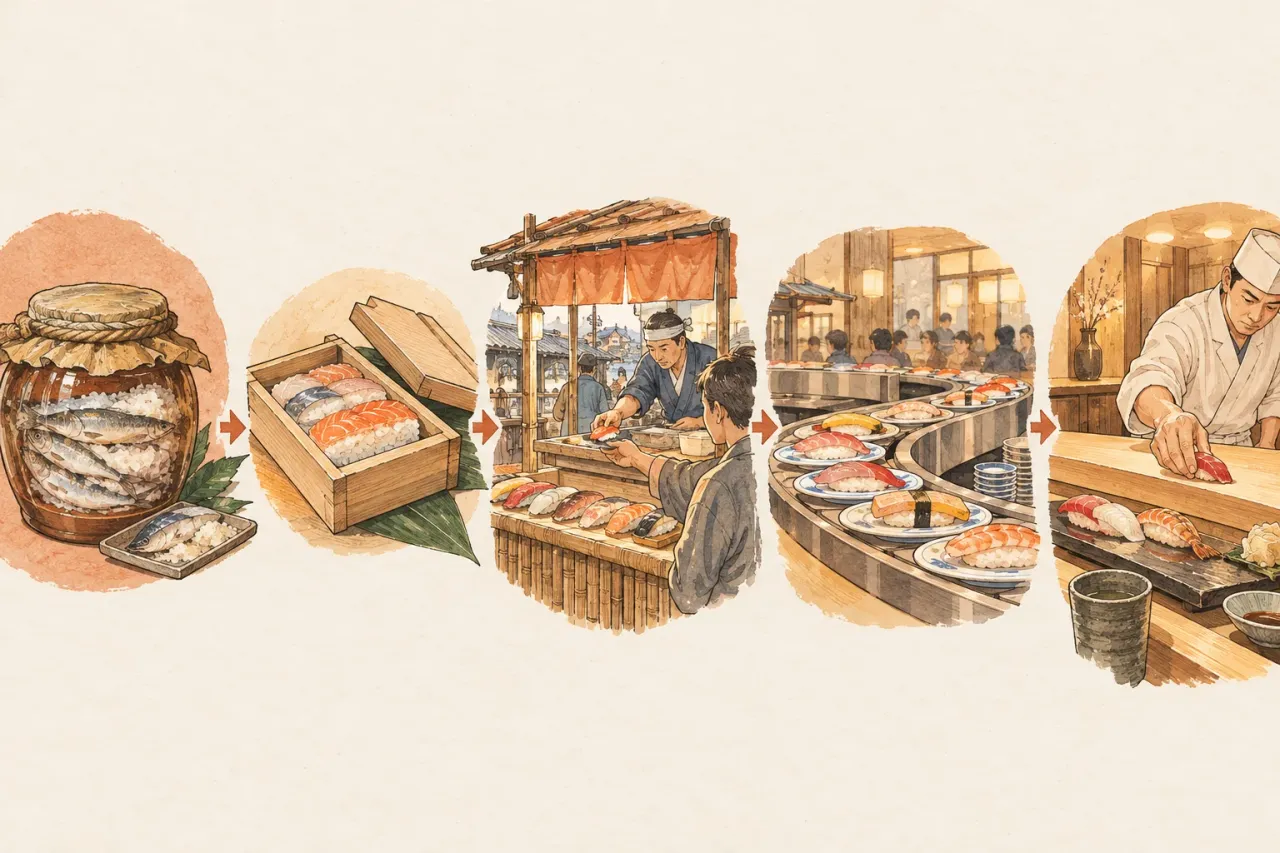
The word covers a thousand years. The oldest form, narezushi, was a way of keeping fish: salted and packed in cooked rice, it fermented for months or years until the rice was a sour paste that was scraped off and thrown away. The agriculture ministry traces the method to the rice-growing uplands of South-East Asia and says it arrived with rice farming; Shiga’s funazushi, crucian carp from Lake Biwa fermented until the bones go soft, is the surviving example, and still goes to shrines as an offering and to the sick as a remedy. In the Muromachi period people shortened the ferment to a few months and started eating the rice too — namanare — and that sour rice is the ancestor of everything on this page.
Edo did the rest. By the National Diet Library’s account, fermented sushi was on sale in the city in the late seventeenth century, vinegar replaced fermentation in the 1750s (hayazushi, “quick sushi”), and at some point before the 1820s somebody took the portion of a pressed box-sushi and shaped it by hand instead. That is nigiri. The Morisada Mankō, a mid-1800s record of city life, says Edo had by then gone over entirely to hand-pressed sushi while Kyoto and Osaka stayed with the pressed box — a split that holds today.
The characters are a separate argument. Sushi can be written 鮨, 鮓 or 寿司; the library’s reference desk notes that the last is a later phonetic flourish and the first two are old Chinese words for fermented fish, and that the spelling tends to follow the region and the type. The trade body, founded in 1961 with some 5,000 member shops, writes it in plain kana and declares 1 November Sushi Day.
Why it is the way it is
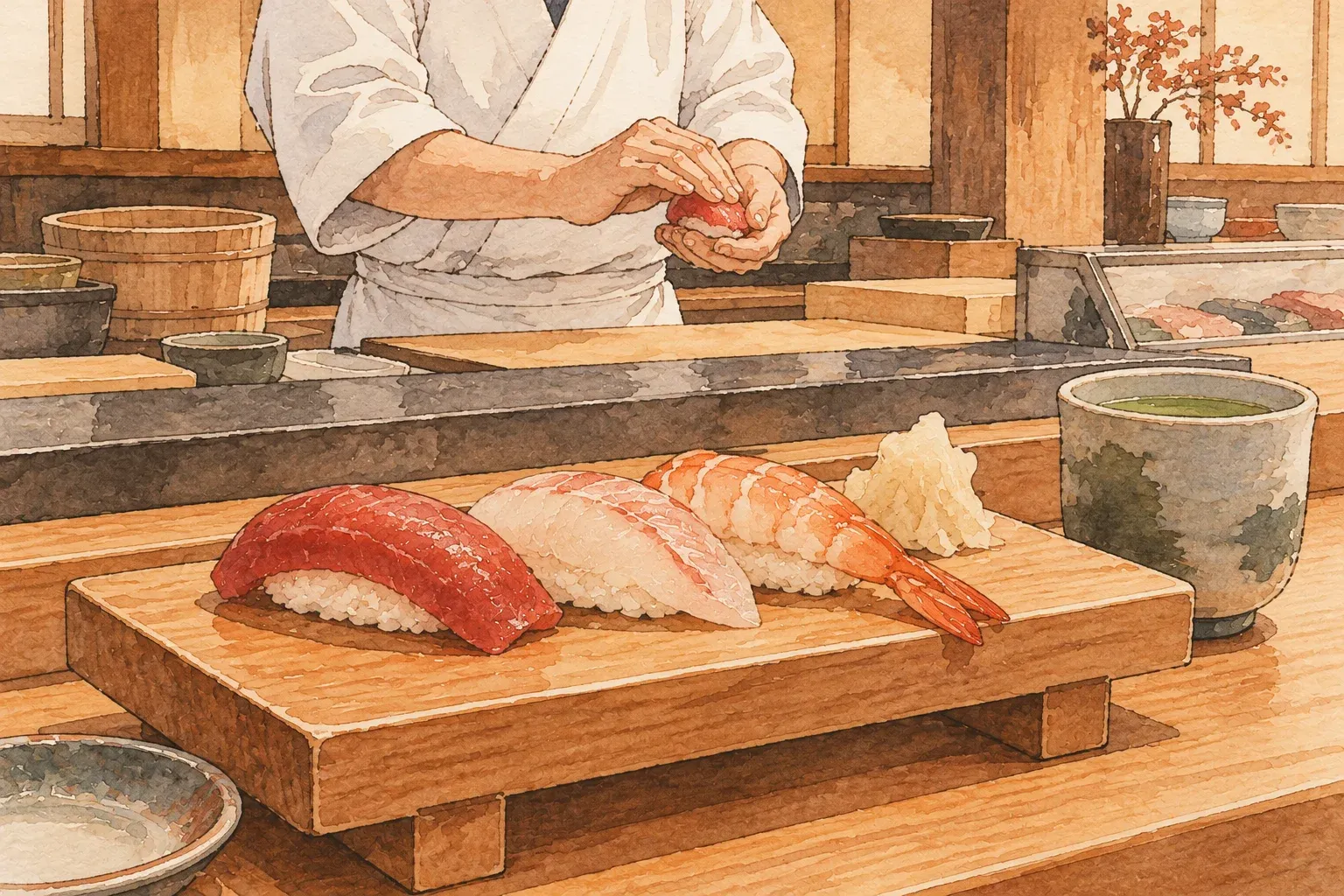
The counter is a stall that stopped moving. Edo nigiri was street food, sold from stalls at a mon or two a piece; the ministry notes that when the stalls became shops they kept the counter, and the chef kept making each piece in front of the customer. The portion was different — the rice ball was about three times today’s, a snack to fill the stomach rather than a frame for the fish.
“Raw” is the exception, historically. Edo had no refrigeration and a bay full of fish that spoiled fast, so the craft was the shigoto, the “work”: curing gizzard shad in vinegar, simmering conger eel, marinating tuna in soy, steaming prawn. Fatty tuna belly was disliked and fed to cats; the word toro for it is said to date from a Nihonbashi shop in the 1920s. Osaka’s box sushi takes the same logic further — the fish is marinated so thoroughly that no soy sauce is needed at the table.
The belt made it everyday. In 1958 a shop owner in Higashi-Ōsaka, who had watched beer bottles ride a conveyor at a brewery, opened the first “revolving” sushi shop; he patented the belt in 1962 and the patent ran out in 1978, after which the format spread to every suburb in Japan. Four chains now run more than 2,400 shops in Japan and the industry body counts more than 4,000 in all. The health ministry’s own summary of the trade is a split market: expensive counters on one side, cheap belts on the other, and the mid-priced neighbourhood sushi shop disappearing between them.
The fish has rules. Packaged fish for raw eating must be labelled as such, and the health ministry’s advice on anisakis — the parasite that caused 330 of Japan’s 1,037 recorded food-poisoning cases in 2024 — is that vinegar, salt, soy sauce and wasabi do not kill it; freezing at −20 °C for 24 hours or heating to 70 °C does. The cured and frozen fish of a modern sushi shop is safer than the romance of “fresh” suggests.
What it costs
Conveyor-belt sushi 回転ずし
- Survey
- ¥241 (≈ €1 / $2)回転ずし店 にぎりずし/まぐろ(赤身)/2個 · Aug 2026 · 特別区部
- Chains
- ¥110–¥120Cheapest plate · Kura Sushi, Hama Sushi, Sushiro · tax incl. · checked 2026-10-05
- Our guide figure
- from ¥2,000 (≈ €11 / $13)A whole meal for one person. The survey figure beside it is for two pieces of tuna, not a bill · Oct 2026
Sushi restaurant, lunch set 寿司店のランチ
- Our guide figure
- ¥1,500 (≈ €8 / $9)Less than half what the same counter charges in the evening · Oct 2026
Sushi restaurant, dinner 寿司店の夜
- Chains
- ¥3,828–¥5,478Nigiri set from the regular menu · Sushizanmai · tax incl. · checked 2026-10-05
- Our guide figure
- from ¥4,000 (≈ €23 / $25)And upwards with no ceiling · Oct 2026
The spread is the widest of any dish on this site, and it is three different meals:
- The plate. ¥110–150 for the cheapest plate of two pieces at Kura, Hama or Sushiro, ¥20–30 more at their city-centre branches; the government survey prices two pieces of conveyor-belt tuna in central Tokyo at ¥241. A full meal averages 9.9 plates and about ¥2,000 per head, by the industry’s 2026 consumer survey.
- The set. At a sit-down shop, lunch is the bargain: Sushizanmai’s weekday sets run ¥1,188–2,530 and its regular nigiri sets ¥3,828–5,478 all day; Yoshino-zushi in Nihonbashi, open since 1879, lists lunch nigiri at ¥2,750–3,850 and evening nigiri from ¥4,950.
- The counter. An omakase evening at a reputable counter starts around ¥16,500 (Yoshino-zushi’s stated budget) and runs to ¥19,800–20,000 at the shops Kanazawa’s tourism office lists. There is no ceiling, and the menu often says jika — market price — rather than a number. Ask before you order; Japanese customers do.
And the city that eats the most of it is not Tokyo. In the household survey, Kanazawa spends ¥22,406 a year per household on sushi eaten out, Toyama ¥21,750, Nagoya ¥21,079; Tokyo is 11th at ¥18,603, Osaka 23rd, Fukuoka 48th. The Sea of Japan coast, with its winter fish, is sushi country.
The lineages
| Lineage | Origin | Form | Rice and fish | Eaten where | How it is eaten |
|---|---|---|---|---|---|
| Edomae (Tokyo nigiri) 江戸前寿司 | Edo (Tokyo)early 1800s | Hand-pressed nigiri, made in front of you | Red-vinegar rice; fish 'worked' — cured, simmered, marinated — not simply raw | A counter; originally a street stall | A little soy on the fish side, one bite; set lunch at half the evening price |
| Kaiten (conveyor belt) 回転寿司 | Higashi-Ōsaka1958 | Nigiri on plates, on a belt or ordered to your seat by screen | Machine-pressed; salmon is the most-ordered topping, 15 years running | Suburban roadside and shopping malls; 4,000-plus shops | Pick or order, pay by the plate |
| Osaka box sushi 大阪の箱寿司・押し寿司 | Osaka (Senba)Meiji era; battera 1891 | Rice and fish pressed in a wooden box and cut; battera (mackerel) | Rice cooked with kelp stock and sweetened; fish marinated so no soy is needed | A shop or a box to take away; the theatre interval meal | Without soy sauce; keeps for hours |
| Toyama masu-zushi ます寿司 | ToyamaKyōhō era; station bento from 1912 | A round pressed cake of trout and rice in bamboo leaves | Lightly vinegared; cherry salmon | Station kiosks and 20-plus specialist shops in Toyama city | Cut like a cake; eaten cold, hours later |
| Shiga funa-zushi 鮒鮨(なれずし) | Lake Biwathe ancestor of all sushi | Whole crucian carp fermented in rice for months to years | The rice is a fermentation medium and was once discarded | Festivals and homes around the lake; ¥5,400 for one fish | Sliced thin; pungent; the bones are soft enough to eat |
| Nara kakinoha-zushi 柿の葉寿司 | Yoshino, Naramid-Edo | Salted mackerel on rice, wrapped in a persimmon leaf | — | Summer festivals; station bento; 30-plus makers | Better the next day |
| Kyoto saba-zushi 鯖寿司 | KyotoEdo period; Izuu 1781 | A whole cured mackerel fillet pressed on rice, in kelp | — | The three great festivals; take-away | No soy needed |
| Kanazawa and Hokuriku 金沢・北陸の寿司 | Kanazawa— | Nigiri; 'conveyor' shops that take orders instead | Gas shrimp, sweet shrimp, nodoguro, white shrimp | The city that spends most on sushi in Japan | Order from the counter, not the belt |
Lineages without a link are on the list but not written yet. The table is kept in one place so every lineage is described on the same terms.
Where to eat it
- Edomae — Tokyo’s old houses (Nihonbashi, Ginza, Tsukiji); the Toyosu market’s restaurant row opens at five in the morning, and the tuna auction can be watched by advance lottery.
- Kaiten — any suburb; the chains’ city-centre shops are dearer and the industry’s own respondents say the best belts to travel for are in Hokkaido, Ishikawa and Toyama.
- Osaka — Senba’s box-sushi houses and the take-away battera counters at the stations.
- The Sea of Japan — Kanazawa for nigiri, Toyama for pressed trout, Shiga for the fermented original.
What people get wrong
- “Sushi means raw fish.” It means vinegared rice. The oldest sushi is fermented, the Osaka kind is marinated and pressed, and the Edo craft was curing.
- “The conveyor belt is a tourist thing.” It is where Japan eats sushi — 4,000 shops, and 65% of people who eat sushi out eat it there.
- “Tokyo is the sushi capital.” Tokyo made nigiri. Kanazawa eats it most.
- “Fresh is best.” Cured, aged and frozen is how the trade has always handled a fish that spoils in hours and carries a parasite that soy sauce does not kill.
- “It is all the same abroad.” The agriculture ministry counts about 181,000 Japanese restaurants outside Japan; JETRO’s history of the American market is that sushi arrived there as the California roll, built for customers who would not eat raw fish, and only later grew toward the Edo repertoire.
Questions people ask
Is sushi raw fish?
Not by definition. Sushi is vinegared rice with something on or in it. Edo-style nigiri traditionally used fish that had been cured, simmered or marinated, and Osaka presses marinated mackerel in a box. Raw tuna and salmon are modern conveyor-belt favourites.
What does sushi cost in Japan?
¥110–150 for the cheapest plate at a conveyor-belt chain (two pieces), about ¥2,000 for a full conveyor-belt meal, ¥1,188–3,850 for a set lunch at a sit-down shop, ¥4,000–5,000 and up for a nigiri set in the evening, and ¥16,500–20,000 and up for an omakase counter.
Where does Japan eat the most sushi?
Kanazawa. In the government household survey (2023–25) Kanazawa spends ¥22,406 a year per household on sushi eaten out, ahead of Toyama and Nagoya. Tokyo is 11th and Osaka 23rd.
Sources
- 農林水産省「にっぽん伝統食図鑑」なれずし
- 農林水産省「うちの郷土料理」にぎりずし(東京都)
- 農林水産省「うちの郷土料理」ふなずし(滋賀県)
- 国立国会図書館 本の万華鏡「天下タイ平」第3章(早鮨・握り鮨)
- 国立国会図書館 レファレンス協同DB「江戸のにぎりずしの発祥は?」
- 国立国会図書館 レファレンス協同DB「鮨」「鮓」「寿司」の違い
- 全国生活衛生営業指導センター「全国すし商生活衛生同業組合連合会」
- 厚生労働省 生活衛生適正化分科会 資料「すし店営業の現況について」
- 中小機構 J-Net21 EXPO70特集(元禄産業・回転寿司)
- 総務省統計局 家計調査 品目別都道府県庁所在市ランキング 外食「すし」(2023〜2025年平均)
- 厚生労働省「アニサキスによる食中毒を予防しましょう」
- 東京観光財団 GO TOKYO「東京で寿司を食べるガイド」
- 吉野鮨本店 お品書き
- 金沢市観光協会「金沢の絶品寿司を味わいつくす」
- Umios「回転寿司に関する消費者実態調査2026」
- 農林水産省「海外における日本食レストラン数の調査結果(令和7年)」
- JETRO「2022年度 米国における日本食レストラン動向調査」
Prices are in Japanese yen. Conversions are approximate, at ¥177.30 to the euro and ¥158.23 to the US dollar as of 20 Oct 2026. Rates come from the European Central Bank, which publishes on working days only. Prices checked Oct 2026. What food costs in Japan →