
Kakinoha-zushi: salted mackerel on rice in a persimmon leaf, the mountain festival food of Nara
I have not been to every place in this guide. The figures below are taken from the sources listed at the end, with the date each one was published — not measured by me. Where I have been, the article says so.
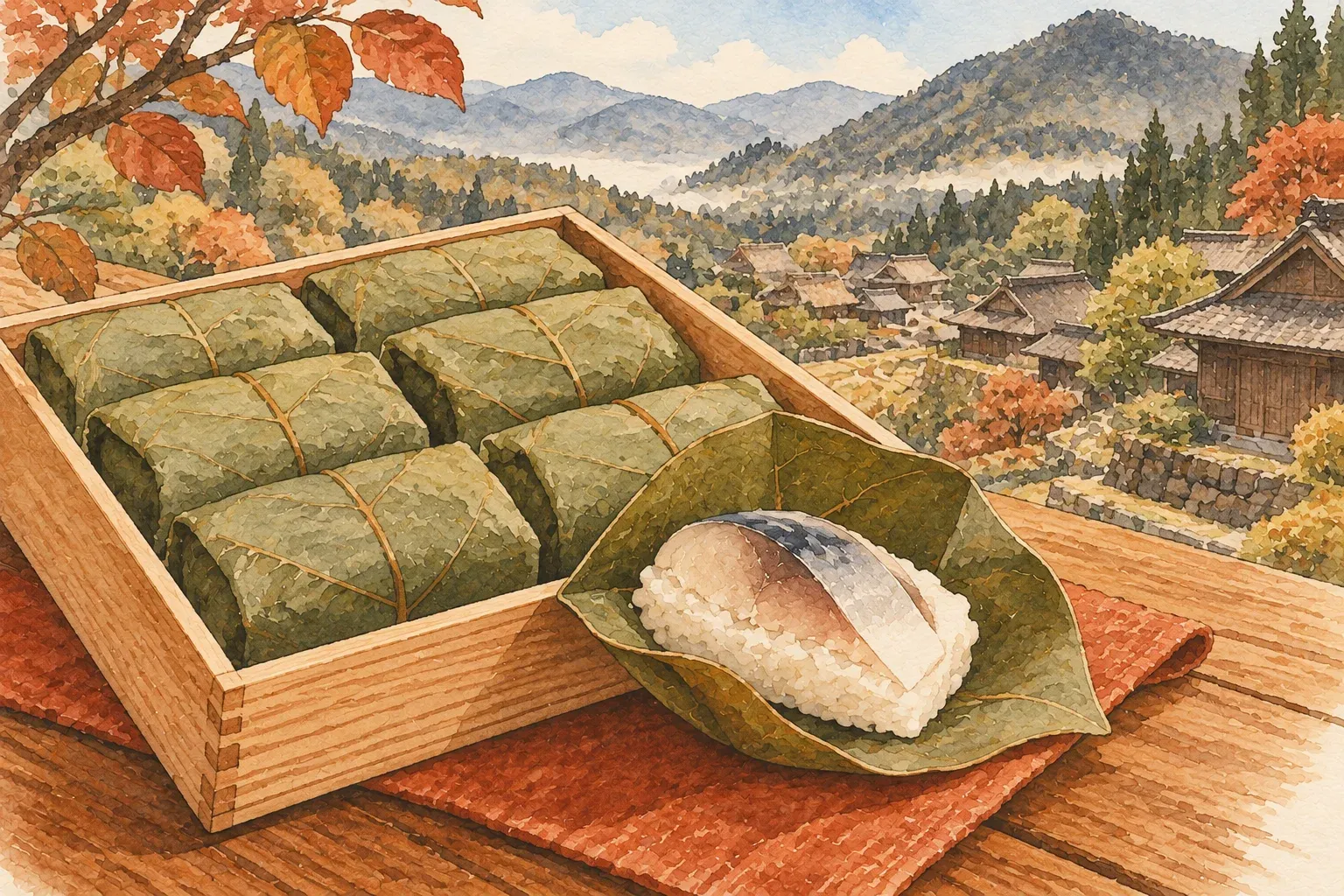
Kakinoha-zushi is sushi for a place with no sea. In the Yoshino hills of southern Nara, a day’s carry from the coast, people pressed a thin slice of salted mackerel onto a mouthful of rice, wrapped it in a persimmon leaf, and stacked the parcels in a box to eat at the summer festival. It is the neatest sushi in Japan — one piece, one leaf — and it is one of the few that is better the day after it is made.
Where it came from
The agriculture ministry’s record places it in Gojō and the Yoshino district, and gives two origins without choosing. In one, fishermen from Kii — the peninsula’s Pacific coast — salted the summer mackerel of the Kumano Sea and carried it up the Yoshino river valley to sell in the mountain villages, where it became the feast food of the summer festivals. In the other, it began as a preserved ration and changed over time into the festival dish. The persimmon leaf is local: the hills grow the fruit, and the astringent leaf wraps, keeps and scents a single piece. The ministry’s practical note is the one that explains everything else — it tastes better after a night in the leaf.
In fiscal 2024 the Agency for Cultural Affairs recognised it as a “100-year food”, with a special award, and counted more than thirty makers in the prefecture.
What makes it kakinoha-zushi
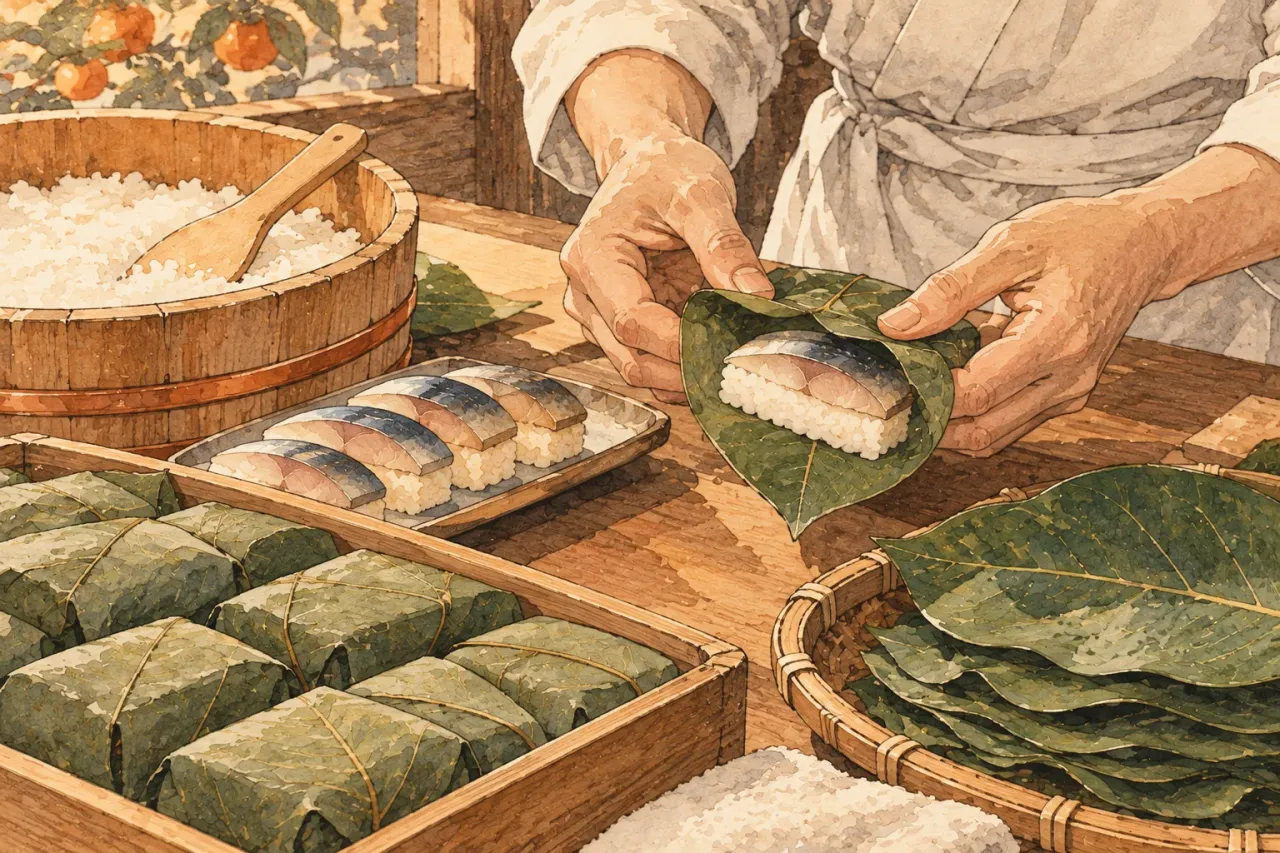
The piece. A small block of vinegared rice, a thin slice of cured mackerel on top, pressed and wrapped in a single persimmon leaf, folded like a parcel. Salmon is a common second filling now; shad, prawn and sea bream appear at some makers.
The fish. Salted mackerel, cured firm; the salt and the vinegar do the preserving, so no soy is needed.
The leaf. Removed before eating, not eaten. It keeps the rice from drying and lends a faint tannic smell.
The box. Sold by the dozen or so, in a wooden or card box, and designed to be carried.
Why Yoshino
Mountains without a coast, a river road from the sea, persimmon orchards, and summer festivals that needed a dish to feed a village. The ministry’s two origin stories are the same geography told twice: salted fish came up the valley, and the valley wrapped it in what it had.
The shops, and what they charge
Kakinoha-zushi is sold by the box at makers’ shops in Gojō, Yoshino and Nara city, at Nara and Kyoto stations, and at Kansai department stores; the makers’ prices were not confirmed from official pages for this edition, so none are given. Expect a box of eight to twelve to cost what a station bento costs.
How to eat it
Unwrap the leaf, eat the piece in one or two bites, leave the leaf. Nothing is added. If you buy a box in the morning, eat it in the afternoon or the next day; the ministry’s advice is the maker’s.
Kakinoha-zushi away from Nara
It is a travel food by design, and the makers sell it at stations and fairs across Kansai, so the thing itself travels well. The cousin to compare it with is Kyoto’s saba-zushi — a whole cured mackerel fillet pressed along a log of rice and wrapped in kelp, the city’s festival sushi since the Edo period — which is the same fish, the same cure and the same idea in a grander form. Nara’s is the mountain version: one leaf, one bite, no knife.
Getting there
Gojō and Yoshino are on the Kintetsu Yoshino line from Osaka-Abenobashi and the JR Wakayama line; Yoshino is also the cherry-blossom mountain, so the two trips combine. Nara station’s kiosks sell the boxes if you are not going south.
What people get wrong
- “Nara has no sushi.” It has one of the oldest, made precisely because it has no sea.
- “Eat the leaf.” Don’t.
- “Eat it fresh.” Tomorrow is better, by the ministry’s own note.
Questions people ask
Why a persimmon leaf?
The Yoshino hills are persimmon country, and the astringent leaf wraps a single piece neatly, keeps it, and gives it a faint scent. The ministry notes the sushi improves after a night in the leaf, which is why it is a travel food.
Where did the mackerel come from?
From the coast, salted. One account the ministry records has Kii fishermen bringing summer mackerel from the Kumano Sea up the Yoshino river valley to sell, where it became the feast of the summer festivals; another treats it as a preserved ration that changed over time.
Is it a recognised regional food?
Yes. The Agency for Cultural Affairs listed it as a "100-year food" in the traditional category with a special award in fiscal 2024, and counts more than 30 makers in the prefecture.
Sources
Prices are in Japanese yen. Conversions are approximate, at ¥177.30 to the euro and ¥158.23 to the US dollar as of 20 Oct 2026. Rates come from the European Central Bank, which publishes on working days only. Prices checked Oct 2026. What food costs in Japan →