
Conveyor-belt sushi: a brewery line in Osaka, a patent that ran out, and the ¥110 plate
I have not been to every place in this guide. The figures below are taken from the sources listed at the end, with the date each one was published — not measured by me. Where I have been, the article says so.
Conveyor-belt sushi is how Japan actually eats sushi. Two-thirds of people who eat sushi out eat it here; four companies run more than 2,400 shops; and a plate of two pieces costs ¥110, less than a can of coffee. It was invented by a man who could not afford enough staff, in a suburb of Osaka, in 1958, and it has spent the last few years quietly getting rid of the belt.
Where it came from
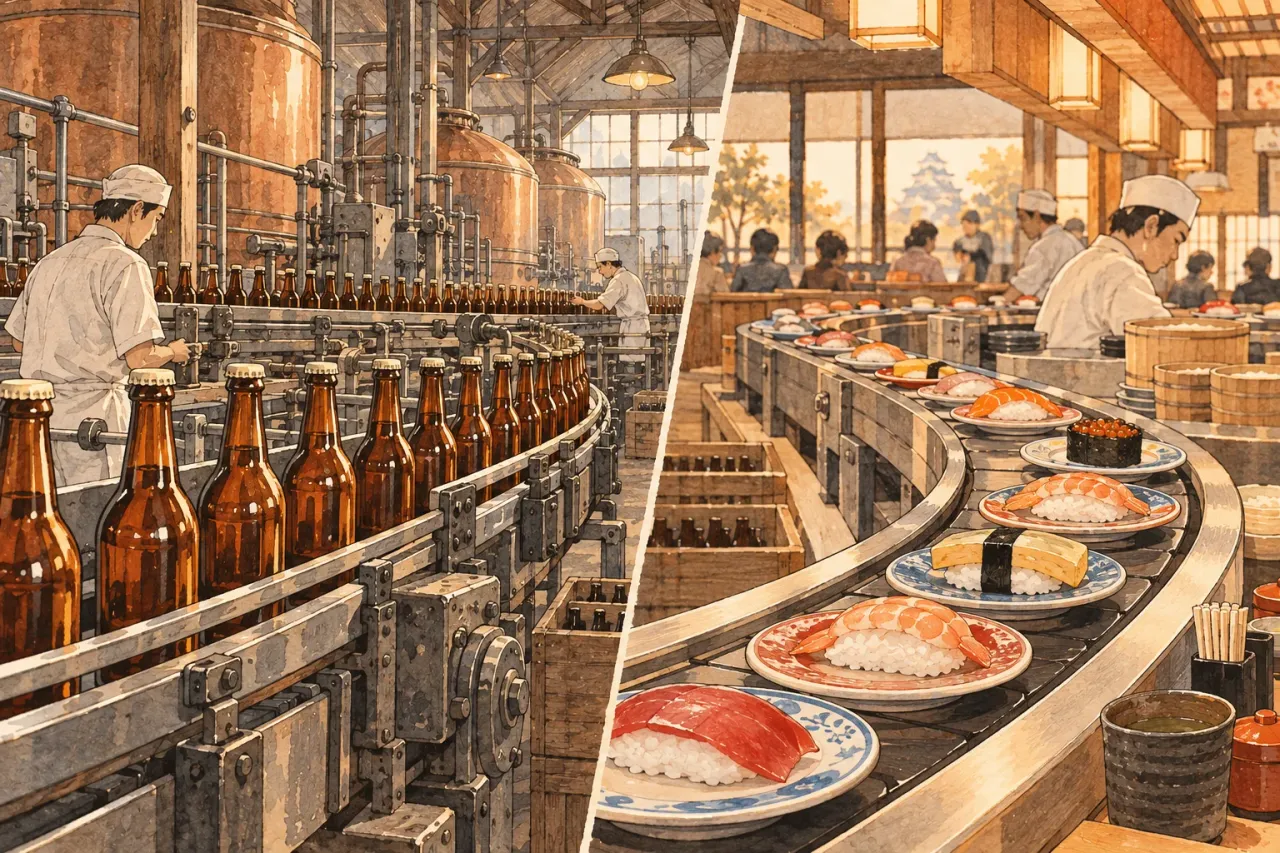
Shiraishi Yoshiaki moved from Ehime to Osaka in 1947 and opened a small standing sushi shop in Fuse, now part of Higashi-Ōsaka, selling four pieces for ¥20. In 1948, by the account the small-business agency and his own company give, he visited a beer factory in Suita and watched bottles ride a conveyor; it took him ten years to build a version that could carry plates round a corner without dropping them — the solution was a fan-shaped crescent plate he called uroko, fish scales. The first “revolving Genroku sushi” opened near Fuse station in April 1958, a second in Dōtonbori in 1960. He patented the “rotating dining table” in 1962 and used the patent to warn off imitators; at Expo ’70 in Osaka his pavilion shop drew queues down the concourse. The patent expired in 1978, and the format spread across the country; Genroku itself peaked at about 250 shops and opened the trademark “kaiten” to the industry in 1997. In 2021 the machine and its uroko plate were designated a Mechanical Engineering Heritage.
What makes it kaiten
The plate is the price. The format’s whole idea is that the colour of the dish tells you what you owe, and the bill is a stack counted at the end — or, now, a QR tag on each plate read by a camera. Kura’s plates carry a dated tag and a clear cover; a system it built in 1997 removes any plate that has been round too long.
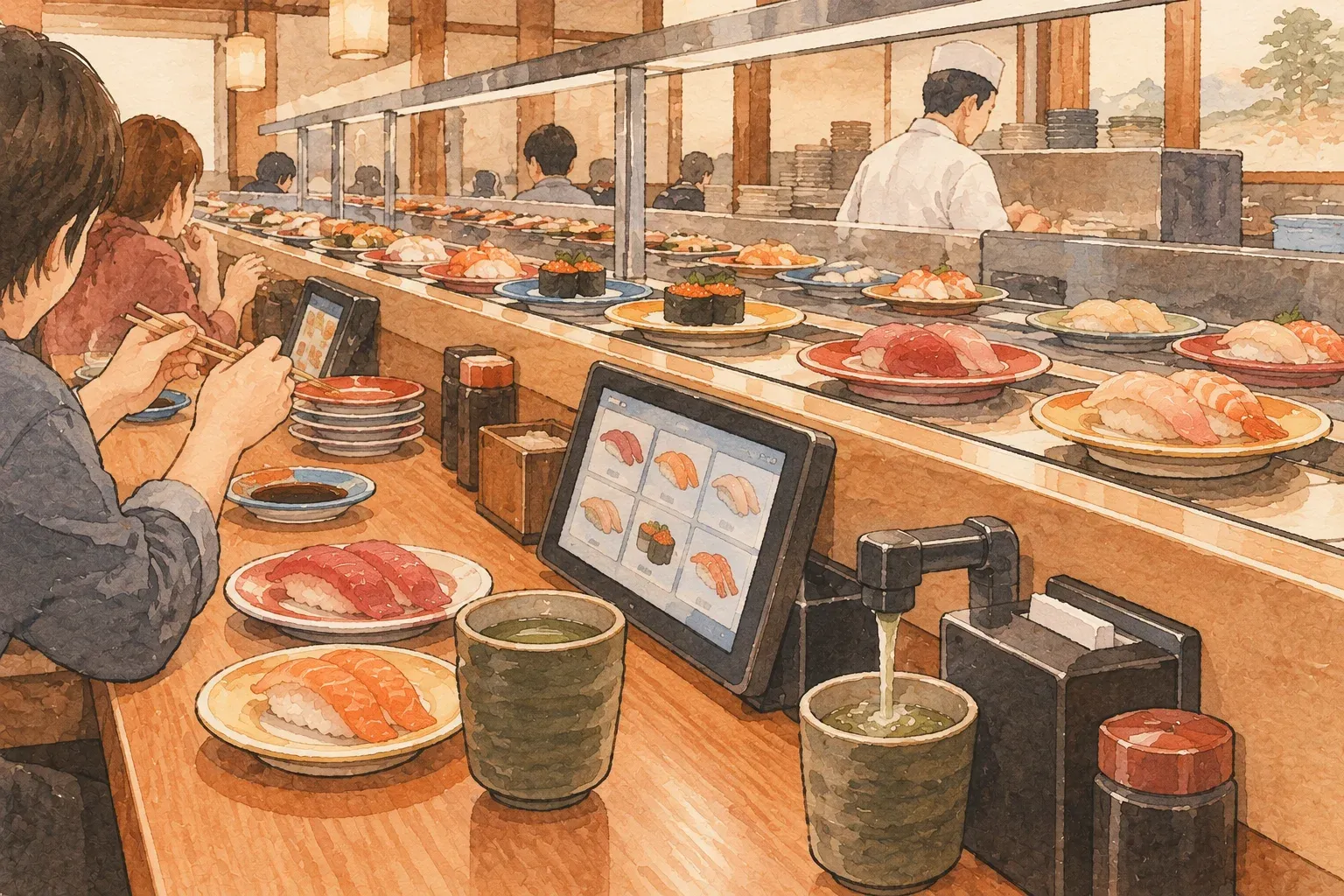
The order is replacing the belt. Kura says it is the only major chain still serving sushi on the belt. Sushiro’s “Digiro” — a touchscreen at every table showing plates you tap to order — makes its new shops fully to-order, which the company says cuts waste and staff; 123 shops had it by September 2025. Kappa has 222 shops with an “auto-waiter” lane that delivers your order direct to the seat. The industry survey finds three-quarters of customers now order more than they pick off the belt, and a majority say a chain that scraps the belt to cut waste moves up their list.
Salmon. The industry’s annual survey has put salmon first for fifteen years — first plate, last plate, most-eaten. Lean tuna and prawn follow. Edo never ate salmon raw; the belt made it the national sushi fish.
Why Osaka
A city of merchants, cheap eats and machines. Shiraishi’s problem was labour — a sushi chef at every seat is what makes the counter dear — and his answer was Osaka’s: automate the service, keep the chef in one place, and sell volume. That the format came from the city that had kept pressed box sushi for a hundred years rather than from Tokyo is not an accident; Osaka had no nigiri tradition to protect.
The chains, and what they charge
Conveyor-belt sushi 回転ずし
- Survey
- ¥241 (≈ €1 / $2)回転ずし店 にぎりずし/まぐろ(赤身)/2個 · Aug 2026 · 特別区部
- Chains
- ¥110–¥120Cheapest plate · Kura Sushi, Hama Sushi, Sushiro · tax incl. · checked 2026-10-05
- Our guide figure
- from ¥2,000 (≈ €11 / $13)A whole meal for one person. The survey figure beside it is for two pieces of tuna, not a bill · Oct 2026
The four, by their own latest accounts:
- Sushiro (Food & Life Companies): 659 shops in Japan and 227 abroad, revenue ¥429.6 billion in the year to September 2025. It ended its 38-year ¥100 (pre-tax) plate in October 2022 and now runs three price tiers — suburban (¥120 cheapest plate), semi-urban and urban (¥150) — and publishes which shop is which.
- Kura Sushi: 687 shops at October 2025 including 79 in the US, revenue ¥245.1 billion, and a Guinness record in March 2026 for the most conveyor-belt sushi shops in the world (694). It abolished per-plate pricing in 2022, then cut its floor price from ¥115 back to ¥110 in September 2026 — 37 items at ¥110 — while moving salmon and 32 others to ¥120.
- Hama Sushi (Zensho): 862 shops (664 in Japan), revenue ¥320.3 billion in the year to March 2026, the fastest-growing of the four; it raised some prices in May 2026 and its city-type shops charge ¥121 for the cheapest plate.
- Kappa Sushi: 299 shops, revenue ¥73.2 billion, the one chain shrinking.
What this costs you: about 9.9 plates and ¥2,175 for a man, ¥1,785 for a woman, by the 2026 survey — more in Hokuriku, where the average is ¥2,399 and the fish is better. The government’s two pieces of belt tuna in central Tokyo is ¥241.
How to do it
- Book a slot on the app or at the door; six in ten customers do, and a Saturday without one is a long wait.
- Sit, and look at the screen before the belt. Most of what is good is ordered, not picked up.
- Plates by colour, specials by screen. Soy sauce, ginger, green tea powder and hot water are at the seat.
- Stack the plates (or let the slot count them). Pay at the machine on the way out.
- Dessert and ramen are on the menu because the chains are restaurants now, not sushi bars.
The belt away from the suburbs
The format’s own geography is the thing to know. The chains’ city-centre shops are the same food at a higher plate price — Sushiro’s three tiers, Kura’s four (¥110 to ¥145), Hama’s “urban type” — and they say so in their price lists. Kanazawa’s tourism office notes that in the city that spends most on sushi in Japan, many shops “with the conveyor-belt sign” do not rotate anything: you order from the counter and a chef makes it, at belt-shop prices, from Sea of Japan fish. The industry survey’s respondents name Hokkaido, Ishikawa and Toyama as the places they would travel to for conveyor sushi, and in Ishikawa the one topping they will not skip is nodoguro, in Toyama buri. The belt is national; the fish on it is not.
Getting there
Higashi-Ōsaka, where it began, is on the Kintetsu line from Namba (Fuse station). Everywhere else, the nearest chain is at the nearest shopping mall or roadside; the city-centre shops are at the main stations and cost more.
What people get wrong
- “It still goes round.” Mostly not. The belt is a screen now at the biggest chain’s new shops, and the plates arrive by lane.
- “¥100 sushi.” That ended in 2022. ¥110–150 by tier, and the chains publish the tier.
- “It is low quality.” It is standardised. The survey’s own customers travel to Hokuriku for it, and order the local fish.
- “A Tokyo invention.” Osaka, 1958, by a man who was short of staff.
Questions people ask
How much is a plate?
¥110 at Kura and Hama for the cheapest plate of two pieces, ¥120 at Sushiro’s suburban shops and ¥150 at its city-centre ones; Kura’s central shops run to ¥145. The chains publish which shops are which. Kura cut its floor price back to ¥110 in September 2026.
Do the plates still go round?
Less and less. Kura says it is now the only major chain still serving sushi on the belt; Sushiro’s new shops have a screen at each table and no revolving plates; Kappa delivers orders on a direct lane. You order, it arrives.
What do Japanese people order?
Salmon, for fifteen years running in the industry’s annual survey — first plate, last plate and most plates. Lean tuna and prawn follow. The average visit is 9.9 plates and about ¥2,000.
Sources
- 中小機構 J-Net21 EXPO70特集(元禄産業・白石義明)
- 元禄産業 公式「回転寿司の歴史」
- 大阪観光局 OSAKA-INFO「回転寿司」
- FOOD & LIFE COMPANIES 2025年9月期 決算短信・店舗数データ
- FOOD & LIFE COMPANIES「国内スシローにおける本年10月以降の価格改定について」
- くら寿司 2025年10月期 決算短信
- くら寿司「寿司メニュー価格改定のお知らせ 最低価格を115円から110円に」
- くら寿司「回転寿司 店舗数 世界No.1 ギネス世界記録」
- くら寿司 プレスリリース(鮮度くん・時間制限管理システム)
- ゼンショーホールディングス 2026年3月期 決算短信(はま寿司)
- はま寿司「一部商品価格改定のお知らせ」
- カッパ・クリエイト 2026年3月期 決算説明資料
- FOOD & LIFE COMPANIES「スシロー未来型万博店」(デジロー)
- Umios「回転寿司に関する消費者実態調査2026」
- 厚生労働省 生活衛生適正化分科会 資料「すし店営業の現況について」
- 金沢市観光協会「金沢の絶品寿司を味わいつくす」
Prices are in Japanese yen. Conversions are approximate, at ¥177.30 to the euro and ¥158.23 to the US dollar as of 20 Oct 2026. Rates come from the European Central Bank, which publishes on working days only. Prices checked Oct 2026. What food costs in Japan →