
Funa-zushi: the fermented carp of Lake Biwa, the ancestor of all sushi, and why it smells like that
I have not been to every place in this guide. The figures below are taken from the sources listed at the end, with the date each one was published — not measured by me. Where I have been, the article says so.
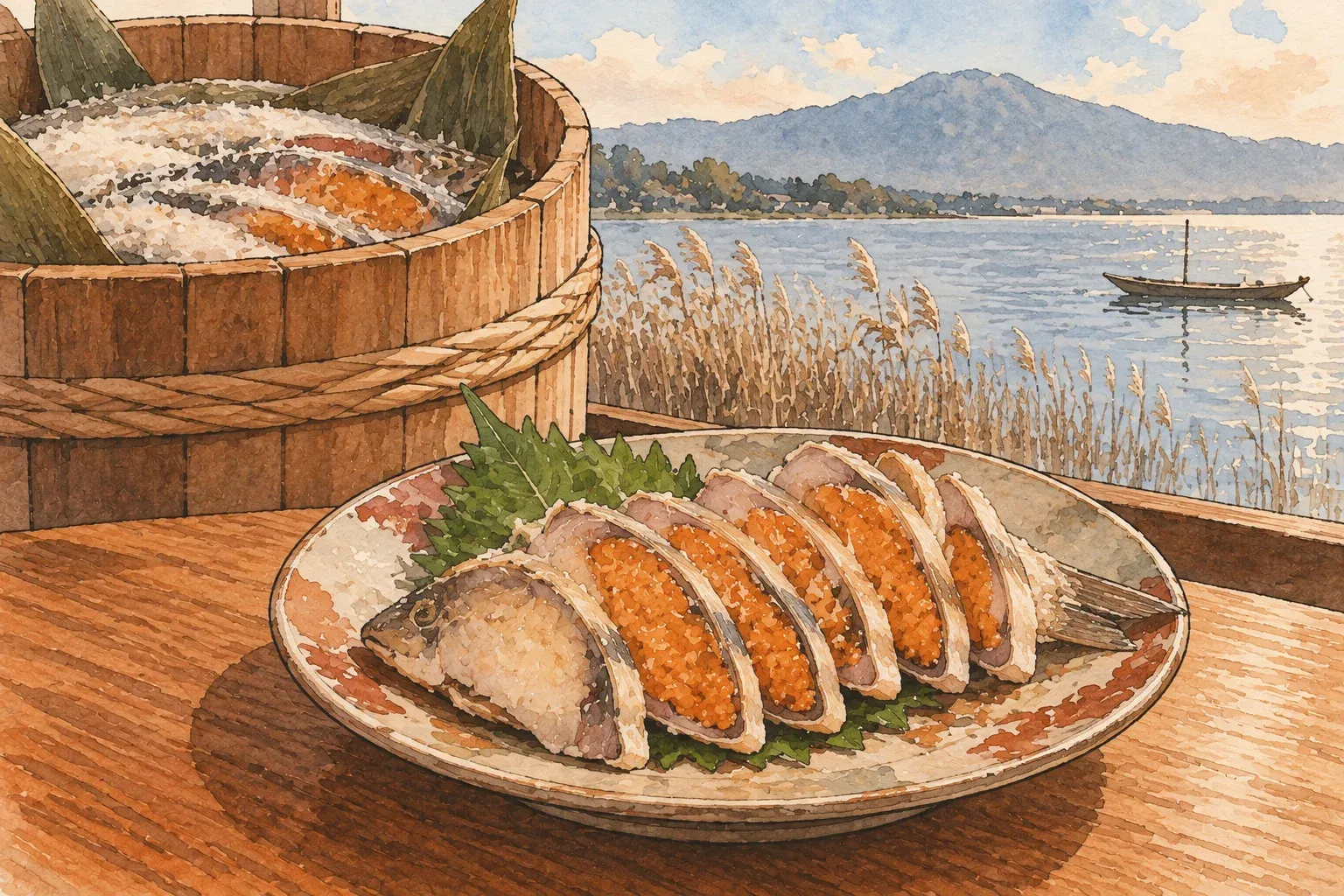
Funa-zushi is the sushi that was here before the word meant what it means now. No vinegar, no chef, no counter: a carp from the largest lake in Japan, salted, buried in cooked rice, and left to ferment through a summer and an autumn until the rice has turned to a sour cream and the fish tastes like a very old cheese. It is the dish the agriculture ministry calls the ancestor of all Japanese sushi, and it is eaten today mostly at festivals and funerals around Lake Biwa, by people who grew up with the smell.
Where it came from
The ministry’s history of narezushi — “matured sushi” — is the history of preserving fish without ice. The technique of packing salted fish in cooked rice and letting lactic fermentation preserve it is thought to have come from the rice-growing hills of South-East Asia and to have arrived in Japan with wet-rice farming. For most of its history the rice was a medium, not a food: it was scraped off and thrown away. In the Muromachi period people began shortening the ferment to a few months so that the rice could be eaten too (namanare), and the sour rice of that shortcut is the direct ancestor of the vinegared rice of Edo. The ministry’s grading is simple: one to three months is namanare; a year or more, sometimes two or three, is honnare, and Shiga’s funa-zushi is its representative.
What makes it funa-zushi
The fish. Nigoro-buna, a crucian carp endemic to Lake Biwa, caught in spring when it carries roe.
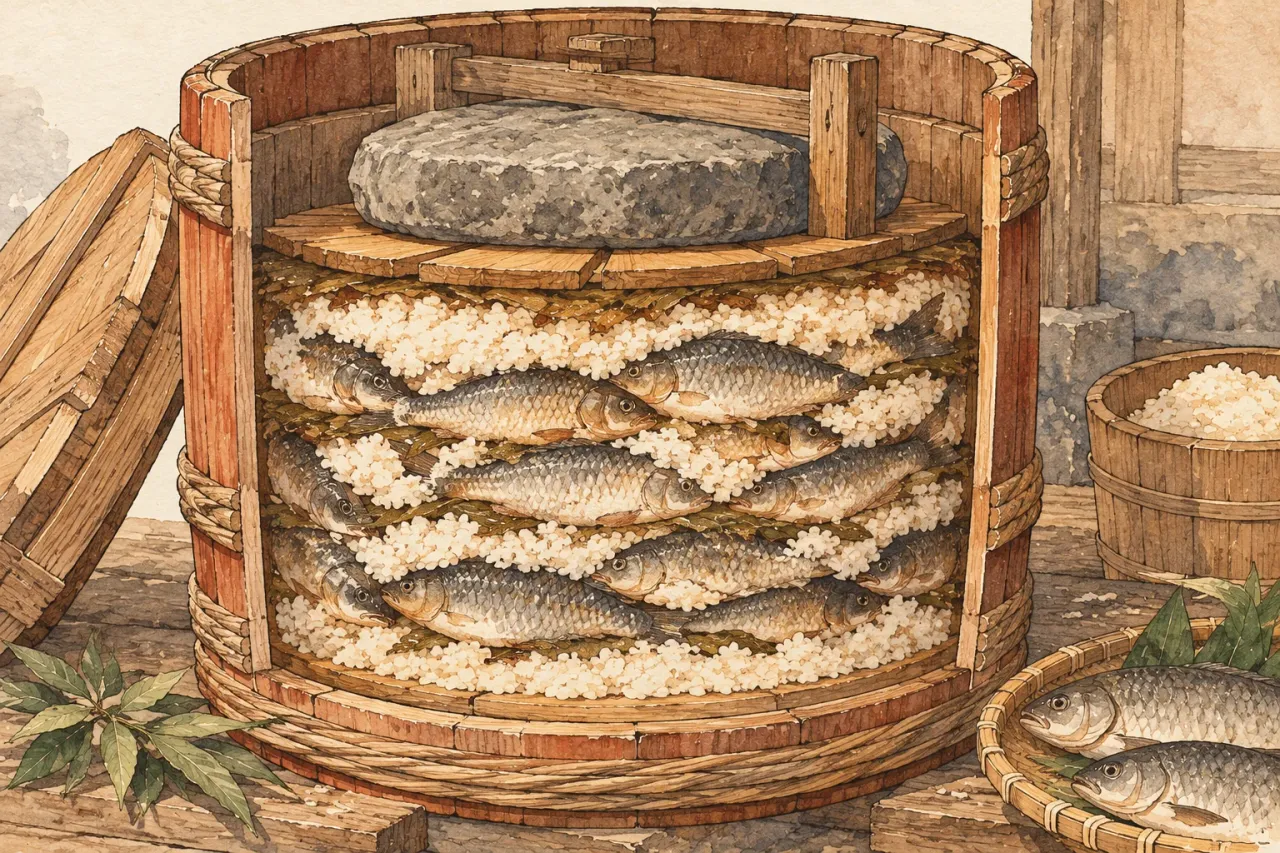
The method. Salted for about three months; in the dog days of summer the salt is washed off and the fish dried, then packed in alternating layers with cooked rice in a wooden tub, weighted, and left until New Year. Lactic acid does the preserving; the bones soften until the whole fish can be eaten.
The taste. Sour, salty, sharp, with the roe firm and the flesh soft. It is sliced thin and eaten a piece at a time with rice or sake; the fermented rice around it is eaten too, or stirred into hot water as a broth.
The status. Shiga selected funa-zushi as an intangible folk cultural property — a “food cultural asset” — in 1998. It is not among the prefecture’s “100-year food” listings, a reminder that the national scheme favours dishes people still cook at home.
Why Lake Biwa
Because the fish is there and nowhere else, and because a lake in the middle of Japan, far from the sea, needed a way to keep fish. Funa-zushi is offered to shrines at festivals around the lake and was eaten, the ministry notes, as a remedy for stomach complaints. It is in retreat: the nigoro-buna has declined with the loss of spawning grounds and the arrival of invasive fish, and most households that still make it now buy fish already salted and do only the summer packing.
The shops, and what they charge
Conveyor-belt sushi 回転ずし
- Survey
- ¥241 (≈ €1 / $2)回転ずし店 にぎりずし/まぐろ(赤身)/2個 · Aug 2026 · 特別区部
- Chains
- ¥110–¥120Cheapest plate · Kura Sushi, Hama Sushi, Sushiro · tax incl. · checked 2026-10-05
- Our guide figure
- from ¥2,000 (≈ €11 / $13)A whole meal for one person. The survey figure beside it is for two pieces of tuna, not a bill · Oct 2026
Funa-zushi is sold by the fish. Uoji in Takashima, on the lake’s north-west shore, a maker since 1784, lists a fully matured fish of 24–25 cm at ¥5,400 including tax in its online shop, and describes its method — three months in salt from spring, then rice at the height of summer, then two winters of fermentation. Shops in Hikone and Ōtsu sell slices by the plate; a few restaurants serve it with sake. It is not cheap, and it is not meant to be: one fish is a year’s work and a table’s worth of slices.
How to eat it
A slice or two, thin, with hot rice or sake. Try the rice paste around it before deciding you dislike it. Do not add soy sauce. If a host offers it, accept a small piece; it is the lake’s way of showing you were worth the trouble.
Funa-zushi away from Shiga
It travels only as a jar or a vacuum pack, and almost no restaurant outside the prefecture serves it. Kansai department stores sell it at New Year. What does travel is its descendant: every piece of nigiri in Japan is, by the ministry’s own genealogy, this dish with the waiting removed.
Getting there
Hikone and Ōtsu are on the JR Biwako line from Kyoto; Takashima is on the Kosei line up the western shore. The lake’s fish-market towns — Hikone, Nagahama, Ōmi-Hachiman — have shops selling it; ask at the station tourist office, because the makers are small.
What people get wrong
- “It is a curiosity.” It is the original. The rest of sushi is the abbreviation.
- “The rice is a garnish.” The rice is the preservative, and for a thousand years it was not eaten at all.
- “It is rotten.” It is lacto-fermented, like yoghurt or sauerkraut, and it is safe by design — that was the point.
Questions people ask
What is funa-zushi?
Nigoro-buna, a crucian carp native to Lake Biwa, taken with roe in spring, salted for about three months, then packed in layers of cooked rice in a tub in high summer and left to ferment with lactic acid until New Year or longer. The rice becomes a sour paste; the fish keeps for years and its bones go soft enough to eat.
Why is it called the ancestor of sushi?
Because this is what sushi was before vinegar. The agriculture ministry traces the method of preserving fish in fermented rice to South-East Asia and says it arrived in Japan with rice farming; the rice was originally discarded. The quick vinegared sushi of Edo was a shortcut for people who wanted the sour taste without the year’s wait.
How much does it cost?
A whole fermented fish of 24–25 cm is ¥5,400 including tax from Uoji in Takashima, a maker since 1784. It is sliced thin, so one fish serves a table.
Sources
Prices are in Japanese yen. Conversions are approximate, at ¥177.30 to the euro and ¥158.23 to the US dollar as of 20 Oct 2026. Rates come from the European Central Bank, which publishes on working days only. Prices checked Oct 2026. What food costs in Japan →