
Osaka box sushi: the pressed, sweetened, soy-free sushi that Tokyo forgot
I have not been to every place in this guide. The figures below are taken from the sources listed at the end, with the date each one was published — not measured by me. Where I have been, the article says so.
In Tokyo, “sushi” means nigiri. In Osaka, by the agriculture ministry’s own phrasing, the representative sushi is pressed: rice and fish packed into a wooden frame, weighted, turned out and cut into neat blocks. It is older than nigiri, it needs no soy sauce, it keeps for hours, and it is disappearing — because, as the ministry says plainly, it takes too much work.
Where it came from
Pressed sushi is the form that nigiri came out of. The National Diet Library’s history records that Edo had pressed sushi before anyone thought to shape a portion by hand, and that when Edo switched to nigiri around the 1820s, Kyoto and Osaka did not. The Morisada Mankō, mid-1800s, puts it in a sentence: Edo is all hand-pressed now; the Kamigata cities keep the box.
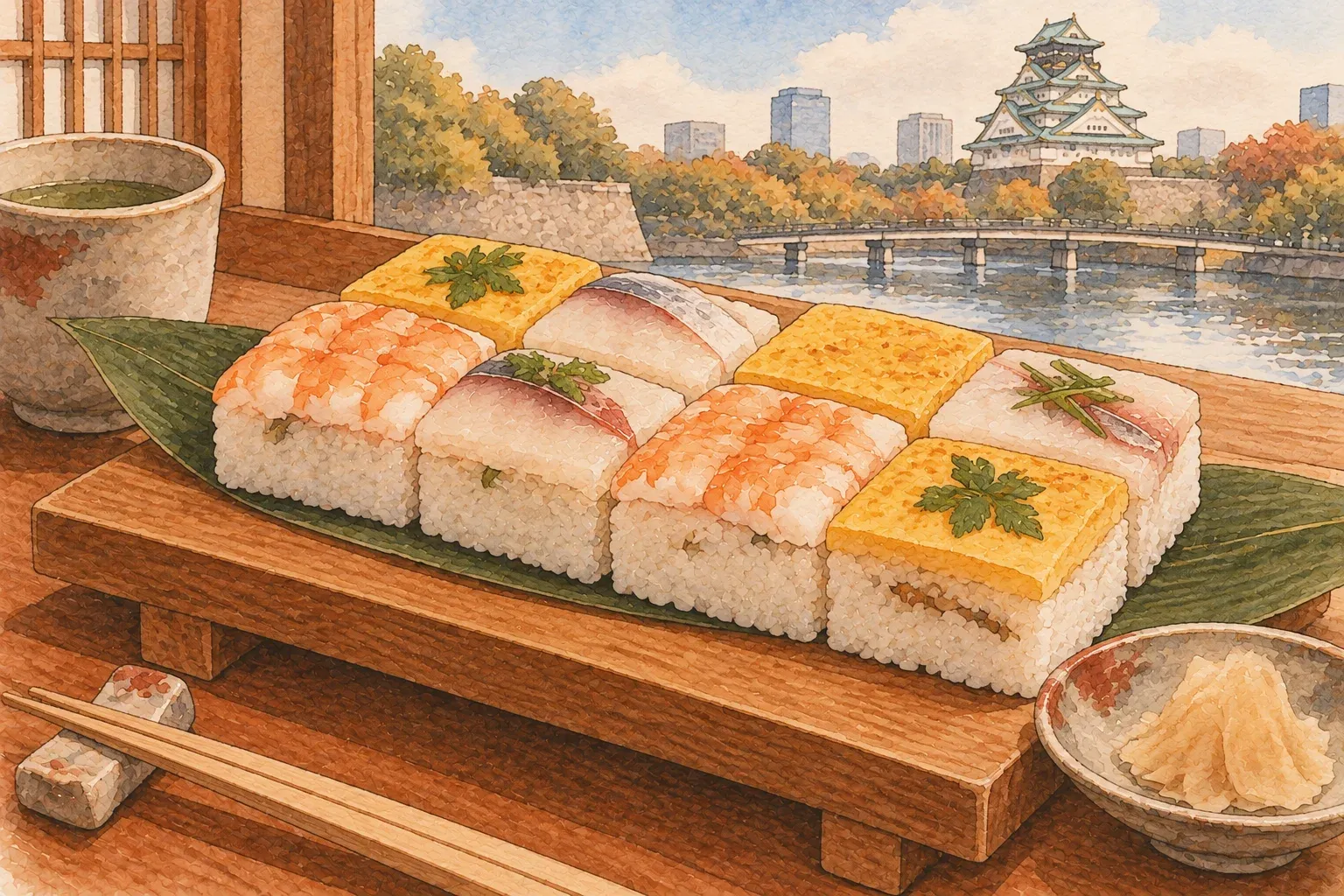
Osaka then refined the box into something richer. In the Meiji era, the ministry says, Yoshino-zushi in Senba — the merchants’ quarter — devised a box sushi of sea bream, prawn and conger eel, luxurious enough to be nicknamed “a kaiseki in two sun six bu” (the size of the box, about 8.5 cm), and sold it to the Senba merchants as an interval meal at the theatre and a gift to carry home. The shop still presses it by hand rather than with a weight, in a thick cypress frame of that size, and still closes at six and on weekends like the merchant shop it was.
Battera is the people’s version. In 1891 Sushi-tsune in Minami-Senba pressed vinegar-cured gizzard shad on rice; the half-fish on its block looked like a small boat, bateira in Portuguese, and the name stayed when the fish changed to cheaper mackerel and the mould to a plain rectangle. The shop closed and reopened under its fourth generation in 2016.
What makes it Osaka sushi
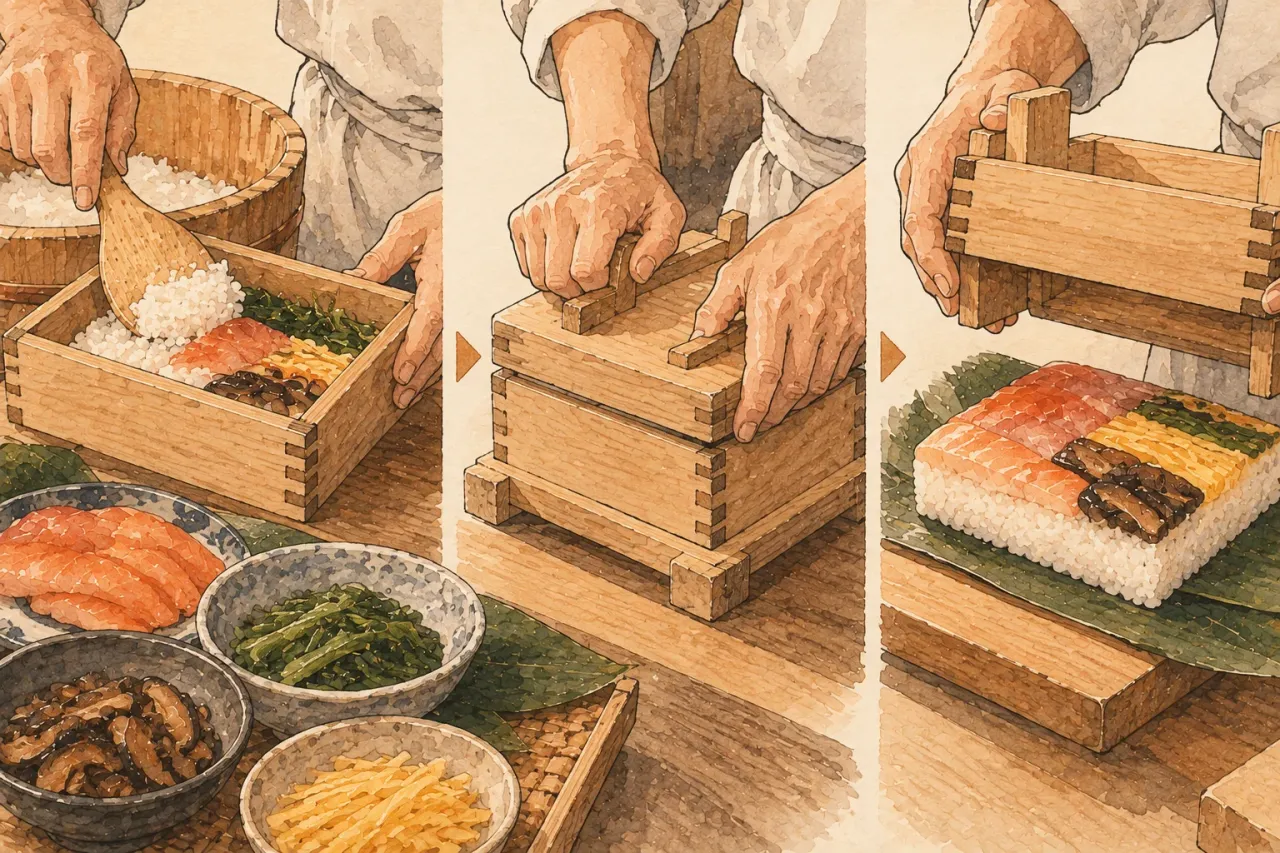
The box. A wooden frame — cypress at Yoshino — lined with rice, layered with fish, pressed by weight or by hand, turned out, cut. The pieces are uniform and dense; a block of hako-zushi is a different texture from a nigiri and is meant to be.
The rice. The Osaka tourism board notes that the city cooks its sushi rice with kelp stock and seasons it with sugar and mirin, and that sugar goes into the rice even at Osaka’s nigiri counters; hard Ōmi rice suits the box where soft rice suits the hand.
The fish is finished. Sea bream, conger, prawn, shad and mackerel, cured or simmered. Both ministry entries make the point that the result is eaten without soy sauce — the seasoning is already in it — and that this is what made it the gift and the interval meal.
Battera. Cured mackerel, a translucent sheet of white kelp (shiraita kombu) on top, cut into slices; the city’s everyday pressed sushi, and the one you will find at station counters. Kyoto, forty minutes away, has its own cousin — saba-zushi, a whole cured mackerel fillet pressed on rice, the festival dish of the city, made at Izuu since 1781.
Why Osaka
Merchants, theatres and gifts. Nigiri is food eaten the moment it is made; a city of shopkeepers and theatre-goers wanted sushi that could be carried to a box seat, given to a customer or eaten after the second act, and pressed sushi, cured and soy-free, is that food. The tourism board’s summary of the Meiji–Taishō cliché — “Edo for nigiri, Kamigata for the box” — is a description of two cities’ days as much as their tastes.
The shops, and what they charge
Osaka’s own pressed sushi is priced per box rather than per plate, and no prices were found on the official pages of the two historic houses, Yoshino-zushi (Awajichō 3-4-14, 09:30–18:00, closed weekends and holidays) and Sushi-tsune (Minami-Senba), so none are given here.
In the government’s household spending survey (2023–25 average), Osaka ranks 23rd of 52 cities for sushi eaten out, at ¥16,839 a year per household, against a national average of ¥16,577 and ¥22,406 in first-placed Kanazawa. The ministry also remarks that fewer shops now make box sushi.
How to eat it
Without soy sauce, with the fingers or chopsticks, as it comes — the seasoning is in the fish and the rice. A box of hako-zushi is a meal for one or a gift for two; battera is lunch on a train. It is at its best an hour or two after pressing, not straight from the box, which is the opposite of nigiri and the whole point.
Osaka sushi away from Osaka
It barely travels, except as battera in station bento across Kansai. In Tokyo, “Osaka sushi” is a speciality a few shops keep rather than a category, and the Tokyo habit of dipping everything in soy sauce defeats it — the fish is already seasoned, and soy on battera is the local tell of someone from the east. The reverse is also true: order nigiri in Osaka and the rice may be sweeter than Tokyo’s, by the city’s own account, and the shop may offer a box as well. The two cities split in the 1820s and never quite rejoined.
Getting there
Senba is between Yodoyabashi and Honmachi stations on the Midōsuji subway line; Yoshino-zushi is a short walk from Awajichō. Battera is at any JR or Nankai station kiosk in the city, and on the Kansai Airport train.
What people get wrong
- “Pressed sushi is a lesser form.” It is the older form; nigiri is its shortcut.
- “Sushi needs soy sauce.” Not this one. It is seasoned already, and the ministry says so.
- “Battera is a Japanese word.” Portuguese, for a boat, since 1891.
- “Osaka is a sushi city.” It is a box-sushi city that invented the conveyor belt; for nigiri, go to Kanazawa.
Questions people ask
What is battera?
Pressed sushi of vinegar-cured mackerel on rice, topped with a sheet of white kelp, made in a rectangular box and cut into slices. It began at Sushi-tsune in Osaka’s Minami-Senba in 1891, originally with gizzard shad; the half-fish shape looked like a small boat — “bateira” in Portuguese — and the name stuck.
Why is there no soy sauce?
Because the fish is already seasoned. Osaka cures and marinates its toppings and sweetens the rice, so the ministry’s description of both hako-zushi and battera notes they are eaten without soy — which is also why they travel well as a take-away box.
Where can I eat it?
The Senba district of central Osaka, where Yoshino-zushi has made box sushi since the Meiji era (9:30–18:00, closed weekends), and the battera counters at the stations. Fewer shops make it each year; the ministry says the labour is the reason.
Sources
Prices are in Japanese yen. Conversions are approximate, at ¥177.30 to the euro and ¥158.23 to the US dollar as of 20 Oct 2026. Rates come from the European Central Bank, which publishes on working days only. Prices checked Oct 2026. What food costs in Japan →