
Kanazawa sushi: the city that spends most on sushi in Japan, and its conveyor shops that do not revolve
I have not been to every place in this guide. The figures below are taken from the sources listed at the end, with the date each one was published — not measured by me. Where I have been, the article says so.
Tokyo invented nigiri. Kanazawa eats it. In the government’s household survey the old castle town on the Sea of Japan spends more per household on sushi eaten out than any city in the country — ¥22,406 a year, a fifth more than Tokyo — and its neighbour Toyama is second. The reason is on the plate: winter fish from a cold sea, a shrimp that cannot be shipped, and a local habit of treating a conveyor-belt shop as a counter where you order from the chef.
Where it came from
Kanazawa’s sushi is not a lineage with a founding shop; it is a market town’s relationship with its sea. The Maeda lords’ castle town was the richest domain outside the shogun’s, with the merchants and craftsmen to match, and the Ōmicho market has sold the Sea of Japan’s catch since the Edo period. What the city’s tourism office stresses is the present: a roster of high-level counters competing with one another, a branded local shrimp, and the fact that the city tops the national spending table.
What makes it Kanazawa sushi
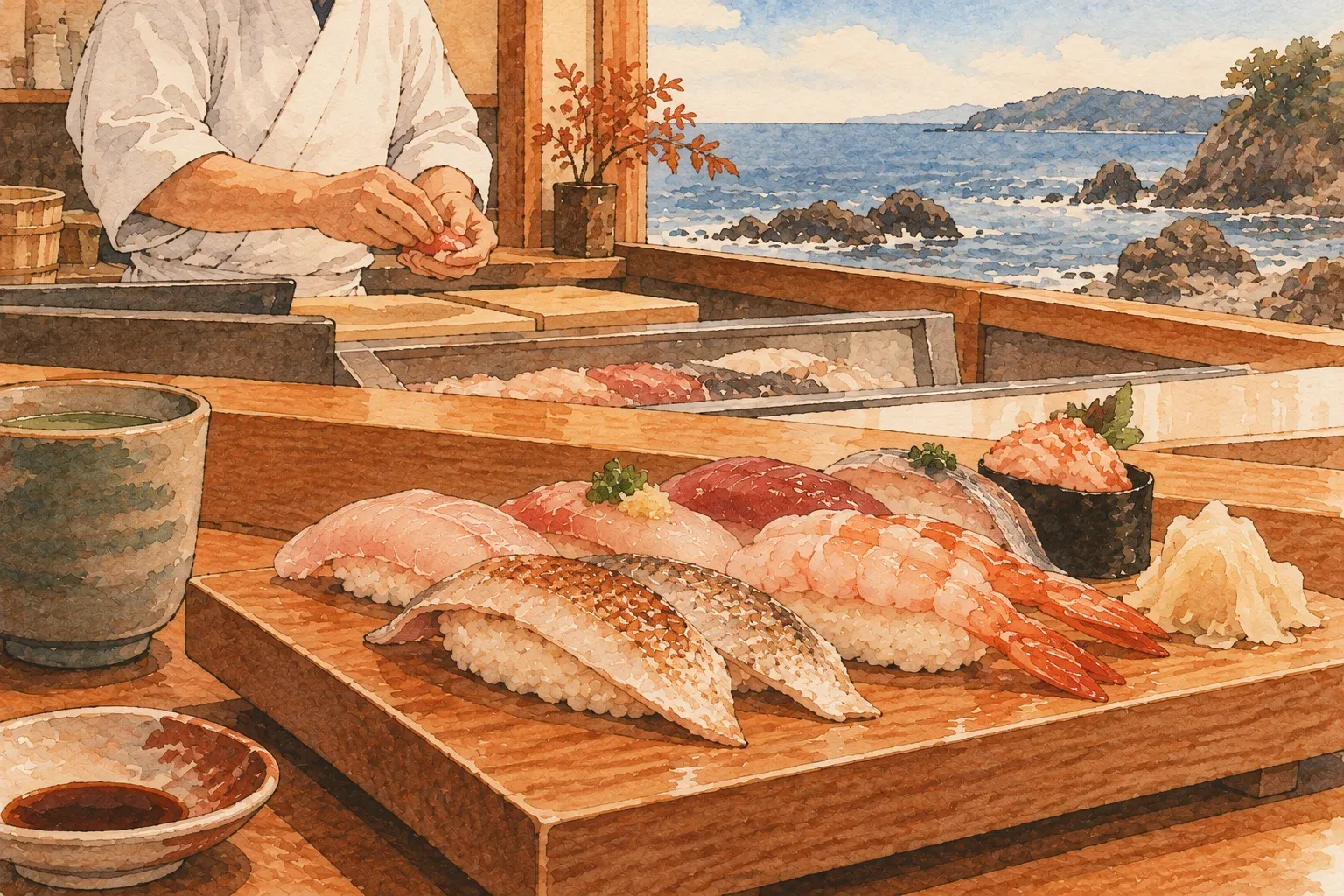
The fish. The tourism office’s list is the menu: Kanazawa ama-ebi, the branded sweet shrimp; gasu-ebi, a deep-water shrimp that spoils too fast to leave the prefecture; shiro-ebi, white shrimp from Toyama Bay; nodoguro, the fatty blackthroat seaperch that is Hokuriku’s prize; ume-gai whelk; and hotaru-ika kurozukuri, firefly squid cured black in its own ink. The regional conveyor chain Morimori-zushi sells these as a “Hokuriku five-piece set”. The industry’s 2026 survey asked diners which topping they would not skip in each prefecture: in Ishikawa the answer was nodoguro, in Toyama yellowtail.
The season. Winter. The Sea of Japan’s cold-water fish — crab, yellowtail, the shrimps — are at their best from November, which is also when the city is at its greyest.
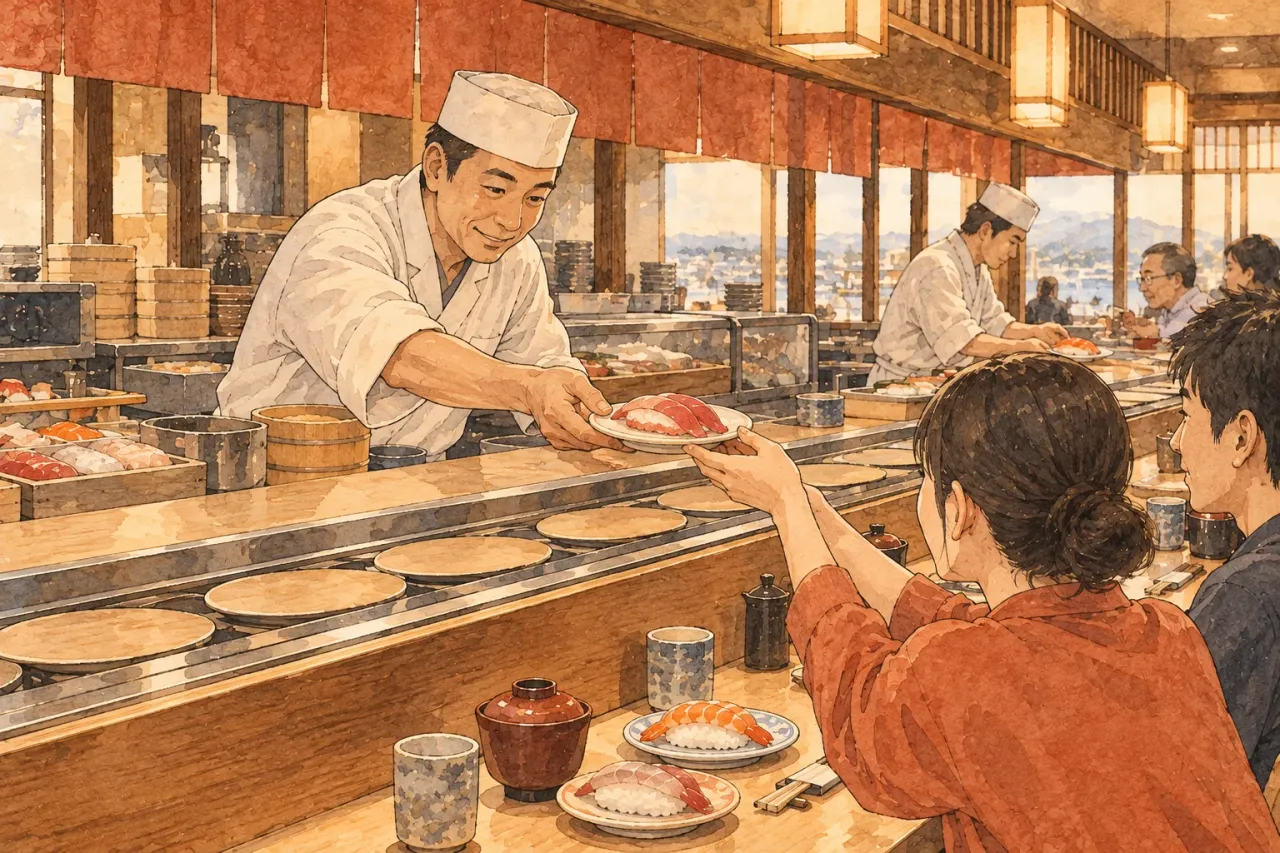
The counter that says “conveyor”. The tourism office’s observation is the useful one: many Kanazawa shops carry the kaiten sign and rotate nothing. You sit at a counter, order from the chef, and pay belt-shop prices for hand-made nigiri of local fish. Locals, it says, order directly rather than take from the belt even where there is one. The prefecture’s tourism body names Morimori-zushi as “the originator of Kanazawa conveyor sushi” and the pioneer of the regional-conveyor model, and counts the local chains at Morimori 12 shops, Kaiten-zushi 7, Sushi-kuinee 6 and Kanazawa Maimon 3 in the prefecture.
Why Kanazawa
Cold sea, rich town, no Tokyo. The fish is the first answer; the second is that Kanazawa’s sushi culture grew up at a distance from Edo’s, around a market rather than a street stall, and never learned to think of the conveyor shop as second-class. The national industry survey has respondents naming Hokkaido, Ishikawa and Toyama as the places they would travel to for conveyor sushi, and the Hokuriku average spend — ¥2,399 a head against a national ¥2,000 or so — shows what they pay for when they get there.
The shops, and what they charge
Conveyor-belt sushi 回転ずし
- Survey
- ¥241 (≈ €1 / $2)回転ずし店 にぎりずし/まぐろ(赤身)/2個 · Aug 2026 · 特別区部
- Chains
- ¥110–¥120Cheapest plate · Kura Sushi, Hama Sushi, Sushiro · tax incl. · checked 2026-10-05
- Our guide figure
- from ¥2,000 (≈ €11 / $13)A whole meal for one person. The survey figure beside it is for two pieces of tuna, not a bill · Oct 2026
Those are the national chains. Kanazawa, from the city tourism office’s own listings:
- Sushi Mitsukawa, evening from ¥19,800 including tax; Sushi Kibatani, evening from ¥20,000 before tax — the omakase counters.
- Sentori-zushi Honten, lunch from ¥3,800, dinner from ¥8,000, tax included — the mid-priced counter the city still has, and the kind the health ministry says is disappearing nationally.
- Morimori-zushi and the other local conveyor chains, at belt prices for local fish; the Hokuriku five-piece set is the way to taste the roster in one order.
- Ōmicho market, where the restaurants’ counters open at lunch and the tourist premium is visible — the price reference page has the general rule for market bowls.
How to eat it
In winter, if you can. At a conveyor shop, order from the chef rather than the belt and ask for the local set; at a counter, say omakase and the nodoguro will come. Gasu-ebi, if offered, is the thing you cannot eat anywhere else; it is soft and sweet and ugly, and the chef will tell you so.
Kanazawa sushi away from Kanazawa
The branded sweet shrimp and the nodoguro travel to Tokyo counters at Tokyo prices; the gas shrimp does not travel at all, and the black-cured firefly squid is a jar. What does not export is the model — the conveyor-sign counter at belt prices — which depends on a city that eats sushi weekly and a sea an hour away. Kanazawa is the proof, in the national survey’s own numbers, that the best cheap sushi in Japan is not in Tokyo.
Getting there
Kanazawa is two and a half hours from Tokyo on the Hokuriku Shinkansen and two from Osaka or Kyoto by the Thunderbird to Tsuruga and the Shinkansen beyond. Ōmicho market is a fifteen-minute walk from the station; the counters are around Katamachi and Higashi-chaya.
What people get wrong
- “Tokyo is where you eat sushi.” Kanazawa spends 20% more on it, per household.
- “Conveyor sushi is a chain thing.” In Kanazawa the sign means a counter with local fish.
- “Nodoguro is a Tokyo luxury.” It is the Hokuriku home fish, and it is on the belt.
Questions people ask
Why is Kanazawa a sushi city?
Sea of Japan fish in winter, a wealthy castle-town culture, and a habit of eating out for it. In the government household survey (2023–25) Kanazawa spends ¥22,406 a year per household on sushi eaten out, first of 52 cities, with Toyama second. Tokyo is 11th.
What is the local fish?
Kanazawa’s branded sweet shrimp (ama-ebi), the deep-water "gas shrimp" (gasu-ebi) that does not travel, white shrimp, nodoguro (blackthroat seaperch), ume-gai whelk, and firefly squid cured black. The industry survey finds nodoguro is the one topping Ishikawa diners will not skip.
How much does it cost?
Omakase counters from ¥19,800–20,000 (Mitsukawa, Kibatani); Sentori-zushi lunch from ¥3,800 and dinner from ¥8,000; the local conveyor chains at belt prices, with the Hokuriku average spend the highest in Japan at ¥2,399 a head.
Sources
Prices are in Japanese yen. Conversions are approximate, at ¥177.30 to the euro and ¥158.23 to the US dollar as of 20 Oct 2026. Rates come from the European Central Bank, which publishes on working days only. Prices checked Oct 2026. What food costs in Japan →