
Toyama masu-zushi: a round cake of trout and rice that a station kiosk made famous
I have not been to every place in this guide. The figures below are taken from the sources listed at the end, with the date each one was published — not measured by me. Where I have been, the article says so.
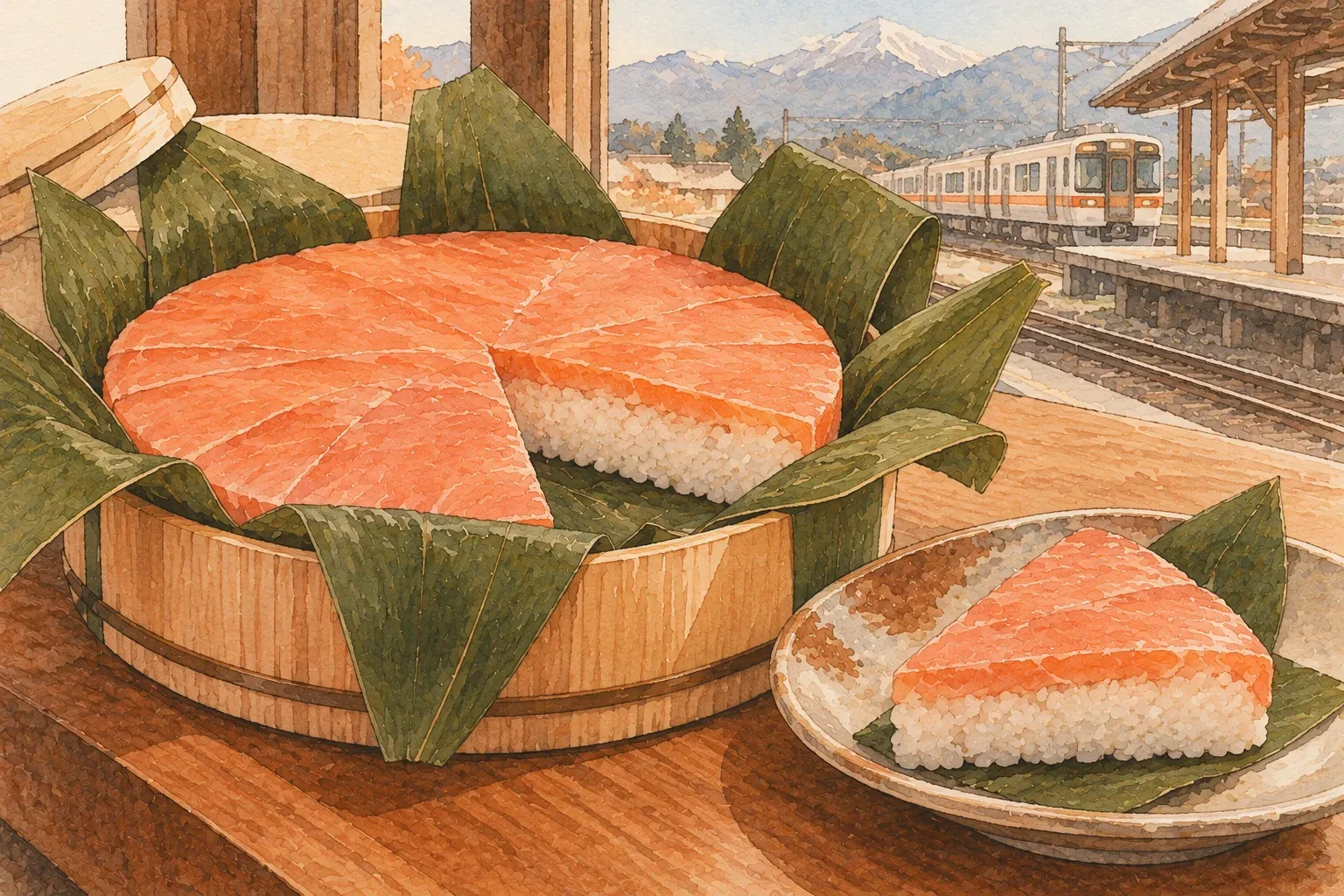
Masu-zushi is the sushi you eat on a train. A flat round of rice under a layer of pink cherry salmon, pressed in a bamboo-lined wooden frame and sold in a box with a plastic knife, it is the station lunch of the Hokuriku line and the only pressed sushi most Japanese people outside Kansai eat regularly. Toyama, the city that makes it, has more than twenty specialist makers and spends more on sushi eaten out than any city but Kanazawa.
Where it came from
The agriculture ministry’s account begins with a samurai. In the Kyōhō era, Yoshimura Shinpachi of the Toyama domain made a sushi of sweetfish (ayu) for the third lord, Maeda Toshioki, who presented it to the shogun Yoshimune and was praised for it. Over time the sweetfish gave way to cherry salmon (sakura-masu) from the Jinzū river, and the dish took its present round form. What made it famous was the railway: the ministry dates its national reputation to the Taishō period, when it was sold as a station bento. Minamoto, the maker whose box is the one you will see, began as a hotel in 1900, was licensed to sell bento on Toyama station in 1908, and started selling masu-zushi in 1912; its own chronology records a price of 45 sen in 1932 and ¥110 for a single tier in 1949.
What makes it masu-zushi
The form. A round wooden frame, lined with bamboo leaves; rice pressed in, salmon laid over, more leaves, a lid and a weight. It is sold whole and cut into wedges.
The fish. Cherry salmon, lightly salted and vinegared. The pink surface is the dish’s signature.
The rice. Lightly vinegared, pressed firm enough to hold a wedge.
The timing. It is meant to be eaten hours after pressing, cold, which is the whole logic of a bento. Fresh from the frame it is too soft.
Why Toyama
A river with cherry salmon, a domain with a reason to impress Edo, and a railway junction. Toyama’s station was on the main line from Osaka to Niigata before the Shinkansen, and a sushi that improved on the journey was the ideal thing to sell there. The city still has more than twenty makers, a Masu-zushi Museum run by one of them, and a cooperative that offers hands-on pressing.
The shops, and what they charge
Conveyor-belt sushi 回転ずし
- Survey
- ¥241 (≈ €1 / $2)回転ずし店 にぎりずし/まぐろ(赤身)/2個 · Aug 2026 · 特別区部
- Chains
- ¥110–¥120Cheapest plate · Kura Sushi, Hama Sushi, Sushiro · tax incl. · checked 2026-10-05
- Our guide figure
- from ¥2,000 (≈ €11 / $13)A whole meal for one person. The survey figure beside it is for two pieces of tuna, not a bill · Oct 2026
Masu-zushi is sold by the round, not the plate, and the best-known maker does not publish prices online — Minamoto’s site records revisions in June and September 2026 but not the figures — so none are given here. Expect a single-tier round to cost what a good station bento costs. Toyama households rank second in Japan for sushi eaten out, at ¥21,750 a year; the industry’s conveyor-sushi survey finds the topping Toyama diners will not skip is buri, yellowtail, not trout — masu-zushi is the gift and the lunch, not the counter.
How to eat it
Open the box, lift the top leaves, cut wedges with the knife provided, eat with the fingers. No soy sauce; it is seasoned. It keeps for a day.
Masu-zushi away from Toyama
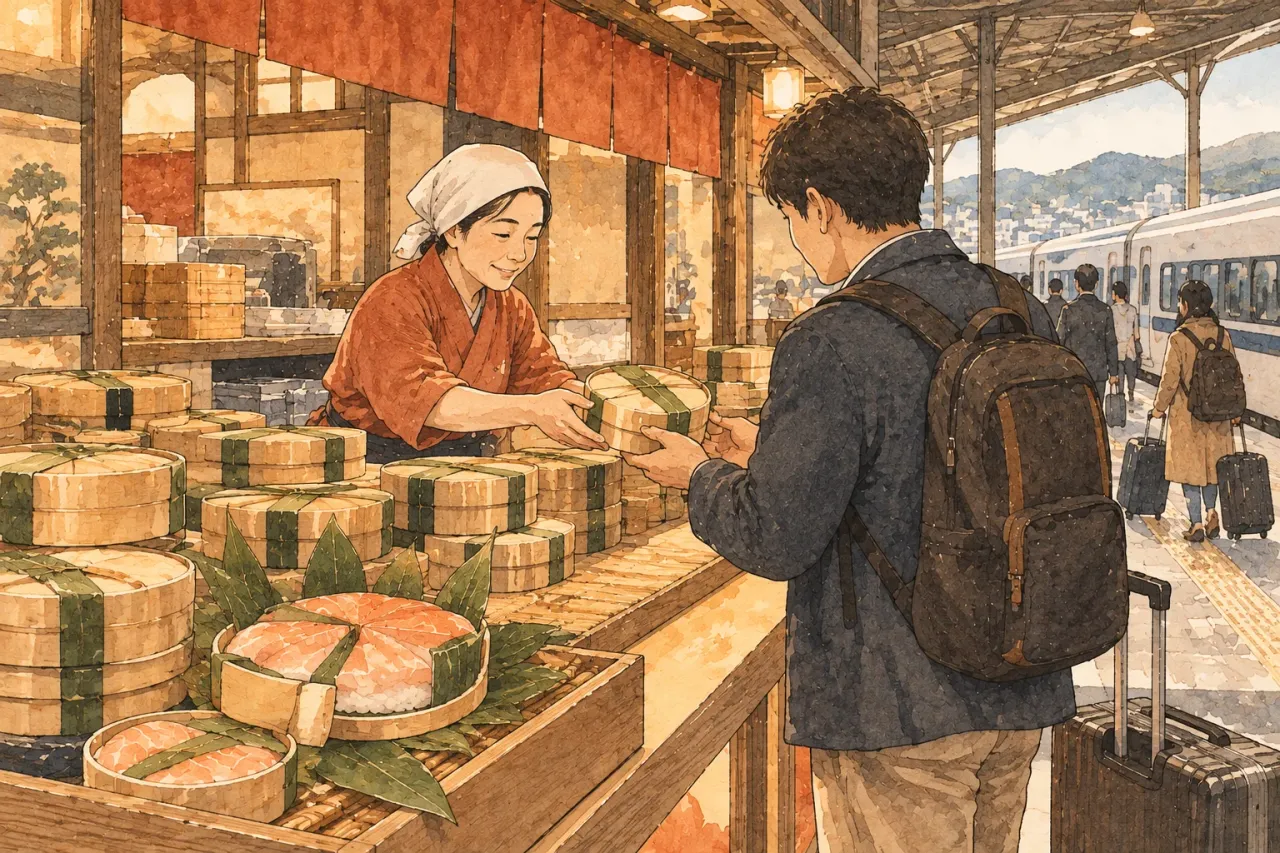
It is the rare regional sushi that is widely available elsewhere, because it was built to travel — the Toyama makers sell through station kiosks and department-store fairs across Japan. What you cannot get elsewhere is the choice: in Toyama the twenty-odd makers differ in the thickness of the fish, the sweetness of the rice and the pressing, and locals have a maker the way other cities have a baker.
Getting there
Toyama is on the Hokuriku Shinkansen from Tokyo (about two hours) and the Hokuriku line from Kanazawa. The makers’ shops are around the station and in the city; the museum is a short taxi ride.
What people get wrong
- “It is a bento, not real sushi.” It is a pressed sushi with a three-hundred-year pedigree that happens to travel well.
- “Toyama eats trout sushi.” Toyama eats yellowtail at the counter and gives masu-zushi as a gift.
- “One maker.” More than twenty, and they argue.
Questions people ask
What is masu-zushi?
Lightly vinegared rice pressed into a round wooden frame under slices of cherry salmon (masu), wrapped in bamboo leaves and weighted. It is cut like a cake and eaten cold, hours after it is made, which is why it became a station bento.
How old is it?
The agriculture ministry traces it to the Kyōhō era (1716–36), when a Toyama samurai, Yoshimura Shinpachi, made a sweetfish sushi for his lord, who presented it to the shogun Yoshimune. Sweetfish gave way to cherry salmon from the Jinzū river, and the dish went national as a station bento in the Taishō period.
How much is it?
The best-known maker, Minamoto, does not publish current prices online and revised them in June and September 2026, so none are given here. Its own history records ¥110 for a single tier in 1949.
Sources
Prices are in Japanese yen. Conversions are approximate, at ¥177.30 to the euro and ¥158.23 to the US dollar as of 20 Oct 2026. Rates come from the European Central Bank, which publishes on working days only. Prices checked Oct 2026. What food costs in Japan →