
Edomae sushi: the Tokyo counter, the cured fish behind the word "raw", and what lunch and dinner cost at the same bar
I have not been to every place in this guide. The figures below are taken from the sources listed at the end, with the date each one was published — not measured by me. Where I have been, the article says so.
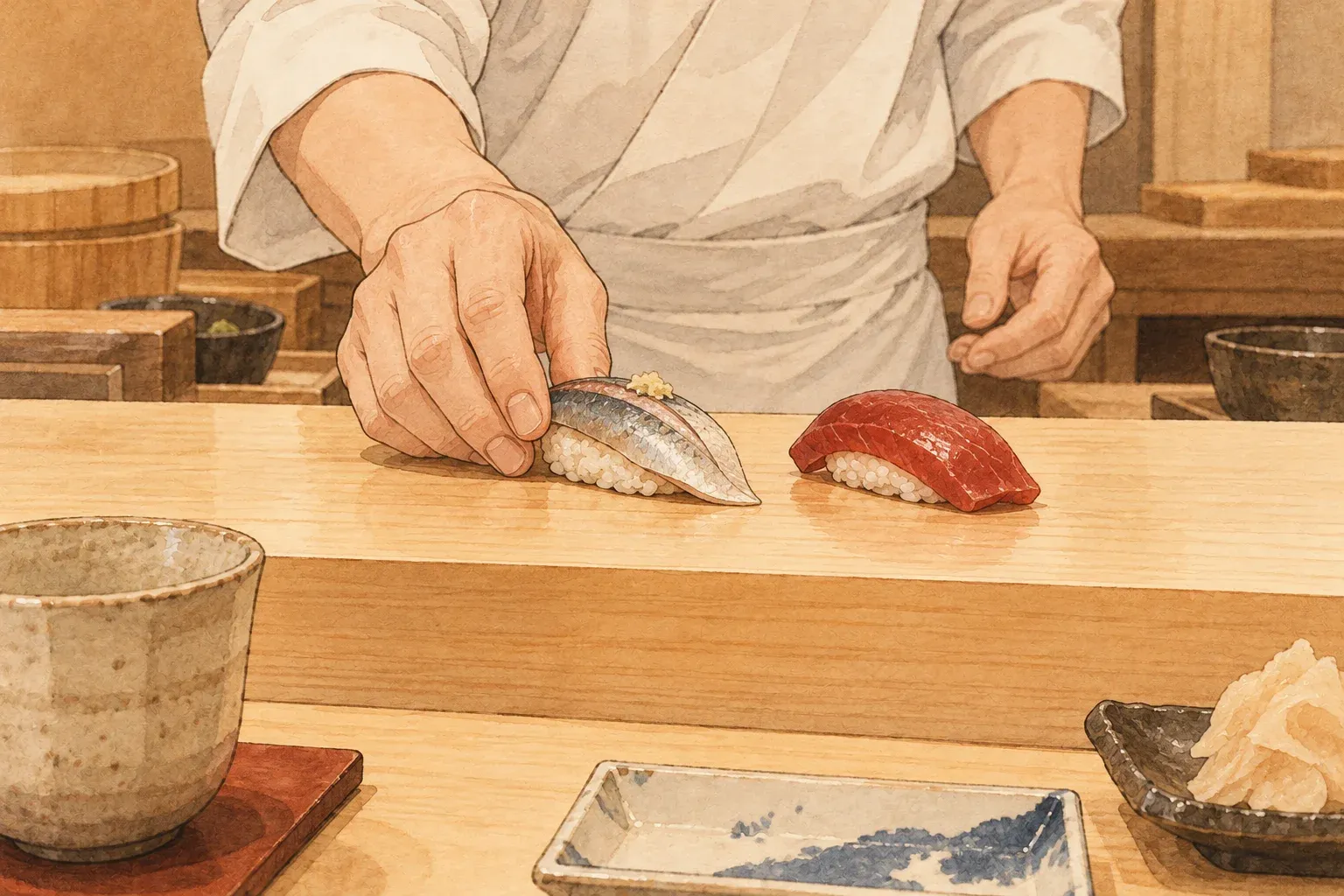
The sushi the world copies is this one: a chef behind a plain wood counter, a ball of vinegared rice pressed in the palm, a slice of fish laid over it, handed across one piece at a time. It is Tokyo’s invention, it is about two hundred years old, and almost everything people believe about it — that it is raw, that it is ancient, that it is expensive — is only partly true.
Where it came from
The National Diet Library’s history is careful about dates. Fermented sushi was sold in Edo in the late seventeenth century; vinegared “quick sushi” appeared in the 1750s; and hand-pressed nigiri — a single portion of box sushi shaped by hand instead of cut — was being sold by the 1820s, probably earlier. The reference-desk literature gives the usual names: Matsu-ga-zushi in Fukagawa around 1820, and Hanaya Yohei, who by the most-repeated account devised the modern form in the Bunsei years, sold it from a carrying box and a stall, and opened a shop in Ryōgoku in 1824. A piece cost 8 mon; a slab of omelette 16. The agriculture ministry lists three founding houses — Kenuki-zushi, Yohei-zushi, Matsu-ga-zushi — and credits them with spreading the form. Yohei’s shop survived the earthquake of 1923 but not the loss of its customers, and closed in 1930.
The stall is why the counter exists. The ministry’s account is that when stalls became shops they kept the habit of the chef working in front of the customer, and that the Edo rice ball was about three times today’s size — a filling snack, not a delicacy.
What makes it Edomae
The rice. Vinegared with red akazu rice-lees vinegar in the old houses, white vinegar in most; Yoshino-zushi in Nihonbashi says it has used only red vinegar and salt since 1879.
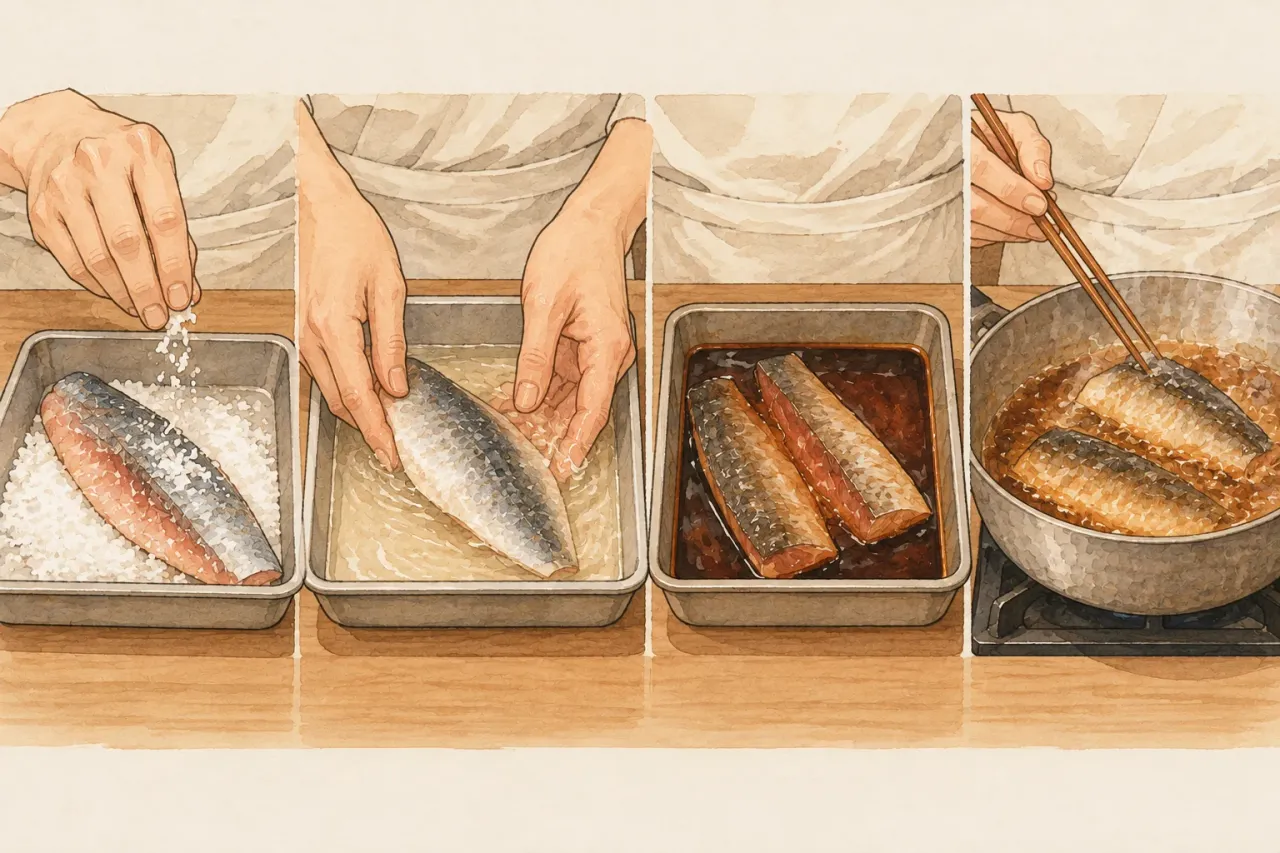
The work. Edomae means Tokyo Bay, and the bay’s fish — gizzard shad, horse mackerel, mackerel, conger eel, prawn, clams, whiting — spoiled fast in a city without ice. So the craft was shigoto: curing shad and mackerel in salt and vinegar, simmering conger and clam, steaming prawn, marinating tuna in soy, pressing with kelp. The ministry’s definition of Edomae sushi is exactly this list. Raw fish straight from the knife is the exception the style was built to avoid. The library adds a detail: Edo did not like fatty tuna and ate the lean cut marinated; toro only got its name, by the shop’s own account, at Yoshino-zushi in the 1920s, when a regular asked for the “melting” belly.
The counter. One piece at a time, made to order, eaten at once. The Tokyo tourism office’s etiquette is short: a little soy sauce, on the fish rather than the rice, and one bite; go easy on perfume.
Why Edo
A million-person city on a bay full of fish, with no refrigeration, a vinegar industry, and a taste for food eaten standing up. Everything about nigiri — the small portion, the cured fish, the chef at arm’s length — is a solution to selling fish fast in that city. Osaka, with a merchant culture and a hundred years of pressed sushi, saw no reason to change; the Morisada Mankō records Edo going over to nigiri and Kyoto-Osaka staying with the box.
The shops, and what they charge
Sushi restaurant, lunch set 寿司店のランチ
- Our guide figure
- ¥1,500 (≈ €8 / $9)Less than half what the same counter charges in the evening · Oct 2026
Sushi restaurant, dinner 寿司店の夜
- Chains
- ¥3,828–¥5,478Nigiri set from the regular menu · Sushizanmai · tax incl. · checked 2026-10-05
- Our guide figure
- from ¥4,000 (≈ €23 / $25)And upwards with no ceiling · Oct 2026
Those are Sushizanmai’s figures. One counter up the scale:
- Yoshino-zushi Honten, Nihonbashi, founded 1879. Lunch (cash only): nigiri ¥2,750 / ¥3,300 / ¥3,850, chirashi ¥2,750 / ¥3,300. Evening: nigiri from ¥4,950, sashimi from ¥4,950, and a stated budget from ¥16,500 (prices shown before tax with the tax-included figure alongside).
- Kenuki-zushi Sōhonten, which the ministry dates to 1702, still makes the bamboo-wrapped pressed sushi that preceded nigiri.
- The old-house names a visitor will hear — Sukiyabashi, Saitō, Mizutani — publish no prices in a form this site could verify, and would not matter if they did: an evening there is by introduction.
The health ministry’s summary of the trade explains the gap. Sushi shops carry more species than any other restaurant, the price of good fish is high and volatile, and the market has split into expensive counters and cheap belts, with the mid-priced family shop thinning out. Tokyo households rank 11th of 52 cities for sushi eaten out, at ¥18,603 a year; Kanazawa and Toyama spend more.
How to behave at the counter
- Lunch first. The set is the same chef’s rice at a third of the evening price.
- Order omakase in the evening if you can afford not to ask the price of each piece; otherwise order by piece and ask — jika (market price) is a legitimate menu entry, and asking is what Japanese customers do.
- Soy sauce on the fish, lightly. Pickled ginger between pieces, not on them.
- One bite. Hands or chopsticks as you like.
- Do not linger at a short counter when there is a queue; the stall is still in the walls.
Edomae away from Tokyo
Nigiri is the form that was exported as “sushi”, so what changes outside Tokyo is the fish and the work rather than the shape. In Japan, the ministry notes drily that today’s nigiri uses fish from well beyond Tokyo Bay — salmon above all, which Edo never ate — and the curing is lighter or absent at belt shops. Abroad, JETRO’s history of the American market is that sushi arrived in the 1970s as the California roll, invented for customers who would not eat raw fish, and that only recently have American diners moved toward shad and horse mackerel — the cured “silver” fish that are the heart of the Edo repertoire. The irony is complete: the style built on not serving raw fish became famous as raw fish, and is now coming back round.
Getting there
Nihonbashi (Yoshino-zushi) is on the Ginza, Tōzai and Asakusa subway lines; the Toyosu wholesale market, where the trade’s fish arrives from 2018, is on the Yurikamome line (Shijō-mae), with a public viewing deck open 05:00–17:00 and tuna-auction viewing by advance lottery.
What people get wrong
- “Edomae means raw.” It means cured, simmered and marinated — the opposite.
- “Nigiri is ancient.” About 1820. Fermented sushi is ancient; this is a Georgian-era invention.
- “Toro is the traditional prize.” Edo fed it to cats. The name is a century old.
- “Sushi in Tokyo is expensive.” Lunch at a 150-year-old counter is ¥2,750. Dinner is a different purchase.
Questions people ask
What does "Edomae" mean?
Literally "in front of Edo" — Tokyo Bay. It came to mean the Tokyo style of nigiri made from the bay’s fish, and the craft of curing, simmering and marinating that fish so it would keep. Today it means the style, not the catch.
Why is lunch so much cheaper than dinner at the same sushi bar?
Because lunch is a fixed set and dinner is the chef’s selection. Yoshino-zushi in Nihonbashi lists lunch nigiri at ¥2,750–3,850 and an evening budget from ¥16,500 — the same counter, a different product. Sushizanmai’s sets show the same pattern at a lower level.
Hands or chopsticks?
Either. The Tokyo tourism office’s advice is simpler. A little soy sauce, on the fish side rather than the rice, and eat the piece in one bite.
Sources
- 農林水産省「うちの郷土料理」にぎりずし(東京都)
- 国立国会図書館 本の万華鏡「天下タイ平」第3章
- 国立国会図書館 レファレンス協同DB「江戸のにぎりずしの発祥は?」
- nippon.com「寿司は江戸の昔からお手軽ファストフードだった:守貞漫稿」
- 東京観光財団 GO TOKYO「東京で寿司を食べるガイド」
- 吉野鮨本店 公式(トロの命名)
- 吉野鮨本店 お品書き
- すしざんまい グランドメニュー・ランチメニュー(既掲載の価格)
- 東京都中央卸売市場「豊洲市場のご紹介」「見学」「早朝のマグロせり見学」
- 厚生労働省 生活衛生適正化分科会 資料「すし店営業の現況について」
- 総務省統計局 家計調査 外食「すし」都市別ランキング(2023〜2025年平均)
- JETRO「2022年度 米国における日本食レストラン動向調査」
Prices are in Japanese yen. Conversions are approximate, at ¥177.30 to the euro and ¥158.23 to the US dollar as of 20 Oct 2026. Rates come from the European Central Bank, which publishes on working days only. Prices checked Oct 2026. What food costs in Japan →