
Yufuin Onsen: a basin of springs, a town that chose not to become a resort, and its quieter neighbours
I have not been to every place in this guide. The figures below are taken from the sources listed at the end, with the date each one was published — not measured by me. Where I have been, the article says so.
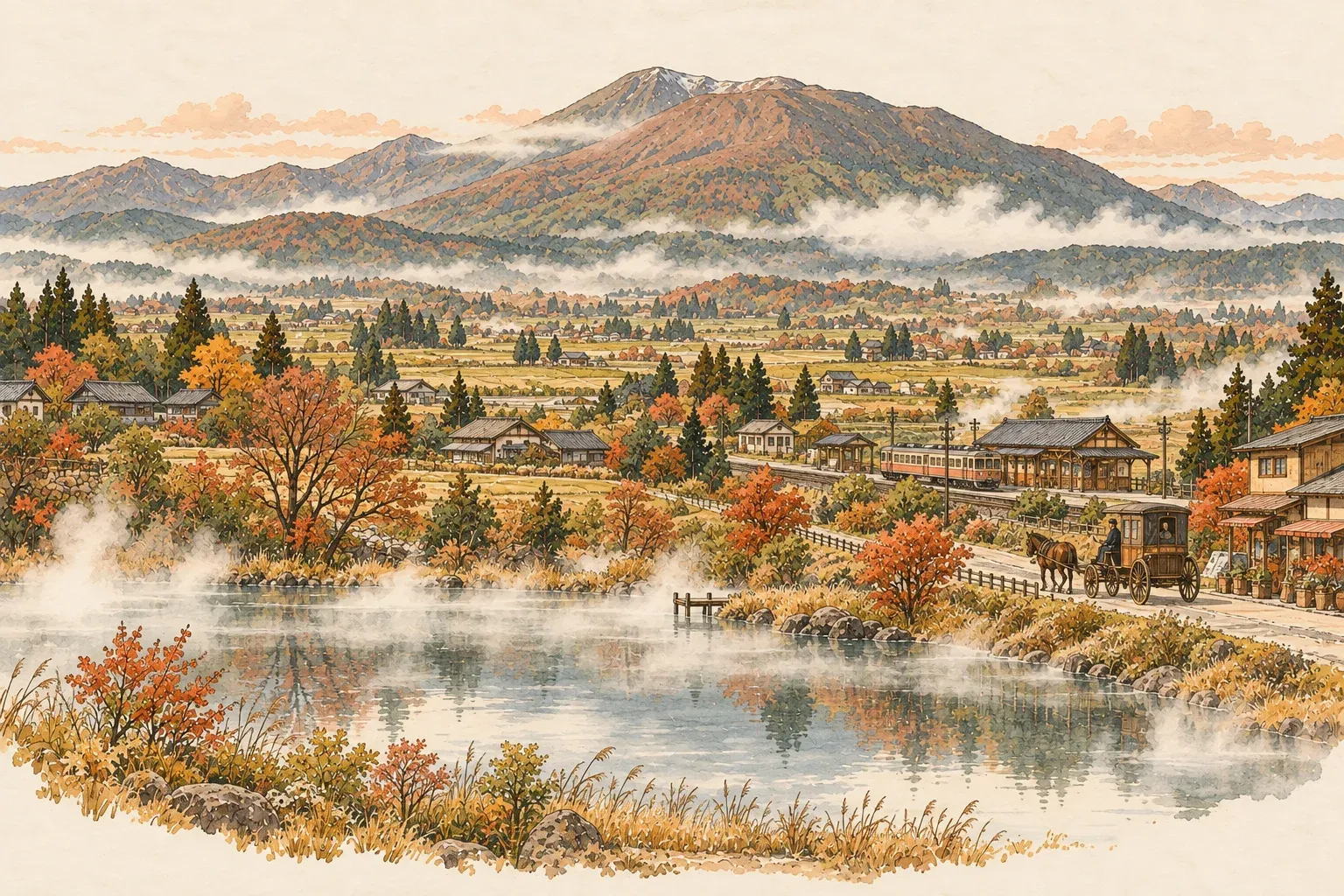
Yufuin sits in a basin at the foot of Mount Yufu, about 30 km by road from Beppu according to JNTO. It is the best known of five hot spring towns in Yufu city, and its story is less about the water than about what the town decided to do with it. This page explains how the area works using the environment ministry’s 2026 plan for the Yufuin onsen district, Yufu city’s own plan and guides, Oita prefecture, the Yufu city tourism bureau and JNTO. Where they give different figures, I give both. It does not rate any bath or inn.
For how Yufuin compares with the rest of Kyushu, start from the Kyushu hot springs overview. For what the spring names and pH mean, see the guide to onsen water types; for the posted notices about added water, heating and disinfection, see the piece on kakenagashi.
Where it came from
Five towns, one district
The ministry’s plan, dated April 2026, treats five hot spring towns in Yufu city as the “Yufuin onsen district”: Yufuin, Yunohira, Tsukahara, Shōnai and Hasama. It defines Yufuin Onsen itself as the whole of the Yufuin basin at the foot of Mount Yufu. Yufu city was formed in October 2005 by the merger of the towns of Hasama, Shōnai and Yufuin.
Two ways of writing Yufuin. In Japanese the name is written two ways, both read Yufuin. The plans write the hot spring town and the station as 由布院, and the former town, the district and administrative offices as 湯布院. The plans note that the old town of 由布院 merged into the town of 湯布院 on 1 February 1955. That is the pattern in the official pages; I found no official explanation of why.
Early records
The tourism bureau says the name appears in the Bungo Fudoki of the early Nara period, and that Yufuin became known across Japan as a hot spring town after residents began planning the town themselves from the late 1950s. The Bungo Fudoki survives, but I have not seen the passage on Yufuin. I found no official founding year or founder for Yufuin’s springs, so I do not give one.
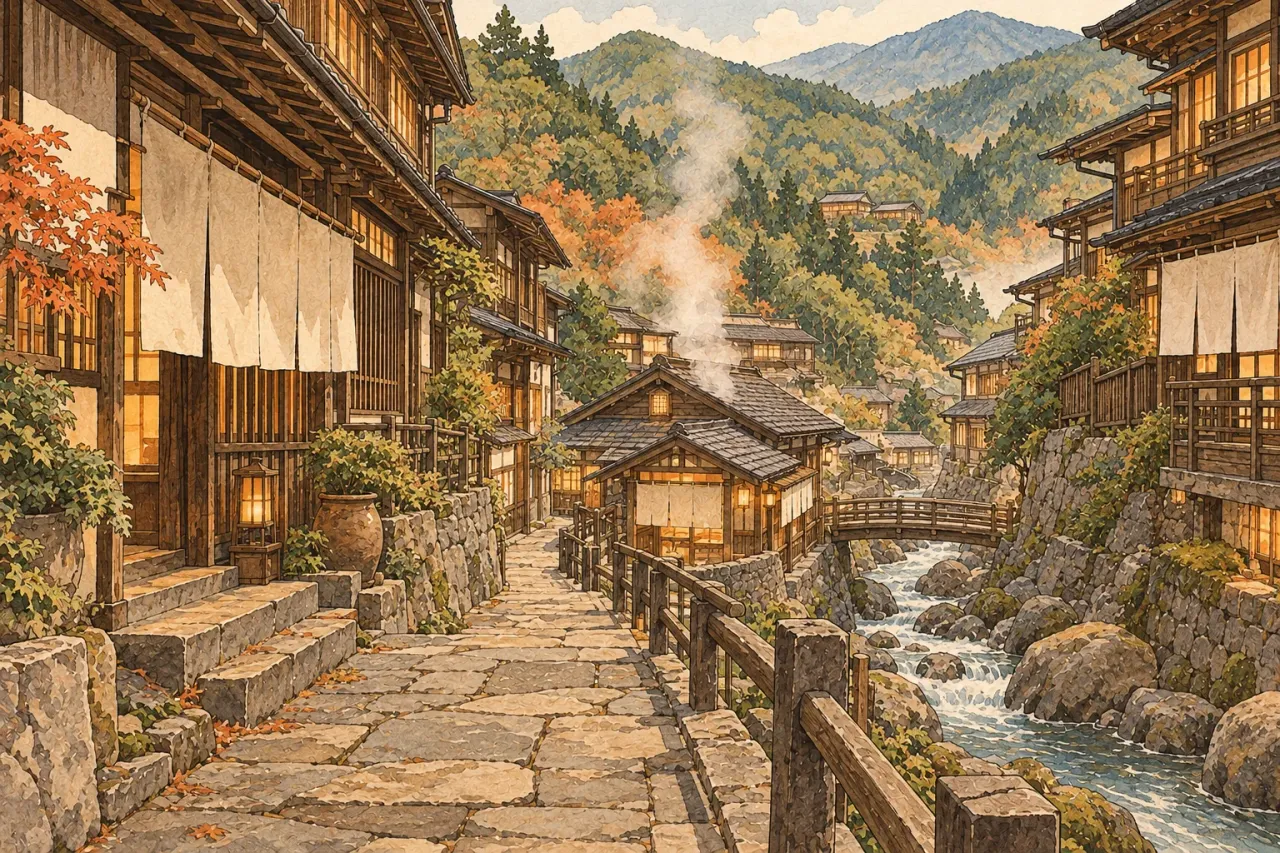
For Yunohira, the plan says its founding is “said” to go back about 800 years to the Kamakura period, that its present shape as a bath town dates from the late Edo period, and that it is recorded in the Edo-period Bungo Kokushi. The tourism bureau tells a legend of a white old monkey healed in its water. The stone-paved slope along the river was laid about 300 years ago. A fire in 1912 burned almost every inn and house, and the town was rebuilt.
For Tsukahara, the tourism bureau tells a legend that in the 12th century Minamoto no Tametomo saw a wounded deer healed in a pond, while the city’s 2019 plan calls the Tsukahara plateau a settlement with a tradition going back to the 4th century. These are different kinds of account, and I give both. Shōnai’s first well for bathing was drilled in 1968, the tourism bureau says, and Hasama grew to more than ten springs after a successful drilling in 1973.
The town that said no to resort development
The plan tells the modern story like this. When Beppu prospered first, Yufuin was a farming area with hot spring inns, called Oku-Beppu, “the back of Beppu”. To set itself apart from Beppu, which was building heavily, Yufuin and Yunohira were designated a national health resort onsen (kokumin hoyō onsenchi) on 5 May 1959, which the plan calls the second such effort in Kyushu. Under a slogan of “a hundred years of town-making”, the town took a line opposed to resort development, aiming to live with nature and the farming landscape, and drew on the German idea of the Kurort, the health resort.
After the 1975 central Oita earthquake damaged the area, events followed. A land ministry profile from about 2006 says horse-drawn carriages and the Yufuin music festival were started to overcome the damage to the town’s reputation, and the plan names the carriages, the Yufuin film festival and a beef-eating “shouting contest”. The same profile lists later steps: a town-planning ordinance in 1990, and a traffic experiment in 2002 to keep cars out of the centre, run with more than 1,400 volunteer shifts. I could not confirm the first year of the film festival or the shouting contest.
Beppu city adds a detail from the other side: in the Taishō era, Beppu’s group of baths was called the “ten baths of Beppu”, with Yufuin and Tsukahara included.
In 2004 a Japanese academic society for hot spring regions chose four items in Yufu city as “hot spring heritage”, the plan says: Lake Kinrin and the Shitan-yu communal bath in Yufuin, the stone-paved streets of Yunohira, Yunohira’s communal bath culture, and the source area at Tsukahara.
The water
How many springs
The figures come from different years and areas, and I do not treat them as one count.
| Area | Springs | Date and source |
|---|---|---|
| Yufu city | 939 | End of March 2017, city plan (October 2019) |
| Yufu city | 1,055 | End of March 2023, ministry plan (April 2026) |
| Yufu city | 1,074, flowing 51,998 litres a minute | End of March 2025, Oita prefecture’s hot spring data, citing the environment ministry |
| Yufuin Onsen only | “More than 800”, flowing 41,000 litres a minute | Yufu city’s English guide, no year |
| Yufuin Onsen only | About 850 | Tourism bureau, no year or method |
The city figures rise over time. The Yufuin-only figures are smaller than the city’s, which fits their being part of it, but neither says how it counts. The plans also list 378 or 381 “main” springs, which are not all of them. The plan says Yufuin was second in Japan for number of springs (in 2009) and for flow (in 2014), citing two issues of the Japan Spa Association’s journal; those are old figures from an association, and I did not check them against current national statistics.
What kind
The most detailed official picture is a 2015 study by Oita prefecture’s health and environment research centre, which sorted the spring analyses done in Yufu city over ten years, 2004 to 2013, by district. It counts analyses, not springs.
- Yufuin — simple springs make up most of them: 171 of 195 analyses. Most are weakly alkaline or alkaline. The ministry’s plan agrees: mostly alkaline or weakly alkaline simple springs, with chloride and hydrogen carbonate springs in some parts. The tourism bureau describes three broad groups: alkaline simple springs, sodium chloride springs, and sodium chloride-sulphate-hydrogen carbonate springs.
- Yunohira — the plan says mainly chloride springs. The tourism bureau gives sodium chloride-hydrogen carbonate springs and weakly alkaline simple springs.
- Tsukahara — strongly acidic, with iron and aluminium. The plan, quoting a local pamphlet, says it sits by a spring on the side of the active volcano Garandake, with steam vents above 120°C and a mud volcano. Its pH is given differently by each source, with no year on most of them: about 1.8 (tourism bureau), 1.4 (JNTO), and 1.3 and 2.0 for two springs measured on site (the 2015 study).
- Shōnai — the plan says wells of about 500 m tend to give simple springs, and 600 to 800 m tend to give sulphate springs. The 2015 study found a cold carbon dioxide spring at Asono.
Across the city, the 2015 study says about 90% of the analyses were 42°C or above, and that Tsukahara and parts of Shōnai seem to have water of a different origin from Yufuin.
Why here
The plan calls Yufuin’s water a typical volcanic spring: rain falling on the mountains around the basin soaks in and is heated by geothermal heat from the Kujū volcanoes and the Yufu and Tsurumi volcanoes, then rises. It says the flow is plentiful and many facilities use gensen kakenagashi, water flowing straight from the source. The tourism bureau also calls the water volcanic, and Oita prefecture says most of its hot springs are volcanic and gathered around the volcanoes.
The Japan Meteorological Agency’s page on Yufudake (1,583 m) notes that Yufuin Onsen lies to its west, but says nothing about how the water is heated; nor do the geological survey’s volcano pages. The sources differ slightly on its last eruption, and I give each:
- The agency’s list of Kyushu volcanoes: about 2,000 years ago.
- The agency’s Yufudake page: a large eruption about 2,200 years ago.
- The geological survey: about 2,000 to 1,900 years ago.
Yufudake is not under constant watch. Tsurumidake and Garandake are; Tsukahara’s spring is on Garandake’s flank, and the agency says a new mud volcano formed in Garandake’s crater in 1995.
How the town works
A district, not a single street
The ministry, JNTO and the tourism bureau describe the five towns differently from one another: Yufuin in the basin at the foot of Mount Yufu, Yunohira with a stone-paved street from the 17th century, Tsukahara on a strongly acidic plateau, with Shōnai and Hasama besides. They are spread out rather than joined into one bath town.
Yufuin itself
The plan says the main tourist area runs from JR Yufuin station to Lake Kinrin at the foot of the mountain. A tourist information centre opened in front of the station in April 2018. Yufu city’s English guide says about 70 shops line the Yu-no-tsubo street. JNTO suggests walking or cycling around Lake Kinrin, mentions a footbath at the station, and says the information office next to the station takes bookings for rental bicycles and the horse-drawn carriage. The city’s manners booklet (2019) describes Yufuin as a hot spring town where residents’ daily lives and tourism are mixed together, and asks visitors not to litter, enter homes or fields, or block the road.
Lake Kinrin. The tourism bureau says the lake was once called, in local dialect, “the pond below the peak”, and that it is said to have been named Kinrin, “golden scales”, in 1884 by the scholar Mōri Kūsō, after fish scales shining in the setting sun. The bureau says it is wrapped in morning mist on cold mornings in autumn and winter. Yufu city’s English guide gives the reason as spring water and hot water flowing into the lake, which keeps it warm, so that steam rises from it on winter mornings.
Communal baths
Yufuin has small communal baths. The city says users of communal and public baths are exempt from the bathing tax, which is charged on overnight stays and on day bathing above a set fee. As checked on 11 October 2026, I found prices for two of them, but none says whether tax is included, so I do not give them.
- Shitan-yu, by Lake Kinrin, is a mixed-sex communal bath. Oita prefecture’s tourism site lists it as open 10:00 to 22:00 with no closing day, about 20 minutes’ walk from the station. It gives no price.
- Yunotsubo Onsen is open 10:00 to 17:00 according to the tourism bureau, and 10:00 to 22:00 according to the city’s page, both saying hours can vary and neither giving an update date. I give both. The tourism bureau says there are no towels, and you put the fee in a box at the entrance.
Yunohira’s shared bath
The plan says Yunohira opened its communal baths free of charge in the Shōwa era, which it calls rare in Japan. The counts have fallen between the two editions of the plan, both quoting the local tourism association: 21 inns, 7 restaurants and shops, and 5 communal baths in the 2019 edition; 18 inns, 9 restaurants and shops, and 1 communal bath open in the 2026 edition. Many of the inns’ baths are for staying guests only. The city’s 2019 plan also says Yunohira has, since 1970, been the only place in Oita to manage its hot water centrally.
Crowds
The plan quotes Yufu city’s visitor survey for 2024: 4,297,903 visitors, 1,444,387 of them from abroad, with 2,902,445 day-trippers and 1,395,458 staying overnight. The 2019 plan gave 3.86 million for 2017. It says concentration in one area has brought traffic jams and problems with toilets and rubbish that also affect residents.
Bathing there
I found no official prices for baths in the area whose tax status I could confirm, so none are given.
I found no Yufuin-wide guidance on tattoos. JNTO’s Yufuin page, the tourism bureau’s pages and the city’s English guide do not mention them. Oita prefecture’s English tourism site says many onsen in Japan do not allow tattoos, but that rules differ by facility: some accept them, some only in certain baths, some only in private or family baths (kashikiri or kazoku-buro), some only for staying guests, and some if they are covered with tape or a bandage. Ask each inn or bath in advance.
The same prefectural site’s general guide says to bring cash, as many places do not take cards, and towels; to bathe naked and wash first; not to swim or make noise; to keep your hair and towel out of the water; and not to take phones or cameras in. Yufu city’s English guide says the Kuāju Yufuin bathhouse, built on German spa ideas, is entered in swimwear, which can be rented. The general manners and the national picture on tattoos are also in the water types guide.
What it is eaten with
Two dishes are named both by the farm ministry’s list of Oita dishes and by Yufu city’s own sources, but neither belongs to Yufuin Onsen in particular.
- Dangojiru — flat noodles of wheat dough in a miso soup. The ministry gives it as eaten across the whole prefecture. Yufu city’s English guide calls it a representative Oita local dish, and the tourism bureau features it at a farm-shop restaurant in Hasama.
- Yaseuma — boiled flat strips of wheat dough coated in soybean flour and sugar. The ministry says that, by tradition, it was born in Furuno, in Yufu city, and tells a story of a nurse called Yase. The tourism bureau says Hasama is regarded as its birthplace. I give both.
Yufu city’s guide also names Bungo beef, soba and shōchū, but the ministry’s list includes none of them.
Getting there
As checked on 11 October 2026. Timetables change, so check the operator before you travel.
- From Hakata by train. JR Kyushu’s limited express Yufuin no Mori (timetable revised 14 March 2026) leaves Hakata at 9:17, arriving at Yufuin at 11:31, and at 14:38, arriving at 16:50 — by my reckoning about 2 hours 12–14 minutes. All seats are reserved, and booking opens a month ahead. On days it does not run, the limited express Yufu runs at the same times. Yufu city’s English guide gives about 2 hours 10 minutes.
- From Oita and Beppu by train. JNTO gives about 1 hour from Oita station on the JR Kyūdai line, and about 1 hour 15 minutes from Beppu, changing at Oita. The city’s guide gives the same: about 15 minutes from Beppu to Oita and about 1 hour from Oita.
- From Fukuoka by bus. Kamenoi Bus lists the Yufuin-gō highway bus as 14 round trips a day, about 2 hours 20 minutes between Yufuin station and Fukuoka Tenjin, with reserved seats. Its stops include Fukuoka Airport’s international terminal and the Hakata bus terminal, but it gives no separate time from the airport.
- From Oita Airport by bus. The airport gives about 55 minutes non-stop by expressway to Yufuin station.
- From Beppu by road. JNTO gives about 40 minutes by car or 50 minutes by bus; the city’s guide gives about 40 minutes by car or about 1 hour by bus. The distance is about 30 km. The tourism bureau says an open-top double-decker bus runs between Beppu and Yufuin from 7 October to 13 December 2026, about 65 minutes one way, booking required.
- From Kumamoto. The city’s guide gives about 4 hours by bus or about 2 hours 30 minutes by car. I did not find an official train time.
Fares are not on this page.
What people get wrong
- “Yufuin has about 850 springs” and “Yufuin has 1,074 springs” are the same claim. The 1,074 (and the earlier 939 and 1,055) are Yufu city as a whole, with dates; the 800-plus and 850 are for Yufuin Onsen, with no year or method.
- “Yufuin is a suburb of Beppu.” It is in a different city. It was once called the back of Beppu, and once counted among Beppu’s ten baths, but its modern identity came from deciding not to follow Beppu’s path.
- “All the water is the same.” Yufuin is mostly simple and alkaline, Yunohira mostly chloride, Tsukahara strongly acidic, and at Shōnai the type depends on how deep the well goes.
- “Mount Yufu heats Yufuin’s water.” The plan says the heat comes from the Kujū, Yufu and Tsurumi volcanoes together; the meteorological agency only says the town lies west of the mountain.
- “Kakenagashi means a better bath.” The plan says many facilities use it; it is a description of how the water is handled, not a grade. The kakenagashi guide explains the notices.
- “The water cures things.” This page does not say so. The plan and the city’s pages quote claims about Tsukahara and Yunohira and the body, which I have not repeated. The official list of indications by spring type is in the water types guide, along with the environment ministry’s note that spa therapy is best done under a doctor’s guidance.
Questions people ask
How many hot springs does Yufuin have?
It depends on what is counted and when. For Yufu city as a whole, official figures give 939 springs in March 2017, 1,055 in March 2023 and 1,074 in March 2025. For Yufuin Onsen alone, the city’s English guide says more than 800 and the tourism bureau about 850, neither with a year.
What kind of water is it?
Mostly simple springs, many of them alkaline or weakly alkaline, according to the ministry’s plan and a 2015 prefectural study of spring analyses. Nearby Yunohira is mainly chloride, Tsukahara is strongly acidic, and Shōnai has a carbon dioxide spring.
Is Yufuin part of Beppu?
No. It is in Yufu city. The ministry’s plan says that when Beppu prospered first, Yufuin was a quiet farming area known as Oku-Beppu, the back of Beppu, and Beppu city says that in the Taishō era Yufuin was counted among ten Beppu baths.
Can I bathe in Yufuin with tattoos?
I found no town-wide policy. Oita prefecture’s English tourism site says rules differ by facility, with some accepting covered tattoos and private family baths as an option. Ask each inn or bath in advance.
Sources
- 環境省 湯布院温泉郷 国民保養温泉地計画書
- 由布市 湯布院温泉郷 国民保養温泉地計画書(令和元年10月)
- 由布市 英語版ガイドブック Yufu Scenic Routes
- 由布市 観光と文化 温泉
- 由布市 ゆのつぼ温泉
- 由布市 入湯税
- 由布市・ゆふいん交通緩和対策連絡会議 ゆふいん街歩きマナーブック
- 由布市まちづくり観光局 YUFUINFO 温泉
- 由布市まちづくり観光局 YUFUINFO トップ
- 由布市まちづくり観光局 YUFUINFO 英語トップ
- 由布市まちづくり観光局 YUFUINFO アクセス
- 由布市まちづくり観光局 YUFUINFO 運営団体について
- 由布市まちづくり観光局 YUFUINFO 金鱗湖
- 由布市まちづくり観光局 YUFUINFO ゆのつぼ温泉
- 由布市まちづくり観光局 YUFUINFO 特集 由布院〜挾間 後編
- 大分県 温泉データ
- 大分県 温泉の特徴
- 大分県衛生環境研究センター年報 第43号「由布市における泉質の分布状況について」
- Visit Oita(大分県観光公式サイト)下ん湯
- Visit Oita, Tattoo-Friendly Hot Springs Special Feature
- Visit Oita, Japanese Onsen: A Traveler’s Guide
- JNTO, Yufuin Onsen
- JNTO, Beppu and Yufuin area
- 気象庁 九州の活火山
- 気象庁 由布岳
- 気象庁 鶴見岳・伽藍岳
- 産総研 第四紀火山 由布岳
- 国土交通省 観光100選 由布院温泉
- JR九州 特急ゆふいんの森
- 亀の井バス 高速バス
- 大分空港 バス案内
- 別府市 別府八湯ガイド
- 農水省 うちの郷土料理 大分県
- 農水省 うちの郷土料理 やせうま
- 農水省 うちの郷土料理 だんご汁
Prices are in Japanese yen. Conversions are approximate, at ¥177.30 to the euro and ¥158.23 to the US dollar as of 20 Oct 2026. Rates come from the European Central Bank, which publishes on working days only. Prices checked Oct 2026. What food costs in Japan →